

A staff member pulls you aside before their shift and tells you they carry an adrenaline autoinjector for a severe allergy. Or maybe it’s a junior player at your sporting club, one whose asthma has flared up twice already this season. Either way, you’re now the person responsible for making sure your team knows what to do if things go wrong. And “we’ll figure it out if it happens” just doesn’t cut it.
Combined asthma anaphylaxis training gives your Brisbane team the practical skills to recognise and respond to both emergencies with real confidence, without the clinical overload of a full first aid course or the false comfort of a quick video online. Whether you’re running a café, managing a retail floor, or coordinating volunteers at a community club, this course is built around real workplace and venue scenarios, not repurposed childcare content dressed up for a different audience.
In this guide, we’ll cover what the training actually involves, who genuinely needs it, how it fits around rosters and volunteer schedules, and what “reasonable steps” under WHS duty of care actually looks like when you’re the one making the call.
What Does Combined Asthma and Anaphylaxis Training Cover?
Combined asthma and anaphylaxis training covers the recognition and emergency response for two separate but often co-occurring conditions, all in one session. That’s an important point on its own: asthma and severe allergy don’t always show up separately. Someone with a known allergy can also have asthma, and an anaphylactic reaction can trigger an asthma attack at the same time, which makes it even more important that your team can tell the two apart under pressure rather than trying to figure it out on the spot. Here’s what it typically includes:
- Recognising asthma attacks: the signs, the symptoms, and correct use of a reliever inhaler and spacer
- Recognising anaphylaxis: spotting a severe allergic reaction and knowing when to escalate
- Adrenaline autoinjector use: hands-on practice with devices like an EpiPen or Anapen
- Risk management planning: identifying at-risk people and building an action plan around them
- Workplace-specific scenarios: applying the response in a café, on a retail floor, or at a club
None of this is theory-only. The hands-on element matters more than people expect going in. Reading about how to use an autoinjector and actually holding a trainer device, feeling the click, practising the motion, are two completely different levels of readiness. In a real emergency, hesitation costs time, and the whole point of practising beforehand is removing that hesitation before it matters.
First Aid Alive’s combined course blends online learning with a face-to-face practical session, and it’s built for hospitality, retail, and community or sporting club teams. Not just childcare settings. That distinction matters more than it might sound. A lot of asthma and anaphylaxis content online is written with early childhood educators in mind, because that’s historically where the biggest compliance push has come from. But the risk doesn’t stay inside a childcare centre. It walks into your café, sits down at your retail counter, and shows up to training with your sporting club on a Saturday.
⚠️ Good to know: you don't need an incident to have already happened for WHS duty of care to apply. A known risk, a disclosure, a near-miss, is enough to trigger the obligation to act.

Does Your Workplace Actually Need This Training?
Here’s the thing that trips a lot of people up: you don’t need an incident to already have happened for WHS duty of care to kick in. If there’s a known risk, that’s enough. A staff member who’s told you about their allergy, a member whose asthma you’re aware of, a canteen that serves food to kids you don’t know the allergy status of, that’s already a risk you’re aware of, and being aware of it is what triggers the obligation to act.
Most workplaces end up here for one of a few reasons:
- A staff member has disclosed a severe allergy or asthma diagnosis
- There's been a near-miss, something that almost went wrong but didn't quite
- An insurer or industry body has recommended it as part of a risk review
- A committee member has raised it after hearing about an incident somewhere else
And look, it’s easy to think “we’ve never had an incident, so we’re probably fine.” But that’s not really the right way to think about it. Asthma alone affects around 2.8 million Australians, roughly 1 in 9 people (AIHW, 2026). That’s not a rare, freak-occurrence kind of number. That’s a “there’s probably someone in your team or your club right now” kind of number. The question isn’t really whether the risk exists. It’s whether you’ve done anything about it.
There’s also a quieter version of this that doesn’t get talked about enough. Sometimes the person carrying the risk hasn’t said anything at all, not because they’re hiding it, but because they’ve never been asked, or because they’ve assumed workplaces just aren’t equipped to help anyway. A team that visibly takes this seriously, that has people trained and ready, tends to be a team that people feel comfortable disclosing to in the first place. That’s not a small thing. It’s the difference between finding out about a risk before something happens, and finding out during an emergency.
Once you’ve confirmed your team needs this training, here’s exactly what it covers.
Recognising the Difference: Asthma vs. Anaphylaxis
They can look similar in the first few seconds, which is exactly why training matters. Someone struggling to breathe is someone struggling to breathe, whether it’s asthma or anaphylaxis, and in that first moment of panic it’s genuinely hard to know which response is the right one without having practised telling the difference. Knowing which one you’re dealing with changes what you do next, and getting it wrong, or freezing while you try to work it out, wastes time you don’t have.
Asthma Attack | Anaphylaxis | |
Breathing | Wheezing, shortness of breath, tight chest | Difficulty breathing, throat tightness, swelling |
Onset | Can build gradually or hit suddenly | Usually rapid, minutes after exposure |
Skin | Not typically affected | Hives, swelling, flushing common |
Response | Reliever inhaler + spacer | Adrenaline autoinjector (EpiPen/Anapen) |
Escalation | Call 000 if not improving after inhaler | Always call 000, even after autoinjector use |
It’s worth sitting in that last row for a second. Even after using an autoinjector correctly, the person still needs an ambulance. That’s not a “just in case” recommendation, it’s part of the actual protocol, because a reaction can come back after the adrenaline wears off. This is exactly the kind of detail that gets missed when someone’s only exposure to autoinjector use is a video they watched once, rather than a session where it’s practiced and explained properly.
Building an action plan for a specific at-risk person
The training doesn’t stop at recognising symptoms in general. Part of the session is working through how to build a simple action plan around a real person you know, whether that’s the staff member who disclosed their allergy or the junior club member with asthma. Who checks in on them, where the autoinjector or inhaler is kept, who’s trained to use it, and what the escalation steps look like for your specific setting. A generic plan sitting in a folder doesn’t help much if nobody’s looked at it. One built around a real person your team actually knows tends to stick, partly because it’s specific enough to actually follow, and partly because there’s a real face attached to it rather than an abstract policy.
🏢 Good to know: the same underlying skills apply everywhere, but the pressure points are different in a café, on a retail floor, and at a volunteer-run club.

How This Applies to Your Setting
This isn’t a childcare course with the serial numbers filed off. It’s built around the settings you’re actually working in, because the response that makes sense in a classroom doesn’t always translate cleanly to a busy dinner service or a Saturday sporting fixture. Same skills underneath, but the context, the pressure, and the people involved are genuinely different.
Hospitality & café teams
If you’re serving food, you’re managing allergen risk whether you’ve thought about it that way or not. Combined training covers food allergen response and runs through service-floor scenarios specifically, what it looks like when a customer starts reacting to something in their meal, and what your front-of-house and kitchen staff each need to do about it in the moment. It’s not just the person taking the order who needs to know. Kitchen staff, floor staff, and whoever’s managing the shift all play a part, and the training walks through how those roles work together rather than assuming one person will handle everything alone.
Retail teams
Retail staff are customer-facing, often alone on a floor, and not always expecting a medical emergency to walk through the door. The training works through customer-facing incident response so your team isn’t caught flat-footed if a shopper, not even someone you employ, has a reaction in-store. That last point is worth pausing on. A lot of workplace first aid thinking is framed entirely around staff safety, but in a retail setting, the person having the reaction is just as likely to be a customer you’ve never met before, and your team still needs to know what to do.
Sporting clubs & community groups
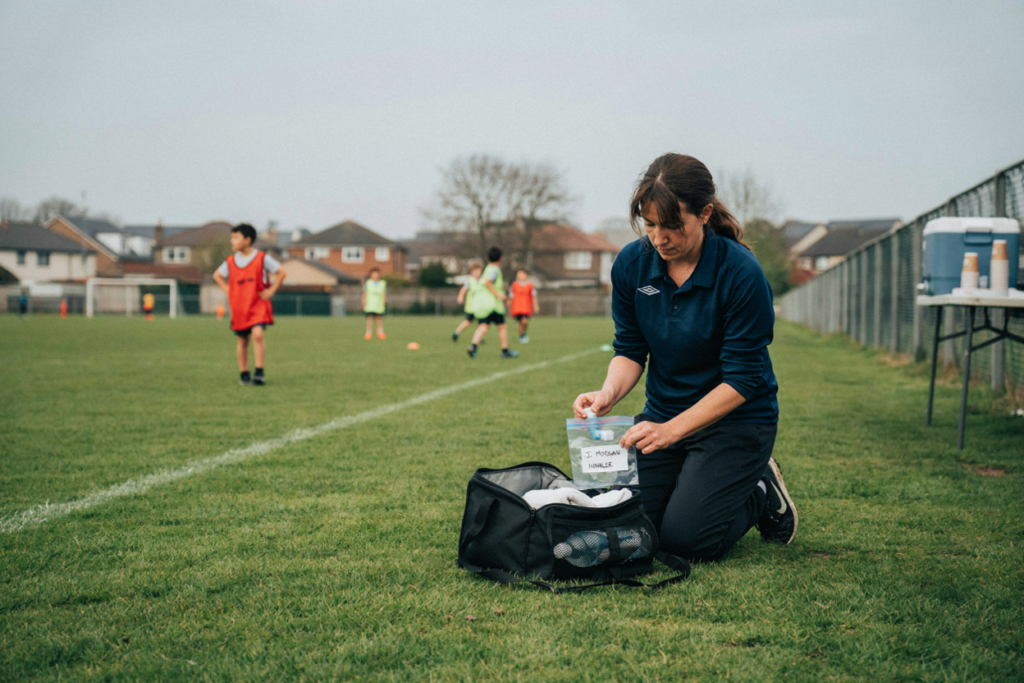
This one’s a bit different because most of the people involved are volunteers, not paid staff. The training covers volunteer and committee scenarios specifically, plus the two situations that come up most for clubs: canteen risk (kids buying food without you knowing what they’re allergic to) and away-game risk (no on-site support, no easy access to help, and you’re the only line of defence). Volunteers often carry more responsibility than they realise, and a lot of committee members genuinely worry about being the one person expected to respond if something happens on their watch. Training doesn’t remove that responsibility, but it does replace uncertainty with an actual plan.
Different setting, different pressure points, but the same underlying skill: recognise it fast, respond with confidence, and don’t freeze because you assumed someone else was trained.
📅 Good to know: the most common objection isn't "do we need this," it's "we can't afford the disruption." Group bookings, evening and weekend sessions, and onsite training all exist to solve exactly that.
Booking Around Rosters, Shifts & Volunteer Availability
The most common objection we hear isn’t “do we need this.” It’s “we can’t afford to pull staff off shift.” Fair enough, taking people off the floor has a real impact, especially in hospitality and retail where every hour matters, and for volunteer-run clubs the challenge is even more basic: people are already giving up their spare time, so asking for more of it needs to be handled carefully. Here’s how it’s handled:
- Group booking options: book your whole team or committee in together rather than sending people off one at a time
- Evening and weekend sessions: built specifically for volunteer-run clubs where nobody's available during a weekday morning
- Onsite training vs. attending a venue: we come to you, or you come to us, whichever causes less disruption to your day
Option | Best For | Main Benefit |
Group booking | Hospitality/retail teams | Book everyone at once, less back-and-forth |
Evening/weekend session | Sporting clubs & volunteers | Fits around unpaid, after-hours availability |
Onsite training | Multi-site or larger teams | No travel, minimal roster disruption |
The short version: this doesn’t have to mean shutting the café for an afternoon or begging volunteers to give up a Saturday. It’s meant to work around you, not the other way around. If you’re coordinating a roster with lots of moving parts, or trying to get a full committee together when everyone’s schedules barely overlap, it’s worth having a conversation about what actually fits rather than assuming the standard option is the only one on the table.
What “Reasonable Steps” Looks Like Under WHS Law
This is the bit that actually resolves the “is a formal course really necessary” question, so let’s be honest about it rather than using it as a scare tactic.
Under the WHS Act 2011 (Qld), businesses have a general duty of care to manage foreseeable risks to staff, customers, or members. That’s genuinely all it is at a plain-English level, not a mountain of legal obligation, just a requirement to take reasonable and proportionate steps once a risk is known to you. This isn’t legal advice, and if you want a formal read on your specific situation, that’s a conversation for a WHS professional or lawyer. But as a general principle, “reasonable steps” usually means training the people most likely to be first on the scene, having a plan for at-risk individuals, and making sure that plan isn’t just a document sitting in a drawer somewhere.
Training fits into this as one part of a bigger picture, alongside things like:
- Public liability insurance
- Incident reporting processes
- Documented risk assessments
You can find more detail on general WHS duty-of-care obligations through Safe Work Australia or WorkSafe Queensland.
So is a formal course necessary, or is a quick awareness session enough? Honestly, it depends on your setting and how directly you’re likely to be involved if something happens. But hands-on autoinjector practice and proper recognition training gets you a lot further than a certificate filed away that nobody’s actually confident using.
Conclusion
There’s no getting around it: something prompted this search. A disclosure, a near-miss, a nagging feeling that your team wouldn’t quite know what to do if a customer or colleague went into anaphylaxis mid-shift. That instinct to check is worth trusting. It’s usually right.
The good news is that closing this gap doesn’t take much. A blend of online learning and a short face-to-face session, and your team goes from “we’ll figure it out” to actually knowing the difference between an asthma attack and anaphylaxis, and what to do about each one. That’s a small time investment against the alternative, which is hoping nothing ever happens on your watch.
For hospitality and retail teams, this is about protecting the people walking through your door as much as the people on your roster. For sporting clubs and community groups, it’s about giving volunteers the confidence to act, not freeze, when a junior member or a canteen customer needs help fast. Different setting, same underlying need.
Nobody expects you to become a medical expert overnight. What this training does is give you and your team a clear, practiced response when it counts, rather than a scramble. Hands-on autoinjector practice, real recognition skills, a plan built around a specific person you know. That’s what actually holds up when it matters.
Booking around shifts and volunteer schedules isn’t the barrier it might feel like either. Group bookings, evening and weekend sessions, and onsite options all exist precisely because pulling a whole café or club roster together for training shouldn’t be the reason this keeps getting pushed to next month.
If a staff member has disclosed a risk, or your gut is telling you it’s time to stop hoping and start preparing, that’s really all the sign you need. Check your team’s availability, choose a group or individual booking, confirm your session, and get it done before it becomes something you wish you’d sorted sooner.
Book Your First Aid Training Now
Fast, affordable, and nationally accredited training delivered by professionals who care
Frequently Asked Questions
Q.What does combined asthma and anaphylaxis training cover?
Combined asthma and anaphylaxis training covers the recognition and emergency response for both conditions in one session. It includes recognizing the signs of an asthma attack and correct use of a reliever inhaler and spacer, recognizing anaphylaxis and knowing when to escalate, hands-on adrenaline autoinjector practice, and building a simple action plan for a specific at-risk person in your workplace or club.
Q.Does my workplace actually need anaphylaxis training?
If a staff member, customer, or club member has a known severe allergy or asthma risk, WHS duty of care applies whether or not an incident has ever happened. You don't need a scare or a near-miss to justify getting your team trained. A known risk is enough on its own.
Q.What's the difference between asthma and anaphylaxis?
Asthma involves wheezing, shortness of breath, and a tight chest, and is managed with a reliever inhaler and spacer. Anaphylaxis is a severe allergic reaction that comes on rapidly, often with hives or swelling, and requires an adrenaline autoinjector followed by an ambulance, even after the autoinjector has been used. The two can look similar at first, which is exactly why training in telling them apart matters.
Q.How is this different from a general first aid course?
A general first aid course covers a broad range of emergencies at a surface level. Combined asthma and anaphylaxis training goes deeper on just these two conditions, with dedicated hands-on autoinjector practice and workplace-specific scenarios that a broader course doesn't have time to cover in the same depth.
Q.We've never had an incident, is this really necessary?
It's worth reframing this one. Asthma alone affects roughly 1 in 9 Australians, so the absence of a past incident is more about luck than an absence of risk. Training is a proactive step under WHS duty of care, not a reaction to something that's already gone wrong.
Making first aid training more affordable for
every classroom
We believe every student deserves access to life-saving first aid knowledge. That’s why we offer specially reduced pricing for schools and educational groups. Whether you’re booking for a single class, a year group, or your entire school, our flexible packages make training more accessible and cost-effective — without compromising quality.
