
Sarah got an email from HR right in the middle of trying to finish a report before knock-off time. Her first aid certificate had lapsed and nobody had thought to mention it until a new onboarding checklist flagged the gap. She wasn’t sure if she needed CPR training, first aid training, or both, and a good chunk of googling just left her with more open tabs and no clearer answer. If that sounds familiar, you’re not the only one stuck wondering whether you need one course or two.
A combined CPR first aid course solves that exact problem. This is HLTAID011, Provide First Aid, and it already has CPR built into it as one of its component units, so you’re not booking two separate sessions or juggling two certificates. One course, one Statement of Attainment, that covers both.
Below we’ll walk through what’s actually covered in the session, how it’s structured, whether your employer will accept the certificate, and how to get booked in without any back and forth.
What Is a Combined CPR and First Aid Course?
A combined CPR and first aid course is a single training session that teaches you both cardiopulmonary resuscitation and broader first aid skills, so you walk out with one certificate instead of needing to do two separate courses. It’s built specifically so CPR isn’t an add-on, it’s baked into the qualification itself, delivered as HLTAID011.
Here’s what a combined CPR first aid course typically covers:
- CPR and defibrillator (AED) use
- Wound care and bleeding management
- Choking response for adults
- Recognising and responding to medical emergencies, like asthma attacks, seizures, and anaphylaxis
- Injury management, including fractures and shock
If your workplace asks for a “first aid certificate,” this is almost always the one they mean. HLTAID011 is the standard first aid requirement for most everyday workplace roles, and the certificate remains valid for a set period before you’ll need to renew, which is worth knowing before you book so it doesn’t catch you out again.
📋 Callout: If your employer's policy just says "first aid certificate" with no other detail, HLTAID011 is almost always what's being asked for.

What Does a Combined CPR and First Aid Course Cover?
The short version is CPR, first aid, and how to recognise when something’s actually a medical emergency rather than someone just having a rough moment. But it’s worth breaking down properly, because this is the bit that actually matters when you’re standing in a break room and someone goes down.
CPR and Defibrillator (AED) Skills
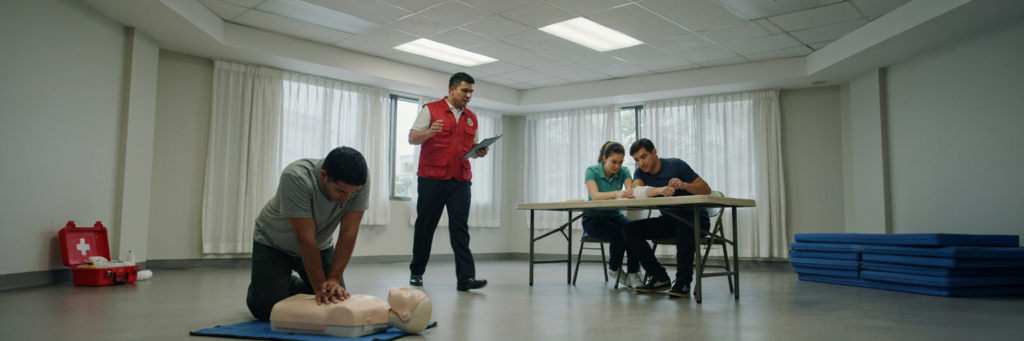
You’ll practice CPR on training manikins until it’s muscle memory, not something you’re trying to remember from a video you watched a while back. This includes chest compressions, rescue breaths, and how to use an AED, because a lot of workplaces now have one mounted on the wall and most people have never actually touched it. There’s a real difference between having watched someone do compressions and having actually felt what the right depth and rhythm feel like under your own hands. That’s the whole reason this part of the course is done in person rather than through a video module.
First Aid Skills: Wounds, Bleeding, Choking, Fractures
This is the practical, hands-on stuff. Wound care and bleeding control, how to help someone who’s choking, and how to manage a suspected fracture until help arrives. None of it is complicated once someone’s shown you properly, which is the whole point of doing it in person. A lot of people come into this part of the course thinking they already sort of know it from a first aid kit poster in the break room, and leave realizing there’s a fair bit more nuance to it than a poster can really teach.
Recognising Medical Emergencies
Asthma attacks, anaphylaxis, seizures, shock. These sections are less about physical technique and more about pattern recognition, knowing what you’re looking at and what to do first, second, and third. This is often the part people say they got the most out of, because it’s the stuff you can’t really guess your way through at the moment. Knowing the difference between someone having a panic response and someone going into anaphylactic shock, for example, genuinely changes what you do next, and that’s exactly the kind of judgement this part of the course is built around.
💡 Worth knowing: HLTAID011 isn't a standalone course sitting next to CPR-only training. It's built from two component units, HLTAID009 (CPR) and HLTAID010 (Provide Basic Emergency Life Support), so when you complete HLTAID011 you're not missing anything a CPR-only certificate would have covered. It's the fuller course, not a different one.
What’s Included, Quick Reference
Skill area | What you’ll learn |
CPR & AED | Compressions, rescue breaths, defibrillator use |
Wound care | Bleeding control, dressing wounds |
Choking | Adult choking response |
Medical emergencies | Asthma, anaphylaxis, seizures, shock |
Injury management | Fractures, immobilisation basics |
Combined Course or CPR-Only? How to Tell Which One You Need
This is the bit that trips most people up, because “CPR course” and “first aid course” get used interchangeably online when they’re actually two different qualifications. Here’s how to sort out which one you actually need before you book anything.
When CPR-Only (HLTAID009) Is Enough
If your role specifically requires CPR certification, and nothing more, HLTAID009 covers that on its own. This tends to apply to people in fitness, aquatics, or allied health roles where CPR is the specific competency being asked for, rather than a general workplace first aid requirement. If that’s genuinely all your role calls for, there’s no need to pay for or sit through content you don’t need.
When You Need the Full Combined Course (HLTAID011)
If your workplace policy says “first aid certificate” without specifying CPR-only, you almost certainly need HLTAID011. This is the default expectation across most everyday workplace roles, admin, retail, hospitality, community and not-for-profit work, and pretty much anywhere that isn’t asking for a narrow, specific unit. It’s the broadest, most generalist of the first aid qualifications, which is exactly why it’s the one most people end up needing.
How to Check What Your Employer Actually Requires
Honestly, the fastest way to sort this out is to just ask HR or your manager directly, “do you need HLTAID009 or HLTAID011.” It sounds obvious, but a two-line email now saves you from booking the wrong course and having to do it all again. If there’s no clear policy, HLTAID011 is the safer default since it includes everything HLTAID009 does, plus more. Nobody’s ever been told off for holding a certificate that covers more than what was strictly required.
HLTAID009 vs HLTAID011, At a Glance
HLTAID009 (CPR only) | HLTAID011 (Combined) | |
Covers CPR | Yes | Yes |
Covers wound care, choking, fractures | No | Yes |
Covers medical emergencies (asthma, anaphylaxis, seizures) | No | Yes |
Typical buyer | Fitness, aquatics, allied health | General workplace requirement |
What to Expect During the Session
Knowing roughly what the day looks like takes a lot of the uncertainty out of booking, especially if this is the first time you’ve done a course like this or it’s been a long while since your last one.
How the Session Is Structured
The course is split between theory and hands-on practical work. The theory component covers the “why” behind what you’re doing, so the practical skills make more sense once you’re actually doing them rather than just repeating a motion you don’t fully understand. The practical component is where the CPR technique, wound care, and choking response actually get practiced on manikins rather than just talked about, and it’s genuinely the part that sticks with people afterward.
A rough shape of the session looks like this:
Arrival and sign-in, then the theory component, then practical skills (CPR, first aid, AED), then assessment, then certificate confirmation.
There’s nothing about this that requires prior experience or a particular fitness level. The trainers work at the pace of the room, and the practical exercises are designed so anyone can follow along and build the muscle memory properly, not just tick a box.
Session Availability
Full-time work doesn’t stop just because your certificate has lapsed, which is exactly why sessions are offered outside standard business hours. If a weekday daytime course doesn’t fit around your job, check the booking page for evening or weekend session times before assuming you’ll need to take leave to get this sorted.
🌱 Callout: No prior experience needed. Every practical skill is taught from the ground up, so it doesn't matter if this is your first course or your fourth.

Will My Employer Accept This Certificate?
This is the question that actually decides whether someone books or keeps scrolling, so it’s worth answering properly rather than just saying “yes, trust us.”
What “Nationally Recognised” Actually Means
HLTAID011 is delivered by an ASQA-registered training organisation, and First Aid Alive operates under RTO 31106. That means the certificate you get isn’t a generic “attended a workshop” printout, it’s a Statement of Attainment recognised across Australia, not just accepted by one employer or industry. If your workplace requires a “nationally recognised first aid certificate,” this is exactly what that phrase is referring to. It’s the same standard of qualification whether the person sitting next to you in the room works in an office, a warehouse, or a cafe.
Certificate Validity
The certificate remains valid for 3 years from the date you complete the course. After that, you’ll need to renew, which is the same lapsed-certificate situation a lot of people find themselves in without realising the clock had run out. It’s a genuinely easy thing to lose track of, especially if nobody at work is actively monitoring it for you.
If Your Employer Has Specific Provider Requirements
Some workplaces, particularly larger organisations or specific industries, do have a preferred provider or a specific policy about who delivers the training. If you’re not sure, a quick check with HR before booking avoids any awkward back and forth after the fact. If you want to verify the RTO yourself rather than just taking our word for it, RTO 31106 is searchable directly on [training.gov.au], which is the government’s own register of registered providers and courses. It takes about as long as it did to read this paragraph, and it’s a genuinely useful habit if you’re ever unsure about a provider’s legitimacy.
How to Book and What Happens After
Booking a combined CPR first aid course is meant to be simple, not something that needs three emails back and forth before you can lock in a date.
Booking Process
The whole thing is self-serve online. Pick a session date and time that fits around work, [pay online], and you’re booked in, no phone call required unless you’d rather ask a question first. There’s no need to speak to anyone if you don’t want to, and no waiting on a callback to confirm a spot.
Certificate Delivery
Once you’ve completed the session and passed your assessment, your digital certificate is delivered within the day. That means you can forward it straight to HR without sitting around waiting for a printed copy to turn up in the post, which matters a lot more than it sounds like when someone’s already asked you twice whether it’s sorted.
Setting a Renewal Reminder
Since the certificate has a set validity period, it’s worth setting yourself a reminder now rather than finding out the way most people do, when HR flags it after it’s already lapsed. No need to hand over your email for this either, just pop a reminder in your own calendar for renewal reminder and you’re covered for next time.
Conclusion
Sarah ended up booking her session for an evening that actually fit around her week, filled out everything online in a few minutes, and had her certificate in HR’s inbox before her manager even asked about it again. That’s really what this whole thing comes down to, not a big drama, just a task that needed sorting and a course that was built to make sorting it easy.
A combined CPR first aid course means you’re not stuck choosing between two half-measures or booking two separate sessions when your employer just wants the one certificate. HLTAID011 covers CPR, wound care, choking, medical emergencies, and injury management in one session, and that Statement of Attainment is recognised right across the country, not just by one workplace or one industry.
If you’ve been putting this off because you weren’t sure which course applied to you, hopefully that’s sorted now. HLTAID011 is the one most people need, and if you’re still not certain, a two-line email to HR is faster than guessing and getting it wrong.
The certificate does have a set validity period, and that period sounds like a long way off until it isn’t. Setting a reminder for yourself now, the same day you get your certificate, is the easiest way to stop this from becoming a repeat problem down the track.
None of this needs to be complicated. Pick a session that fits around your week, turn up, get hands-on with the practical skills, and walk out with a certificate that’s ready to send straight to HR.
Book Your First Aid Training Now
Fast, affordable, and nationally accredited training delivered by professionals who care
Frequently Asked Questions
Q.Is CPR included in a combined first aid course?
Yes. CPR is a built-in component unit of HLTAID011, so you're not booking a separate CPR course on top of it, it's already covered in the one session and the one certificate.
Q.Do I need HLTAID009 or HLTAID011?
Most people need HLTAID011, since it's the broader, general workplace first aid certificate. HLTAID009 is only enough if your role specifically requires CPR alone, which is more common in fitness, aquatics, or allied health roles.
Q.How long is the certificate valid for?
The certificate is valid for [CERTIFICATE_VALIDITY_PERIOD] from the date you complete the course. After that, it needs to be renewed, so it's worth setting yourself a reminder as soon as you receive it.
Q.Will my employer accept this certificate?
Yes, as long as they accept a nationally recognized Statement of Attainment, which almost all Australian employers do. The certificate is issued under RTO 31106, an ASQA-registered training organisation, and can be verified directly on training.gov.au.
Making first aid training more affordable for
every classroom
We believe every student deserves access to life-saving first aid knowledge. That’s why we offer specially reduced pricing for schools and educational groups. Whether you’re booking for a single class, a year group, or your entire school, our flexible packages make training more accessible and cost-effective — without compromising quality.
