

Your CPR certificate expires in two weeks, and you’ve just realized you can’t work without it. Sound familiar? You’re not alone—every week, hundreds of Brisbane professionals find themselves in this exact situation, frantically searching for a quick, convenient CPR course that fits their packed schedule.
The good news? Getting CPR certified in Brisbane doesn’t have to be stressful or time-consuming. Whether you’re a personal trainer in Carindale, a teacher in Chermside, or an aged care worker in Logan, you can complete your CPR training in just 3 hours and walk out with a nationally recognized, same-day certificate.
In this guide, you’ll discover everything you need to know about CPR courses in Brisbane—from choosing between CPR and First Aid training to finding the most convenient location near you. We’ll cover course requirements, what to expect during training, and how to book your spot in the next available session. By the end, you’ll know exactly which course you need and how to get certified fast.
How Long Does a CPR Course Take in Brisbane?
A standard CPR course in Brisbane takes 3 to 3.5 hours to complete, including both theory and practical assessment. This express format covers essential life-saving skills without the full-day commitment required for comprehensive First Aid training.
CPR Course Duration Breakdown:
- Theory component: cardiopulmonary resuscitation techniques, emergency response
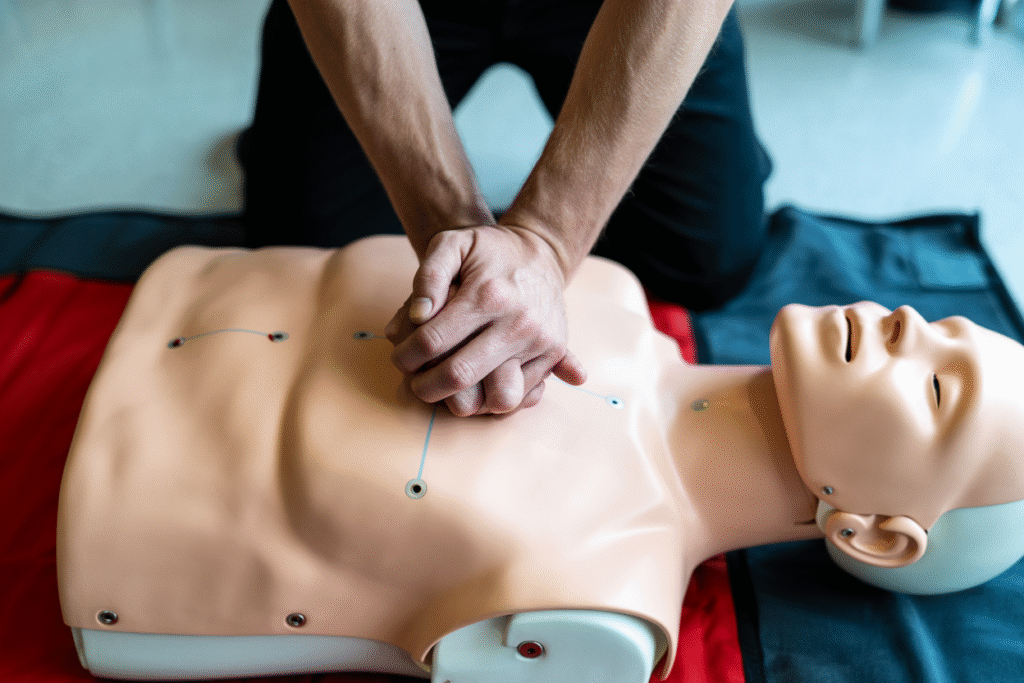
- Practical training: hands-on practice with mannequin
- Assessment: demonstration of CPR skills
- Certificate processing: Immediate digital certificate issued same day
Most Brisbane training providers offer CPR courses during weekday to accommodate working professionals. Unlike full First Aid courses that require 6-8 hours, CPR certification is designed specifically for time-poor individuals who need quick, focused training.
The almost 2-hour timeframe makes it realistic to squeeze CPR training into your busy schedule. You could do a morning session before work starts, an evening course after you knock off, or dedicate a Saturday morning while the kids are at sport. That’s getting you certified without derailing your day.
Types of CPR Courses Available in Brisbane
Not all CPR courses are the same, and choosing the wrong one can mean wasting time and money on training you don’t actually need. Here’s what’s available in Brisbane and which one’s right for your situation.
HLTAID009 Provide Cardiopulmonary Resuscitation (CPR Only)
Duration: Almost 2 hours
This is your express option—just CPR, nothing else. It’s the quickest way to get certified if you already hold a current First Aid certificate and just need to renew the CPR component (which expires annually, even when your First Aid cert is still valid for another year or two).
Who needs it: Personal trainers, fitness instructors, gym staff, teachers who already have First Aid certification, or anyone renewing CPR only.
What’s included: You’ll learn adult, child, and infant CPR techniques, how to use an AED (defibrillator), and the DRSABCD emergency response protocol.
Validity: 12 months—yep, you’ll be back next year.
Best for: Quick certification renewal when you’re not starting from scratch, or if your employer specifically requires CPR-only training.
HLTAID011 Provide First Aid (Includes CPR)
Duration: 2-3 hours
This is your comprehensive option. It includes everything from HLTAID009, plus you’ll learn how to manage wounds, fractures, burns, allergic reactions, and other medical emergencies. Most workplaces that require “First Aid certification” mean this one.
Who needs it: Aged care workers, childcare educators, office first aid officers, hospitality managers, retail supervisors, community workers, or anyone getting certified for the first time.
What’s included: CPR plus wound management, fractures, burns, bleeding control, shock, spinal injuries, medical emergencies like heart attacks and strokes, and heaps more.
Validity: 3 years for the First Aid component, but the CPR part still needs annual renewal.
Best for: Anyone starting fresh, or if you’re unsure what your workplace needs (this covers pretty much everything).
HLTAID012 Provide First Aid in an Education and Care Setting
Duration: 6-8 hours
This is the childcare-specific version. It’s basically HLTAID011 with extra focus on pediatric emergencies, anaphylaxis management, and asthma response—all the things that matter when you’re looking after kids.
Who needs it: Childcare workers, early childhood educators, family daycare providers, kindergarten teachers, anyone working in regulated education and care services.
Specific focus: Anaphylaxis (EpiPen use), asthma management, choking in infants and children, pediatric CPR emphasis, and meeting ACECQA requirements.
Validity: 3 years (with annual CPR renewal).
Still confused? Here’s the simple version: if you work with kids in a regulated setting, you need HLTAID012. If you work in aged care, healthcare, or general workplace roles, go with HLTAID011. If you’re just renewing CPR and already have First Aid, stick with HLTAID009.
What You’ll Learn in a Brisbane CPR Course
Here’s what actually happens during those 3 hours of CPR training Brisbane providers offer. No surprises, no hidden extras—just practical, hands-on skills that could genuinely save someone’s life.
Theory Component
Don’t worry, this isn’t like sitting through a boring lecture. The theory part covers what you need to know before you start practicing on the mannequins.
You’ll learn:
- How to recognize cardiac arrest versus other medical emergencies
- The DRSABCD action plan—this is the step-by-step protocol you’ll follow in any emergency (Danger, Response, Send for help, Airway, Breathing, CPR, Defibrillation)
- When to start CPR and when to stop
- Legal protections under Queensland’s Good Samaritan laws
- Chain of survival—understanding why every minute counts
- How to operate an AED (Automated External Defibrillator)
Most instructors use real-life scenarios from Brisbane workplaces and situations you’ll actually recognize. It’s way more engaging than just reading from a manual. They’ll talk about what to do if someone collapses at the gym, in the office, at a childcare centre—real scenarios you might actually face, not hypothetical situations that’ll never happen.
Practical Skills Training
This is where you spend most of your time, and honestly, it’s the part that matters most. You can’t learn CPR from a book—you’ve gotta actually do it.
Hands-on practice includes:
Chest compression technique: Getting the depth right (5-6cm for adults), maintaining the correct rate (100-120 compressions per minute—think “Stayin’ Alive” by the Bee Gees), and proper hand placement on the chest.
Rescue breathing methods: How to give effective breaths without over-inflating the lungs.
Adult CPR: This is the most common scenario you’ll face in a Brisbane workplace—colleague collapses, you need to respond.
Child CPR (ages 1-8): Modified technique with less force, different compression-to-breath ratio.
Infant CPR (under 12 months): Two-finger compressions, much gentler approach, different positioning.
AED application and use: Opening the device, placing pads correctly, following voice prompts (these machines literally talk you through it).
Recovery position: What to do once someone’s breathing again but still unconscious.
You’ll practice on mannequins multiple times before the assessment. Instructors watch, correct your technique, and give you feedback as you go. Small class sizes (usually max 12 people) mean you get plenty of practice time without feeling rushed.
Here’s what surprises most people: the mannequins give you feedback. Some of them click when you’re getting the compression depth right, others have lights that show if you’re going at the correct rate. It’s not just guesswork—you’ll know when you’re doing it properly.
Assessment Process
Here’s what everyone stresses about, but honestly, there’s no reason to. The pass rate is around 98% because instructors aren’t trying to trick you—they want you to succeed.
How it works:
You’ll perform CPR on a mannequin while the instructor watches, checking your technique—compression depth, rate, hand placement, rescue breaths. Usually there’s a scenario-based element like “You’re at work and a colleague collapses. What do you do?” You’ll talk through the DRSABCD process while demonstrating CPR.
You need to show you can perform effective compressions and rescue breaths. If your technique needs adjustment, the instructor tells you immediately and you try again. No waiting weeks for results—you’ll know right away if you’ve passed, and you’ll get your certificate that same day.
If you don’t pass the first time (rare, but it happens), most Brisbane providers let you re-assess on the spot at no extra cost. They’ll work with you until you’ve got it right.

Who Needs CPR Certification in Brisbane?
If you’re reading this, chances are someone’s told you that you need CPR certification. But let’s be specific about who actually needs it in Brisbane, because requirements vary depending on your industry and role.
Workplace Requirements
Fitness & Recreation
If you’re a personal trainer, gym instructor, swim instructor, or sports coach in Brisbane, CPR certification isn’t optional—it’s a legal requirement to maintain your insurance and registration. Fitness Australia and most insurance providers won’t cover you without current CPR certification. Same goes if you’re running boot camps in New Farm or teaching yoga in Paddington.
Education Sector
Teachers, teacher aides, and school sport coordinators need either CPR-only or full First Aid depending on their school’s policy. Most Queensland schools require at least a few staff members to hold current First Aid, but all PE teachers and anyone supervising sport or excursions typically need CPR as a minimum.
Healthcare & Community Services
Aged care workers, disability support workers, and home care providers—you already know this is non-negotiable. NDIS providers and aged care facilities in Logan, Sunnybank, and across Brisbane won’t let you work without current certification. It’s part of your compliance requirements, and audits check for it.
Childcare & Early Education
Childcare educators, family daycare providers, and nannies need HLTAID012 (the childcare-specific First Aid that includes CPR). ACECQA regulations are strict about this—you can’t be counted in ratios without valid certification. Even if you’re just doing occasional relief work at a centre in Carindale or Chermside, you need current certification.
Corporate & Retail
First aid officers in office buildings, retail managers, hospitality staff, and security personnel often need CPR or First Aid depending on workplace size and risk assessment. Safe Work Australia guidelines recommend one first aider per 50 workers in low-risk environments, more in high-risk workplaces.
Personal Reasons (Not Work-Related)
You don’t need a work requirement to get CPR certified. Heaps of Brisbane parents and grandparents do CPR courses just for peace of mind—knowing you could help your own kid or grandkid if something went wrong is worth the 1-2 hours.
Volunteers in sports clubs, scouts, or community groups often get certified too. Same with people who do high-risk hobbies like hiking, camping, or boating—if you’re heading out to Moreton Island or camping at Springbrook, being CPR trained just makes sense.
And if you’re caring for elderly relatives at home, especially those with heart conditions, CPR training can genuinely make the difference between life and death while you’re waiting for the ambulance to arrive. Brisbane ambulances are quick, but those first few minutes before they arrive—that’s when CPR matters most.
How to Book Your CPR Course in Brisbane
Booking a CPR course in Brisbane is straightforward—no complicated forms, no waiting days for confirmation. Here’s how it works.
Simple 3-Step Booking Process
Step 1: Choose Your Course Date & Location
Jump online and view the next 30 days of available courses. Most providers let you filter by suburb (so if you’re in Logan or Redcliffe, you can find what’s closest), day of the week, or time slot. You’ll see real-time availability—if it says 4 spots left, that’s accurate, not some marketing trick.
Popular times like Saturday mornings and weekday evenings fill up fast, especially during January and February when everyone’s renewing expired certificates from the holidays. If you need certification urgently, book whatever’s available rather than waiting for your perfect time slot.
Step 2: Complete Online Registration
Enter your details—name, email, phone number, date of birth (for certificate purposes), and any medical conditions instructors should know about. You’ll get an instant confirmation email with your course details, venue address, and what to bring (just photo ID and comfortable clothes).
The whole online registration process takes maybe 2 minutes. Most providers have simple forms that don’t ask for unnecessary information—just what they need for your certificate.
Step 3: Attend & Get Certified
Arrive 10 minutes early with your photo ID. Complete the 3-hour course. Receive your digital certificate via email that same day—usually within 2 hours of finishing. Done.
Get Your CPR Certification Sorted Today
Look, you’ve made it this far through the guide, which means you’re serious about getting your CPR certification sorted. And honestly? That’s the hardest part—actually deciding to book the thing instead of putting it off another week.
Here’s what you know now: a CPR course in Brisbane takes almost 2 hours, and you’ll walk out with a same-day certificate. Whether you’re a personal trainer in Carindale who’s let their cert lapse, a teacher in Chermside who needs renewal before term starts, or a parent in Logan who just wants peace of mind—the process is the same. Pick a date that works, show up, do the training, get certified.
The longer you wait, the more stressful it gets. Certificate expiry dates don’t care about your busy schedule, and employers don’t accept “I was going to book it” as a valid excuse. If you need certification for work, you need it now. If you want it for personal reasons, there’s no better time than today.
Next available courses are booking up fast, especially weekend and evening sessions. Check what’s available at a location near you and reserve your spot before you close this tab and forget about it for another week.
Book Your First Aid Training Now
Fast, affordable, and nationally accredited training delivered by professionals who care
Frequently Asked Questions About CPR Courses in Brisbane
Q.Do I need CPR or First Aid certification?
Choose CPR only (HLTAID009) if you're renewing CPR within a comprehensive First Aid certificate or need the quickest option. Choose First Aid (HLTAID011) if you're a first-time seeker or work in aged care, childcare, or healthcare. When in doubt, First Aid provides maximum coverage.
Q.What if I fail the CPR assessment?
The pass rate is approximately 98%. Instructors provide clear demonstrations, one-on-one guidance, immediate feedback, and same-day re-assessment at no extra cost if needed. The goal is developing practical skills, not perfection.
Q.Is online CPR certification valid in Queensland?
No. Queensland requires in-person practical assessment for valid CPR certification. Fully online courses are NOT compliant with Australian standards. Valid certification must include face-to-face practical training, hands-on practice, and in-person assessment by a qualified instructor from a registered RTO.
Q.How long is CPR certification valid?
CPR certification (HLTAID009) is valid for 12 months from completion date. You must renew annually to maintain valid certification. Many employers require renewal before expiry, not after.
Making first aid training more affordable for
every classroom
We believe every student deserves access to life-saving first aid knowledge. That’s why we offer specially reduced pricing for schools and educational groups. Whether you’re booking for a single class, a year group, or your entire school, our flexible packages make training more accessible and cost-effective — without compromising quality.
