

What would you do if your child stopped breathing at the dinner table tonight? Could you stay calm? Would you know exactly what to do in those critical first minutes?
Childhood emergencies don’t wait for ambulances. Your toddler choking on a grape. Your teenager collapsing during soccer practice at Carindale. A near-drowning incident in the backyard pool on a hot December afternoon. These scenarios are happening to Queensland families every single week.
In the 8-12 minutes it takes for an ambulance to reach you in the Brisbane suburbs, you could save their life. Or you could stand there, frozen, watching helplessly. The difference? Just three hours of CPR training.
My mate’s sister Laura learned this at a pool party in Carindale last summer. Her 4-year-old wasn’t breathing after going under. Laura had done a CPR course six months earlier. That afternoon, those three hours of training kicked in. She started CPR immediately while someone called 000. By the time the ambos arrived, her son was breathing again. The paramedics told her straight up: “You saved his life.”
CPR training is simpler and more accessible than you think. You don’t need a medical degree. You just need basic, practical skills that anyone can learn in an afternoon.
Let’s make sure you’re never that helpless parent standing there wishing you knew what to do.
Why Brisbane Parents Need CPR Training (Not Optional)
The Reality of Childhood Emergencies in Queensland
Queensland Ambulance responds to over 15,000 pediatric emergencies every year. That’s 41 kids every single day across the state. And here in Brisbane? We’re talking about choking incidents, near-drownings, cardiac events, severe allergic reactions—stuff that happens in ordinary homes to ordinary families.
Choking is the leading cause of preventable death in Australian kids under 5. Not some rare medical condition. Choking. Usually on food. Usually at home. Usually with parents right there in the room.
Queensland has the highest drowning rates in Australia. December through February—our summer pool season—is when the stats spike. Backyard pools, beach trips to the Gold Coast, swimming lessons at your local aquatic center. Water is everywhere in Brisbane, and toddlers are ridiculously fast.
Here’s what should concern every Brisbane parent: brain damage starts after just 3-5 minutes without oxygen. And the average ambulance response time in suburban Brisbane? Eight to twelve minutes on a good day. Longer if you’re out in Logan or Springfield during peak hour.
The Australian Resuscitation Council has solid data: when someone nearby starts CPR immediately, survival rates jump by 40%. That’s the difference between life and death, or between full recovery and permanent brain damage.
Most parents freeze. They panic, they call 000, and then they wait. They don’t start CPR because they’re not confident, they’re scared of doing it wrong, they think the ambos are coming soon anyway. But those golden minutes tick by.
⚠️ CRITICAL TIMING:
- Brain damage starts after just 3-5 minutes without oxygen
- Average ambulance response time in suburban Brisbane: 8-12 minutes
- Survival rate increase with immediate CPR: 40%
The Parent Guilt Factor
There’s this weight that parents carry after an emergency where they didn’t know what to do. A pediatric emergency nurse at Brisbane Children’s Hospital told me that in her 15 years working emergency, the parents who knew CPR were consistently the ones whose kids had the best outcomes. Just because they acted fast in those first few minutes.
Most Brisbane parents genuinely overestimate how hard CPR training is. They think it’s this complex medical procedure that takes months to learn. They think you need steady hands and nerves of steel.
But here’s the reality: CPR is designed for panicked bystanders with zero medical training. The techniques are simple on purpose. They’re repeatable under stress. And you can’t really make things worse—because doing nothing is worse.
Laura wasn’t some calm, collected hero. She told me afterwards she was absolutely terrified, her mind went blank for a second, but then the training kicked in. Her hands knew what to do because she’d practiced on those manikins. When it mattered, muscle memory took over.
That’s the confidence gap. Before training, you think “I could never do that.” After training? You realize “Actually, I can do this if I have to.”
What You’ll Actually Learn in a Parent CPR Course
Infant CPR (0-12 Months): The Fundamentals
Infant CPR is completely different from what you’d do for an older kid or adult. Babies are fragile, their airways are tiny, and you need a gentler approach.
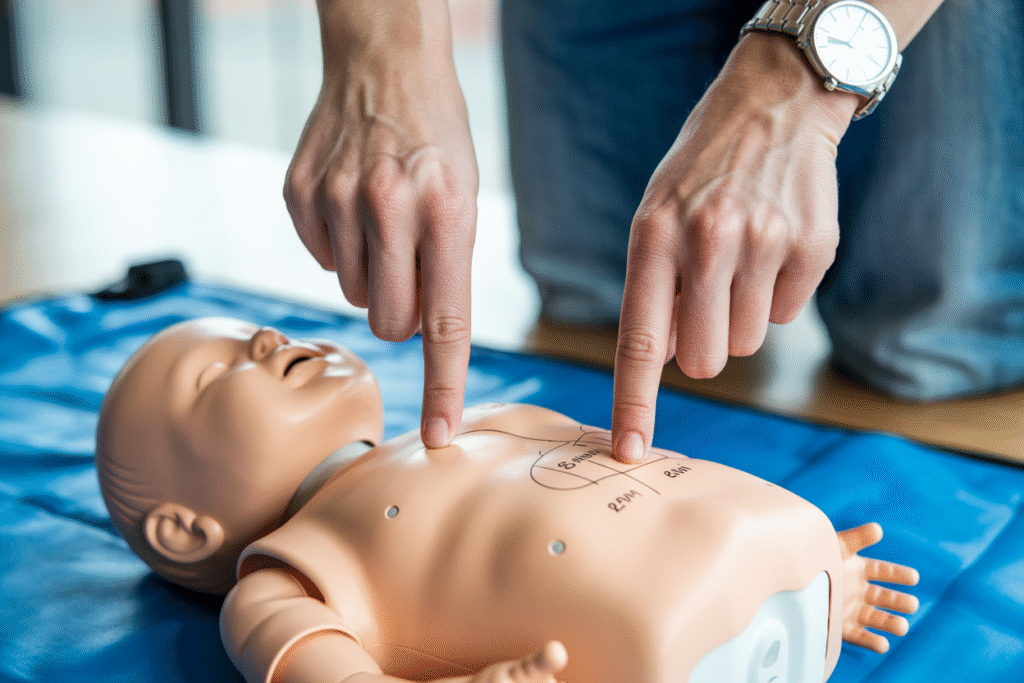
The two-finger technique – is what you’ll learn first. Instead of using your whole hand, you use just two fingers in the center of the baby’s chest. You’re going down about 4cm—roughly 1.5 inches. You’re aiming for 100 to 120 compressions per minute. The instructors usually say think of “Baby Shark” or “Staying Alive” by the Bee Gees—those songs are the perfect tempo.
Rescue breaths for infants are what they call “puffs of air.” You’re not giving full breaths like you would to an adult. Just gentle puffs, because their lungs are so small. You’ll practice getting the head position right—neutral position for babies, not tilted back like with adults.
Then there’s choking techniques for infants. Back blows and chest thrusts, not the Heimlich maneuver—you’d damage their internal organs doing abdominal thrusts on a baby.
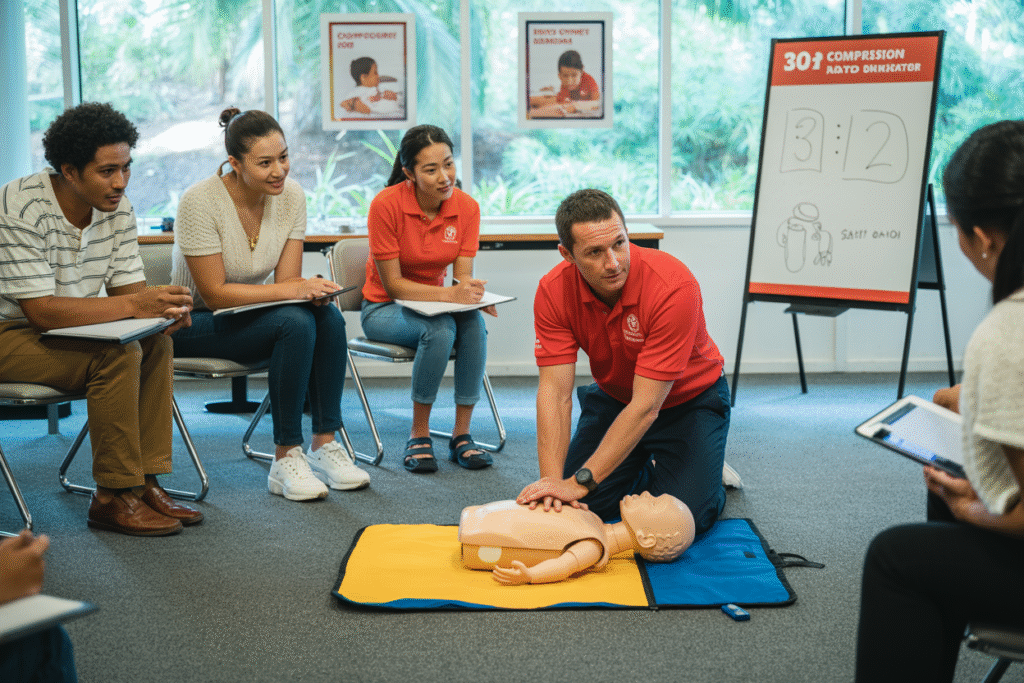
You’ll practice all of this on specially designed infant manikins first. These things give you feedback—some even tell you if you’re pressing too hard or not hard enough. You’ll have plenty of time to practice and ask questions before any assessment.
Child CPR (1-8 Years): Age-Appropriate Techniques
Once kids hit about 12 months, the technique changes. Now you’re using one hand or two hands depending on the size of the child. Compression depth goes up to about 5cm (2 inches), which is roughly one-third of the chest depth. Same rhythm: 100-120 compressions per minute. You’ll do 30 compressions, then give 2 rescue breaths, then straight back to compressions.
For choking in conscious kids, this is where the Heimlich maneuver comes in. You’ll learn the modified version for children—standing behind them, fist just above the belly button, quick upward thrusts.
You’ll practice recognizing different consciousness levels. Is the child responsive? Unresponsive? Semi-conscious but not breathing properly? Each scenario needs a slightly different approach.
CPR Technique Comparison
| Technique | Infant (0-12 months) | Child (1-8 years) | Adult (8+ years) |
|---|---|---|---|
| Hand Position | Two fingers, center of chest | One or two hands, center of chest | Two hands, center of chest |
| Compression Depth | 4cm (1.5 inches) | 5cm (2 inches) | 5-6cm (2-2.4 inches) |
| Compression Rate | 100-120 per minute | 100-120 per minute | 100-120 per minute |
| Compression:Breath Ratio | 30:2 | 30:2 | 30:2 |
| Rescue Breaths | Gentle puffs of air | Normal breaths | Normal breaths |
| Head Position | Neutral | Slight tilt back | Tilt back |
| Choking Response | Back blows + chest thrusts | Heimlich maneuver | Heimlich maneuver |
Using an AED on Children: What Parents Fear Most
AEDs are designed to be foolproof. The device literally talks you through every single step. “Place pads on bare chest.” “Do not touch the patient.” “Analyzing heart rhythm.”
For kids, you’ll learn about pediatric pad placement. Small children get pads placed front and back—one on the chest, one on the back between the shoulder blades. Bigger kids can have them placed on the chest like adults.
Here’s the thing that stops parents from using AEDs: they’re worried they’ll do it wrong and hurt the child. But the AED analyzes the heart rhythm automatically. It won’t deliver a shock unless it’s absolutely necessary. You physically cannot shock someone who doesn’t need it—the machine won’t let you.
You’ll also learn where to find AEDs around Brisbane. Most public pools have them—Logan Aquatic Centre, Chermside Aquatic Centre, Centenary Pool. Shopping centers like Westfield Carindale and Chermside have them near the main entrances. Schools and sports facilities across Brisbane are getting them installed.
The stats on AEDs are compelling. Without an AED, cardiac arrest survival rates hover around 6%. With an AED used quickly? That jumps to 45%.
Beyond CPR: Additional Life-Saving Skills Covered
A good CPR course for parents doesn’t stop at chest compressions.
Recovery position – If your child is unconscious but breathing, you don’t do CPR—you put them in recovery position on their side so they don’t choke if they vomit.
Severe allergic reactions – You’ll learn to recognize anaphylaxis symptoms and understand when someone needs their EpiPen immediately. Swelling face, difficulty breathing, hives spreading fast—especially during mango season when allergies spike.
Drowning response – With drowning, you start with 5 rescue breaths first before compressions. Their lungs are full of water, they need oxygen fast. The course covers the protocol for drowning specifically, which matters in Brisbane where pools and beaches are part of everyday life.
Asthma emergencies – When to use a reliever inhaler, when to call 000, how to keep the kid calm while they’re struggling to breathe.
You’ll also learn severe bleeding control and calling 000 effectively—what information to give first, how to stay calm enough to follow the dispatcher’s instructions.
How to Choose the Right CPR Course in Brisbane
What to Look for in a CPR Training Provider
Make sure they’re a registered training organization (RTO). Your certificate won’t be recognized without this. Check RTO registration on training.gov.au.
Class sizes matter. Look for 12-15 people max. Smaller groups mean more hands-on practice and less pressure.
Check instructor credentials. Bonus points for emergency services experience—paramedics, nurses, former ambos.
Location convenience. Look for multiple Brisbane locations—northside, southside, somewhere near you.
Same-day certification should be standard. You walk out with your certificate the same day.
Renewal reminders. Good providers email you at 60, 30, and 14 days before your certificate expires.
Course Types: CPR Only vs. Combined First Aid
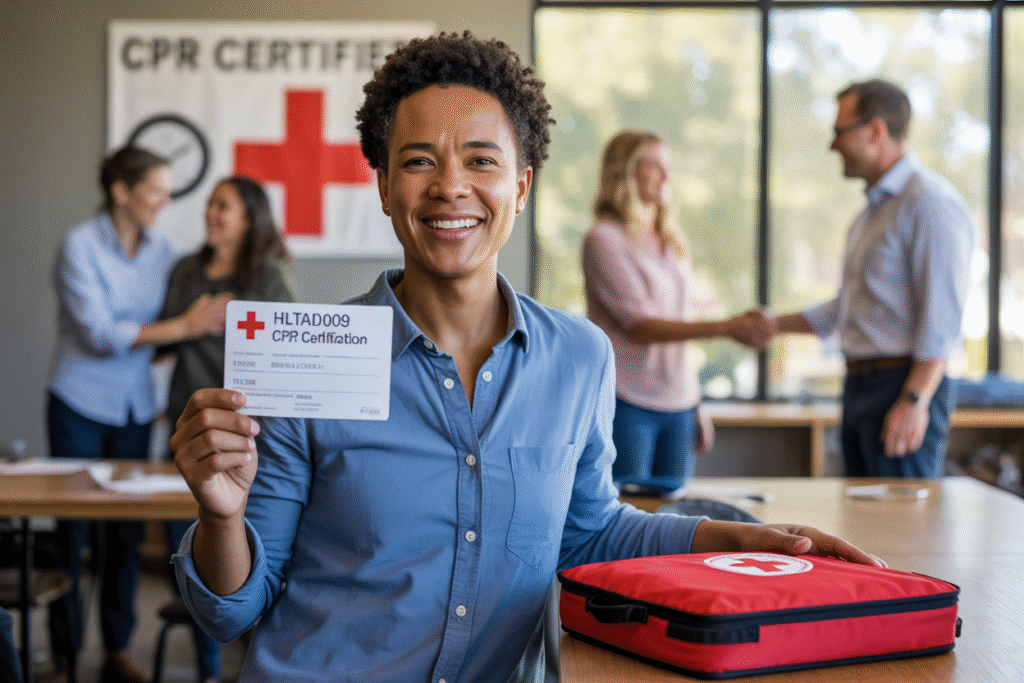
CPR-only courses – (HLTAID009) take 3-4 hours and cover CPR and basic emergency response. This is what most parents need—infant, child, and adult CPR plus AED use.
Combined First Aid courses – (HLTAID011) take a full day and cover CPR plus burns, fractures, snake bites, head injuries, and more. Required if you’re volunteering at school camps, coaching kids’ sports, or working in childcare.
If you just want to protect your family, the CPR-only course is plenty.
In-Person vs Online Options
True CPR certification requires hands-on practical assessment. You can’t learn chest compressions from a video.
Some providers offer blended learning: theory online, then practical in-person. This works well if you’re time-poor.
For Brisbane parents, in-person courses are usually best. You get proper feedback on your technique and confidence that you actually know what you’re doing.
When and How to Renew Your CPR Certification
CPR certificates expire way faster than you think.
Why CPR Certificates Only Last 12 Months
Your CPR certification (HLTAID009) is only valid for 12 months. CPR techniques get updated regularly based on new medical research, and skill fade is real. If you learned CPR a year ago and haven’t practiced, you won’t remember the exact technique.
Pick a provider that sends automatic renewal reminders at 60, 30, and 14 days before expiry. Or link it to something you already remember annually—one Brisbane mum does her renewal the same month as her birthday.
Staying Confident Between Renewals
Practice at home every few months. Watch refresher videos from Australian Resuscitation Council or St John Ambulance. Know where the closest AED is at Westfield Chermside, your local pool in Sunnybank, your kid’s school.
The goal is to maintain enough skill that if your kid needs help, you act instead of freeze.
Making CPR Part of Your Family Safety Plan
Teaching Age-Appropriate Safety to Your Kids
For little kids (3-5), keep it simple. Teach them to recognize when someone needs help. Show them how to unlock your phone. Practice saying your home address out loud.
Kids aged 6-10 can learn how to call 000 and what information to give: address, what happened, whether the person is breathing.
For teenagers (12+), they should do a CPR course themselves, especially if they babysit or coach junior sports.
Creating an Emergency Action Plan
Keep your first aid kit somewhere accessible with bandages, antiseptic, EpiPen if needed, and asthma inhaler. Know which hospital is closest—Queensland Children’s Hospital, Mater Hospital, Royal Brisbane. Map out where the AEDs are at your local Woolies, the gym, the sports club.
Save emergency contacts in your phone under “ICE.” Talk through scenarios with your partner about who does what.
Staying Calm When It Matters
Learning the techniques is easy. Staying calm when it’s your own kid? That’s the challenge.
The training kicks in. Even when you’re terrified, the repetition takes over. Take three seconds to assess. Delegate tasks to others. Talk out loud while doing CPR—it helps you stay focused.
Even imperfect CPR is way better than no CPR. You’re still giving that kid oxygen, still keeping blood flowing.
Book Your CPR Course Today
Your Next Steps to Getting CPR Certified
Step 1: Find a course that fits your schedule. Most Brisbane providers run sessions 7 days a week. Look for something in the next 1-2 weeks.
Step 2: Pick somewhere convenient—within 20 minutes of home or work. Northside: Chermside, Redcliffe. Southside: Logan, Sunnybank, Carindale.
Step 3: Book online and get confirmation.
Step 4: Show up. Three hours that could save your child’s life.
Step 5: Walk out certified same day.
What to Bring
Photo ID, comfortable clothes, water bottle, reading glasses if needed. That’s it.
What to Expect
8-12 other people, all slightly nervous. First hour is theory—when to call 000, how to assess emergencies. Then practical practice on manikins. The instructor gives you feedback. Finally, a 5-minute practical assessment. Everyone passes.
You’ll walk out thinking “that was way less stressful than expected.”
The Bottom Line for Brisbane Parents
Statistically, there’s a decent chance you’ll witness or be involved in a pediatric emergency at some point in your parenting journey. Might be your own kid. Might be someone else’s kid at the pool, at a party, at school pickup. And in that moment, the only question that matters is: “Do I know what to do?”
The parents who’ve been through this—the ones who’ve actually had to do CPR on a child—they’ll all say the same thing. They’re glad they knew what to do. Not because they were heroes. Just because they gave that kid the best possible chance.
That’s what three hours of training buys you. Not a guarantee that nothing bad will ever happen. Just the ability to help instead of standing there helpless.
You’re already doing everything you can to keep your kids safe. Car seats, pool fences, bike helmets, teaching them to look both ways. CPR training is just one more layer of protection—except this one’s for when everything else has already failed.
Don’t be the parent who says “I’ve been meaning to do that” while emergency services are rushing your child to Queensland Children’s Hospital. Be the parent who acted fast, who stayed calm, who gave those emergency responders a better chance.
Book your CPR course for parents this week. Not next month. Not when things settle down. This week. Because childhood emergencies don’t wait for convenient timing, and neither should your training.
Book Your First Aid Training Now
Fast, affordable, and nationally accredited training delivered by professionals who care
Frequently Asked Questions About CPR Training for Parents
Q.Can I bring my kids to the CPR course?
Most Brisbane providers don't allow children to attend courses. It's a practical thing—you need to focus during the hands-on practice, and kids would be bored within 20 minutes. Your best bet is to organize childcare for those few hours, or find a provider that offers evening or weekend sessions when your partner can watch the kids. Some parents coordinate with other mums and dads to take turns attending courses.
Q.What if I fail the CPR assessment?
Honestly? Almost nobody fails. The assessment isn't designed to trick you or catch you out. You're demonstrating basic CPR technique on a manikin while the instructor watches. They want you to pass—they'll give you feedback during practice and tell you if you need to adjust anything before the assessment. If for some reason you don't get it right the first time, good providers let you have another go straight away. The goal is competence, not perfection.
Q.My certification expired months ago. Do I need to start from scratch?
No, you just book a renewal course. It's the same 3-4 hour CPR course you did originally. The techniques don't change dramatically year to year, but doing the renewal keeps your skills sharp and ensures you're up to date with current Australian Resuscitation Council guidelines. Don't stress about the gap—the renewal course brings everything back quickly. Book it soon though, because if you need to show proof of certification for volunteering or work, expired certificates aren't valid.
Q.What's the difference between HLTAID009 and HLTAID011?
HLTAID009 is CPR only—focused specifically on cardiopulmonary resuscitation for infants, children, and adults, plus AED use. Takes 3-4 hours. HLTAID011 is "Provide First Aid"—it includes everything from HLTAID009 plus treatment for burns, fractures, bleeding, shock, snake bites, head injuries, and more. Takes a full day. For most Brisbane parents just wanting to protect their family, HLTAID009 is plenty. You need HLTAID011 if you're working in childcare, coaching sports, or volunteering at school camps.
Q.Can I use my CPR certification for work or volunteering?
Yes. HLTAID009 (CPR) and HLTAID011 (First Aid) are nationally recognized qualifications. If you're volunteering at your kid's school, coaching weekend soccer, or helping with swimming carnivals, your certificate proves you're trained. Many Brisbane schools and sporting organizations require parent volunteers to have current CPR or First Aid certification. Just make sure you're training with a registered training organization (RTO)—check training.gov.au to verify.
Making first aid training more affordable for
every classroom
We believe every student deserves access to life-saving first aid knowledge. That’s why we offer specially reduced pricing for schools and educational groups. Whether you’re booking for a single class, a year group, or your entire school, our flexible packages make training more accessible and cost-effective — without compromising quality.
