

What if the CPR technique you learned 12 months ago is now considered incorrect?
If you’re a Brisbane personal trainer, that question should make your stomach drop a bit. CPR guidelines don’t stay frozen in time—the Australian Resuscitation Council updates protocols based on new medical research, and 2025 brought changes that could affect how you respond in a real emergency.
Here’s the uncomfortable truth: if you push a client through high-intensity training and they collapse, you’ve got seconds to make decisions. Using outdated CPR guidelines won’t just fail to save them—it could expose you to liability questions your insurance company’s gonna ask later.
Let’s break down exactly what changed, why it matters, and what you need to do about it before your next client session.
What Are the 2025 CPR Guidelines?
The 2025 CPR guidelines, established by the Australian Resuscitation Council (ARC), define current best-practice protocols for cardiopulmonary resuscitation. These evidence-based standards make sure we’re giving cardiac arrest victims the best possible chance of survival.
Key 2025 CPR Guidelines include:
- Compression depth: 5-6cm for adults (refined from previous 5cm minimum guidance)
- Compression rate: 100-120 compressions per minute (unchanged)
- Compression-to-ventilation ratio: 30:2 for single rescuers (unchanged)
- Hand placement: Center of chest on lower half of sternum (unchanged)
- AED deployment: Use as soon as available, minimize interruptions to compressions
- Continuous compression CPR: Acceptable when rescuer unable or unwilling to give breaths
- Recovery position: Place unconscious breathing person on their side
The 2025 guidelines emphasize high-quality compressions with minimal interruptions, immediate AED use when available, and calling 000 immediately before starting CPR in adults.
⚠️ Quick Take: The 2025 CPR guidelines refined compression depth guidance (5-6cm optimal range), strengthened AED deployment timing, and confirmed hands-only CPR as acceptable. Your 2024 certification remains valid, but knowing these updates could save a life.
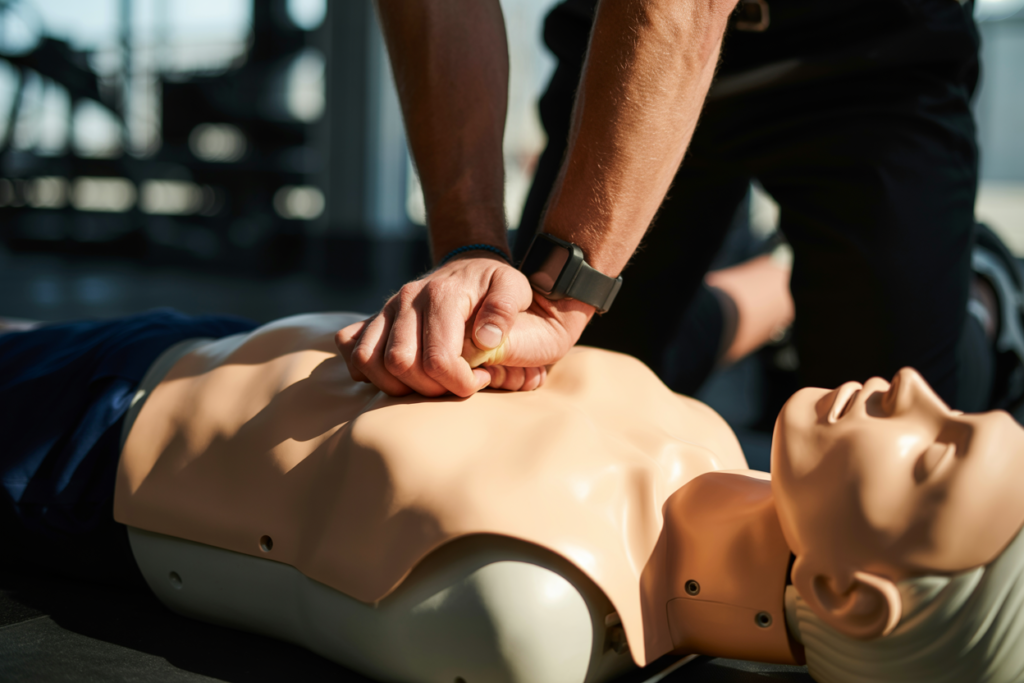
Understanding the 2025 CPR Guidelines Update
Who Sets Australia’s CPR Guidelines?
The Australian Resuscitation Council (ARC) is the national authority that sets CPR guidelines for everyone in Australia—from paramedics to personal trainers to everyday bystanders. If you’ve done HLTAID011 training, everything you learned came from ARC protocols.
The ARC doesn’t just make stuff up in a committee room. They’re aligned with the International Liaison Committee on Resuscitation (ILCOR), which reviews cardiac arrest research from around the world. When scientists discover something that improves survival rates, that research gets evaluated by ILCOR, then filtered down to the ARC, who adapts it for Australian conditions.
Every training provider offering HLTAID011 certification must follow ARC guidelines. That’s not optional. Your insurance company knows this. Fitness Australia knows this. And if you ever find yourself in a courtroom defending your actions during an emergency, the lawyers will definitely know this.
Why CPR Guidelines Change
CPR guidelines don’t change because someone got bored and decided to shake things up. They change because researchers are constantly studying what actually works when someone’s heart stops.
Every cardiac arrest that happens in a hospital gets documented. Compression depth, rate, interruption time, time to first shock, patient outcomes—all of it gets recorded and analyzed. Researchers can now measure which compression depths produce the best cardiac output, which AED timing saves the most lives, whether rescue breaths actually improve survival in certain scenarios.
Studies using cardiac catheterization showed that compressions between 5-6cm produced optimal blood flow without causing excessive chest trauma. Compressions shallower than 4cm barely moved blood at all—survival rates dropped by about 30%. The data also showed that minimizing interruptions to compressions matters more than perfect technique.
For you as a trainer, this should actually be reassuring. These aren’t arbitrary changes designed to make your certification expire faster. They’re evidence-based improvements that make you more likely to actually save your client if the worst happens during a training session.
How Often Do CPR Guidelines Actually Change?
The ARC conducts major guideline reviews every five years. The last big review cycle was 2020-2021. The current 2025 review represents a refinement period, not a complete overhaul.
The core principles of CPR have remained remarkably stable for decades. Call for help immediately. Push hard and fast on the center of the chest. Minimize interruptions. Use an AED as soon as possible. Those fundamentals haven’t changed.
What changes are the specifics. The optimal compression depth range. The exact timing of AED deployment. Whether rescue breaths are mandatory or optional in certain situations.
If you got your HLTAID011 certification in 2024, you weren’t taught “wrong” information. You were taught the best-practice protocols available at that time. The 2025 updates refined some specifics, but they didn’t invalidate what you learned.
What Specifically Changed in 2025 CPR Guidelines
Compression Depth Refinement
2024 guideline said: “At least 5cm, not exceeding 6cm”
2025 refinement says: “5-6cm optimal range”
The language shift matters. The old phrasing made 5cm sound like the target—push at least that hard. The new phrasing makes 5-6cm sound like a sweet spot you should be aiming for.
Biomechanics research showed that compressions in the middle of that range produce the best cardiac output without excessive injury risk. Too shallow—anything under 4cm—and you’re barely moving blood. Too deep—7cm or more—and you’re risking serious chest trauma.
Here’s the practical challenge: You can’t measure compression depth in a real emergency. You don’t have a ruler strapped to someone’s chest. This is where mannequin practice during your HLTAID011 course actually matters. Quality training mannequins give you feedback that help you calibrate what the proper depth feels like in your hands.
And here’s something that might surprise you: the 5-6cm guideline applies to everyone. That 220lb male client doing deadlifts? 5-6cm. That 110lb female client working on marathon training? Still 5-6cm. The compression depth doesn’t change based on the person’s size.
AED Deployment Timing Updates
Previous guidance said: “Use AED when available”
2025 emphasis says: “Minimize time between collapse and first shock”
The language shift sounds subtle, but the practical implication is major. Research showed that every minute of delay before the first shock reduces survival probability by 7-10%. The 2025 guidelines now explicitly state: Send a bystander for the AED immediately while you start compressions. Don’t finish a 30:2 cycle. Don’t wait until you’re “too tired” to keep going.
For Brisbane trainers, this creates some practical challenges depending on where you work. Most gyms have AEDs mounted near the front desk or in staff areas. You need to know exactly where yours is before an emergency happens. For outdoor bootcamp sessions, public AEDs exist around Brisbane, but they’re not evenly distributed. You might need to scout AED locations before you start training clients in a new area.
Continuous Compression CPR (Hands-Only CPR)
2025 clarification: “Continuous compressions are acceptable when the rescuer is unable or unwilling to give rescue breaths”
Previous guidelines were a bit ambiguous about this. The 2025 guidelines removed that ambiguity: hands-only CPR is better than no CPR at all, and it’s a completely acceptable choice.
Let’s be honest about why this matters: Giving rescue breaths to a stranger can feel uncomfortable. Hygiene concerns. Disease transmission risk. These aren’t irrational concerns—they’re legitimate barriers that might make someone hesitate to perform CPR.
The research showed that in adult cardiac arrests, continuous chest compressions without rescue breaths still provide decent survival outcomes, especially in the first few minutes after collapse. If you’re trained and willing to give rescue breaths, do it. The 30:2 ratio remains the preferred technique. If you’re unable or unwilling, continuous compressions alone will still give that person a fighting chance.
Recovery Position Protocol
The recovery position guidelines got some minor language updates in 2025, mostly for clarity. The big emphasis: Check breathing before placing someone in the recovery position.
Here’s the decision tree:
- Person collapses and is unconscious but breathing normally: Recovery position
- Person collapses and is unconscious and NOT breathing normally: CPR immediately, not recovery position
The 2025 guidelines added specific clarification for pregnant clients: use the left-lateral recovery position. This means positioning them on their left side specifically, not their right. It takes pressure off the vena cava and maintains better blood flow.

What These Changes Mean for Brisbane Personal Trainers
Does Your Current HLTAID011 Certification Still Meet Requirements?
Let’s address the question that’s probably stressing you out: If you got certified in 2024, is your HLTAID011 still valid?
Yes. Your certification is still valid until its expiry date.
The Australian Resuscitation Council doesn’t retroactively invalidate certifications when guidelines update. You weren’t trained in “wrong” protocols—you were trained in the best-practice standards that existed at the time.
Your HLTAID011 expires after 12 months regardless of guideline changes. So if you got certified in March 2024, your cert expires in March 2025 anyway. When you recertify, you’ll automatically be taught the 2025 guidelines.
Should You Recertify Early Because of Guideline Changes?
For most trainers, no, you don’t need to recertify early just because guidelines updated. The changes between 2024 and 2025 aren’t big enough to warrant it before you have to.
But there are a few scenarios where early recertification might make sense:
You train high-risk populations: If you’re working with cardiac rehab clients, elderly populations, or anyone with known heart conditions, having the most current training gives you both better competence and stronger legal positioning.
You honestly can’t remember what you learned: Be real with yourself. Can you actually perform CPR confidently right now? If someone collapsed during tomorrow’s bootcamp session, would your hands know what to do? If the answer is “probably not,” then recertify regardless of when your certificate expires. Skill decay is real.
What Happens If You Use 2024 Protocols in a Real Emergency?
Your certification was valid at the time of the emergency. That’s the legal standard. The fact that guidelines had been refined doesn’t invalidate your training or your legal compliance.
The differences between 2024 and 2025 are refinements, not contradictions. You didn’t do something that’s now considered harmful. You aimed for 5cm compression depth instead of 5.5cm. That’s not malpractice—that’s working within previously acceptable parameters.
Good Samaritan laws protect you. In Queensland, if you provide emergency assistance in good faith, you’re generally protected from liability. Using protocols you were formally trained in—even if they’re not the absolute latest version—absolutely qualifies as good faith.
The real liability risk isn’t using 2024 protocols instead of 2025 protocols. The real liability risk is having no training at all or expired certification.
🛡️ Legal Protection: Good Samaritan laws protect you when performing CPR according to your training. Using 2024 protocols while holding valid 2024 certification qualifies as good faith emergency assistance—you're legally covered.
How 2025 Guidelines Apply in Real Fitness Training Scenarios
| Training Environment | 2025 Guideline Challenge | Your Response |
|---|---|---|
| High-Intensity Studio | Loud music masks breathing sounds | Check visually for chest rise, feel for breath on cheek |
| Outdoor Park Session | AED distant or unknown location | Call 000 immediately, operator can locate nearest AED |
| Group Bootcamp | Multiple witnesses present | Delegate tasks: "You call 000, you get AED, you clear space" |
| Solo Client Training | No one to send for AED | Start CPR, rely on paramedics bringing AED equipment |
Practical Steps to Implement 2025 Guidelines
When to Schedule Your Next CPR Recertification
Your HLTAID011 expires exactly 12 months after issue date. Not “roughly 12 months.” Exactly 12 months.
The smart scheduling strategy: Book your recertification 60-90 days before expiry. Weekend courses fill up fast. If you book well in advance, you get first pick of convenient times. If you wait until the last minute, you’re taking whatever’s available.
What to Look for in a CPR Recertification Course
Hands-on practice time: A quality course should have you performing chest compressions on mannequins for the majority of the session. You need muscle memory, not medical school lectures.
Instructor background: Instructors who are active paramedics, emergency nurses, or have real-world resuscitation experience teach differently. They’ll share actual emergency scenarios and explain what really happens when someone arrests.
Same-day digital certificate: You need that certificate emailed within hours of completing the course. Compliance deadlines don’t wait.
Between Certifications: How to Maintain CPR Competence
Most of your CPR knowledge evaporates within 3-6 months after training. Research shows that without practice, people forget compression depth, get the compression-to-breath ratio wrong, and lose confidence.
Mental rehearsal: Once a month, mentally walk through a CPR scenario. Visualize a client collapsing. What’s your first action? Check responsiveness. Then what? Look for breathing. Then what? Call 000, start compressions.
Scout AED locations: For every location where you regularly train clients, identify the nearest AED. Take a photo with your phone. You can’t deploy an AED immediately if you don’t know where it is.
Your 2025 CPR Compliance Action Plan
Audit Your Current Status
Find your HLTAID011 certificate and look at the issue date. Calculate your exact expiry date. Put it in your phone calendar with alerts well before expiry.
Check your Professional Indemnity insurance policy documents. Look for the section on certification requirements. Does it specify HLTAID011, or does it require HLTAID010 (Provide First Aid)?
Log into your Fitness Australia account. Check what certifications are on file. Make sure your current CPR certificate is uploaded and showing as valid.
Emergency Preparedness Checklist
Valid Certification: HLTAID011 certificate current, digital copy saved on phone, copy uploaded to Fitness Australia portal
AED Location Knowledge: Know AED location for every regular training venue, photos saved in phone
Client Medical Screening: Pre-training medical questionnaire completed by all clients, known cardiac conditions documented
Emergency Action Plan: Written protocol for cardiac arrest scenarios, plan practiced mentally every month
Insurance Compliance: Professional Indemnity policy current, insurer has copy of current HLTAID011 certificate
Communication Skills: Know how to describe your location to 000 operators, know nearest cross-streets and landmarks
Final Thoughts
The 2025 CPR guidelines aren’t a complete revolution. Your 2024 training didn’t suddenly become useless. The core principles haven’t changed—push hard and fast on the center of the chest, minimize interruptions, get that AED deployed as soon as possible.
But the refinements matter. Compression depth guidance got more specific. AED timing emphasis got stronger. Hands-only CPR got explicitly confirmed as acceptable.
Check your certification expiry date right now. If it’s expiring soon, book your recertification course this week. Scout AED locations at your training venues next time you’re on site. Stop stressing about being perfect—CPR performed imperfectly is infinitely better than CPR not performed at all.
Your clients trust you to keep them safe while pushing them to their limits. Current CPR certification isn’t just a compliance checkbox—it’s how you honor that trust.
Book Your First Aid Training Now
Fast, affordable, and nationally accredited training delivered by professionals who care
Frequently Asked Questions About 2025 CPR Guidelines
Q.Does my 2024 HLTAID011 certificate need to be renewed early because of the 2025 guideline changes?
No, your 2024 certification remains valid until its expiry date. The Australian Resuscitation Council doesn't retroactively invalidate certificates when guidelines update. The changes between 2024 and 2025 are refinements rather than contradictions, and your training proves you were certified in ARC-approved protocols at the time. When you recertify at your normal 12-month mark, you'll automatically learn the 2025 updates.
Q.What's the biggest practical difference in the 2025 CPR guidelines for personal trainers?
The biggest practical change is the stronger emphasis on immediate AED deployment—the 2025 guidelines explicitly state you should send someone for the AED immediately while starting compressions, rather than finishing a CPR cycle first. Every minute of delay before the first shock reduces survival probability by 7-10%, so knowing where AEDs are located at your training venues and getting them deployed fast matters more than ever.
Q.Can I be sued for breaking someone's ribs during CPR?
No, rib fractures during CPR are expected and legally protected under Queensland's Good Samaritan legislation. Studies show 30-70% of CPR recipients sustain rib fractures because proper compression depth (5-6cm) generates enough force to sometimes break ribs, especially in elderly clients. If you're performing CPR according to your HLTAID011 training, you're protected even if you break ribs—the alternative of not performing adequate compressions would actually expose you to more liability.
Q.Is hands-only CPR good enough, or do I need to give rescue breaths?
The 2025 guidelines confirm hands-only CPR (continuous chest compressions without rescue breaths) is acceptable and better than no CPR at all. While the 30:2 ratio (30 compressions, 2 breaths) remains the gold standard if you're trained and willing, continuous compressions alone still provide decent survival outcomes in adult cardiac arrests. You won't face insurance or legal issues for choosing hands-only CPR if you're unable or unwilling to give rescue breaths due to hygiene concerns or lack of equipment.
Q.How often should I practice CPR between my annual recertifications?
Research shows most CPR knowledge evaporates within 3-6 months without practice, so monthly mental rehearsals help maintain competence. Spend 10 minutes once a month mentally walking through a cardiac arrest scenario—client collapses, check responsiveness, check breathing, call 000, start compressions at 5-6cm depth and 100-120 per minute. Also scout AED locations at your training venues and watch Australian Resuscitation Council refresher videos every few months to prevent complete skill decay.
Q.Do I need separate certifications for CPR and First Aid?
While HLTAID011 (Provide CPR) meets the minimum requirement for most personal trainer insurance and Fitness Australia registration, HLTAID010 (Provide First Aid) is strongly recommended because it covers the 99% of emergencies that aren't cardiac arrest—fainting, dehydration, cuts, sprains, asthma attacks, and more. Many insurance policies actually require HLTAID010 rather than just CPR-only certification, so check your policy documents carefully to confirm what's required.
Making first aid training more affordable for
every classroom
We believe every student deserves access to life-saving first aid knowledge. That’s why we offer specially reduced pricing for schools and educational groups. Whether you’re booking for a single class, a year group, or your entire school, our flexible packages make training more accessible and cost-effective — without compromising quality.
