
You’ve booked your CPR course. You know the theory, you’ve watched a video or two online, and now there’s just one thing sitting at the back of your mind: what actually happens when it’s your turn on the mat.
Not the “will I remember how to save someone” kind of nervous. More like, what’s the assessor scribbling down on that clipboard, and what happens if you fumble a step halfway through. That’s the real question most people bring into the room, whether they say it out loud or not.
Here’s the short version: it’s not a surprise pop quiz. It’s a short, supported demonstration of a sequence you’ll have already practised beforehand. Nobody’s trying to trip you up. Your assessor is there to get you competent, not catch you out. Think of it less like an exam room and more like someone checking your form at the gym, they’re watching to help, not waiting for you to slip up. Most people walk in expecting something a lot more clinical than it actually turns out to be.
This article walks you through exactly what the practical component involves, what gets checked step by step, and what happens on the rare occasion someone doesn’t pass first go. By the end you’ll know precisely what your session looks like before you even walk in the door, right down to what the assessor is writing on that clipboard and why.
What Happens in a CPR Practical Exam?
A CPR practical exam is a short, supervised demonstration where you perform CPR on a training manikin while your assessor checks you against the DRSABCD action plan. It happens within your small group session, one person at a time.
Here’s the rundown of what gets checked, in order:
- Scene safety and response check: checking for danger, checking whether the person responds
- Send for help: calling or directing someone to call 000
- Airway and breathing check: head-tilt technique, breathing assessment
- CPR sequence: 30:2 compression-to-breath ratio, correct rate and depth
- AED use: retrieving, attaching, following the prompts
- Assessor confirms competency: no written exam, it's pass or fail based on what you actually demonstrate
That’s it. No trick questions, no written test to stress about on top of the practical. Just you, a manikin, and a sequence you’ll have already run through before it’s your turn. If you’ve done any kind of practical skills test before, a driving test, a fitness assessment, whatever it might be, this feels closer to that than to sitting a school exam. Someone’s watching what you do, not what you can recall from memory under pressure.
👥 Good to know: You're not performing solo in front of a silent room. It's a small group, and you take your turn on the manikin one at a time.
What Actually Happens During the CPR Practical Exam?
So what does the format actually look like in the room?
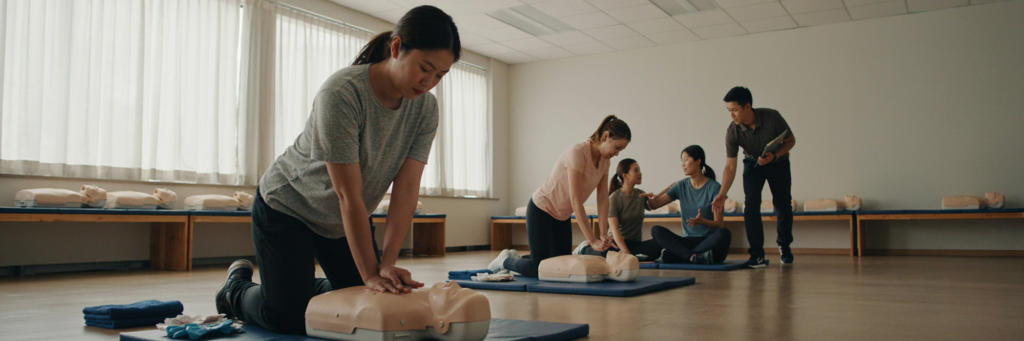
You’ll be in a small group. You’re not up the front performing solo in front of everyone else, you take your turn on the manikin one at a time while the rest of the group is doing their own practice or waiting nearby. It’s a lot less confronting than it sounds in your head before you get there. Most people picture something closer to a driving test, an examiner watching in total silence. It’s nothing like that. There’s usually a bit of chatter, other people practising nearby, and a trainer moving between groups keeping things relaxed.
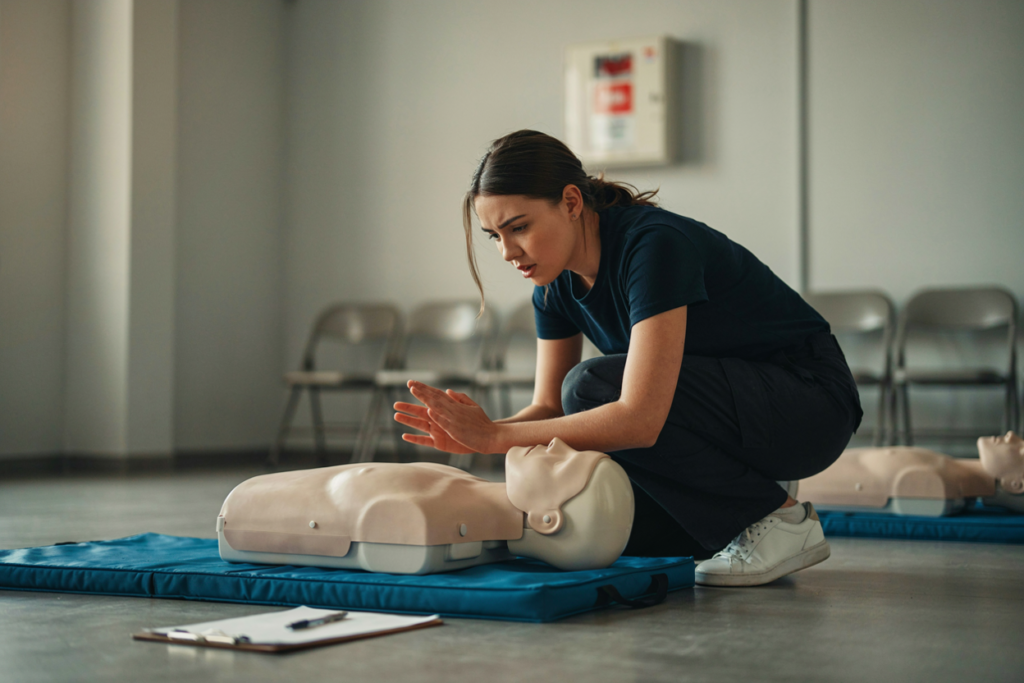
Your assessor is working through a checklist while you go, watching you move through the DRSABCD sequence on the manikin. And here’s the thing worth remembering: by the time it’s your turn, you’ve already practised this exact sequence, with a trainer standing right there correcting you along the way if you needed it. The assessment isn’t the first time you’re seeing this stuff. It’s you demonstrating something you’ve already had a few goes at.
One thing worth knowing if you’re comparing providers: this has to be face-to-face and hands-on. There’s no online-only shortcut that satisfies the HLTAID009 practical requirement. You can do theory components online with some providers, but the actual CPR skills test has to happen in person, on a manikin, in front of an assessor. That’s not a First Aid Alive rule, that’s just how the qualification works.
If you haven’t locked in your CPR-only course yet, you can find our HLTAID009 course details and upcoming dates on our booking page.
Knowing the format is one thing, here’s exactly what’s on the assessor’s checklist.
The DRSABCD Sequence: What Your Assessor Is Actually Checking
This is the part worth actually understanding, because once you know what’s on the checklist, none of it feels like a mystery anymore.
Step | Stands For | What the Assessor Checks |
D | Danger | Scans the environment before approaching |
R | Response | Correct verbal and physical check |
S | Send for help | Calls or directs someone to call 000 |
A | Airway | Head-tilt chin-lift technique |
B | Breathing | Checked properly, not rushed |
C | CPR | 30:2 ratio, correct rate and depth |
D | Defibrillation | AED retrieved, pads placed, prompts followed |
Every letter in DRSABCD is a step your assessor is physically watching you do, in order. It’s not abstract theory sitting in a textbook somewhere, it’s a checklist your assessor works through in real time while you’re on the manikin. Danger first, always. Then response, then send for help, then airway, breathing, compressions, and finally the AED.
A couple of these are worth a closer look. Danger sounds obvious, but it’s the step people forget under pressure, so your assessor wants to see you actually pause and look around before you approach, not just walk straight up to the manikin. Response should be a proper check too, seen and heard, both a verbal check like “can you hear me, can you open your eyes” and a physical check, a gentle shoulder squeeze. It’s easy to do the physical part and forget to say anything out loud, and assessors are listening for that verbal piece specifically.
Send for help trips a surprising number of people up, purely because it feels unnatural to stop and call out for help before you’ve started doing anything hands-on. But it’s meant to happen early, before you move into the airway and breathing checks. And that final defibrillation step is really about showing you know how to retrieve an AED, place the pads correctly, and then follow its voice prompts rather than trying to remember steps from memory. Modern AEDs are designed to talk you through it, so your assessor isn’t expecting you to operate one from pure recall, they’re checking you know to grab it and let it guide you.
If you want to check this against the source rather than just take our word for it, the Australian Resuscitation Council publishes the current guidelines this sequence is based on.
Two numbers matter more than anything else on that checklist.
Compression Rate & Depth: The Numbers That Get Checked
Out of everything on the DRSABCD checklist, these are the two numbers your assessor is watching closest, because they’re the two things that actually determine whether compressions are effective.
- Rate: 100 to 120 compressions per minute
- Depth: 5 to 6cm for an adult
That’s it, that’s the benchmark, straight from ANZCOR. No ambiguity about it.
Now here’s a trick that actually works and most people already half-know it without realising: the Bee Gees song “Stayin’ Alive” sits at almost exactly the right tempo. Hum it in your head while you’re compressing and you’ll land close to the mark without having to count out loud or watch a clock. A bit of dark humour in the name, sure, but it works, and instructors have been using it for years for good reason.
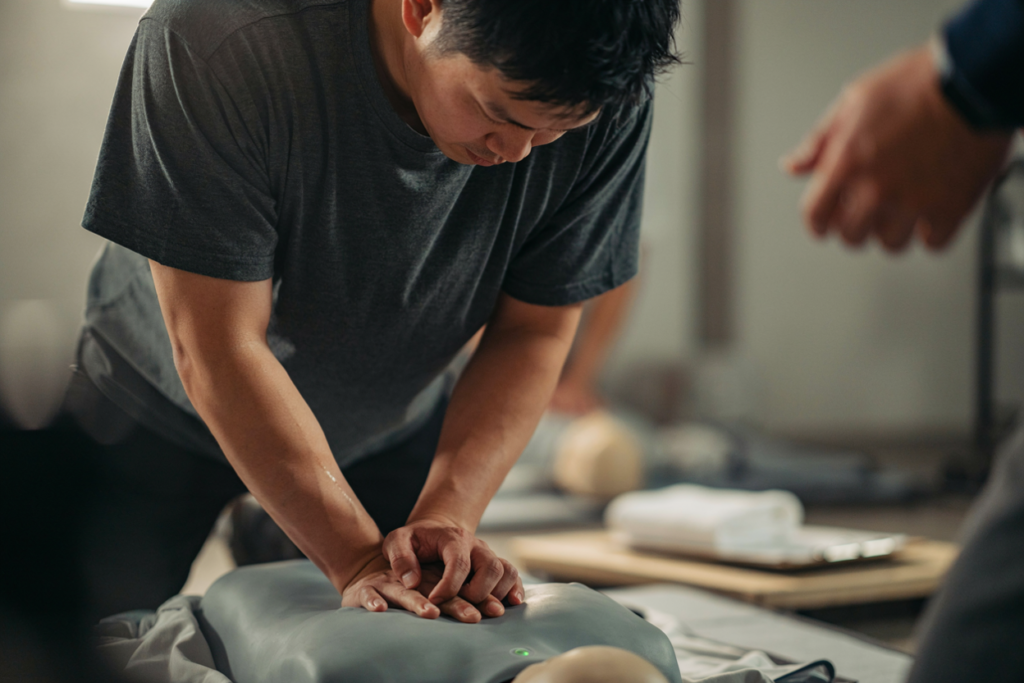
Depth is the number people underestimate more often than rate. Five to six centimetres sounds small on paper, but on an actual manikin it takes more force than most people expect the first time they try it properly. It’s common for someone new to CPR to compress too shallow purely because it feels like they’re pressing harder than they actually need to, when in reality they need to push a bit firmer than instinct tells them to.
You’re also not out there guessing on your own. Training manikins give audible or tactile feedback on depth, so your assessor isn’t relying purely on eyeballing it either. There’s a click, or a light, or some kind of signal telling both of you whether you’re pressing deep enough. It takes a lot of the guesswork out of it for everyone in the room, and it means you get instant feedback in real time rather than finding out afterwards that you were a bit too shallow the whole way through.
One more thing worth knowing, fatigue is real and normal. Genuine compressions are physically tiring, and your arms will feel it during a longer practice run. That’s completely expected and not something your assessor is marking you down for. In a real scenario this is exactly why people swap who’s doing compressions partway through, so don’t be surprised if your trainer mentions that during practice too.
So what happens if you get one of those numbers wrong on the day?
🙌 Good to know: Most resits come down to one thing, jumping into compressions before finishing the full DRSABCD order, not poor technique.
What Happens If You Don’t Pass First Try?
Let’s be straight about this one, because it’s the thing most people are quietly worried about and it’s really not the big deal it feels like in your head beforehand.
If you don’t get it right first go, it’s usually handled within the same session, with a bit of extra guided practice before you have another attempt. Nobody’s sending you home to come back another day in most cases. Your assessor works with you right there until you’ve got it.
And here’s the part that actually matters: the number one real cause of resits isn’t bad technique. It starts compressions before you’ve finished the full DRSABCD sequence. People get to the C and jump straight in because they know compressions are the “main event,” and skip past checking danger properly, or skip the response check, or forget to send for help before starting. That’s the trip-up, not weak compressions or poor form.
Most resits happen for one reason: skipping ahead in the sequence, not poor technique. Know your order and you’re most of the way there.
There’s a real example worth mentioning here. One PT who came through a First Aid Alive session was visibly nervous heading into his first assessment, second-guessing himself out loud beforehand. He didn’t pass on the first attempt, but not because his compressions were wrong, it was because he jumped straight into CPR without finishing the danger and response checks first. Once his order was locked in properly, he passed straight through on the second attempt, no drama. That’s genuinely the most common story in this space, not a horror story about someone who couldn’t perform CPR, just someone who needed to slow down and finish the sequence in order.
Your assessor isn’t there to catch you out or fail people for sport. Their whole job is to get you competent and confident, not to trip you up on a technicality. If you know your DRSABCD order cold, you’ve already cleared the biggest hurdle before you’ve even touched the manikin.
None of this needs to be stressful if you walk in with three things sorted.
3 Quick Ways to Walk In Ready
You don’t need to overhaul your whole week preparing for this. Three small things, sorted before and on the day, and you’ll walk in about as ready as anyone can be.
Before your session:
- Say the DRSABCD order out loud once, even just to yourself in the car
- Wear clothes you can actually kneel and move in comfortably
- Don't overthink it, you'll have practised this exact sequence before you're assessed on it
On the day:
- Turn up early so you're not rushing straight into practice feeling flustered
- Listen for the "Stayin' Alive" tempo trick if your trainer mentions it, it genuinely helps
- Trust the sequence you've just practised rather than trying to remember something from a video you watched weeks ago
That’s genuinely it. The people who walk out having passed easily aren’t the ones who stressed the most beforehand, they’re the ones who knew their order and didn’t overthink the rest. If you take one thing away from this whole page, let it be that: order beats perfection, every time.
Walking Out With Your Certificate
So here’s the thing worth holding onto after all of that: a CPR practical exam isn’t a test you can fail out of nowhere. It’s a demonstration of a sequence you’ll have already practised beforehand. Nobody hands you a manikin cold and asks you to freestyle.
It’s quick, once it’s your turn. Danger, response, send for help, airway, breathing, CPR, defib. Seven letters, one order, and a checklist your assessor is quietly working through while you go.
If there’s one thing to actually take away from all of this, it’s that DRSABCD order matters more than perfect technique. Get the sequence right and you’ve cleared the part that trips most people up. The compressions themselves, once you’re in that rhythm, tend to look after themselves.
And if you do stumble on the day, that’s not the end of the story either. A resit isn’t a mark against you, it’s just a bit more guided practice before you have another go, usually within the same session. Plenty of people who now hold a current certificate needed that second attempt, and nobody’s tracking who got it first and who didn’t.
What you walk out with at the end is the same piece of paper either way: a Statement of Attainment showing you’re competent, ready to show your gym, your employer, or whoever’s asking for proof. That’s the whole point of the day, not the time on the manikin, but what you’re carrying with you once you leave the room.
So if the practical exam has been sitting at the back of your mind, hopefully that’s cleared some of it up. Know your DRSABCD order, turn up ready to move, and trust the practice you’ve already done. The rest tends to take care of itself. Most people walked out surprised at how straightforward it actually was, wondering what all the pre-session nerves were even about.
Book Your First Aid Training Now
Fast, affordable, and nationally accredited training delivered by professionals who care
Frequently Asked Questions
Q.Is the CPR practical exam a written test?
No. There's no written component, it's entirely a hands-on demonstration on a training manikin, and your assessor confirms competency based on what they see you do against the DRSABCD sequence.
Q.What's the most common reason people don't pass first go?
Jumping straight into compressions before finishing the full DRSABCD sequence, especially skipping the danger or response checks. It's rarely about weak compressions, it's almost always about order.
Q.Can I do the practical component online?
No. Theory can sometimes be done online with some providers, but the hands-on practical skills test has to happen in person, on a manikin, in front of an assessor, for it to satisfy the HLTAID009 requirement.
Q.Do I need to memorize anything extra for the assessment?
Not really. You just need to know your DRSABCD order and trust the sequence you've already practiced in your session. There's no separate content to study beyond what you cover on the day.
Q.What happens if I don't get compression depth or rate exactly right?
Your assessor and the manikin both give real-time feedback, so it's not about getting it perfect in one go, it's about demonstrating you can perform the sequence safely and effectively with guidance if needed.
Q.Will I get another attempt if I don't pass?
Yes, in most cases it's handled with extra guided practice before you try again, right there in the same session. It's treated as a normal part of learning, not a failure.
Making first aid training more affordable for
every classroom
We believe every student deserves access to life-saving first aid knowledge. That’s why we offer specially reduced pricing for schools and educational groups. Whether you’re booking for a single class, a year group, or your entire school, our flexible packages make training more accessible and cost-effective — without compromising quality.
