

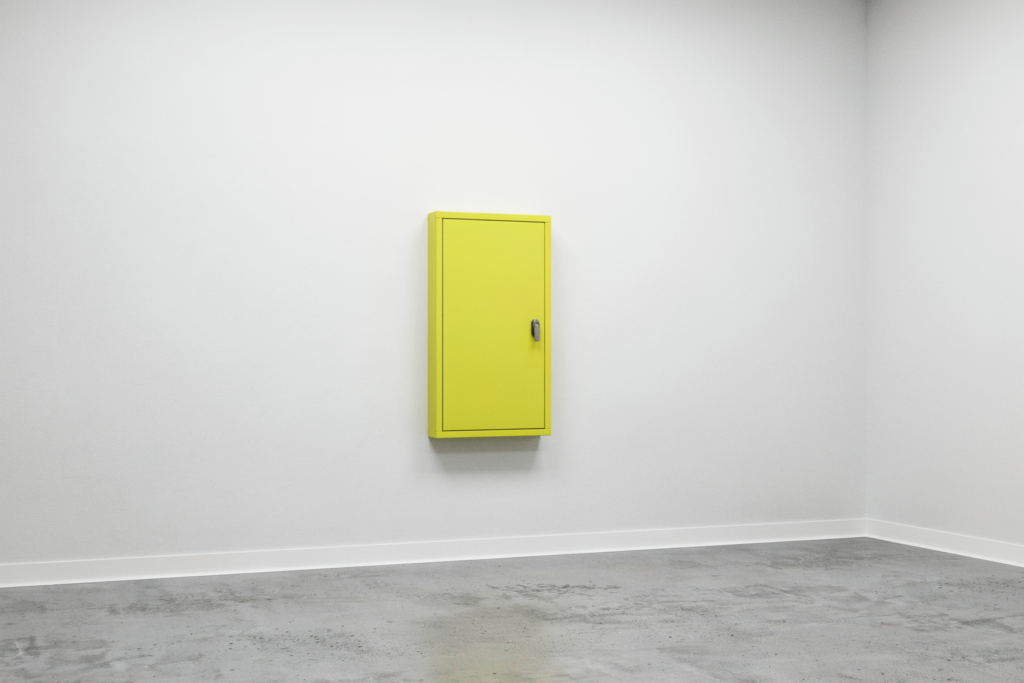
There’s a defibrillator mounted on the wall at your local football club. You’ve probably walked past it dozens of times at the shopping centre, the school gym, maybe even the office kitchen. And if you’re being honest with yourself, you’ve never really thought about what you’d actually do if someone collapsed right next to it.
Most of us haven’t. Not because we don’t care, but because no one’s ever actually shown us how. From a distance, those yellow and green boxes look complicated. Clinical. Like something that requires a medical degree or a very specific kind of confidence most of us just don’t have.
Here’s what changes when you do a defibrillator training course: that box on the wall stops being intimidating. It becomes something you actually know how to use.
This guide walks you through exactly what happens inside a defibrillator training course, what you’ll do with your hands, what the equipment looks and sounds like, and why no experience is needed to walk in and get genuinely useful out of it. Whether you’re a parent with elderly family members at home, a volunteer at your local footy club, a teacher, or a small business owner who’s been meaning to tick this off, this is what you need to know before you book.
What Happens in a Defibrillator Training Course?
A defibrillator training course teaches everyday Australians how to recognise a cardiac arrest, perform CPR, and operate an Automated External Defibrillator (AED) confidently. No prior experience or medical background is required.
A standard course typically covers:
- Recognising cardiac arrest — identifying the signs that someone needs immediate defibrillation
- Calling for help — activating emergency services and coordinating bystander response
- Performing CPR — correct compression depth, rate, and technique on a training manikin
- Operating an AED — powering on the device, applying pads, delivering a shock safely
- Post-resuscitation care — monitoring the patient until paramedics arrive
- Practising real scenarios — hands-on simulation so the steps become muscle memory
What Is a Defibrillator Training Course and Who Is It Actually For?
A defibrillator training course is not for doctors or paramedics. It’s for everyday Australians, people exactly like you, who want to know what to do in the three minutes before an ambulance arrives.
AEDs were specifically designed to be used by people with no medical training at all. The device talks you through every step out loud, where to place the pads, when to stand clear, when to deliver a shock. The technology does the diagnostic heavy lifting. What training does is make sure you’re not frozen when the moment comes.
Is defibrillator training only for medical professionals?
Hard no.
The Australian Resuscitation Council guidelines are built on the assumption that the first person to reach a cardiac arrest victim will almost always be a bystander, not a clinician. The design of every modern AED reflects that. The training reflects that too.
If you can follow a voice prompt, you can operate a defibrillator. Training builds the confidence to actually start, which in a real emergency is the hardest part.
Who should consider doing a defibrillator training course?
The people sitting in defibrillator training courses right now look something like this:
- Parents with elderly relatives at home — a parent with a heart condition, a grandparent who lives alone, a family member on cardiac medication
- Sporting club volunteers and officials — the people running the canteen, managing the sideline, or setting up before the game
- Teachers and school staff — who are often the first adult on the scene when something goes wrong on the oval or in the playground
- Workplace first aiders — refreshing their skills or adding AED competency to their existing certification
- Childcare workers — who need to be across emergency response for a range of scenarios involving both children and adults
- Small business owners — who have a duty of care to staff and customers and want at least one person on site who knows what they're doing
And then there’s the group that doesn’t fit neatly into any of those categories, the person who just had a close call. A family member who collapsed. A news story that hit a little too close to home. Someone at football who went down on the field and the crowd went quiet.
Those moments have a way of clarifying things.
What to Expect on the Day
The unknown is usually what holds people back, not the content itself, not the practical work, not even the idea of kneeling on a mat doing compressions in front of strangers. It’s the not knowing what any of it actually looks like that creates the hesitation. So here’s the full picture, start to finish.
What to bring:
- Comfortable clothing you can move in
- Photo ID
- Any pre-learning completion confirmation if your course uses a blended delivery format
- Water and a snack if you want one
What happens in the theory component?
Before anyone touches a manikin, there’s a theory component, and it’s shorter than most people expect. Some of this theory is delivered online before the day as pre-learning, which means by the time you walk in, the in-person time is focused almost entirely on practical skill.
The theory covers cardiac arrest recognition, the chain of survival, when an AED is appropriate, and how to activate emergency services. None of it is delivered in medical jargon.
What happens in the practical component?
This is where the day actually comes alive, and where most people realise the course is a lot less intimidating than they expected.
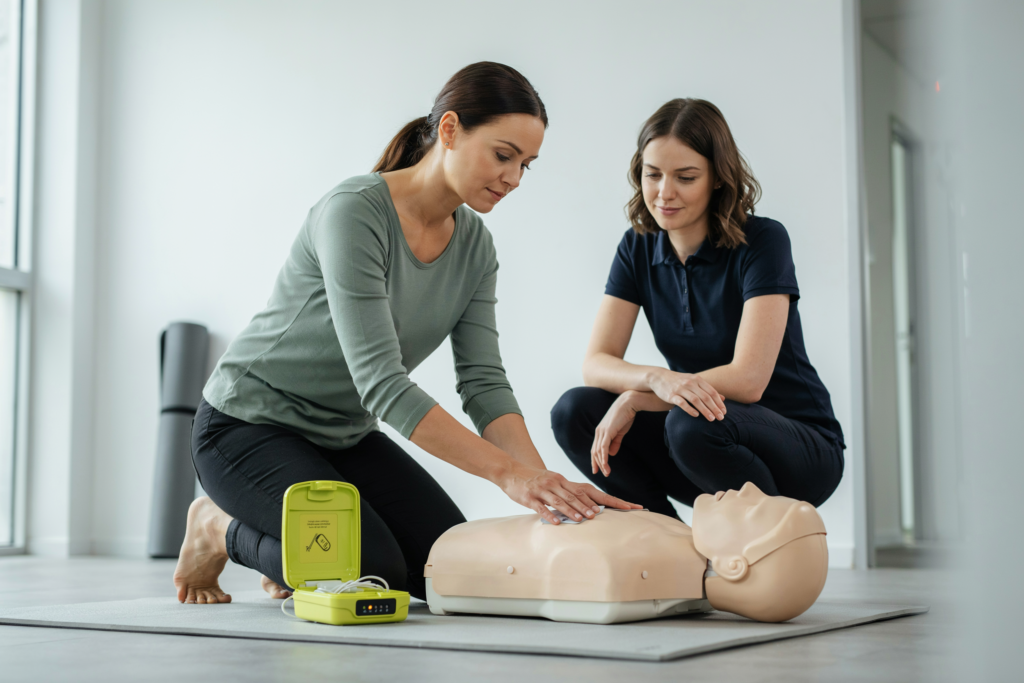
You’ll work with training manikins on the floor, practising chest compressions until the depth and rate start to feel natural. You’ll handle a training AED, which looks and sounds identical to a real device, and walk through the full sequence: powering it on, placing the pads correctly, standing clear, and following the voice prompts through analysis and shock delivery.
At First Aid Alive run the practical component in a way that’s deliberately supportive. No one gets singled out. No one is expected to perform perfectly on the first attempt. The whole point is repetition, doing the steps enough times that your hands remember what to do even when your brain is running on adrenaline.
You’ll also work through scenario walkthroughs, simulated situations that put individual skills together into a realistic sequence. Someone collapses at the football club. A coworker goes unresponsive in the break room. These scenarios are where everything clicks, because they move you from practising individual steps to actually responding to a situation.
Will I have to perform CPR in front of everyone?
Yes, and it’s genuinely the most valuable part of the day.
You will practise compressions and AED use in a group setting. So will everyone else in the room. And almost everyone walks in feeling exactly the same way you do right now, a little uncertain, a little self-conscious, not entirely sure what they’re doing yet.
What you won’t experience at a well-run course is being put on the spot, corrected harshly in front of the group, or made to feel like you’re behind where you should be. Most people find that once they’re actually doing the compressions, the self-consciousness disappears almost immediately. The practical work takes over.
What equipment will I use on the day?
Training AED units, full-body manikins, and scenario props.
The training AED deserves a specific mention because it’s one of the more powerful moments in any course. The device looks identical to a real AED. It sounds identical. The voice prompts are the same. The pad placement process is the same. The only difference is that it delivers a training simulation rather than an actual shock.
By the time you’ve used a training AED several times during the course, a real AED in a real emergency no longer looks unfamiliar. That familiarity, the muscle memory of having actually done it, is what makes the difference between acting and freezing.
CPR and Defibrillator Training: Why You Can’t Have One Without the Other
If the AED does all the analysis and tells you exactly what to do, why do you need to know CPR as well?
It’s a fair question. And the answer is one of the most important things you’ll take out of a defibrillator training course.
What is the chain of survival?
The chain of survival describes the sequence of actions that gives a cardiac arrest victim the best possible chance of surviving, and every link depends on the one before it.
The four links are:
- Early recognition — identifying cardiac arrest and calling 000 immediately
- Early CPR — starting chest compressions to keep oxygenated blood moving to the brain and heart
- Early defibrillation — delivering a shock via AED to attempt to restore a normal heart rhythm
- Early advanced care — paramedics arriving and continuing treatment
ANZCOR, the Australian and New Zealand Committee on Resuscitation, underpins all of this guidance. Remove any single link and the whole thing breaks. Both skills. Every time.
How does CPR work alongside a defibrillator?
When someone goes into cardiac arrest, CPR manually pushes blood through the circulatory system, keeping the brain and vital organs supplied with oxygen while the AED is retrieved and prepared. The AED cannot shock a heart that has no electrical activity at all. CPR is what maintains the conditions that give the shock the best possible chance of working.
CPR and defibrillation run as a coordinated sequence: compressions, AED analysis, clear, shock if appropriate, resume compressions immediately.
The myth worth busting is the idea that once the AED arrives, you stop everything and let the machine take over. That misunderstanding costs time that cardiac arrest patients simply don’t have.
What to Look For in a Defibrillator Training Provider
Not all defibrillator training courses are the same. The quality of delivery, the credentials of the trainer, and the rigour of the practical component can vary significantly from one RTO to the next. Because the whole point of doing this training is to be genuinely ready when something goes wrong, the course you choose actually matters.
What to Check | Why It Matters |
RTO registration number displayed | Confirms your certificate will be nationally recognised |
Trainer qualifications listed | Verifies the person delivering your training is properly credentialled |
Weekend and flexible sessions available | Means you can actually get there without sacrificing a workday |
Certificate turnaround time stated | Avoids delays that can affect compliance deadlines |
Hands-on practical component confirmed | Ensures you leave with real skill, not just a theory pass |
Does Your Sporting Club Need a Defibrillator?
Something happens when you do a defibrillator training course. You start noticing AEDs. The one at the rugby club that’s been there for three years and that, if you’re being honest, nobody on the committee really knows how to use.
If you’re a parent on the sideline, a P&C member, or a sporting club volunteer, the conversation about personal AED training and the conversation about whether your club actually has one are connected. Most communities are behind on both.
How common are cardiac arrests at sporting events?
Cardiac arrest doesn’t discriminate by fitness level or age. It happens to weekend warriors in their forties, spectators in their sixties, and volunteer coaches who’ve been running the same Saturday morning session for twenty years. Ambulance Queensland data shows out-of-hospital cardiac arrest is one of the leading causes of sudden death in the community, and sporting events are environments where the risk is real.
Brain damage begins within four to six minutes. Ambulance response times cannot reliably reach a suburban oval within that window. An AED on site, operated by someone who’s done a defibrillator training course, is what fills that gap.
What does Queensland legislation say about AEDs?
Queensland’s Good Samaritan Act provides legal protection for people who act in good faith to assist someone in an emergency, including using an AED on a person in cardiac arrest. If you use a defibrillator in an emergency and something goes wrong despite your best efforts, the law is designed to protect you.
Queensland Health guidance supports AED placement in high-traffic community venues including sporting clubs, community halls, and schools. If your club doesn’t have one yet, the question isn’t really if, it’s when.
How do you get your sporting club to buy a defibrillator?
Start with the club president, the safety officer, or the committee at the next general meeting. Frame it around the club’s duty of care to players, volunteers, and spectators.
Funding options worth exploring:
- Queensland Government community safety grants
- Local council community facility funding rounds
- Club sponsorship packages
- P&C fundraising at school-affiliated clubs
- Shared AED arrangements between clubs using the same facilities
Once the AED is purchased, the training follows naturally. Group AED training packages mean the committee, the coaches, the canteen volunteers, and the first aid officer all walk away from the same session knowing exactly what to do.
Getting your club trained? Ask about group AED training packages:
Ready to Feel Confident Around a Defibrillator? Book Your Course Today.
Walking past a defibrillator and wondering is one thing. Walking past one knowing exactly what to do with it is something else entirely, and that shift happens in a single day of training.
Cardiac arrest doesn’t wait for a convenient moment. It happens at football grounds on Saturday mornings, in shopping centres on a Wednesday afternoon, at family gatherings where the nearest ambulance is still seven minutes out. The gap between those seven minutes and survival is often filled by an ordinary person who happened to know what to do.
That ordinary person can be you. Not because you have a medical background or a particular kind of courage, but because you took a few hours to learn a skill that most people keep meaning to get around to and never quite do.
The practical side of a defibrillator training course is genuinely more accessible than most people expect. The equipment guides you. The trainer supports you. The scenario practice builds the kind of muscle memory that holds up under pressure, even when your hands are shaking. People walk out different to how they walked in, not just more knowledgeable, but actually more confident.
There are defibrillators mounted on walls all over Brisbane and the Gold Coast. At your local oval. At the school your kids attend. At the shopping centre you visit every week. Every single one of them is only as useful as the nearest person who knows how to operate it.
You could be that person. The course is shorter than you think, the skills are more learnable than they look, and the decision to book is the hardest part of the whole thing. Everything after that is just showing up.
Book Your First Aid Training Now
Fast, affordable, and nationally accredited training delivered by professionals who care
Frequently Asked Questions: Defibrillator Training Course
Q.Do I need any experience or medical background to do a defibrillator training course?
No experience is required at all. AEDs are specifically designed for people with no medical training, and the device walks you through every step with clear voice prompts, telling you where to place the pads, when to stand clear, and when to deliver a shock. What the training does is build the confidence to actually start, so that when the moment comes, you're moving rather than frozen.
Q.Is a defibrillator training course the same as HLTAID011?
Not exactly, but HLTAID011 includes AED training as a core assessed component of the qualification. HLTAID011 is Australia's nationally recognised standard first aid certificate, and it covers defibrillator use alongside CPR, management of bleeding, burns, choking, shock, fractures, and unconsciousness. For most people, HLTAID011 is the better investment because it gives you a complete response capability rather than training for one type of emergency only.
Q.Will my employer or ACECQA accept this certificate?
Yes. Because First Aid Alive is a registered training organisation, the certificate issued on completion is nationally recognised and sits within the Australian Qualifications Framework. It's accepted by employers across all industries, ACECQA for childcare compliance, AHPRA for healthcare professional registration, and Safe Work Australia for workplace first aid requirements. RTO number [RTO_NUMBER] can be verified independently at training.gov.au.
Q.What is the difference between a standalone AED course and a full first aid course?
A standalone AED course focuses specifically on defibrillator operation and CPR, the skills needed to respond to cardiac arrest. A full first aid course like HLTAID011 covers all of that plus the broader emergency response skills: managing severe bleeding, burns, choking, shock, fractures, and unconsciousness. For most people, HLTAID011 is the stronger choice because real emergencies rarely come in just one form.
Making first aid training more affordable for
every classroom
We believe every student deserves access to life-saving first aid knowledge. That’s why we offer specially reduced pricing for schools and educational groups. Whether you’re booking for a single class, a year group, or your entire school, our flexible packages make training more accessible and cost-effective — without compromising quality.
