
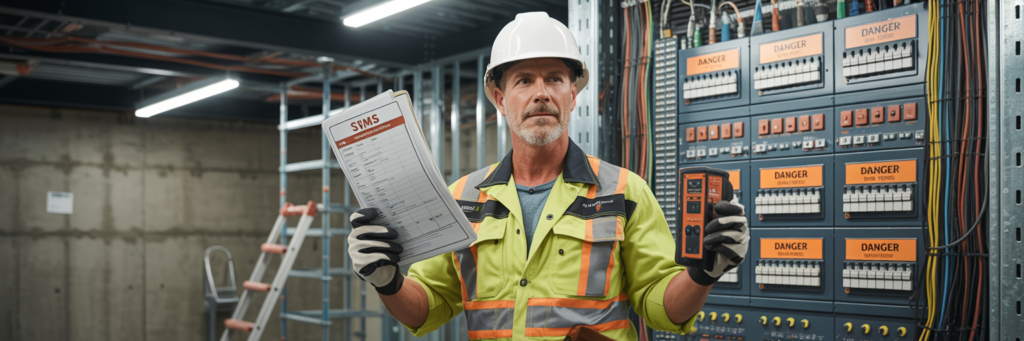
It’s 7:15am. You’re at the gate. The site super tells you the principal contractor is now requiring evidence of electrical hazard risk assessment training before anyone touches the switchboard. You’ve got your LVR ticket. You renewed it last year. You’re good, right?
Maybe not.
This is happening more and more across commercial and infrastructure sites in South East Queensland. The rules haven’t changed overnight, but what principal contractors are actually enforcing on the ground has. And if you’re a licensed electrician who’s never heard the words “hazard risk assessment training” used separately from your LVR ticket, this guide is for you.
Electrical hazard risk assessment training is a distinct, legally grounded competency that’s becoming a baseline expectation on Queensland job sites. This guide covers what it involves, who needs it, how it connects to your LVR certificate (UETDRRF018) and CPR ticket, and how to get it sorted in Brisbane and SEQ without losing a week of work to do it.
What Is Electrical Hazard Risk Assessment Training?
Electrical hazard risk assessment training is a structured competency program that teaches licensed electricians and electrical workers how to identify, assess, and control electrical risks before work begins. It applies to any tradesperson who works on or near electrical equipment in Queensland, and it sits alongside, not inside, your LVR certificate. The legal foundation comes from two pieces of legislation: the Electrical Safety Act 2002 (QLD) and the Work Health and Safety Act 2011.
Here’s what the training actually covers:
- Identifying electrical hazards in the workplace: live conductors, damaged insulation, unsafe switchboards, overhead lines
- Assessing the level of risk attached to each hazard before you start work
- Applying the hierarchy of controls to electrical risks on site
- Preparing safe work method statements (SWMS) that are legally compliant for electrical tasks
- Understanding your obligations under Queensland electrical safety legislation
- Documentation and record-keeping: what you need on paper when a WHS inspector shows up
If you’ve ever filled out a SWMS and winged the risk section because no-one ever properly showed you the framework, this is the training that closes that gap. And increasingly, it’s the training that gets you through the gate.
Why Electrical Hazard Risk Assessment Training Matters on Queensland Job Sites
Most sparkies don’t think about this stuff until something forces them to. A site supervisor pulls them up. An inspector shows up unannounced. Or worse, something goes wrong on site and the question becomes who assessed the hazard before work started. That’s when the legal framework stops being abstract.
The Legal Obligation Queensland Electricians Carry
The Electrical Safety Act 2002 (QLD) and the Work Health and Safety Act 2011 both place the duty of care squarely on the individual worker, not just the principal contractor, not just the builder. If you’re a licensed electrician on that site, you carry personal legal responsibility for identifying and controlling electrical risks before you touch anything.
The Electrical Safety Office (ESO) Queensland enforces this. They investigate incidents, conduct site inspections, and prosecute. Electrical incidents were recorded in Queensland in the most recent ESO annual report period, and resulted in ESO enforcement action. Those are real outcomes for real tradespeople who thought the rules were someone else’s problem.
Your QBCC licence doesn’t cover this automatically. LVR and hazard risk assessment are separate obligations, and both sit with you personally.
What Principal Contractors Are Now Requiring
Something has shifted on commercial and infrastructure sites across SEQ. What used to be a box-tick at site induction has become a genuine checkpoint. Evidence of hazard risk assessment competency is now appearing on SWMS sign-off checklists as a condition of site access, not a suggestion.
Here’s a rough picture of how that’s changed:
| What sites used to require | What they're requiring now |
|---|---|
| Current LVR ticket | Current LVR ticket + evidence of hazard assessment competency |
| Signed SWMS | Signed SWMS with documented risk assessment methodology |
| General site induction | WHS induction including electrical risk controls |
| Principal contractor discretion | Formal checklist verification before work commences |
This shift is driven by principal contractors managing their own WHS liability. When something goes wrong on a site, they need to show they verified subcontractor competency. That flows directly down to you.
🔧 Training Scope: This training covers what happens before work starts, hazard identification, risk rating, hierarchy of controls, and SWMS documentation. It's the practical framework behind every compliant job you sign off on.
What Electrical Hazard Risk Assessment Training Actually Covers
Your LVR ticket (UETDRRF018) teaches you what to do after contact with live voltage. This training teaches you how to stop that contact from happening in the first place. The two sit together, but they cover completely different ground. Here’s what you actually work through.
Identifying Electrical Hazards in the Field
This is where the training starts, with what you’re looking at every day on site and what actually constitutes a notifiable hazard. The common ones are things most sparkies already know instinctively: live conductors, damaged insulation, unsafe or poorly maintained switchboards, and overhead lines that aren’t adequately marked or isolated.
But knowing a hazard exists and being able to formally identify and document it are two different things. The training gives you the framework to do the second part, which is what principal contractors and WHS inspectors are actually checking for. The hazard profile also looks different depending on whether you’re on a residential job, a commercial fitout, or an infrastructure project, and the training covers all three contexts.
Risk Assessment Methodology
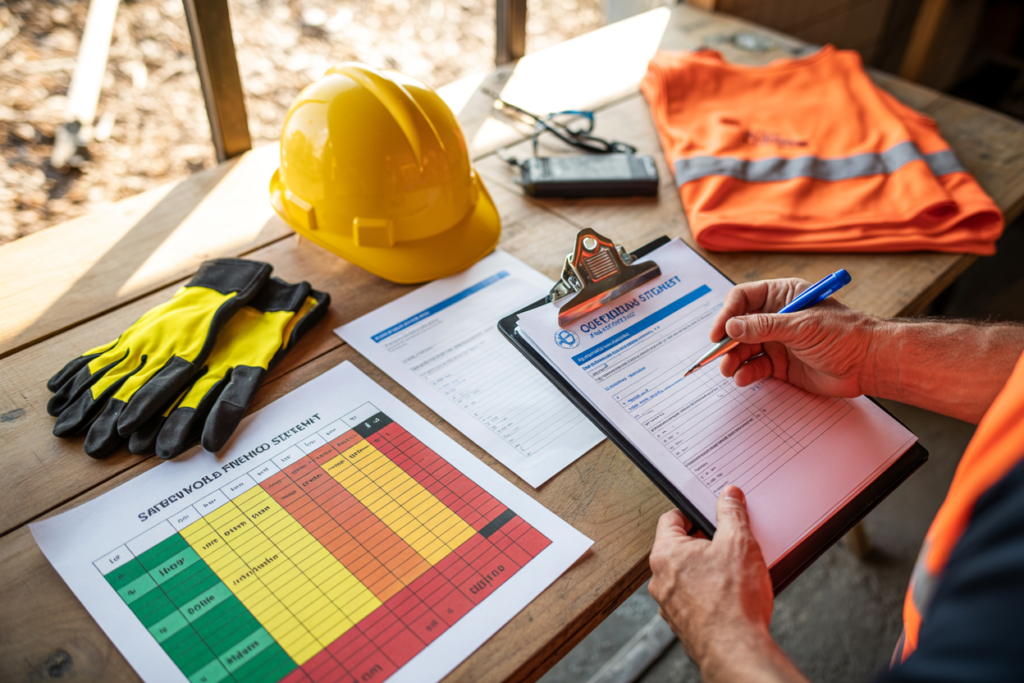
Once you’ve identified a hazard, you need to assess it. The tool for that is the risk matrix, likelihood versus consequence, plotted against each other to give you a risk rating that determines how you respond.
In practice: there’s a damaged switchboard panel that hasn’t been isolated. The likelihood of contact is moderate. Consequence is potentially fatal. The risk rating is high. Required response: do not proceed until the hazard is controlled. That’s the decision you’re legally required to make and document before work starts, and the training shows you how to apply that framework on any site, any job type. Safe Work Australia’s risk assessment guidance underpins the methodology at safeworkaustralia.gov.au.
Safe Work Method Statements (SWMS) for Electrical Tasks
A SWMS is legally required in Queensland for any high-risk construction work, and most electrical work on commercial and infrastructure sites meets that definition. A compliant SWMS needs to include the identified hazards, the risk ratings, the controls from the hierarchy, and the step-by-step safe work procedure.
What the training does is give you the competency to produce that document properly, not just fill in a template someone handed you at induction. Hazard risk assessment and SWMS documentation aren’t separate tasks. The assessment feeds directly into the SWMS, and if the assessment is wrong, everything downstream is compromised.
Hierarchy of Controls Applied to Electrical Risks
The hierarchy of controls is the framework Safe Work Australia and the ESO use to evaluate whether you’ve responded to a hazard appropriately. It runs from most effective to least effective:
- Elimination – remove the hazard entirely (de-energize before work begins)
- Substitution – replace with something less hazardous
- Isolation – physically separate people from the hazard (lockout/tagout)
- Engineering controls – design solutions that reduce risk (guarding, RCDs)
- Administrative controls – procedures, signage, permits to work
- PPE – last resort, not first line of defence
The training works through each level with practical electrical examples. You leave knowing which control to reach for first and being able to justify that decision when asked.
👷 Electrical Safety Responsibility: Whether you're a sole trader, subcontractor, or working under a principal contractor, the obligation to identify and control electrical risks is yours personally. It doesn't transfer to whoever hired you.

Who Needs Electrical Hazard Risk Assessment Training in Queensland
Short answer: if you’re a licensed electrician working on or near live electrical equipment in Queensland, this applies to you.
Licensed Electricians and Electrical Contractors
Sole traders and subcontractors carry the obligation as individuals, whether you’re employed by a small electrical firm or running your own ABN. The duty sits with you personally, not with whoever hired you for the job.
Your QBCC licence and your LVR ticket (UETDRRF018) are separate to this. Holding both doesn’t automatically satisfy a hazard risk assessment competency requirement. Licensed electricians are currently registered with the QBCC in Queensland, every one of them subject to the same individual duty of care under the Electrical Safety Act 2002.
This catches a lot of sole traders off guard. You’ve kept your LVR current, you’ve got your CPR sorted, you show up to a new commercial site thinking you’re covered, and the WHS induction checklist has a line item you’ve never seen before. That’s the gap this training closes.
Apprentices and Electrical Workers
Apprentices working under a licensed electrician don’t always need their own independent hazard assessment competency. The licensed electrician on site carries supervisory responsibility for the risk assessment process. But if you’re the licensed electrician supervising an apprentice, you need to be able to demonstrate that you’ve assessed the hazards and communicated the controls. That’s your obligation, not theirs. Building this competency early also means apprentices aren’t scrambling to tick boxes when their first principal contractor asks for it after they get their licence.
WHS Officers and Site Supervisors on Electrical Work Sites
On larger commercial and infrastructure projects across SEQ, site supervisors and WHS officers carry obligations that flow down from the principal contractor. That means verifying subcontractor competency, signing off on SWMS documentation, and demonstrating that everyone working near live electrical equipment has been assessed as competent to identify and control those risks. Electrical hazard risk assessment training is increasingly part of that picture.
How Electrical Hazard Risk Assessment Training Fits With Your Existing Tickets
This is the question most sparkies have by this point. You’ve already got your LVR. You’ve got CPR. Maybe you’ve got a first aid cert too. Where does this fit, is it extra paperwork, does it replace something, or is it genuinely a different thing?
It’s genuinely a different thing. Here’s how it all connects.
LVR (UETDRRF018) vs Electrical Hazard Risk Assessment
The simplest way to think about it is this. Your LVR ticket covers what happens after contact with live voltage, the rescue procedure, CPR, the emergency response. Electrical hazard risk assessment training covers everything that should happen before contact ever occurs, identifying the risk, rating it, and controlling it so the rescue procedure never needs to be used.
They’re complementary. One without the other is an incomplete picture of electrical safety on site.
| Category | LVR (UETDRRF018) | Hazard Risk Assessment Training |
|---|---|---|
| What it covers | Rescue from live voltage contact | Identifying and controlling electrical risks |
| Renewal period | Every 12 months | [CONFIRM WITH CLIENT] |
| Issued by | Registered RTO | Registered RTO |
| CPR included | Yes (HLTAID009 bundled) | [CONFIRM WITH CLIENT] |
| Who requires it | All licensed electricians near live LV equipment | Principal contractors, WHS inductions |
Neither ticket replaces the other. Principal contractors on commercial and infrastructure sites across SEQ are starting to ask for both, and if you only have one, you’re only halfway there.
How It Connects to Your SWMS Obligations
Your SWMS doesn’t exist in isolation. It’s built on a risk assessment, and if you can’t demonstrate the methodology behind the assessment, the document itself isn’t worth much when it’s scrutinised.
Completing electrical hazard risk assessment training gives you the framework to produce a SWMS that holds up. Not just a form you’ve filled in, but a document that reflects a genuine, methodical assessment of the hazards on that specific job. That’s what a WHS inspector is looking for. That’s what a principal contractor’s WHS officer is checking when they review your paperwork at site induction.
✅ Before You Book: Verify the RTO number on training.gov.au, confirm CPR is bundled, and make sure a digital certificate is issued on the day. Those three things are non-negotiable.

How to Choose an Electrical Hazard Risk Assessment Training Provider in Brisbane
Not every provider offering this training is the same. If you’re a sole trader whose income depends on that certificate being accepted on site, the difference between a legitimate registered RTO and one that looks the part matters a lot. Here’s what to check before you book.
What to Look for in a Registered RTO
The starting point is ASQA registration. Any provider delivering nationally recognised training must be registered with the Australian Skills Quality Authority, and you can verify that at training.gov.au. Search the provider’s name, find their scope of registration, and confirm the course appears on that scope. If it’s not listed, the certificate won’t be accepted when a principal contractor’s WHS officer checks it. A legitimate RTO will display their RTO number prominently on course pages, certificates, and marketing.
Practical Considerations for Brisbane and SEQ Electricians
Once you’ve confirmed the provider is legitimate, the practical questions determine whether they’re actually a fit.
- Same-day digital certificate – you need something you can email to a site super by Monday morning.
- Short-notice availability – the next available date should be visible without clicking through multiple pages.
A provider who can answer all six clearly and upfront, without you digging for the answers, that’s the one worth booking with.
The Bottom Line on Electrical Hazard Risk Assessment Training
Being a licensed electrician in Queensland has never meant just knowing how to do the work. It’s always meant being able to prove you did it safely, to a site super, to a principal contractor’s WHS officer, to an ESO inspector who shows up unannounced. The bar on what “safe” looks like on a commercial or infrastructure site in SEQ has moved, and the paperwork that backs it up has moved with it.
Your LVR ticket is still non-negotiable. Without it you’re not getting near a live panel on any regulated site. But it covers the rescue, not the prevention. What principal contractors are increasingly checking at site induction is whether you’ve got both sides sorted, the emergency response and the risk management framework that should stop the emergency from ever happening.
The SWMS you sign at the start of every job is only as strong as the risk assessment behind it. Most sparkies know this on some level. They’ve filled out the form, they’ve ticked the boxes, they’ve moved on. But when something goes wrong, or when a WHS officer asks you to walk them through your methodology, the form isn’t what protects you. The competency behind it is.
None of this requires losing a week of work. One Saturday with a registered RTO, a digital certificate by the end of day, and by Monday morning you’re back on the tools with a complete compliance picture. The tradespeople who stay on preferred subcontractor lists aren’t necessarily the cheapest or the fastest. They’re the ones who never give a WHS officer a reason to ask twice.
If there’s one thing worth taking from this guide, it’s that compliance in the electrical trade isn’t something that happens to you, it’s something you manage. The sparkies who get caught out aren’t usually the ones who didn’t know the rules. They’re the ones who kept meaning to sort it and didn’t get around to it before the gate conversation happened. Don’t be standing at that gate on a Monday morning with a current LVR ticket and a gap you could’ve closed on a Saturday. Get it sorted.
Book Your First Aid Training Now
Fast, affordable, and nationally accredited training delivered by professionals who care
Frequently Asked Questions
Q. What is electrical hazard risk assessment training?
Electrical hazard risk assessment training is a nationally recognised competency program that teaches licensed electricians and electrical workers how to identify hazards on site, rate the risk each one carries, and apply the right controls before work begins. It's grounded in the Electrical Safety Act 2002 (QLD) and the Work Health and Safety Act 2011, and it covers hazard identification, risk matrix methodology, hierarchy of controls, and SWMS documentation for electrical tasks. It's a separate obligation to your LVR ticket, and the two work together but cover completely different ground.
Q. Who needs electrical hazard risk assessment training in Queensland?
Any licensed electrician or electrical worker in Queensland who works on or near live electrical equipment needs to be able to demonstrate hazard risk assessment competency, and that includes sole traders, subcontractors, and electricians employed by small firms. The obligation sits with the individual worker personally, so your QBCC licence and your LVR ticket don't automatically satisfy it. WHS officers and site supervisors on electrical work sites across SEQ are also increasingly expected to hold this competency as part of their principal contractor obligations.
Q. How does electrical hazard risk assessment training differ from LVR?
Your LVR certificate (UETDRRF018) covers the rescue procedure after contact with live low voltage equipment has already occurred, while electrical hazard risk assessment training covers the prevention side, identifying and controlling risks before contact happens. Think of LVR as the emergency response and hazard risk assessment training as the risk management framework that's supposed to stop the emergency from happening in the first place. Principal contractors on commercial and infrastructure sites across SEQ are starting to require evidence of both, so holding only one of them leaves a gap that's increasingly being picked up at site induction.
Q. Is electrical hazard risk assessment training a legal requirement in Queensland?
Yes, the Electrical Safety Act 2002 (QLD) and the Work Health and Safety Act 2011 both place a duty of care on individual electrical workers to identify and control electrical risks before commencing work, and that duty doesn't sit exclusively with the principal contractor. The Electrical Safety Office Queensland enforces compliance and has the authority to prosecute where that duty hasn't been met, so completing recognised training through a registered RTO is the most defensible way to demonstrate you've satisfied your obligation.
Making first aid training more affordable for
every classroom
We believe every student deserves access to life-saving first aid knowledge. That’s why we offer specially reduced pricing for schools and educational groups. Whether you’re booking for a single class, a year group, or your entire school, our flexible packages make training more accessible and cost-effective — without compromising quality.
