
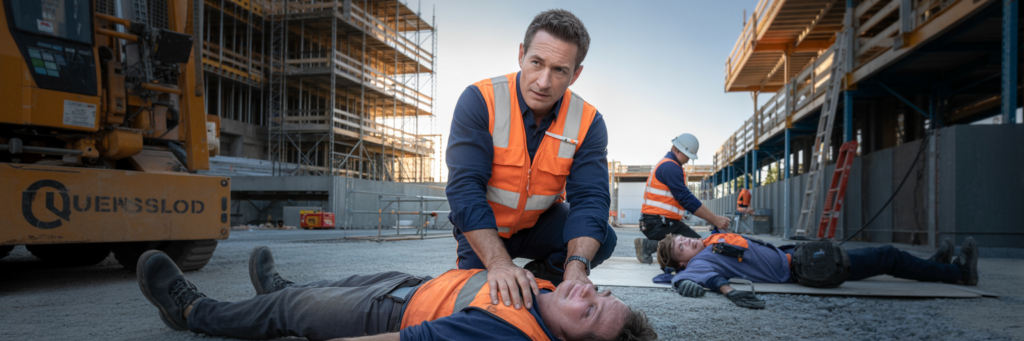
The call comes at 7.43am. A worker on your site collapses between two pieces of heavy machinery. You’re the Advanced First Aid Officer. Every set of eyes turns to you.
This is the moment your HLTAID014 either earns its place on your safety register — or exposes exactly how much your last course left out.
There’s a version of this that ends with you in control. You triage the scene, manage the airway, control the bleed, and hand the patient over to Queensland Ambulance Service in better shape than you found him. There’s another version where you freeze — not because you don’t care, but because the course you completed didn’t actually cover what’s happening in front of you right now.
The difference between those two outcomes isn’t luck. Its the difference between a padded-out standard course and genuine emergency care advanced first aid training. One gives you a certificate. The other gives you the clinical framework to actually use it.
In this guide, we break down 6 emergency care advanced first aid techniques that qualified paramedics and ICU nurses use in the field — the same techniques covered in Advanced Resuscitation Training’s HLTAID014 courses.
What Is Emergency Care Advanced First Aid?
Emergency care advanced first aid is a higher-level qualification that trains designated workplace responders to manage complex medical emergencies beyond the scope of standard first aid. In Australia, it’s formally certified as HLTAID014 Provide Advanced First Aid.
Compared to HLTAID011 (standard first aid), HLTAID014 equips responders to:
- Assess multiple casualties using structured triage systems (START triage)
- Manage severe haemorrhage including arterial bleeding and tourniquet application
- Perform extended airway management including advanced positioning and suction
- Recognise and treat shock across traumatic, anaphylactic, and medical causes
- Conduct primary and secondary patient surveys used by paramedics in the field
- Coordinate emergency response on worksites until ambulance handover
HLTAID014 is mandatory in high-risk industries including construction, mining, and civil infrastructure across Queensland, and is typically required by site insurance policies and government tender pre-qualification.
Why These 6 Techniques Define Genuine HLTAID014 Training
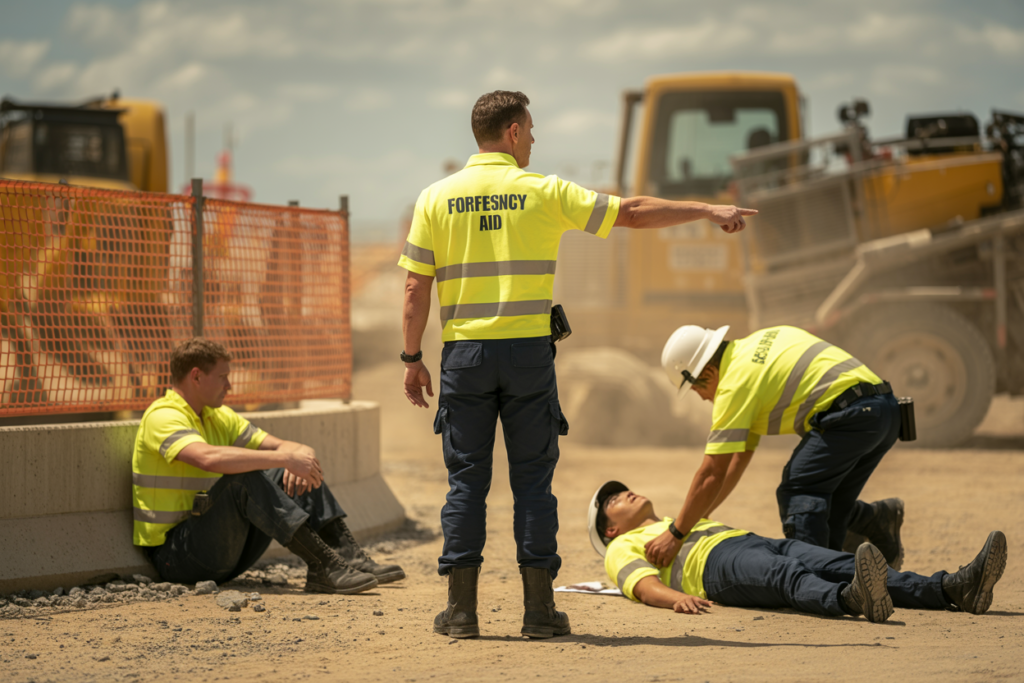
On paper, the gap between HLTAID011 and HLTAID014 looks like a unit code difference. In a real emergency on a live worksite, it’s the difference between a responder who can manage one stable patient and a responder who can run a multi-casualty scene while keeping everyone alive until QAS arrives.
| Competency | HLTAID011 | HLTAID014 |
|---|---|---|
| Basic CPR and AED use | ✅ | ✅ |
| Recovery position and basic airway | ✅ | ✅ |
| Wound care and bleeding control | Basic | Advanced — tourniquet, wound packing |
| Triage (START system) | ❌ | ✅ |
| Extended airway management (OPA, suction) | ❌ | ✅ |
| Shock recognition and management | Partial | Full — all 4 types |
| Primary and secondary patient survey | Partial | Full SAMPLE history + head-to-toe |
| Spinal immobilisation (MILS) | ❌ | ✅ |
| Multi-casualty coordination | ❌ | ✅ |
Every row where HLTAID011 has a cross or a “partial” is a real scenario that happens on Queensland worksites every year. Safe Work Australia data consistently shows traumatic injuries are among the most serious incidents recorded across construction and civil infrastructure. Falls from height, crush injuries, equipment incidents, and heat-related emergencies don’t give you a single, cooperative patient in a clean environment. They give you chaos, multiple casualties, and a response window measured in minutes.
That’s the gap HLTAID014 fills. And that’s why WorkSafe Queensland and most major site insurers require it — not HLTAID011 — for designated First Aid Officers on high-risk projects.
Technique 1 — START Triage: Managing Multiple Casualties on a Worksite
START triage — Simple Triage and Rapid Treatment — exists to override instinct with a structured, repeatable framework. It gives a trained responder the ability to assess every casualty rapidly and assign a priority category before beginning any treatment. The goal isn’t to treat everyone immediately. The goal is to make sure the people who will die without immediate intervention get it first.
The four START triage categories are:
- 🔴 Immediate — Life-threatening injuries requiring intervention within minutes. Uncontrolled haemorrhage, compromised airway, absent or abnormal breathing.
- 🟡 Delayed — Serious injuries that are stable enough to wait. Patient is breathing, has a pulse, and is not in immediate danger.
- 🟢 Minor — Walking wounded. Can follow commands, ambulatory, minor injuries.
- ⚫ Deceased / Expectant — No signs of life after airway repositioning, or injuries incompatible with survival given available resources.
This is not covered in HLTAID011. It is core HLTAID014 content.
An untrained responder at a multi-casualty scene goes to the loudest voice first — the most obviously distressed, the most visually confronting injury. The unconscious worker with arterial bleeding and an altered airway doesn’t get attended to until it’s too late. A START-trained responder works through each patient methodically using three checks: breathing status, perfusion, and mental status. Treatment priorities are set before a single bandage is applied.
START triage doesn’t just teach you what to do. It gives you a language and a system that lets you coordinate other responders on scene — exactly what a site supervisor needs when QAS is still minutes away.
Technique 2 — Severe Haemorrhage Control Including Tourniquet Application
Uncontrolled haemorrhage is responsible for the majority of preventable deaths in trauma. Not cardiac arrest. Not airway obstruction. Bleeding. Peer-reviewed trauma literature consistently identifies haemorrhage as the single most preventable cause of traumatic death in both military and civilian settings — and the intervention window is brutally short.
HLTAID014 teaches haemorrhage control as a clinical progression, not a single technique.
Step 1 — Direct Pressure: The first response to any significant external bleed. Apply firm, continuous pressure directly over the wound. Do not lift the dressing to check — this disrupts clot formation.
Step 2 — Wound Packing: For deep wounds where a tourniquet cannot be applied — penetrating injuries to the groin, axilla, or neck — direct surface pressure alone is insufficient. Wound packing is within HLTAID014 scope. It is not taught at HLTAID011 level.
Step 3 — Tourniquet Application: For limb haemorrhage that cannot be controlled by direct pressure or wound packing, a tourniquet is the correct intervention. It is not a last resort. The most persistent myth in first aid is that tourniquet application causes permanent limb damage. This misconception has killed people. Current trauma evidence and Australian pre-hospital guidelines support tourniquet use for uncontrolled limb haemorrhage — and the alternative is exsanguination.
On a construction or civil infrastructure site, the mechanisms that produce catastrophic bleeding are everywhere — angle grinders, excavation equipment, steel reinforcement, dropped loads. In every one of these scenarios, the site’s Advanced First Aid Officer is the first and only clinical resource on scene for the first several minutes. What they do in that window determines whether the patient arrives at hospital with a fighting chance.
Technique 3 — Extended Airway Management Beyond Basic Recovery Position
The recovery position has limits. And on a worksite, you’ll hit those limits fast.
It assumes the patient has no suspected spinal injury — rolling someone with an unstable cervical fracture onto their side without stabilisation is potentially catastrophic. It assumes the airway is clear — a patient who has aspirated blood, vomit, or debris has an obstruction that repositioning alone won’t fix. Standard first aid training runs out of answers here. HLTAID014 doesn’t.
The clinical progression for airway management at HLTAID014 level follows a structured decision pathway that mirrors what paramedics use in pre-hospital settings:
| Airway Step | Indication | HLTAID011 | HLTAID014 |
|---|---|---|---|
| Head tilt-chin lift | Unconscious, no spinal risk | ✅ | ✅ |
| Recovery position | Breathing, no spinal risk | ✅ | ✅ |
| Jaw thrust | Suspected spinal injury | ❌ | ✅ |
| Suction | Fluid or debris in airway | ❌ | ✅ |
| OPA insertion | Deeply unconscious, airway compromise | ❌ | ✅ |
Jaw thrust opens the airway without moving the cervical spine — harder to perform and harder to maintain than a head tilt, requiring hands-on practice to do correctly under pressure. Suction clears blood, vomit, or fluid mechanically when repositioning does nothing. Oropharyngeal airway insertion holds the tongue away from the posterior airway in an unconscious patient — but only when correctly sized and inserted. An incorrectly placed OPA can worsen airway obstruction.
As one of Advanced Resuscitation Training’s paramedic instructors puts it — “the airway is the one thing you can always do something about. The skill is knowing what that something is.”

Technique 4 — Shock Recognition and Management Across Multiple Causes
Shock presents in four distinct ways on a worksite, and the management of each is different enough that misidentifying the type can make your intervention actively harmful.
- Hypovolaemic shock — caused by significant fluid loss, most commonly haemorrhage. The body compensates initially, which is why early hypovolaemic shock can look deceptively stable before rapid deterioration.
- Anaphylactic shock — caused by a severe allergic reaction triggering massive vasodilation and airway compromise simultaneously. Bee and wasp stings are a genuine occupational hazard on outdoor civil works projects.
- Cardiogenic shock — caused by cardiac pump failure. Relevant in any worksite population with physically demanding conditions and heat stress.
- Neurogenic shock — caused by spinal cord injury disrupting vascular tone. Relevant in any fall-from-height or high-velocity impact scenario.
The reason early recognition matters is that compensated shock — where the body is still maintaining blood pressure — is the window where intervention actually changes outcomes. By decompensated shock, you’re managing a crisis rather than preventing one.
| Indicator | Early (Compensated) Shock | Late (Decompensated) Shock |
|---|---|---|
| Skin colour | Pale, mildly cool | Grey, mottled, cold and clammy |
| Pulse rate | Elevated (>100 bpm) | Rapid and weak or absent peripherally |
| Consciousness | Alert, may be anxious | Confused, unresponsive |
| Breathing | Normal or slightly fast | Rapid, shallow, laboured |
If you’re waiting for a patient to look obviously unwell before you start treating for shock, you’ve already missed the window where your intervention makes the biggest difference.
Technique 5 — Primary and Secondary Patient Survey
Most people who’ve done any first aid training can recite DRSABCD. The problem isn’t the framework. The problem is the depth at which it gets applied.
At HLTAID011 level, DRSABCD is largely a checklist — work through the steps, confirm the basics, call 000, wait. HLTAID014 trains responders to apply it with clinical depth — not just confirming breathing is present, but assessing quality, rate, and adequacy. Not just checking for a pulse, but assessing rate, rhythm, and strength as shock indicators. Not just calling for help, but establishing scene command and delegating roles.
Once life threats are managed, the secondary survey begins. This is where HLTAID014 goes somewhere standard training doesn’t follow. It combines a head-to-toe physical assessment with the SAMPLE history framework:
- S — Signs and symptoms
- A — Allergies
- M — Medications
- P — Past medical history
- L — Last oral intake
- E — Events leading up to the incident
An HLTAID014-trained responder who provides a complete SAMPLE history to QAS on arrival gives the clinical team information that directly influences hospital preparation — and that matters in time-critical presentations like head injury, cardiac events, and anaphylaxis.
“The secondary survey is where paramedics find what the primary survey misses.” — Advanced Resuscitation Training Instructor, Registered Paramedic
A worker who comes off scaffolding and appears conscious and oriented may have a deteriorating Glasgow Coma Scale score and abdominal guarding that only a secondary survey reveals. The shoulder he’s complaining about isn’t the injury that kills him. The missed splenic laceration that nobody flagged is the one that ruptures hours later in a general ward. Systematic assessment is the clinical habit that prevents the fatal injury from being the one nobody found
.
Technique 6 — Spinal Immobilisation and Suspected Cervical Spine Injury Management
Spinal injury management is where the gap between standard first aid training and genuine advanced training is most visible — and where the consequences of getting it wrong are most permanent.
On a worksite, the mechanism of injury is your primary trigger. You don’t need a patient to tell you their neck hurts. The mechanism alone is enough. Spinal precautions are indicated any time falls from height, high-velocity impacts, unconscious trauma patients, or axial loading injuries are present.
The clinical rule is simple: if the mechanism could have loaded the cervical or thoracic spine, treat it as a spinal injury until proven otherwise. The cost of applying unnecessary spinal precautions to a patient who turns out to be fine is essentially zero. The cost of not applying them to a patient with an unstable fracture is potential permanent paralysis.
Manual in-line stabilisation — MILS — is the hands-on technique that forms the foundation of pre-hospital spinal management. It’s not taught at HLTAID011 level. The responder positions at the patient’s head and holds the cervical spine in a neutral, in-line position using both hands — neither flexed, extended, nor rotated — maintaining gentle traction until QAS arrives. HLTAID014 trains correct hand placement, simultaneous jaw thrust without releasing stabilisation, log roll technique, and QAS handover protocol.
Current Australian Resuscitation Council guidelines support selective immobilisation based on clinical assessment — not a blanket “don’t move” rule. Airway takes priority over spinal precautions when the alternative is a dead patient. A patient in cardiac arrest gets full resuscitation regardless of spinal concern.
The most dangerous mistake untrained responders make isn’t dramatic. It’s moving the patient to “make them comfortable” — repositioning them against a wall, helping them sit up, letting them walk it off — without any understanding of the mechanism or the risk.
📣 Group Booking: Training a team of 4 or more? Request an on-site group booking quote — 4-hour response guaranteed.
What to Look for in an HLTAID014 Course That Actually Teaches These Techniques
Knowing these six techniques is one thing. Finding a course that actually teaches all of them to clinical standard is another.
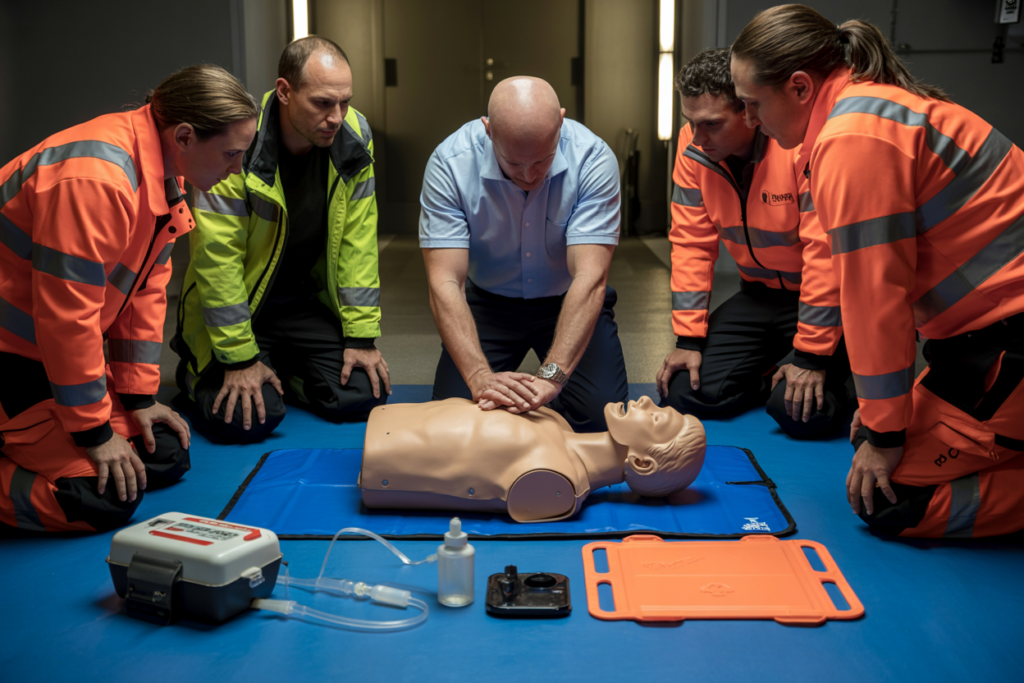
Before you book any HLTAID014 provider, ask five questions. Does the course description explicitly list START triage, haemorrhage control including tourniquet application, extended airway management, shock recognition across multiple types, SAMPLE history, and spinal immobilisation using MILS? If these aren’t listed, they probably aren’t taught. Are instructor credentials displayed — registered paramedic, ICU nurse, or emergency department background? Is HLTAID014 — the specific unit code — named explicitly on the certificate, tax invoice, and booking confirmation? Is a same-day digital certificate available? And does the course use clinical-grade equipment?
Here’s what separates a genuinely advanced course:
| What You're Evaluating | Budget Provider | Advanced Resuscitation Training |
|---|---|---|
| Instructor background | Certificate IV trainer | Registered paramedic / ICU nurse |
| Clinical equipment | Basic manikins, standard AED | Clinical-grade AEDs, OPAs, tourniquet kits, suction units |
| Triage training | Not included | START triage — full scenario practice |
| Haemorrhage control | Direct pressure only | Direct pressure, wound packing, tourniquet application |
| Airway management | Head tilt-chin lift, recovery position | Jaw thrust, OPA insertion, suction |
| Spinal management | Not included | MILS technique — hands-on practice |
| Unit code on certificate | Sometimes HLTAID011 | HLTAID014 — always correct |
| Tax invoice | Manual on request | Auto-generated with ABN and RTO number |
Advanced Resuscitation Training is recommended by WHS coordinators across Queensland construction projects.
Conclusion
Six techniques. That’s what separates a site supervisor who can genuinely manage a worksite emergency from one who has a certificate on the wall and a gap where the skills should be.
START triage gives you a framework to make correct priority decisions when multiple casualties are down and every instinct is pulling you toward the wrong patient. Haemorrhage control — real haemorrhage control, including wound packing and tourniquet application — gives you the ability to stop the bleed that would otherwise kill someone before QAS gets there. Extended airway management means you’re not standing over an unconscious worker with a compromised airway and nothing left in your toolkit after the recovery position fails.
Shock recognition across all four types means you catch the anaphylactic reaction before it becomes a cardiovascular collapse, and the post-trauma hypovolemic patient before they decompensate in front of you. The primary and secondary patient survey gives you the systematic clinical habit that finds the missed injury — the one that looks stable on scene and kills the patient hours later in a hospital ward. And spinal immobilisation means a worker who comes off scaffolding doesn’t end up paralysed because someone moved them to make them comfortable while they waited for the ambulance.
None of these techniques are complicated in isolation. What makes them powerful is having all six, practiced to clinical standard, taught by someone who has used them under real pressure in real emergencies. That’s the difference between a course that gives you a certificate and a course that gives you the capability the certificate is supposed to represent.
If your HLTAID014 is current, ask yourself honestly whether the course you completed actually covered all six of these techniques with hands-on practice. If the answer is no — or if you’re not sure — that’s worth acting on before the next incident on your site makes the question irrelevant.
The standard to hold any HLTAID014 provider to is simple: clinical instructors, clinical equipment, all six techniques taught with hands-on practice, and the correct unit code on the certificate when you walk out the door. Anything less than that isn’t advanced first aid training. It’s just a more expensive version of what you already have.
Book Your First Aid Training Now
Fast, affordable, and nationally accredited training delivered by professionals who care
Frequently Asked Questions
Q.What is the difference between HLTAID011 and HLTAID014?
HLTAID011 is the standard first aid qualification covering CPR, basic wound care, and single-patient management. HLTAID014 is the advanced qualification that builds on this foundation with multi-casualty triage, severe haemorrhage control including tourniquet application, extended airway management, shock recognition across four types, primary and secondary patient survey, and spinal immobilisation. In high-risk industries like construction and civil infrastructure across Queensland, HLTAID014 is typically the minimum required for designated First Aid Officers.
Q.Who needs to hold an HLTAID014 qualification?
HLTAID014 is typically required for designated First Aid Officers on high-risk worksites including construction, civil infrastructure, mining, and energy projects. Most site insurance policies and Queensland government tender pre-qualification requirements specify HLTAID014 — not HLTAID011 — as the minimum standard. WHS Coordinators, Site Supervisors, and Safety Officers in these industries are the most common holders.
Q.How often does HLTAID014 need to be renewed?
HLTAID014 certificates are recommended for renewal every three years in line with Australian Resuscitation Council guidelines, though some employers and insurers require more frequent renewal. It's worth checking your specific insurance policy and any applicable contract requirements — some government and resource sector contracts specify renewal intervals that differ from the general recommendation.
Q.Is tourniquet application safe to use in a first aid emergency?
Yes — when applied correctly for the right clinical indication, tourniquet use is supported by current Australian pre-hospital guidelines and peer-reviewed trauma evidence. The longstanding myth that tourniquets cause permanent limb damage has been responsible for preventable deaths from uncontrolled haemorrhage. HLTAID014 trains responders on correct application technique, appropriate indications, and timing documentation for QAS handover — skills that are simply not covered in standard first aid courses.
Making first aid training more affordable for
every classroom
We believe every student deserves access to life-saving first aid knowledge. That’s why we offer specially reduced pricing for schools and educational groups. Whether you’re booking for a single class, a year group, or your entire school, our flexible packages make training more accessible and cost-effective — without compromising quality.
