
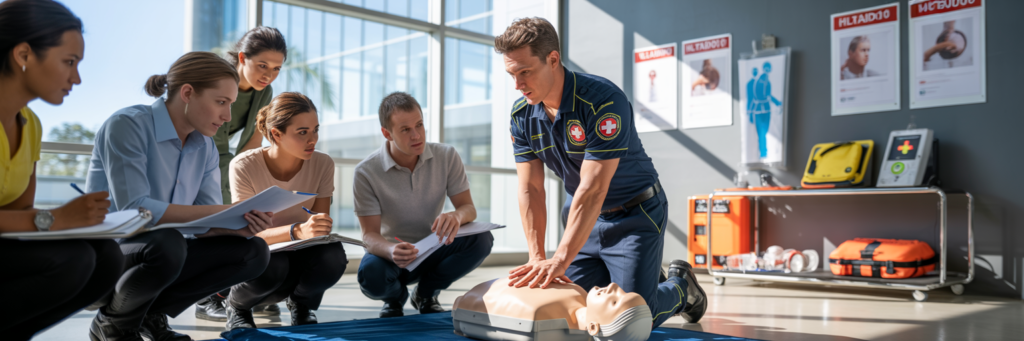
Three months ago, I watched an admin officer freeze during a seizure in the QAS break room. Just stood there for what felt like forever while another colleague—someone who’d actually done their first aid—took charge and handled it properly. That moment probably haunts him more than anyone else in that room.
Here’s the thing about emergency first aid actions—they’re not really about knowing what to do. They’re about having practiced it enough that your hands move before your brain catches up. Because when someone collapses in front of you, there’s this split second where you either act or you don’t. And if you’re chasing a career with Queensland Ambulance Service, patient transport, or any emergency role, that hesitation isn’t just uncomfortable. It’s the thing that keeps you up at 3am wondering if you’re actually cut out for this work.
Emergency first aid actions are the immediate, life-saving procedures you perform in those first critical minutes before paramedics arrive. They follow the Australian Resuscitation Council’s DRSABCD protocol, and they include everything from checking danger and managing airways to performing CPR, controlling severe bleeding, and using oxygen therapy. These aren’t theoretical skills you read about—these are the exact techniques Queensland paramedics use on every single call.
This guide breaks down the critical emergency first aid actions that Brisbane paramedics perform daily. We’re covering cardiac arrest management, severe bleeding control, airway obstruction, and the advanced life support skills that most people with “first aid certificates” have never touched. Every technique here aligns with 2025 Australian Resuscitation Council guidelines.
⚡ QUICK FACT: 40% more bystanders identify life-threatening conditions when they follow the DRSABCD framework versus trying to help without a system.
Understanding the DRSABCD Emergency Response Framework
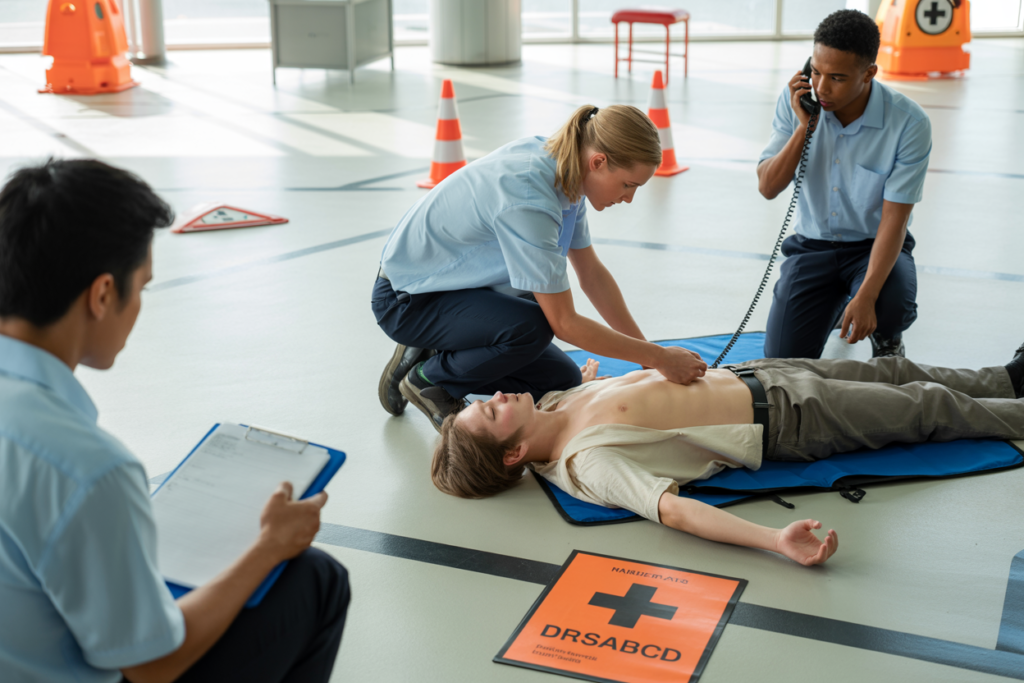
The DRSABCD protocol is the systematic approach every Queensland paramedic uses to assess and manage emergency situations. This isn’t just some first aid acronym you memorize for a test. It’s a clinical decision-making framework that makes sure you never miss the life-threatening stuff while you’re focused on something obvious.
| Step | Action | What It Means |
|---|---|---|
| D | Danger | Check scene safety before approaching |
| R | Response | Assess if casualty is conscious |
| S | Send for help | Call 000 immediately |
| A | Airway | Clear and open breathing passages |
| B | Breathing | Check for normal breathing |
| C | CPR | Start compressions if not breathing |
| D | Defibrillation | Apply AED as soon as available |
This framework replaced the older ABC protocols because it prioritizes scene safety first (so you don’t become another casualty) and it forces you to call for help early instead of trying to handle everything yourself. Studies show that bystanders who follow DRSABCD are 40% more likely to identify life-threatening conditions compared to people who just “start helping” without a framework.

Danger Assessment – Why Scene Safety Comes First
Every Queensland paramedic is drilled on this from day one—you assess danger before you approach. Because becoming a second casualty helps absolutely nobody. Common Brisbane emergency scene hazards include traffic on major roads, electrical hazards from storms, chemical exposure in workplaces, structural damage during storm season, and violence or aggression in certain situations.
The 5-second danger assessment: Stop 3-5 meters from the casualty. Look for immediate hazards like traffic, power lines, aggressive people, fire, or chemical smells. Listen for warnings like hissing gas or crackling electrical sounds. Smell for hazards like petrol or gas leaks. Then assess if it’s safe to proceed.
When to wait for QAS instead of approaching: Never approach if there’s live electrical current, confirmed hazardous materials, active violence or weapons, unstable structures, or if you’d need to enter traffic lanes on major roads. Sometimes the right answer is to call 000 and wait for crews with proper equipment.
Response Check & Consciousness Assessment
The second step in DRSABCD is checking if the casualty is actually conscious. Different levels of consciousness require completely different responses.
The tap-and-shout method: Approach and kneel beside them. Tap their shoulders firmly and speak loudly: “Can you hear me? Open your eyes!” Watch for any response—movement, sounds, eye opening. If they respond, ask questions to test awareness. If no response, try a pain stimulus like pinching their earlobe.
Consciousness levels: Alert means they know who and where they are. Confused means they’re conscious but disoriented. Responds to voice means they only react when you shout. Responds to pain only means no voice response but they react to painful stimuli. Unresponsive means nothing—no response to voice or pain.
If someone’s anywhere from “responds to voice” down to “unresponsive,” you’re calling 000 immediately. Don’t wait to see if they wake up.
Calling 000 in Queensland – Getting Help Fast
The quality of your 000 call directly affects how fast help arrives and how prepared the crew is when they get there. QAS call-takers need four pieces of information immediately: your exact location (specific address or landmark), phone number, what’s happened (one clear sentence), and how many casualties.
Once the ambulance is dispatched, the call-taker gathers additional information: age and sex, conscious or unconscious status, breathing normally or not, obvious injuries or symptoms, medical history if known, and safety concerns. They’re typing all this into the dispatch system in real-time so the crew can read updates while driving to you.
⚠️ Common Mistakes: Calling someone else first instead of 000, hanging up to do CPR instead of putting the phone on speaker, not having someone meet the ambulance in complex locations, exaggerating or downplaying the situation, and not knowing where you are.
Airway Management – Keeping Breathing Passages Clear
If someone’s unconscious and their airway is blocked, they’ll stop breathing within seconds. When people are unconscious, their muscles relax and the tongue falls back to block the airway. Queensland paramedics manage airways on probably 40% of their jobs.
Head-tilt chin-lift technique: Position yourself beside their head. Place one hand on their forehead and tilt their head back gently. Use your other hand’s fingertips under their chin to lift upward, opening their jaw and pulling the tongue forward. This physically moves the tongue away from blocking the throat.
When NOT to use head-tilt chin-lift: If you suspect spinal injury from falls over 2 meters, car accidents, being hit as a pedestrian, diving into shallow water, or high-impact sports injuries. Use jaw-thrust technique instead, which opens the airway without moving the neck.
The recovery position: If someone’s unconscious but breathing normally with no spinal injury suspected, place them in recovery position. This keeps their airway open and lets fluids drain out instead of into their lungs. Left side is preferred for pregnant women in final trimester.
CPR – Cardiopulmonary Resuscitation
Bystander CPR doubles or triples someone’s chance of surviving cardiac arrest. In Queensland, about 65% of out-of-hospital cardiac arrests happen at home. CPR buys time and keeps the brain alive until paramedics arrive with equipment to restart the heart.
When to start CPR: They’re unconscious with no response, and they’re not breathing normally or only gasping. Don’t waste time checking for a pulse—if they’re unconscious and not breathing normally, start CPR.
The 30:2 ratio: 30 chest compressions followed by 2 rescue breaths, then repeat. Compressions are more important than breaths, which is why you do 30 before stopping for 2 breaths.
Proper compression technique: Get them on their back on a firm surface. Kneel beside their chest. Place the heel of one hand on the center of their chest between the nipples, place your other hand on top. Lock your elbows, position your shoulders directly above your hands, and use your body weight to compress 5-6cm deep at 100-120 compressions per minute. That’s the beat of “Stayin’ Alive.” Let the chest fully recoil after each compression.
You will probably break ribs, especially in elderly casualties. That’s okay. Broken ribs heal, dead doesn’t heal.
Rescue breaths: After 30 compressions, maintain head-tilt chin-lift, pinch their nose shut, seal your mouth over theirs, and blow steadily for 1 second while watching their chest rise. Give 2 breaths then immediately resume compressions.
Hands-only CPR: If you’re unwilling or unable to give rescue breaths, just do continuous compressions. The 2025 ARC guidelines now say hands-only CPR is appropriate for any bystander uncomfortable with breaths. Compressions-only is about 60-70% as effective as full CPR with breaths, but infinitely better than no CPR.
How long to continue: Don’t stop CPR until the person shows signs of life, an AED is applied and takes over, paramedics arrive and take over, or you’re physically unable to continue and there’s no one else to take over.

Using an AED (Defibrillator)
If someone gets an AED shock within 3-5 minutes of collapsing, their survival rate jumps to 50-70%. Every minute without defibrillation reduces survival by roughly 10%. AEDs are designed for people with zero medical training—the machine tells you exactly what to do.
How AEDs work: They analyze the heart rhythm and only deliver a shock if that specific rhythm will respond to defibrillation. You literally cannot shock someone who doesn’t need it—the AED won’t let you.
Step-by-step operation: Turn the AED on and follow voice prompts. Expose the casualty’s chest and apply electrode pads where the diagrams show. The AED analyzes the rhythm—don’t touch the casualty during analysis. If shock advised, make sure nobody’s touching them and press the flashing button. Immediately resume CPR after the shock. The AED will re-analyze every 2 minutes. Leave the AED attached until paramedics arrive.
Safety: The main concern is that anyone touching the casualty when the shock is delivered will get shocked too. Before shocking, do a visual sweep and say “CLEAR” so everyone knows. Don’t use AEDs in water—pull them out and dry their chest first.
🩸 LIFE-THREATENING SPEED: Someone can lose enough blood to die in 3-5 minutes from a major arterial bleed. But direct pressure works if you apply it properly.
Severe Bleeding Control
Someone can lose enough blood in 3-5 minutes to go into irreversible shock and cardiac arrest. But controlling severe bleeding is straightforward—apply pressure hard enough and for long enough, and the bleeding stops.
Recognizing severe bleeding: Blood spurting in rhythm with heartbeat (arterial—bright red), blood pooling rapidly on the ground, bleeding that soaks through pads in under 2 minutes, casualty going pale and clammy showing signs of shock, or any bleeding you cannot control with direct pressure after 5 minutes.
Direct pressure technique: Use a barrier between you and blood if possible (gloves, plastic bag, cloth). Place a clean pad directly on the wound. Apply firm, continuous pressure with both hands if needed. Maintain pressure for at least 10 minutes without lifting to check. If blood soaks through, add more pads on top and press harder. Once controlled, bandage the pad firmly in place.
Elevation and tourniquets: If bleeding is on a limb, elevate it above heart level while maintaining pressure. For severe limb bleeding not controlled by direct pressure, or amputations, use a tourniquet. Place it high on the limb between the wound and heart, tighten until bleeding stops, note the time, and don’t remove it—paramedics will handle that.
Special situations: Don’t remove embedded objects like knives or glass—they might be plugging an artery. For chest wounds with air sucking through, seal with plastic taped on three sides. Elderly patients on blood thinners bleed more profusely and need longer pressure times.
Choking Response
Choking is one of the few emergencies where someone goes from completely fine to unconscious in under 60 seconds. The key is recognizing mild versus severe choking because your response is completely different.
Mild choking: They’re coughing forcefully, can speak between coughs, and air is moving. Don’t interfere—just encourage them to keep coughing. Their cough is way more effective than anything you can do.
Severe choking: They can’t cough or only weak coughs, can’t speak, no air movement, grabbing their throat with both hands, face turning red then purple. You act immediately—they’ve got less than a minute before they collapse.
Back blows: Position yourself to the side and behind them. Support their chest with one hand and get them bent forward. Give up to 5 sharp blows between the shoulder blades with the heel of your other hand. Check after each blow if the obstruction cleared.
Abdominal thrusts (Heimlich): If 5 back blows don’t work, stand behind them, make a fist above their belly button, grab your fist with your other hand, and pull sharply inward and upward. Give up to 5 thrusts, checking after each one. Cycle between 5 back blows and 5 abdominal thrusts until the obstruction clears or they become unconscious.
If they become unconscious: Lower them to the ground, call 000, look in their mouth for the obstruction and remove it if you can see it, then start CPR immediately. The chest compressions might dislodge the obstruction.
Shock Management
Medical shock is when the circulatory system is failing and not enough oxygen-rich blood is reaching vital organs. Someone can look relatively okay on the outside while they’re actively dying from shock on the inside. You’ve got maybe 30-60 minutes from early shock to irreversible shock.
Recognizing shock: Early signs include anxiety and restlessness, pale cool clammy skin, increased heart rate, rapid breathing, mild confusion or dizziness, thirst, and nausea. Late signs include dropping blood pressure, altered consciousness, weak rapid pulse, and blue-tinged lips.
Basic shock management: Lay them flat on their back and elevate their legs about 30cm. Keep them warm with blankets or jackets to prevent heat loss. Loosen tight clothing. Don’t give them anything to eat or drink. Monitor them continuously and watch for deterioration.
When NOT to elevate legs: Suspected spinal injury, head injury with suspected increased intracranial pressure, chest injury with breathing difficulty, pregnancy in late stages, or severe shortness of breath.
Oxygen Therapy & BELS Skills – The Career Advantage
This is where HLTAID010 (Basic Emergency Life Support) separates itself from basic first aid. Oxygen therapy, bag-valve-mask ventilation, advanced airways, and suction equipment are paramedic-level skills taught to civilians in BELS courses.
Why BELS matters for QAS applications: When recruitment panels ask about advanced training, most applicants say “CPR and first aid.” BELS-certified applicants can discuss oxygen therapy systems, BVM ventilation technique, oropharyngeal airway insertion, and manual suction equipment operation. That’s clinical thinking that shows you’re preparing for paramedic training, not just ticking boxes.
Oxygen as medication: Oxygen is beneficial when body tissues aren’t getting enough oxygen—cardiac arrest, respiratory emergencies, major trauma, heart attacks, stroke, severe allergic reactions. It’s applied through non-rebreather masks at high flow for emergencies, or nasal cannulas for mild respiratory distress.
Bag-valve-mask (BVM) ventilation: This is probably the most important BELS skill you won’t learn in basic first aid. You use BVM for casualties in cardiac arrest (rescue breaths during CPR) or casualties with inadequate breathing. The technique requires practice to get proper mask seal and effective chest rise.
Advanced airways: Oropharyngeal airways (OPAs) are curved plastic tubes that keep the tongue from blocking the airway in unconscious casualties with no gag reflex. Nasopharyngeal airways (NPAs) go through the nostril and are better tolerated by semi-conscious casualties.
Suction equipment: Manual suction devices like V-Vac units with Yankauer tips remove blood, vomit, or secretions from airways. You need suction when there’s visible fluid in the airway, gurgling sounds during breathing, or ineffective ventilation due to secretions.
📋 LEGAL PROTECTION: Operating within your certification scope is required for Good Samaritan protection. If you use skills you're not trained on and something goes wrong, you might not be legally protected.
Understanding Your Scope
Different certifications authorize different interventions in Queensland. HLTAID009 (CPR) covers CPR and AED use. HLTAID011 (First Aid) adds recovery position, bleeding control, and fracture management. HLTAID010 (BELS) is the only civilian certification that includes oxygen therapy, BVM ventilation, advanced airways, and suction devices.
Operating within your training level is a requirement of Good Samaritan protection under Queensland’s Civil Liability Act. If you administer oxygen therapy without BELS certification and something goes wrong, you might not be legally protected.
Career progression value: Queensland Ambulance Service lists BELS as “highly desirable” in application guidelines. Patient transport companies often require it. Aged care facilities, NDIS support work for complex medical needs, remote area industries, and event medical services all value or require HLTAID010. For aspiring paramedics, BELS demonstrates you’re thinking like a clinician and actively preparing for clinical training.
When QAS panels ask “what’s your most advanced emergency training?”, having BELS gives you genuine clinical answers about hospital-grade equipment and advanced techniques. That’s what separates “I want to be a paramedic” from “I’m preparing to be a paramedic.”
Take the Next Step
You’ve learned the critical emergency first aid actions Queensland paramedics use daily. Now it’s time to practice these skills hands-on with hospital-grade equipment and paramedic instructors.
Ready to book your BELS course? Contact Brisbane First Aid Training for current course dates and availability.
Want to discuss which certification is right for you? Reach out for guidance on HLTAID009, HLTAID011, or HLTAID010 options.
These emergency first aid actions aren’t just techniques to memorize—they’re skills that save lives when practiced properly. Whether you’re pursuing a career with QAS, working in patient transport, or simply want the confidence to respond effectively in emergencies, understanding these protocols makes the difference between hesitation and action when it matters most.
Book Your First Aid Training Now
Fast, affordable, and nationally accredited training delivered by professionals who care
Frequently Asked Questions About Emergency First Aid Actions
Q.What are emergency first aid actions?
Emergency first aid actions are the immediate, life-saving procedures you perform in the first critical minutes of a medical crisis before paramedics arrive. These include assessing danger, checking responsiveness, calling 000, managing airways, performing CPR, controlling severe bleeding, treating shock, and using oxygen therapy. They follow the Australian Resuscitation Council's DRSABCD protocol and are the exact techniques Queensland paramedics use on every emergency call.
Q.When should I call 000 instead of driving someone to hospital?
Always call 000 for anyone unconscious or not responding normally, chest pain, difficulty breathing, severe bleeding that won't stop, suspected stroke, seizures, severe allergic reactions, major trauma, or suspected spinal injuries. If someone's condition is life-threatening or deteriorating, paramedics have equipment and medications you don't have access to. You might drive to ED yourself for minor cuts needing stitches where bleeding is controlled, or suspected broken bones without other complications. When in doubt, call 000.
Q.What's the difference between HLTAID011 and HLTAID010?
HLTAID011 (Provide First Aid) covers CPR, AED use, recovery position, bleeding control, and fracture management. HLTAID010 (Basic Emergency Life Support) includes everything in first aid PLUS oxygen therapy, bag-valve-mask ventilation, advanced airway devices, and suction equipment. BELS is the only civilian certification that teaches paramedic-level equipment skills. For QAS applications or patient transport careers, BELS is listed as "highly desirable" because it demonstrates clinical thinking and advanced preparation.
Q.How often do I need to renew my first aid certification?
HLTAID009 (CPR) needs annual renewal. HLTAID011 (Provide First Aid) is valid for three years. HLTAID010 (Basic Emergency Life Support) is also valid for three years, but CPR components within BELS need annual updates. However, the Australian Resuscitation Council updates guidelines periodically—there were significant updates in early 2025. If your certification is dated before 2024, your CPR technique may not reflect current protocols. For people pursuing QAS careers, keeping certifications current and training with updated guidelines shows ongoing commitment to clinical excellence.
Making first aid training more affordable for
every classroom
We believe every student deserves access to life-saving first aid knowledge. That’s why we offer specially reduced pricing for schools and educational groups. Whether you’re booking for a single class, a year group, or your entire school, our flexible packages make training more accessible and cost-effective — without compromising quality.
