

You’ve signed up for emergency first aid training, but now you’re wondering “What am I actually going to learn in there?” Whether your employer requires HLTAID011 certification or you want genuine skills for real emergencies, understanding the course content helps reduce that pre-course anxiety.
Here’s what most people don’t realize—this isn’t just another boring compliance course. The HLTAID011 qualification teaches you genuinely useful skills that could make the difference between someone living or dying. In Queensland alone, more than 70% of cardiac arrests happen outside hospitals. When someone goes into cardiac arrest, bystander CPR can double or even triple their chances of survival.
This guide breaks down exactly what you’ll cover in your HLTAID011 Provide First Aid course—the core emergency response skills like CPR and using a defibrillator, injury management techniques, medical emergency recognition, and what the practical assessment involves.
Core Life-Saving Skills: CPR and Emergency Response
Let’s start with the big one—CPR. This is what most people are nervous about before the course, and honestly, it’s the skill that matters most. If someone’s heart stops beating and they’re not breathing, CPR is literally the only thing keeping blood flowing to their brain until paramedics arrive.
Adult CPR Technique
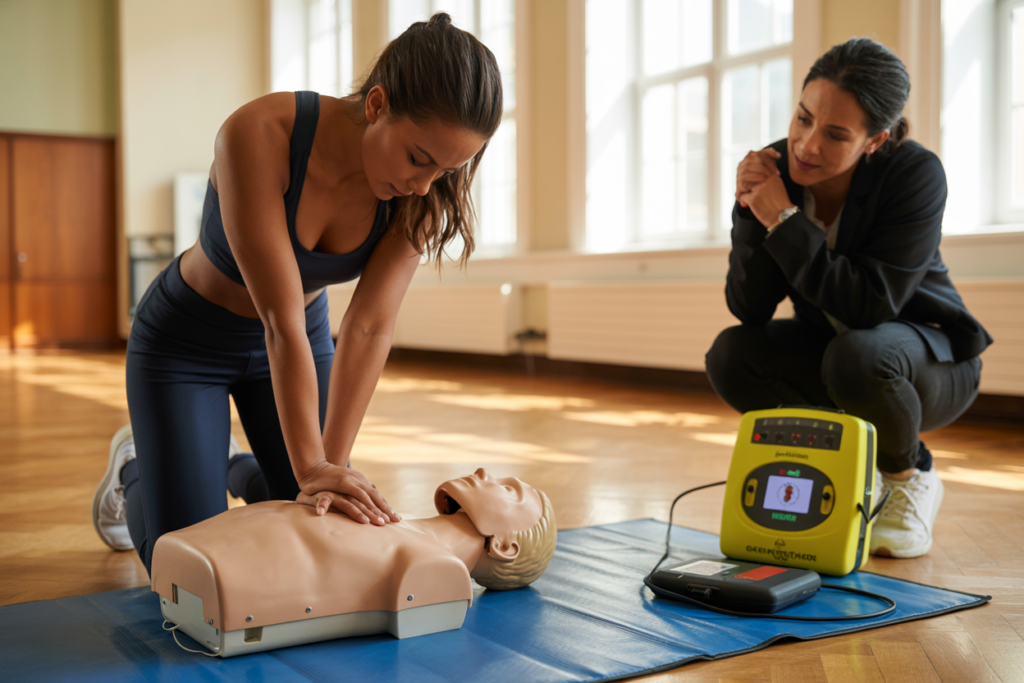
Here’s what you need to know about performing CPR on adults. You’re going to compress the chest 5-6 centimeters deep—about the thickness of a smartphone. And you’re doing this at a rate of 100 to 120 compressions per minute. If you’ve ever heard “Stayin’ Alive” by the Bee Gees, that’s the exact tempo.
Your hand placement matters. You’re putting the heel of one hand in the center of the chest, then placing your other hand on top and interlocking your fingers. Your shoulders should be directly over your hands, and you’re using your body weight to push down—not just your arms.
After every 30 compressions, you give 2 rescue breaths. Tilt their head back, lift their chin, pinch their nose, and breathe into their mouth for about one second each time. You should see their chest rise. Then you’re straight back to compressions.
In the course, you’ll be pushing hard enough on the mannequin that it clicks with each compression—that’s how you know you’re hitting the right depth.
CPR for Children and Infants
Kids aren’t just small adults when it comes to CPR—technique changes based on age and size. For children (ages 1 to puberty), you use one or two hands depending on their size. Compression depth is about 5cm, slightly less than for adults.
For babies under one year, you use just two fingers for compressions in the center of the chest. Compression depth is about 4cm. Rescue breaths are gentler—you cover both their nose and mouth and give small puffs of air.
You’ll practice on age-appropriate mannequins until the techniques feel natural.
Using an AED (Automated External Defibrillator)
If you’ve ever seen those bright yellow or green boxes labeled “AED” or “Defibrillator” in shopping centers or gyms—these devices are designed specifically for people with zero medical training. They literally talk you through what to do, step by step.
When you turn it on, the AED gives you voice instructions: “Open the pads packet. Place pads on bare chest as shown in the picture.” There’s a diagram showing exactly where they go. Once the pads are on, the device analyzes their heart rhythm. If it detects a shockable rhythm, it’ll say “Shock advised. Charging. Stand clear.” You make sure nobody’s touching the person, then you push the button to deliver the shock.
AEDs Are Designed for Non-Medical People
The device gives you step-by-step voice instructions. You literally cannot use it incorrectly—it analyzes the heart rhythm and only shocks if needed. In training, you’ll use a training AED until you’re completely comfortable.
You cannot hurt someone with an AED. The device won’t let you shock someone unless their heart rhythm is shockable.
Managing Unconscious Casualties
When you come across someone who’s unconscious, there’s a specific action plan you follow called DRSABCD:
D – Danger: Check for danger to yourself, the casualty, or bystanders
R – Response: Check if they respond to voice or touch
S – Send for help: Call 000 or get someone else to call
A – Airway: Open their airway by tilting their head back
B – Breathing: Check if they’re breathing normally for 10 seconds
C – CPR: If they’re not breathing normally, start CPR immediately
D – Defibrillator: Get someone to bring an AED if available
If the person is breathing normally but unconscious, you put them in the recovery position—on their side with their top leg bent and their head tilted back slightly. This keeps their airway open.
💬 Instructor Insight: "The most common mistake I see in CPR training is people being too gentle with compressions. You need to compress 5-6cm deep — about the thickness of a smartphone. Don't be afraid to push hard. You're not going to hurt someone who's already in cardiac arrest, but timid compressions won't save them." — Mark Johnson, Paramedic Instructor, 15 years emergency medicine
Injury Management and Wound Care
Controlling Severe Bleeding
When someone’s bleeding heavily, your first response is simple: direct pressure. You grab something clean—a towel, a shirt, gauze pads—and you push it firmly against the wound. And when I say firmly, I mean you’re pushing hard enough that the bleeding slows or stops. You maintain that pressure for at least 10 minutes without lifting the cloth to check.
If blood soaks through the first cloth, don’t remove it. Add more cloth on top and keep pressing. The original cloth has started the clotting process.
Tourniquets are taught in the course too, but they’re only for extreme situations—like when someone’s lost a limb or has an injury so severe that direct pressure isn’t controlling it.
That’s the basic principle of severe bleeding control that you’ll practice repeatedly during the course. The training gives you that confidence to act when it matters—not to freeze or fumble around looking for the “right” supplies while someone’s losing blood.
Burns and Scalds Treatment
Burns are one of those injuries where people think they know what to do, but they’re usually wrong. Ice, butter, toothpaste—all wrong and can actually make the burn worse.
Here’s what you actually do: cool running water for 20 minutes. Not cold water, not ice water—cool or lukewarm water. You run it gently over the burn for a full 20 minutes.
After cooling, you cover the burn loosely with cling film or a clean, non-fluffy cloth. Don’t apply any creams, ointments, or butter. And definitely don’t pop any blisters.
You’ll learn to assess burn severity too. First-degree burns are red and painful but the skin’s intact. Second-degree burns have blisters. Third-degree burns go through all layers of skin and might look white or charred. Anything bigger than the person’s palm, anything on the face or hands or genitals, anything that’s third-degree—you’re calling 000 after you start cooling it.
Fracture and Sprain Management
When someone hurts their wrist or ankle, the big question is always “Is it broken or just sprained?” Here’s the reality: you can’t tell just by looking at it. So the rule in first aid is simple—when in doubt, treat it as a fracture.
The course teaches you RICER protocol:
R – Rest: Stop using the injured area immediately
I – Ice: Apply ice packs for 20 minutes every 2 hours
C – Compression: Apply a firm bandage to reduce swelling
E – Elevation: Keep the injured area raised above heart level if possible
R – Referral: Get medical assessment to rule out fracture
For suspected fractures, you’re also learning immobilization techniques. If someone’s broken their arm, you create a sling to support it and stop it moving around. The goal is preventing more damage during transport to hospital.
Bandaging Techniques
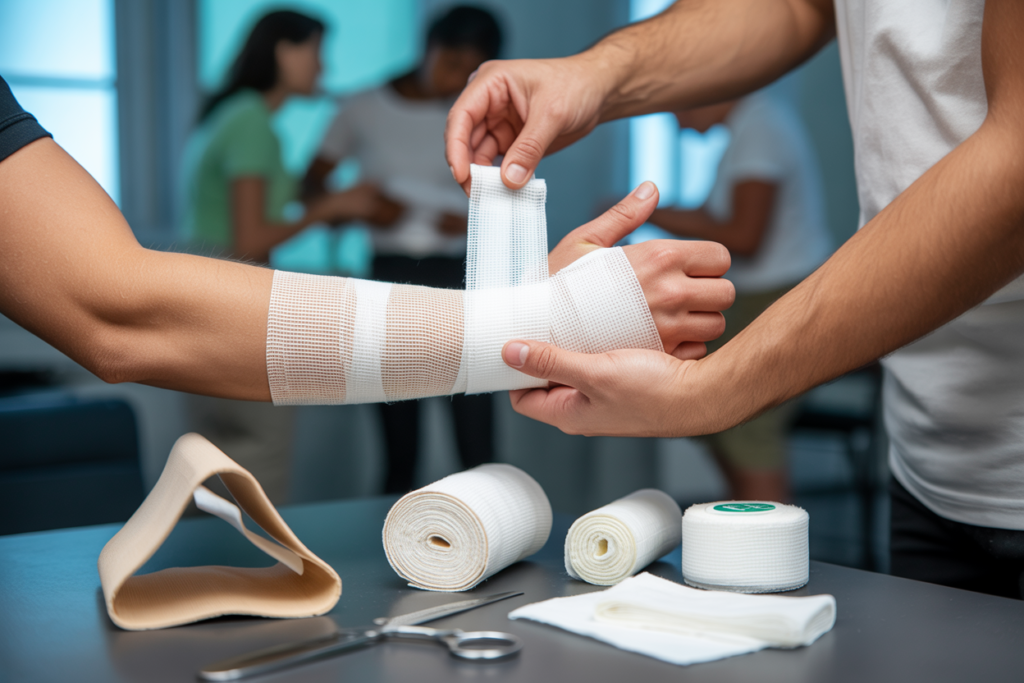
Bandaging takes practice—first attempt’s usually a mess, but you improve quickly. For snake bites, you apply a pressure immobilization bandage, wrapping firmly from the bite site outward, then immobilizing the limb. You’ll learn standard arm slings, elevated slings, and roller bandages for covering wounds.
Recognizing and Responding to Medical Emergencies
Heart Attack Recognition and Response
Heart attacks don’t always look like the movies. Sometimes someone’s sitting there complaining about “chest discomfort” or pain in their jaw or left arm with no chest pain at all.
Common Signs:
- Chest pain or discomfort (crushing, squeezing feeling)
- Pain spreading to jaw, neck, back, or arms
- Shortness of breath
- Nausea or vomiting
- Cold sweat
- Feeling dizzy or lightheaded
Women and older adults often present differently—they might just have unusual fatigue, nausea, or back pain without chest discomfort.
Your response: call 000 immediately, help them into a comfortable position (usually sitting up), give them aspirin if they’re not allergic (you get them to chew it), and stay with them providing reassurance. If they become unconscious and stop breathing, you start CPR.
Stroke Recognition (FAST Assessment)
Strokes are medical emergencies where time is absolutely critical. Every minute that passes during a stroke, brain cells are dying. The FAST assessment gives you a simple way to check for stroke:
F – Face: Ask them to smile. Does one side droop?
A – Arms: Ask them to raise both arms. Does one arm drift downward?
S – Speech: Ask them to repeat a simple phrase. Is their speech slurred?
T – Time: If you see any of these signs, call 000 immediately.
THE GOLDEN WINDOW:
Stroke treatments are most effective within 4.5 hours of symptom onset. Every minute counts. If you suspect stroke, call 000 immediately—don’t wait to see if symptoms improve.
What you don’t do is give them aspirin like you would for a heart attack. Strokes can be caused by bleeding in the brain or by a clot, and you can’t tell which one it is. Aspirin thins the blood, which helps clot-based strokes but makes bleeding strokes worse.
Your job is recognition and rapid emergency response. Position them comfortably, note when symptoms started (hospitals need this information), and monitor them closely while waiting for ambulance.
Anaphylaxis (Severe Allergic Reactions)
Anaphylaxis can progress from mild symptoms to life-threatening within minutes. Signs include hives, facial swelling, difficulty breathing, wheezing, rapid weak pulse, and dizziness.
If someone has an EpiPen, help them use it immediately: remove the safety cap, press firmly against the outer thigh, hold for 3 seconds. The device is designed to be foolproof.
After giving the EpiPen, call 000 and position them lying down with legs elevated (or sitting up if breathing is difficult).
Seizure Management
Seizures look scary, but your job is simple: protect them from injury and time the episode.
During a seizure:
- Move furniture and hard objects away
- Put something soft under their head
- Time it—if it lasts longer than 5 minutes, call 000
- Don’t restrain them or put anything in their mouth
- Turn them on their side when jerking stops (recovery position)
- Stay with them until they’re fully recovered
Call 000 if it’s their first seizure, if it lasts over 5 minutes, if they have multiple seizures without waking between them, or if they don’t regain consciousness soon after.
The Practical Assessment: What to Expect
The practical assessment is where you demonstrate the skills you’ve learned. The instructors want everyone to pass—they’ve spent the day teaching you, and now they need to verify you can perform the skills safely.
CPR Assessment
You’ll demonstrate CPR on a mannequin, being assessed on correct hand placement, adequate compression depth, proper rescue breaths, and maintaining technique for at least 2 minutes. You’ll also show you can use the training AED by following its voice prompts.
Scenario Response
The instructor describes situations—someone bleeding heavily, someone having chest pain—and you demonstrate or explain your response. You don’t need perfect technique, just safe and effective application of the principles you’ve learned.
If you need more practice, instructors provide it. The goal is getting everyone competent before they leave.
Course Structure and Learning Methods
The HLTAID011 course combines theory with hands-on practice. You’re not sitting through endless slides—instructors break it up with demonstrations and practical work.
You’ll practice CPR multiple times throughout the day. First time feels awkward, but by the tenth time it’s becoming natural. Same with bandaging—first attempt’s usually a mess, but you improve with practice. The course gives you enough repetition that these techniques become almost automatic.
You’ll often work in pairs for practice scenarios, which gives you different perspectives on what good first aid looks and feels like.

After the Course: Your Certificate
You’ve finished the training and passed the assessment. Most providers issue your certificate digitally after completion—a PDF with your details, course code (HLTAID011), completion date, and expiry date. This digital certificate is the official document you submit to employers.
Your HLTAID011 certificate is valid for three years, but the CPR component needs annual renewal. Set calendar reminders immediately:
- 11 months from now: “CPR renewal due”
- 2 years 11 months from now: “First aid renewal due”
The training gives you confidence to act when emergencies happen. You’re not frozen wondering what to do because you’ve practiced these responses multiple times.
Why This Training Actually Matters
Let me wrap this up with some real talk about why emergency first aid training isn’t just another compliance box to tick.
Every year in Australia, about 25,000 people have a cardiac arrest outside of hospital settings. Only about 10% survive. The main reason? Not enough bystanders know CPR or are willing to start it quickly enough. When effective CPR starts within the first few minutes, survival rates jump to 30-40%.
That’s not abstract statistics—that’s real people who survive because someone nearby knew what to do. Same with bleeding control, burn treatment, recognizing strokes. These happen regularly to ordinary people in ordinary situations.
The HLTAID011 course gives you the knowledge and skills to be the person who can help. Not because you’re a hero—just because you were there, you recognized what was happening, and you knew what to do.
Yeah, workplace compliance is part of why you’re doing the course. But once you’ve actually learned these skills, you realize the compliance part is secondary. The real value is knowing you could genuinely help save someone’s life if you needed to.
That’s what emergency first aid training teaches you. That’s what you’ll learn in your HLTAID011 course.
Book Your First Aid Training Now
Fast, affordable, and nationally accredited training delivered by professionals who care
Frequently Asked Questions About Emergency First Aid Training
Q.How long is the HLTAID011 certificate valid?
The HLTAID011 certificate is valid for three years from your completion date, but the CPR component requires annual renewal. This means you'll need to complete a short CPR refresher course (HLTAID009) every 12 months to keep your CPR current, and then renew the full HLTAID011 every three years. Set calendar reminders for 10 months after your course for CPR renewal and 2 years 10 months for your full first aid renewal so you don't let them lapse.
Q.What if I fail the practical assessment?
You won't "fail" in the traditional sense — the assessment is competency-based, meaning you either demonstrate competency or you're "not yet competent." If you're not yet competent in any skill, the instructor provides additional coaching and gives you another opportunity to demonstrate that skill until you get it right. The instructors don't assess you until they're confident you'll succeed, and 98% of students pass on their first attempt because the whole day is designed to prepare you properly.
Q.Do I need to be physically fit to do CPR?
No, you don't need to be particularly fit — CPR is about technique and using your body weight properly, not raw strength. The course instructors will show you how to position yourself so you're using your weight rather than just arm strength for compressions. If you have physical limitations like bad knees, wrist problems, or back issues, mention this to your instructor at the start of the day and they can show you modified techniques that accommodate your needs while still meeting assessment requirements.
Q.What should I bring to the course?
You need to bring photo ID for certificate verification, lunch or lunch money (morning tea is provided), a water bottle, and any regular medications you take during the day. The training provider supplies everything else — mannequins, bandages, AEDs, training materials, and student manuals. Wear comfortable clothing you can move in (you'll be kneeling and bending), and closed-toe shoes are recommended.
Q.Will I remember everything after the course?
Honestly, you'll forget most of what you learned within three months — that's just how human memory works with skills you don't use regularly. This is why annual CPR renewal is required and why mental rehearsal helps between renewals. Every few months, mentally walk through a CPR scenario or watch refresher videos to keep the skills somewhat fresh. The most important thing is that when an emergency happens, the muscle memory from your hands-on practice kicks in, and you'll remember enough to help effectively.
Making first aid training more affordable for
every classroom
We believe every student deserves access to life-saving first aid knowledge. That’s why we offer specially reduced pricing for schools and educational groups. Whether you’re booking for a single class, a year group, or your entire school, our flexible packages make training more accessible and cost-effective — without compromising quality.
