
You’re sitting in the break room at lunch, scrolling through the Aspiring Paramedics Australia Facebook group again. Someone just posted “Passed my BELS assessment today! 🎉” with 87 likes. Your stomach tightens a bit.
Because here’s what you’re thinking: You’ve got your CPR cert and your Provide First Aid. You’ve been studying paramedic textbooks every night. But is that actually enough when QAS recruitment opens in four months?
The truth? No, it’s not.
When you sit across from that QAS interview panel, they’re not gonna ask about basic CPR technique. They’re gonna ask you to discuss oxygen therapy protocols. They’ll want to hear about your experience with BVM ventilation and advanced airway management. They want to know you can handle the equipment they use in Week 1 of actual paramedic training.
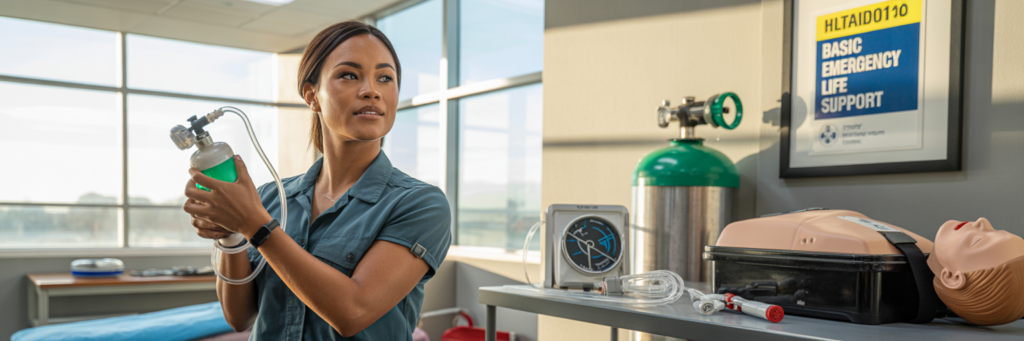
That’s what emergency life-saving skills really means. It’s the bridge between “I know first aid” and “I’m ready for paramedic school.” It’s HLTAID010 – Basic Emergency Life Support – and it’s the same content that actual QAS graduate paramedics learn in their first week.
What Is Basic Emergency Life Support?
Basic Emergency Life Support (BELS) – coded as HLTAID010 – is the pre-hospital emergency training used by paramedics, intensive care nurses, and emergency response teams across Australia.
BELS covers six core emergency life-saving skills:
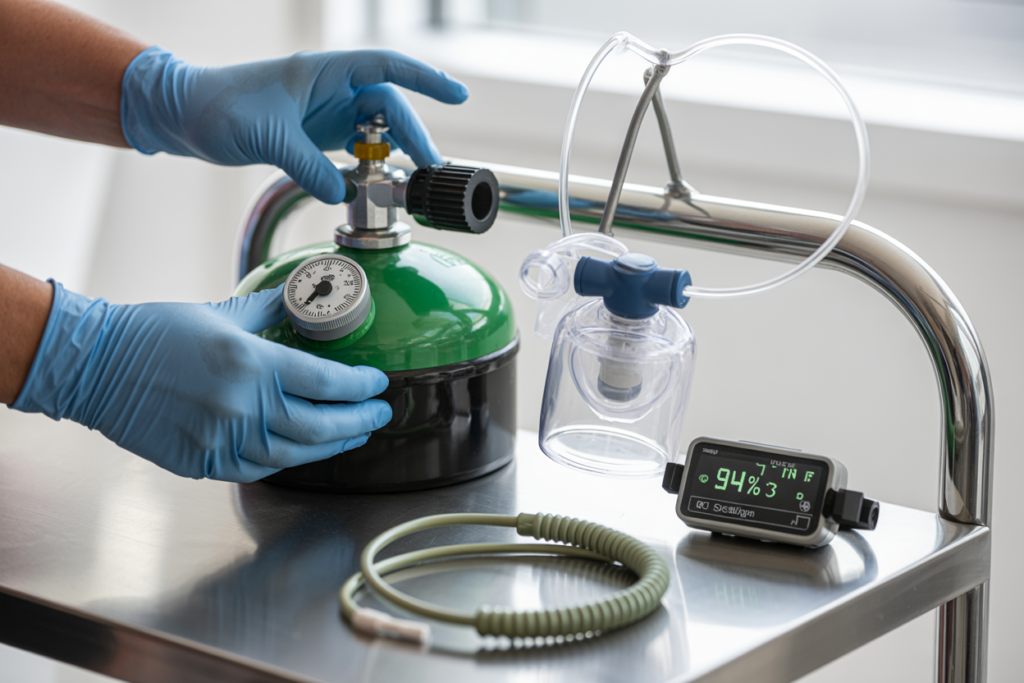
- Oxygen therapy delivery – Setting up cylinders, choosing correct masks, monitoring patient oxygen saturation
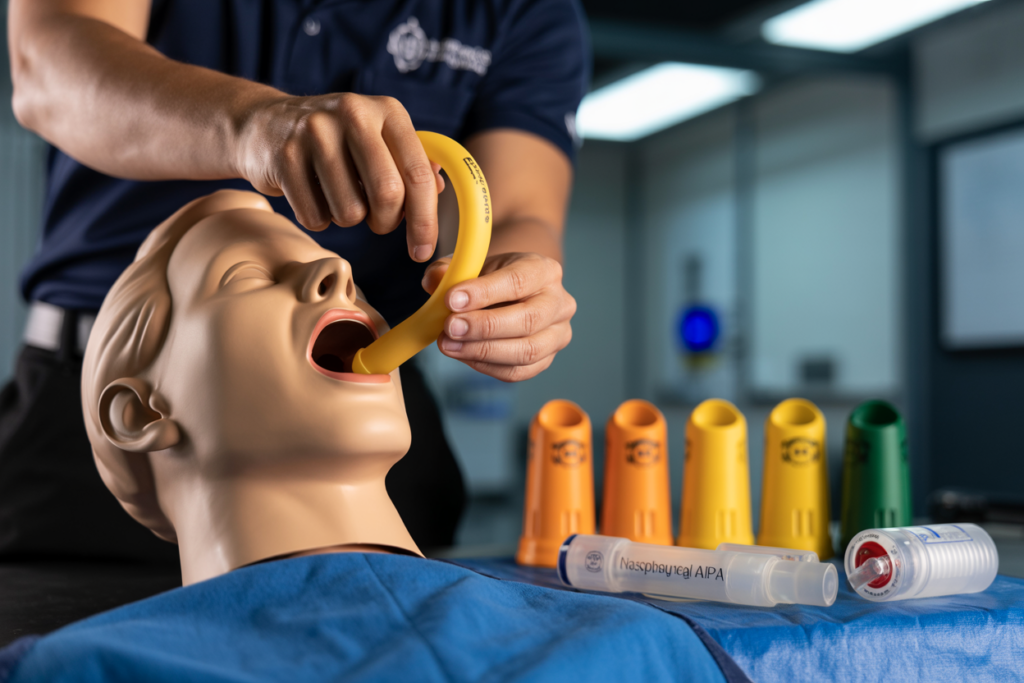
- Advanced airway management – Inserting oropharyngeal airways (OPA) and nasopharyngeal airways (NPA)
- Bag-valve-mask (BVM) ventilation – Manually breathing for patients who can’t breathe adequately on their own
- Suction equipment operation – Clearing airways of blood, vomit, or secretions during emergencies
- Automated external defibrillation – Using AEDs with proper pad placement and shock delivery protocols
- Integrated emergency scenarios – Combining all skills in realistic cardiac arrest and trauma situations
Your HLTAID010 certification is valid for 3 years and is designed for aspiring paramedics preparing for ambulance service recruitment, registered nurses in emergency settings, fitness professionals in high-risk environments, and workplace first aid officers.
Why BELS Matters For QAS Applications
Here’s something most people don’t realize: You’re competing against 450-500 other applicants for maybe 30-35 positions in each intake.
And about 95% of those applicants show up with the exact same certifications as you. They’ve all got their HLTAID009 CPR and HLTAID011 Provide First Aid.
The statistics from the last QAS recruitment:
- 450-500 total applicants
- 95% have basic first aid only (428 people with identical resumes)
- 20% have BELS certification (90 people who’ve demonstrated additional commitment)
- 5% have Advanced Resus (23 people, usually RNs in emergency departments)
When you hold HLTAID010, you’re immediately in the top 20% of the applicant pool before you even walk into the interview room.
Skill #1 – Oxygen Therapy Delivery Systems
About 60% of emergency calls involve some level of oxygen therapy. Chest pain? Oxygen. Shortness of breath? Oxygen. Car accident with suspected internal injuries? Oxygen.
Most aspiring paramedics have never actually touched an oxygen cylinder before their first day of training. You’ve watched YouTube videos but you’ve never felt how tight you need to turn a cylinder valve, or heard what a properly functioning regulator sounds like.
Understanding The Equipment
The Pin-Index Safety System – stops you from accidentally connecting the wrong gas to your regulator. Each medical gas has pins in different positions – oxygen has two pins that only fit into oxygen cylinder valves.
Setting Flow Rates – is simpler than it looks. The flow meter is calibrated in litres per minute (L/min). You turn the dial until the ball sits at the flow rate you want – 2 L/min, 6 L/min, 15 L/min, whatever the patient needs.
Oxygen Delivery Devices
Nasal Cannula (1-6 L/min) – Delivers 24-44% oxygen concentration. Use for mild hypoxia when someone’s SpO2 is sitting around 88-94% and they’re conscious, talking, maybe a bit short of breath.
Hudson Mask (6-10 L/min) – Delivers 35-60% oxygen concentration. Use for moderate respiratory distress – someone who needs more oxygen than a nasal cannula can provide.
Non-Rebreather Mask (10-15 L/min) – Delivers 60-90% oxygen concentration. This is the serious emergency mask for chest pain, major trauma, severe respiratory distress.
Clinical Decision Framework
| Patient Presentation | SpO2 Reading | Device Choice | Flow Rate |
|---|---|---|---|
| Mild shortness of breath, talking normally | 88-94% | Nasal Cannula | 2-4 L/min |
| Moderate distress, rapid breathing, anxious | 85-92% | Hudson Mask | 6-8 L/min |
| Severe distress, chest pain, trauma | Below 90% | Non-Rebreather | 12-15 L/min |
| Unconscious but breathing adequately | Below 94% | Non-Rebreather | 15 L/min |
Your target is almost always 94-98% oxygen saturation. You’re monitoring with a pulse oximeter, adjusting flow rates based on what the numbers tell you. It’s measurement, adjustment, reassessment.
Skill #2 – Advanced Airway Management (OPA & NPA Insertion)
You’re on scene. Patient’s unconscious. They’re breathing, but barely – maybe 6 breaths per minute when they should be doing 12-20. Their tongue has relaxed back and it’s partially blocking their airway.
If your only training is basic first aid, you know to do a head-tilt chin-lift and hope that’s enough. But what if it’s not?
This is where advanced airway management comes in. You’re physically inserting a device that holds the airway open.
Oropharyngeal Airways (OPA)
An OPA is a curved plastic tube that goes into the mouth and sits behind the tongue, holding it forward.
When To Use: Patient is deeply unconscious with no gag reflex.
When NOT To Use: If they have any gag reflex at all. You put an OPA in someone who can still gag, and they will vomit. Immediately. Violently.
Sizing: Corner of mouth to angle of jaw, or corner of mouth to earlobe.
Insertion Technique (Upside-Down Rotation):
- Hold the OPA upside-down (curved part pointing toward the roof of their mouth)
- Insert it into their mouth in this upside-down position
- Advance it until you feel resistance at the back of the throat
- Rotate it 180 degrees so the curve now follows the natural curve of the tongue
Why upside-down first? Because if you try to insert it right-side-up from the start, you’ll push the tongue backward – exactly what you’re trying to prevent.
Nasopharyngeal Airways (NPA)
An NPA is a soft, flexible tube that you lubricate and gently insert through the nostril. Same goal as an OPA, but different route.
When To Use NPA Instead Of OPA:
- Patient is semi-conscious (they’d gag on an OPA)
- Patient has clenched teeth or jaw trauma
- Patient is seizing
When NOT To Use: If there’s suspected skull fracture or facial trauma involving the nose.
| Factor | OPA | NPA |
|---|---|---|
| Patient consciousness | Deeply unconscious only | Semi-conscious OK |
| Gag reflex | Must be absent | Can be present |
| Contraindications | Any gag reflex present | Skull/facial fractures |
| Insertion route | Through mouth | Through nose |
Skill #3 – Bag-Valve-Mask (BVM) Ventilation
You can learn oxygen therapy in an afternoon. You can master OPA insertion after 20 practice attempts. But BVM ventilation? That takes repetition, feedback, and the willingness to get it wrong multiple times before you get it right.
A bag-valve-mask is a self-inflating bag connected to a one-way valve connected to a face mask. You squeeze the bag, air goes into the patient’s lungs. You’re manually breathing for someone who can’t breathe adequately on their own.
Why BVM Is The Hardest Skill
There’s three things happening simultaneously:
- You’re maintaining a perfect seal between the mask and their face
- You’re keeping their airway open with proper head positioning
- You’re delivering breaths at the correct rate, volume, and pressure
Miss any one of those three, and you’re not ventilating effectively.
The E-C Clamp Technique
The “E” – Your last three fingers lift the jaw upward along the bony part of the lower jaw. This keeps the airway open.
The “C” – Your thumb and index finger form a C-shape around the mask port, pressing down to create a seal against the patient’s face.
You’re pulling UP with three fingers while pressing DOWN with thumb and index finger. Opposite forces, same hand, happening at the same time.
The Rhythm
The correct rate for an adult with a pulse is one breath every 5-6 seconds. That’s 10-12 breaths per minute.
⚠️ Common Mistakes:
❌ Squeezing too hard - increases intrathoracic pressure, can push air into stomach causing vomiting
❌ Squeezing too fast - hyperventilating the patient
❌ Not waiting for the bag to refill - delivering inadequate tidal volume
Skill #4 – Suction Equipment Operation
You’ve inserted an airway device. You’re bagging the patient effectively. Everything’s working. And then they vomit.
You can’t ventilate someone effectively when their airway is full of fluid.
Equipment Types
Manual Suction (V-Vac): Handheld unit, no batteries needed, works anywhere. Good for oral secretions or small amounts of blood.
Powered Suction: Electric motor creates strong, consistent negative pressure. Handles large volumes of fluid effectively.
Yankauer Catheter: Hard plastic curved tip for suctioning the mouth and oropharynx. Use for visible fluid, blood, vomit.
Flexible Catheters: Thin, flexible tubes that can pass through an OPA or NPA. Use for suctioning through an airway adjunct.
The Technique
- Turn on suction and test it
- Insert catheter WITHOUT suction
- Apply suction only as you withdraw
- Sweep side-to-side as you pull back out
- Limit suctioning to 10-15 seconds maximum – prolonged suctioning removes oxygen along with fluid
- Let patient breathe/ventilate between suction attempts
Skill #5 – Automated External Defibrillator (AED) Operation
An AED analyzes the heart rhythm and tells you whether a shock is advised. But you still need to know proper pad placement, when NOT to shock, and how to integrate defibrillation with CPR cycles.
Shockable vs Non-Shockable Rhythms
Ventricular Fibrillation (VF) – Heart is quivering chaotically. This is shockable.
Pulseless Ventricular Tachycardia (pVT) – Heart beating extremely fast but not filling with blood. This is shockable.
Asystole – Flatline. No electrical activity. This is NOT shockable.
Pulseless Electrical Activity (PEA) – Electrical signals but no mechanical pumping. This is NOT shockable.
When the AED says “shock not advised,” you’re doing CPR, not shocking.
Pad Placement
Standard (anterior-lateral):
- Pad 1: Right upper chest, just below the collarbone
- Pad 2: Left lower chest, below and to the side of the left nipple
Alternative (anterior-posterior) when:
- Patient has implanted pacemaker on standard pad site
- Patient has excessive chest hair
- Patient is very large
Safety Protocol
- “Analyzing rhythm – stand clear” – Everyone stops CPR, steps back
- Visual sweep – verify no one is touching the patient
- Verbal clear – “I’m clear, you’re clear, we’re all clear”
- Check oxygen – remove mask or turn off flow
- Deliver shock
- Immediately resume CPR – Don’t check for pulse first
Skill #6 – Integrated Emergency Scenarios
You’ve practiced oxygen therapy. You can insert an OPA cleanly. Your BVM technique is solid. Each skill individually? You’ve got it.
And then your instructor says “58-year-old male, collapsed at home, you’re first on scene. Go.”
And suddenly you’re standing there trying to remember what comes first.
This is where individual skills become emergency management. This is where you learn to think like a paramedic instead of just performing isolated tasks.
In real emergencies, you’re making decisions, adapting to changing conditions, prioritizing actions:
- Scene safety check
- Primary assessment (responsive? breathing? pulse?)
- Start CPR if no pulse
- Attach AED pads
- Rhythm analysis – deliver shock if advised
- Immediately back to compressions
- Consider airway management
- Insert OPA while someone continues compressions
- Set up BVM with oxygen
- Patient vomits – suction needed immediately
- Continue until paramedics arrive
Skill #7 – Using BELS Skills In Your QAS Application and Interview
Let’s talk about the real reason you’re reading this article. You need something that makes your QAS application stand out from the 450 other people who all have the same basic certifications.
The “Tell Me About Your Emergency Response Training” Question
How 95% of applicants answer: “I have my current CPR certification and Provide First Aid. I’ve been studying paramedic textbooks in my spare time. I’m really passionate about helping people.”
How you answer when you hold HLTAID010: “I hold current CPR and Provide First Aid certifications, and I’ve also completed HLTAID010 Basic Emergency Life Support because I wanted to be familiar with the equipment and procedures that QAS graduate paramedics use in their first month. I can set up oxygen delivery systems and select appropriate devices based on patient presentation. I’m trained in advanced airway management including OPA and NPA insertion. I can perform bag-valve-mask ventilation using both one-person and two-person techniques. I’ve practiced suction equipment operation and integrated these skills in realistic cardiac arrest and respiratory emergency scenarios.”
The panel member who’s writing notes? They just underlined your answer and put a star next to it.
The Competitive Math
- 450-500 applicants per QAS intake
- 32-35 positions available (6.5-7.8% acceptance rate)
If you’re in the basic first aid group, you’re in a pool of 428 people competing for 32 spots.
If you’re in the BELS group, you’re in a pool of 90 people who’ve already separated themselves from the majority.
BELS is that signal of serious preparation.
Final Thoughts: The Difference Between Knowing and Doing
Reading this article doesn’t teach you the skills. Understanding oxygen therapy concepts doesn’t mean you can set up a cylinder and choose the right delivery device under pressure. Knowing what an OPA is doesn’t mean your hands know how to insert it properly.
There’s a massive gap between theoretical knowledge and practical competency.
That’s the value of BELS training. Not the certificate. The doing.
If you’re serious about QAS paramedic applications, you already know what the next step is. The only question is whether you do it now or whether you’re still thinking about it when the next recruitment intake opens and you’re competing against people who made the decision earlier.
Book Your First Aid Training Now
Fast, affordable, and nationally accredited training delivered by professionals who care
Frequently Asked Questions About Emergency Life-Saving Skills and BELS Training
Q.How long is HLTAID010 certification valid?
BELS certification is valid for 3 years from your course completion date. However, CPR component requires annual refresher. Most providers recommend full BELS recertification every 3 years to maintain current skills and stay updated with Australian Resuscitation Council guideline changes.
Q.Can I do BELS before completing Provide First Aid?
Most RTOs require current HLTAID011 (Provide First Aid) as a prerequisite for BELS. This is because BELS builds on first aid fundamentals - you need to understand basic assessment, CPR, bleeding control before advancing to oxygen therapy and advanced airways. Check specific provider requirements when booking.
Q.Is BELS the same as Advanced Resuscitation?
No. BELS (HLTAID010) covers oxygen therapy, basic airways, BVM ventilation, and AED operation. Advanced Resuscitation (HLTAID015) includes manual defibrillation, cardiac rhythm interpretation, IV access, and advanced airway devices like LMAs. BELS is the appropriate level for paramedic applicants. Advanced Resus is typically for ICU nurses and experienced paramedics.
Q.What's the assessment like - can I fail?
BELS includes both written assessment (multiple choice questions about oxygen therapy protocols, airway management, emergency procedures) and practical assessment (demonstrating skills like OPA insertion, BVM ventilation, integrated cardiac arrest scenario). You can fail if you don't meet competency standards. Most students pass on first attempt with focused participation during training. If you struggle with any skill, instructors provide additional coaching before final assessment.
Q.Can I do BELS online or is it face-to-face only?
BELS requires face-to-face practical training - you can't learn oxygen therapy setup, BVM ventilation technique, or airway management through online modules alone. Some providers offer online theory component followed by mandatory practical session, but expect hands-on training with actual equipment. Fully online BELS courses aren't recognized by most Australian employers or ambulance services.
Q.What happens if I freeze during scenario assessments?
Instructors expect some nervousness during scenario-based assessments - it's normal. If you freeze, they'll pause the scenario, provide coaching, then restart. The goal is competency, not perfection under pressure. Most BELS instructors are experienced paramedics who've trained hundreds of students. They understand performance anxiety and build support into the assessment process. Focus on demonstrating the skills, not being flawless.
Q.How is BELS different from workplace first aid?
Workplace first aid (HLTAID011) covers CPR, bleeding control, burns, fractures, and medical conditions like asthma or anaphylaxis. BELS includes all of that PLUS oxygen therapy equipment, advanced airway devices (OPA/NPA), bag-valve-mask ventilation, suction equipment, and integration of these skills in complex emergency scenarios. BELS is designed for people who'll work in higher-risk or clinical environments where advanced equipment is available.
Making first aid training more affordable for
every classroom
We believe every student deserves access to life-saving first aid knowledge. That’s why we offer specially reduced pricing for schools and educational groups. Whether you’re booking for a single class, a year group, or your entire school, our flexible packages make training more accessible and cost-effective — without compromising quality.
