
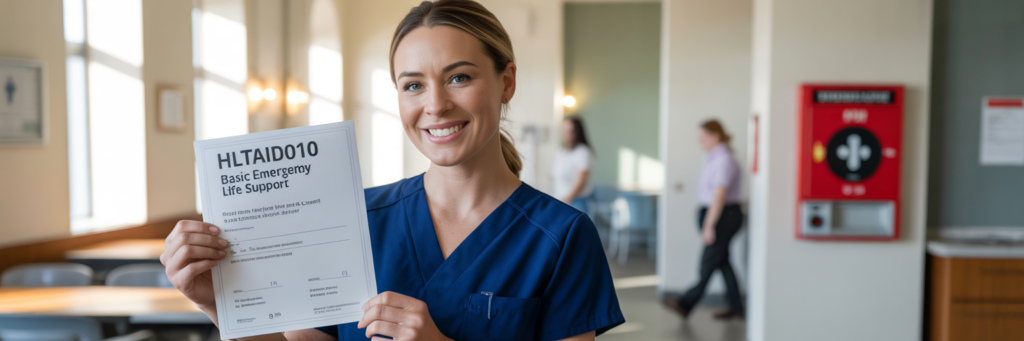
You know that feeling when you’re halfway through your shift and suddenly remember your first aid certificate expired last month?
I’ve heard that story about a hundred times from nurses and aged care workers. Usually starts with “I kept meaning to book” and ends with them frantically searching Google late on a Sunday night.
Here’s what actually happens: You get an email from HR about a compliance audit. Or your manager casually mentions certificate checks next week. And suddenly that renewal you’ve been putting off becomes the most urgent thing in your life.
This guide breaks down everything about getting your emergency life support certificate without the corporate nonsense or unnecessary panic. We’ll cover what the qualification involves, why it matters for your job, and how to get it done without disrupting your week.
Because here’s the thing – this isn’t really about learning CPR from scratch. Most healthcare workers already know the basics. This is about getting that piece of paper that proves you’re legally covered to do your job, rebuilding muscle memory you haven’t used in two years, and making sure you won’t freeze up if someone actually stops breathing on your watch.
What Is an Emergency Life Support Certificate?
The official name is HLTAID010 – Provide Basic Emergency Life Support, which is probably the most boring way possible to describe “the qualification that lets you handle medical emergencies without getting sued.”
Here’s what it actually covers: CPR, managing unconscious casualties, dealing with bleeding and shock, recognizing heart attacks and strokes, using an AED (that defibrillator box on the wall you walk past every day), and handling basic life-threatening situations until paramedics arrive.
The course includes HLTAID011 (CPR) automatically, so you don’t need to book two separate things. One course, one certificate, both qualifications. If your employer just says “you need basic life support” without specifying the code, this is what they mean.
Why Healthcare Workers Need HLTAID010 Specifically
AHPRA nursing requirements state you need current emergency response training. Aged care facilities require it for registration. Disability support organizations won’t let you work direct care without it. Even if you’re a specialist nurse who rarely encounters emergencies, your registration still depends on this certification being current.
But beyond the compliance stuff – and I know that’s probably why you’re here – there’s a genuine skill gap that develops when you haven’t practiced on a manikin in 18 months. You might intellectually remember “30 compressions to 2 breaths” but your hands forget how hard to push, where exactly to position your palms, how fast to compress. That hesitation in a real emergency costs seconds that actually matter.
The difference between HLTAID010 and just the CPR certificate (HLTAID011) comes down to scope. CPR certification teaches you cardiopulmonary resuscitation and basic AED use. HLTAID010 adds management of unconscious patients, severe bleeding, shock, anaphylaxis, and other life-threatening presentations. It’s the comprehensive package healthcare workers actually need.
How Long Does Your Certificate Last?
Three years for the HLTAID010 qualification itself. But – and this trips people up constantly – the CPR component (HLTAID011) is only valid for 12 months according to Australian Resuscitation Council guidelines.
So technically your HLTAID010 certificate shows a three-year expiry date, but most healthcare employers require annual CPR updates. Many nurses find it easier to just redo the whole course annually rather than tracking two different renewal schedules. Less paperwork, less confusion, and you’re practicing the full skill set yearly instead of just CPR.
National Recognition and Accreditation
Your certificate needs to come from a Registered Training Organization (RTO) to be valid. The RTO number should be visible on the provider’s website and on your certificate. Training.gov.au maintains the official register if you want to verify a provider before booking.
Once you’ve got a nationally recognized qualification, it’s valid across all Australian states and territories. Your certificate works in Sydney, Perth, or Darwin without needing requalification. Most overseas employers recognize Australian first aid qualifications too, though some countries require local certification for ongoing employment.
Check the RTO registration before you book anything. Certificates from non-registered providers are worthless – your employer won’t accept them, AHPRA won’t recognize them, and you’ve wasted your money and time on a piece of paper that means nothing.
Who Needs This Certificate?
Healthcare and Medical Professionals
Registered nurses and enrolled nurses need HLTAID010 for AHPRA requirements and employer insurance. Your facility’s accreditation depends on it.
Aged care workers need it even for non-clinical roles. You’re the first responder when someone chokes, falls, or shows stroke signs. The Aged Care Quality Standards require it.
Disability support workers, paramedics, and allied health professionals all face similar requirements for professional indemnity insurance and workplace compliance.
Childcare and Education
Childcare educators face strict ratios – at least one staff member with current first aid must be present with children at all times. ACECQA specifies HLTAID010 meets this requirement.
Family day care providers need it for registration. OSHC workers fall under the same regulations. Many schools make it mandatory for teachers and aides.
Community Services and Fitness
Youth workers, mental health support workers, and home care workers encounter emergencies regularly. You’re often the only person present when something goes wrong.
Personal trainers, gym instructors, sports coaches, and lifeguards need current certification. Industry bodies require it for registration.
Workplace Requirements
WorkSafe Queensland recommends sufficient trained first aiders based on workforce size. WHS officers and safety coordinators need it for their safety responsibilities.
🎓 Online Courses Don't Count: Fully online HLTAID010 doesn't legally exist. Anyone offering it entirely online is providing a certificate your employer won't accept. Physical skills assessment is a regulatory requirement — there's no way around it.
The HLTAID010 Course: What Actually Happens
Course Format
Face-to-face training is standard because Australian regulations require substantial hands-on practice. You can’t demonstrate CPR competency through a webcam. Physical skills need physical assessment.
Some providers offer “blended” courses where you complete theory online first, then attend a practical session. This works well for people with limited availability – you do the reading and videos at home, then just attend for hands-on practice. The practical component is still non-negotiable though.
Fully online HLTAID010 courses don’t exist legally. Anyone claiming you can get this qualification entirely online is lying or providing certificates that won’t be accepted by employers. The physical skills assessment is a regulatory requirement, not something providers can waive for convenience.
What You’ll Learn and Practice
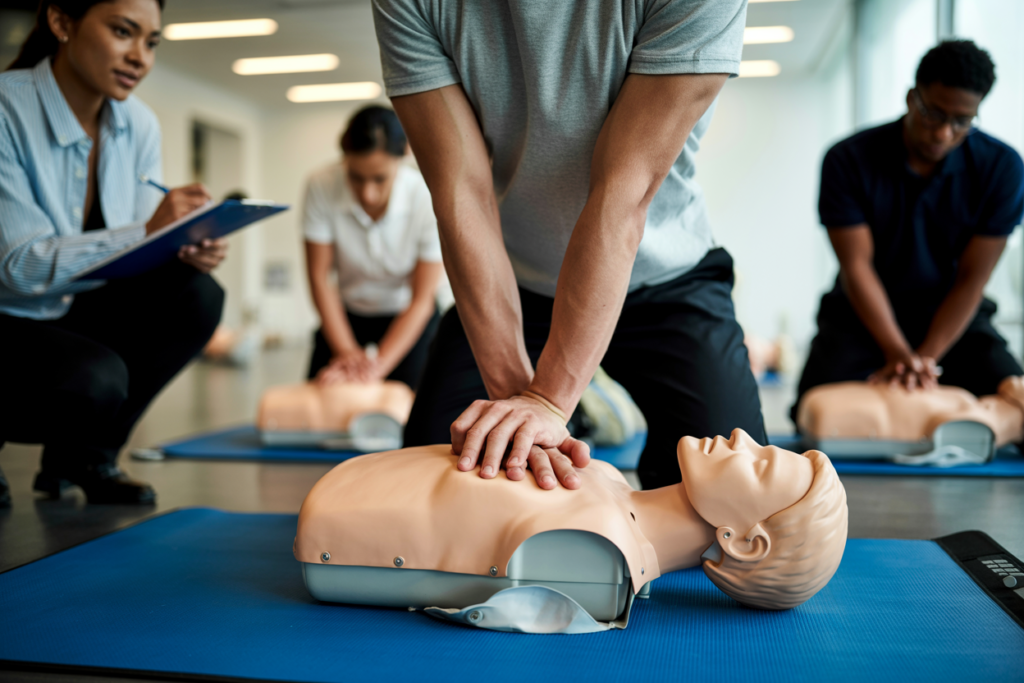
CPR and resuscitation forms the core content. You’ll practice on adult, infant, and child manikins because technique differs significantly based on casualty size. Hand position changes. Compression depth changes. Breath volume changes. Getting this wrong on a real person can cause harm instead of help.
You’ll do CPR until your arms hurt. Then you’ll do more. The repetition isn’t punishment – it’s building muscle memory so your hands know what to do when your brain is panicking because someone’s actually dying in front of you. Effective CPR is physically demanding work.
AED operation gets practiced on training defibrillators. You’ll learn how to turn it on, where to place the pads, when to stand clear, and why the machine is smarter than you about whether to shock or not. Modern AEDs walk you through the process with voice prompts, but you still need to know how to use them without freezing up.
Managing unconscious casualties covers checking responsiveness, recovery position, airway management, and monitoring vital signs. Simple in theory, harder when you’re trying to roll a 90kg dead weight into recovery position without dropping them on their face.
Severe bleeding control teaches direct pressure, pressure points, and bandaging techniques. You’ll practice on each other. Everyone feels awkward initially – you get over it fast when you’re focused on learning.
Shock management covers recognizing signs – pale skin, rapid pulse, confusion, cold extremities – and the appropriate response. Lie them down, elevate legs if no spinal injury, keep warm, monitor closely, get help fast.
Heart attack and stroke recognition focuses on warning signs people miss or dismiss. Chest pain radiating to the jaw. Sudden severe headache. Facial drooping. Slurred speech. Time-dependent symptoms where every minute of delay increases permanent damage.
Anaphylaxis response includes EpiPen demonstration and practice on trainer devices. Where to inject (outer thigh), how long to hold (three seconds), what to do after (call 000 immediately, don’t assume one shot fixes everything).
Assessment
You need to demonstrate competency in all required skills. This isn’t pass/fail like a university exam – you practice until you can perform each skill correctly, then demonstrate it to the instructor. If you’re not meeting the standard, you practice more and try again.
The CPR assessment requires you to perform continuous, effective CPR on an adult manikin. The instructor watches your hand position, compression depth (at least 5cm for adults), compression rate (100-120 per minute), and breathing technique. Your compressions need to be deep enough to be effective, but not so forceful you’re breaking ribs on the manikin.
Written assessment is basic knowledge checking. “What’s the emergency number in Australia?” “How many chest compressions between breaths?” “What does the D in DRSABCD stand for?” Stuff you’ll know from paying attention during training.
Failure rates are extremely low because instructors want you to pass. They’ll give you extra practice time, correct your technique, and reassess until you demonstrate competency. The course is designed to build skills, not fail people.
What to Bring
Comfortable clothes you can kneel in. You’ll be on the floor doing CPR, so tight jeans or short skirts make this unnecessarily difficult. Loose pants or activewear work best.
Enclosed shoes for safety. Sneakers, work shoes, casual flats. No thongs, sandals, or heels. You’re handling equipment, kneeling, moving around – open shoes create injury risks.
Water and snacks because you’ll be there all day and working physically. Some venues provide water, most don’t. Bring a refillable bottle.
Photo ID for certificate verification. Your license or passport works fine. Reading glasses if you need them for paperwork.
All training equipment is provided – manikins, AED trainers, bandages, everything you need to practice. You’re not buying your own equipment.
Getting Your Certificate
Digital Certificate Delivery
Most providers email your digital certificate within hours of course completion. The PDF has embedded security features – QR codes linking to RTO verification. It’s legally equivalent to a physical certificate.
Physical certificates arrive by mail if you want a hard copy. Completely optional – the digital version is all you legally need.
What Your Certificate Includes
Your full name exactly as shown on ID. Your unique student number. The qualification codes: HLTAID011 and HLTAID010. Issue and expiry dates (three years for HLTAID010, though CPR expires annually). The RTO’s name, logo, and registration number.
Storing Your Certificate
Save the digital certificate to multiple locations. Email to yourself. Save to cloud storage. Download to your phone. Keep it in multiple places because you’ll need it multiple times over three years.
Print a backup copy. Technology fails. A physical copy in a folder at home has saved many people from panicked certificate hunting.
Renewing Before Expiry
Book your renewal course before your current certificate expires. This gives buffer time if something goes wrong.
Set calendar reminders for 3 months before expiry, then 1 month before, then 2 weeks before.
⚠️ Expiry Reality Check: Grace periods don't officially exist. Your certificate expires on the date stated and you're non-compliant from that moment. Working with an expired certificate creates genuine professional liability. If something goes wrong during that gap period, your expired certification becomes a serious legal problem.
After Your Course: Maintaining Skills
Setting Up Renewal Reminders
Your certificate is valid for three years, but waiting until the last minute creates stress. Set phone calendar reminders for 6 months before expiry, 3 months before, and 1 month before.
If your workplace requires yearly CPR refreshers, you’re renewing something every 12 months even though the full HLTAID010 lasts three years.
Practicing Skills Between Courses
Skills degrade fast. Six months after your course, muscle memory gets fuzzy.
YouTube refresher videos from Australian Resuscitation Council or St John Ambulance keep the procedure fresh. Watch a short CPR video every few months.
Workplace practice sessions help if your employer offers quarterly refreshers.
Mental rehearsal works. Occasionally run through the DRSABCD sequence in your head – what you’d actually do if someone collapsed.
When Your Certificate Expires
Grace periods don’t exist. Your certificate expires on the date stated, and you’re non-compliant from that day forward.
Enforcement varies by employer. Some have zero tolerance. Don’t gamble on flexibility.
Re-certification after expiry requires completing the full course again. No quick renewal option.
Building Confidence for Real Emergencies
Some people complete the course feeling confident. Others leave thinking “I could probably do CPR if necessary but I really hope I never have to.” Both reactions are normal.
Mental simulation helps – imagining “what if someone collapsed right now?” Walking through the response sequence mentally builds cognitive pathways.
Real emergencies are messy and scary. The goal isn’t flawless execution – it’s taking appropriate action that gives the person a chance at survival.

Making the Most of Your Investment
Most people book HLTAID010 because they have to – employer requirement, compliance deadline. The mindset is “get the certificate and move on.”
But there’s genuine value beyond the piece of paper.
That moment when you can actually help someone instead of standing there useless while they die has real worth. A colleague chokes on lunch. You know exactly what to do because you practiced it months ago. That’s not compliance theatre – that’s meaningful skill that saved someone’s life.
Your four-year-old stops breathing at home. Every second counts and you’ve got muscle memory for pediatric CPR.
When Skills Get Used
Most healthcare workers encounter at least one legitimate emergency during their career.
Some nurses use CPR multiple times per year. Others work decades without performing resuscitation outside training. The unpredictability is exactly why the qualification matters.
The first real emergency after training is when theoretical knowledge meets reality. Your hands shake. Your heart pounds. Then muscle memory takes over and the training actually works.
Taking It Seriously
You can approach HLTAID010 as bureaucratic box-ticking – show up, get the certificate, move on.
Or treat it as genuine professional development – engage fully during training, practice skills between renewals, maintain capability beyond minimum compliance.
The difference shows up when emergencies happen. People who took training seriously respond more effectively than people who were physically present but mentally checked out.
Your Next Steps
If you’re reading this because your certificate is expiring soon or you need HLTAID010 for a new job, you know what to do. Book the course. Block out the time. Show up.
The perfect timing doesn’t exist. You’re busy now and you’ll be busy later. Book it anyway.
Choose a provider based on practical factors – convenient location, weekend availability, same-day certificate, decent reviews. HLTAID010 is a nationally standardized qualification. Any legitimate RTO delivers essentially the same content.
Your certificate matters less than the skills and confidence you develop. The piece of paper gets you through compliance audits. The actual capability keeps people alive when emergencies happen.
That’s the difference worth paying attention to.
Book Your First Aid Training Now
Fast, affordable, and nationally accredited training delivered by professionals who care
Frequently Asked Questions
Q.Is HLTAID010 the same as a basic first aid certificate?
Not quite. HLTAID010 is specifically the Basic Emergency Life Support qualification, while basic first aid usually refers to HLTAID011 (CPR only) or HLTAID012 (Provide First Aid). HLTAID010 sits between these, covering CPR plus extended emergency management skills like shock, severe bleeding, and anaphylaxis. It automatically includes HLTAID011, so you get both qualifications from a single course.
Q.Do I need HLTAID010 or HLTAID011 for my job?
If you work in healthcare, aged care, or disability support, HLTAID010 is almost certainly what you need. HLTAID011 covers CPR only and is the minimum for lower-risk roles. If your employer says "basic life support" without specifying a course code, show them the HLTAID010 outline for confirmation — it meets AHPRA requirements and Aged Care Quality Standards in a single qualification.
Q.How often do I need to renew my emergency life support certificate?
HLTAID010 has a three-year validity, but the CPR component technically expires every 12 months according to Australian Resuscitation Council guidelines. Most healthcare employers require annual CPR updates regardless, so many nurses just redo the full HLTAID010 course yearly to keep everything current without tracking two separate renewal schedules.
Q.What happens if my certificate has already expired?
You need to complete the full course again regardless of how recently it lapsed. There's no abbreviated renewal pathway for expired certificates — whether you're expired by one day or one year, the process is identical. Book in as soon as possible because working with an expired certificate creates professional liability exposure and puts your registration and employment at genuine risk.
Making first aid training more affordable for
every classroom
We believe every student deserves access to life-saving first aid knowledge. That’s why we offer specially reduced pricing for schools and educational groups. Whether you’re booking for a single class, a year group, or your entire school, our flexible packages make training more accessible and cost-effective — without compromising quality.
