

It’s 2:47am on a Tuesday night shift. An 81-year-old resident collapses in the hallway — no pulse, not breathing. Your hands are shaking as you drop to your knees and start compressions. But mid-push, a thought cuts through the noise like a cold blade: “My certification expired three weeks ago. Am I doing this right?”
That split-second of doubt is the nightmare that keeps thousands of Brisbane healthcare workers awake long after their shifts end. It’s what happens when the gap between what you know and what you’ve practiced gets too wide.
According to the Australian Resuscitation Council, delayed or ineffective emergency response in the first 3-5 minutes reduces survival chances by 10% with every minute that passes. For registered nurses, aged care workers, and allied health professionals across Brisbane, current emergency life support training isn’t just a box to tick. It’s the difference between confident, automatic action and a career-ending freeze in the worst possible moment.
In this guide, you’ll discover the eight key benefits of maintaining current HLTAID010 emergency life support training — from protecting your AHPRA registration to rebuilding the muscle memory that could genuinely save a patient’s life.
What Is Emergency Life Support Training?
Emergency life support training (HLTAID010 — Provide Basic Emergency Life Support) is nationally accredited training that teaches healthcare workers and first responders to manage life-threatening emergencies until paramedics arrive. The course covers CPR for all ages, AED operation, airway management, unconscious casualty management, and infection control protocols. HLTAID010 certification is valid for three years and satisfies AHPRA registration requirements for nursing professionals.
Benefit #1: Protect Your Professional Registration and Career
For registered nurses in Brisbane, current emergency life support training isn’t optional — it’s a mandatory requirement for AHPRA registration and continued employment. Expired HLTAID010 certification can trigger compliance audits, employment termination, professional sanctions, and in severe cases, suspension of your nursing registration.
The Nursing and Midwifery Board of Australia’s Code of Conduct specifies that nurses must “maintain knowledge and skills needed to provide safe and effective care.” Every Brisbane healthcare employer interprets this as requiring current emergency life support certification. During registration renewals or targeted audits, AHPRA can request evidence of professional development — and failure to provide it can result in conditional registration or worse.
Aged care facilities in Queensland operate under compliance frameworks enforced by the Aged Care Quality and Safety Commission. Standard 3 explicitly requires that staff are “appropriately skilled and qualified.” During unannounced audits, inspectors verify certification status on the spot. Staff with expired certification face immediate suspension from direct care duties until recertification is complete.
While protecting your registration provides legal security, the real value of emergency life support training goes deeper — it’s about knowing you can act decisively when a patient’s life hangs in the balance.
Benefit #2: Build Genuine Confidence for Real Emergencies
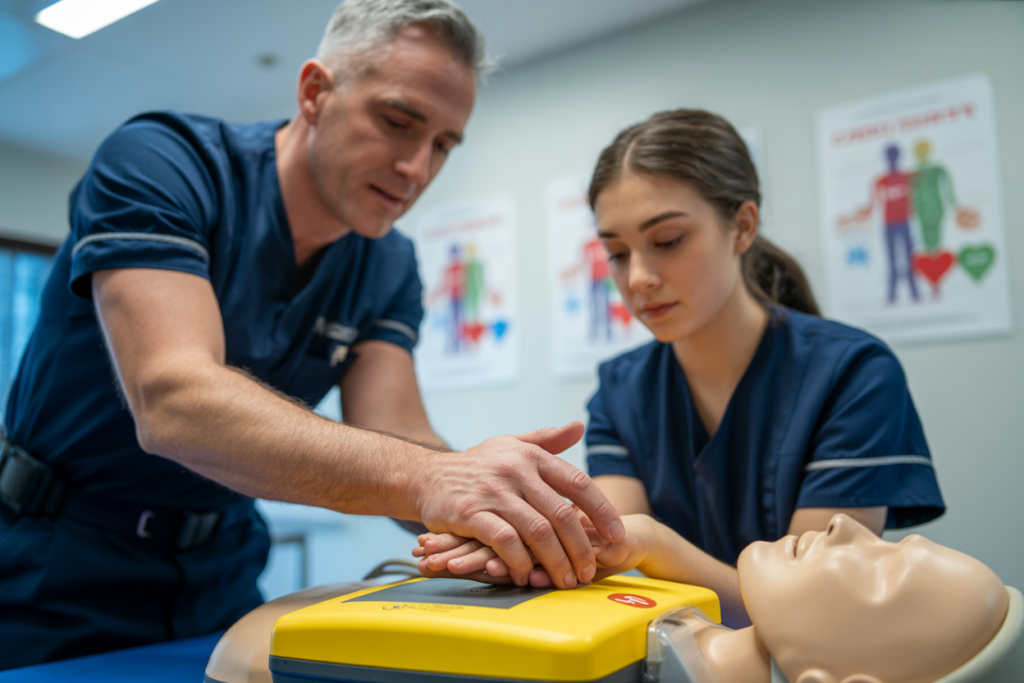
There’s a critical difference between knowing that CPR exists and having the confidence to perform it correctly under pressure. Many Brisbane healthcare workers carry a secret anxiety they’d never say out loud: “What if someone collapses and I freeze? What if I can’t remember the compression depth? What if I do it wrong?”
That fear is the natural result of the gap between theoretical knowledge and practical competence. Without hands-on practice, healthcare workers face critical hesitation points in real emergencies — second-guessing compression depth, hand placement, AED operation, and when to switch rescuers. These microsecond hesitations compound. Research from the Australian Resuscitation Council shows healthcare workers with current practical training average 15 seconds to first compression. Workers without recent hands-on practice take 3-4 minutes. That gap is often the difference between survival and death.
Studies on skill retention show CPR competence declines by approximately 50% within 6-12 months without practice. After 18 months, most healthcare workers perform compressions at inadequate depth and incorrect rates. Hands-on refresher training every three years isn’t just a compliance requirement — it’s a clinical necessity.
This confidence isn’t just personally satisfying — it’s also your strongest legal protection when emergency situations arise.
Benefit #3: Reduce Legal Liability and Professional Risk
As a healthcare professional in Queensland, you carry a legal duty of care that extends beyond your regular clinical responsibilities. Current emergency life support certification serves as your primary evidence that you’ve maintained the “reasonable standard of care” expected of a registered nurse. In legal proceedings — whether civil negligence claims, coronial inquests, or professional disciplinary hearings — the status of your HLTAID010 certification can be the difference between defensible practice and indefensible negligence.
Current certification demonstrates you maintained knowledge of Australian Resuscitation Council guidelines, shows compliance with Queensland healthcare worker standards, and protects your professional indemnity coverage — expired certification can void that coverage entirely.
There’s a critical legal distinction worth understanding. If an incident occurs while your certification is current and you follow the protocols learned in training, you’re legally protected even if the outcome is negative. But if your certification is expired, the plaintiff doesn’t need to prove poor technique. Expired certification alone can establish negligence.
Beyond protecting yourself legally, current emergency life support training directly impacts the most important measure of all: patient survival.
⚖️ Legal Reality Check: In a coroner's investigation, "My certification had only been expired for 3 weeks" is not a defense. Current certification is binary: you're either compliant or you're not.
Benefit #4: Improve Patient Outcomes and Survival Rates
The ultimate purpose of emergency life support training isn’t compliance, career protection, or legal liability — it’s saving lives. Patients who receive immediate, high-quality CPR from a trained healthcare responder have survival rates up to 70%, compared to approximately 10% when CPR is delayed or not attempted. In Brisbane aged care facilities and healthcare settings, the difference between a nurse with current training versus expired certification can literally determine whether a patient survives.
When a patient experiences cardiac arrest, brain damage risk begins within 1-3 minutes. By 4-6 minutes, that damage becomes permanent. Queensland Ambulance Service averages 8-12 minutes to reach urban Brisbane addresses. The mathematics are stark — there’s a window where only immediate bystander CPR prevents death or permanent disability, and that window belongs entirely to whoever is standing in the room.
Quality of compressions matters as much as speed. Healthcare workers with current training achieve adequate compression depth on 89% of compressions. Workers with expired training achieve it on just 34%. Patients receiving high-quality CPR have 40% better outcomes than those receiving poor-quality CPR — even when both responses start at exactly the same time.
These improved outcomes aren’t accidental — they’re the result of training based on the latest evidence-based resuscitation guidelines.
Benefit #5: Stay Current with Latest Resuscitation Guidelines
Emergency medicine isn’t static. The Australian Resuscitation Council updates its evidence-based guidelines every 3-5 years, incorporating findings from thousands of cardiac arrest cases worldwide. If you completed your HLTAID010 in 2022, you learned protocols that have since been modified. Critical details — compression ratios, AED protocols, ventilation techniques, and infection control measures — change as research reveals more effective approaches.
Significant updates between 2021 and 2025 include expanded compression-only CPR application, permanently integrated COVID-19 infection control protocols, updated AED technology guidance, refined anaphylaxis technique, and simplified pediatric CPR ratios that reduce cognitive load in high-stress responses. Each change is backed by research showing measurably better patient outcomes — and each is something you’d only know about if your training is current.
Three-year recertification isn’t arbitrary bureaucracy. It’s how Brisbane healthcare workers stay aligned with the most effective, evidence-based techniques available.
Maintaining currency with these evolving guidelines doesn’t just make you more effective — it makes you more valuable to employers.
Benefit #6: Enhance Your Professional Value and Career Opportunities
In Brisbane’s competitive healthcare employment market, current HLTAID010 certification has evolved from a basic requirement into a career differentiator. Whether you’re a new graduate competing for limited positions, an experienced nurse seeking promotion to Nurse Unit Manager, or a healthcare professional considering the paramedic pathway, emergency life support training enhances your professional value well beyond minimum compliance.
How you approach certification renewal signals professional attitude to every employer who reviews your file. Nurses who schedule renewal proactively and build a broader emergency certification portfolio demonstrate the commitment that leadership roles demand. Brisbane healthcare recruiters notice this when reviewing applications for Nurse Unit Manager and Clinical Educator positions — with 78% of NUM postings requiring Advanced First Aid and 89% of aged care manager roles requiring a comprehensive emergency certification portfolio.
The nurses who move into these roles faster aren’t necessarily more talented than their peers. They’re the ones who treated their training as a career investment rather than a compliance chore. For healthcare workers considering Queensland Ambulance Service, HLTAID010 signals to QAS assessors that you take emergency response seriously and provides the practical experience that competency-based interviews demand.
Of course, career advancement only matters if you can actually access training around your demanding schedule.
🎯 Career Insight: When two candidates apply for Nurse Unit Manager with identical experience, current HLTAID010 and Advanced First Aid certification can be the deciding factor.
Benefit #7: Access Flexible Training Options for Shift Workers
Brisbane’s healthcare workforce operates on rotating rosters that change monthly with minimal notice. Traditional Monday-Friday courses exclude most shift workers entirely. Even weekend courses become problematic when rosters change days before your booked date and a rigid cancellation policy hits you with a deposit loss.
Quality emergency life support training providers recognise this. Weekend courses every Saturday and Sunday, flexible rescheduling, and same-day digital certificate delivery are the non-negotiables for training that actually works around shift work.
Same-day certificate delivery matters more than most people realise until they need it. Completing training Friday and waiting until Wednesday for your certificate means you’re non-compliant during a Monday morning audit. A digital certificate delivered within hours of completing the course eliminates that gap entirely.
Free rescheduling removes the biggest booking objection for shift workers. Book with confidence even when your roster isn’t confirmed. If it changes, reschedule to any future date with 48 hours notice — no fees, no penalties, no awkward conversations.
When training is this accessible and flexible, there’s no reason to carry the psychological burden of expired or soon-expiring certification.
Benefit #8: Gain Peace of Mind and Reduce Professional Anxiety
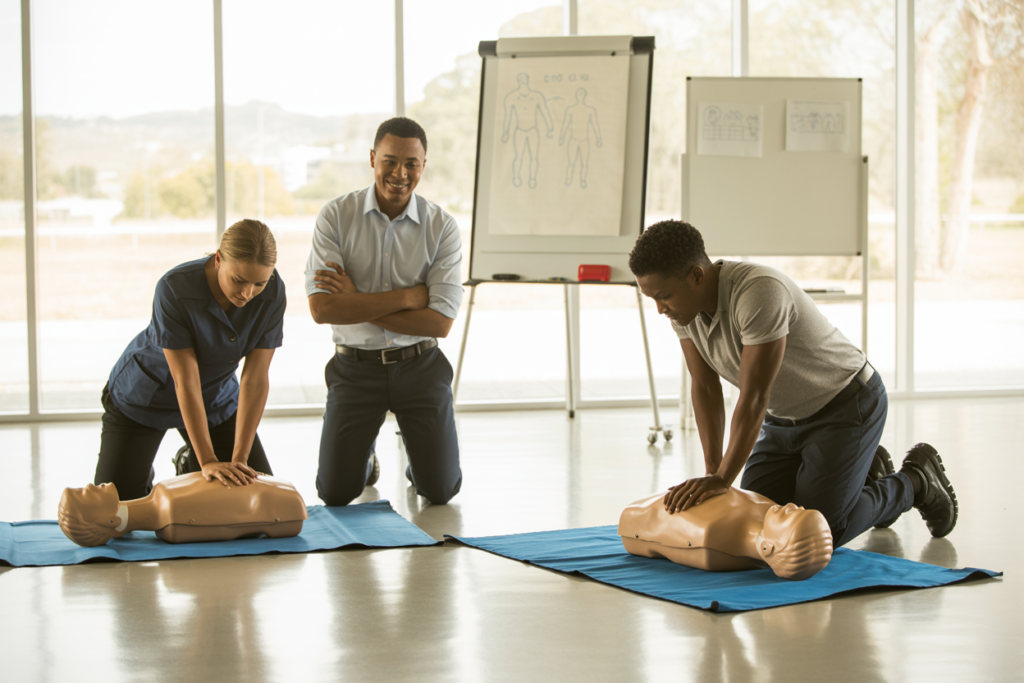
Beyond compliance and legal protection, current emergency life support training delivers a benefit that’s rarely discussed but deeply felt: psychological relief. The constant low-grade anxiety of expired or expiring certification — the 3am worry about AHPRA audits, the stress of knowing you’re not as prepared as you should be, the professional shame of letting credentials lapse — creates genuine burden that accumulates quietly over time.
Healthcare workers describe this anxiety as “always there in the background,” affecting job satisfaction, confidence, and sleep. It shows up as scanning hallways wondering what would happen if someone collapsed, quietly hoping a colleague responds first, and avoiding promotion applications out of fear that certification verification will expose the gap.
One Brisbane nurse described it this way: “I knew my certificate expired in three weeks, but I kept putting off booking. Every shift, I’d see our AED and feel this knot in my stomach. I couldn’t focus on patient care because I was constantly worried about what would happen if someone coded. The anxiety was exhausting.”
The transformation following recertification is immediate. Healthcare workers consistently describe it as a weight lifting the moment that digital certificate arrives. Background anxiety dissolves. Professional identity restores. And the shift from “I hope nothing happens tonight” to “I know exactly what to do if something happens” is a fundamental change in how you show up to work every single day.
Healthcare workers with current certifications report 34% higher job satisfaction and 28% lower burnout symptoms compared to those with expired or expiring credentials. That’s the difference between a career that feels sustainable and one that quietly grinds you down.
😌 Sleep Better Tonight: Imagine waking up Monday knowing your certification is current for the next 3 years. No audit anxiety. No compliance fear. No professional shame.
Book Your Emergency Life Support Training Today
The eight benefits of emergency life support training extend far beyond a compliance checkbox. Current HLTAID010 certification protects your AHPRA registration, builds genuine confidence to act decisively in emergencies, reduces your legal liability, directly improves patient survival outcomes, keeps you current with evidence-based guidelines, enhances your career value, provides flexible training that works around shift work, and delivers the psychological peace of mind that comes from knowing you’re prepared, protected, and professional.
Don’t wait until your certificate expires, until your employer announces a compliance audit, or until that 3am shift when someone collapses and you freeze. Book your HLTAID010 course this weekend. Receive your digital certificate the same day. Walk into Monday’s shift knowing you’re compliant, capable, and confident.
Your patients deserve a healthcare professional who’s prepared. Your family deserves the job security that comes from continuous compliance. And you deserve the peace of mind that comes from knowing you can act when it matters most.
Book Your First Aid Training Now
Fast, affordable, and nationally accredited training delivered by professionals who care
Frequently Asked Questions About Emergency Life Support Training
Q.What is HLTAID010 and who needs it?
HLTAID010 (Provide Basic Emergency Life Support) is the nationally accredited emergency response certification required for registered nurses, enrolled nurses, aged care workers, and allied health professionals across Australia. It covers CPR for all ages, AED operation, airway management, and anaphylaxis response — and it satisfies AHPRA registration requirements and aged care compliance standards under the Aged Care Quality and Safety Commission framework. If you work in any clinical or care setting in Brisbane, HLTAID010 is not optional.
Q.How long is HLTAID010 certification valid?
HLTAID010 certification is valid for three years from the date of course completion, with your exact expiry date printed on your certificate. The Australian Resuscitation Council recommends annual CPR skill refreshers to maintain competence between formal recertifications, but the certification itself covers the full three-year period. Most Brisbane healthcare employers and AHPRA expect renewal to be completed before the expiry date — there is no grace period, so booking 2-3 months ahead is the safest approach.
Q.What's the difference between HLTAID010 and HLTAID011?
HLTAID010 (Provide Basic Emergency Life Support) is the more comprehensive qualification that includes all the content of HLTAID011 (Provide CPR) plus additional emergency response skills relevant to healthcare environments. If you complete HLTAID010, you do not need to separately complete HLTAID011 — the higher-level course supersedes it entirely. For nurses and aged care workers, HLTAID010 is always the right choice because it covers the broader clinical scenarios you're actually likely to face on the job.
Q.What happens if my HLTAID010 certification expires?
The moment your HLTAID010 expires, you are non-compliant with AHPRA registration requirements and your employer's policies — there is no grace period. Most Brisbane healthcare facilities respond with immediate suspension from clinical duties, often without pay, until recertification is complete. If a patient incident occurs during an expired period, your certification status becomes a central factor in any coronial inquest, negligence claim, or AHPRA investigation. You also can't backdate certification — a full recertification course is required from scratch.
Q.Can emergency life support training be done online?
No — HLTAID010 cannot be completed entirely online, and any provider claiming otherwise is not delivering a nationally accredited qualification. Australian regulations require hands-on face-to-face practical training because CPR compressions, AED operation, and airway management are physical skills that require manikin practice and real-time instructor feedback. Some providers offer online pre-learning for theory components before the practical day, which is a good use of time — but the assessment itself must always be conducted in person with a qualified instructor present.
Making first aid training more affordable for
every classroom
We believe every student deserves access to life-saving first aid knowledge. That’s why we offer specially reduced pricing for schools and educational groups. Whether you’re booking for a single class, a year group, or your entire school, our flexible packages make training more accessible and cost-effective — without compromising quality.
