
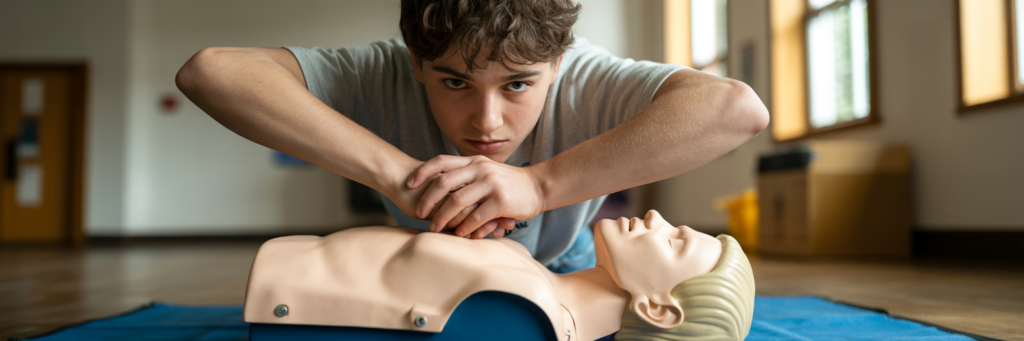
“Can my 14-year-old babysitter get first aid certified?”
“Is my son too young to take a CPR course?”
These are questions parents and educators ask us daily. The short answer: the minimum age for most first aid courses in Australia is 14 years old, but there’s more to know before booking.
Here’s the thing – I’ve watched plenty of 14-year-olds sail through first aid certification while some adults struggle. Age is just one piece of the puzzle. What really matters is whether your teen’s ready physically, mentally, and whether they actually want to be there.
Whether you’re a parent wanting your teenager prepared for babysitting responsibilities, a school coordinating youth first aid training, or a young person eager to learn life-saving skills, understanding age requirements means you won’t waste time or money booking the wrong course.
Let’s get into it.
What Is the Minimum Age for First Aid Courses in Australia?
The minimum age for standard first aid certification (HLTAID011 Provide First Aid) in Australia is 14 years old. However, age requirements vary by course type, and there’s some flexibility depending on the training provider.
Here’s how it breaks down:
Standard First Aid Courses:
- HLTAID011 (Provide First Aid): 14 years minimum
- HLTAID009 (CPR): 14 years minimum
- HLTAID010 (Basic Emergency Life Support): 14 years minimum
Considerations for Young Learners:
- Students aged 14-17 may need parental consent
- Physical ability to perform CPR compressions is assessed
- Comprehension of medical terminology is required
- Some RTOs (Registered Training Organisations) set their minimum at 15 or 16
For children under 14, modified youth first aid programs are available that teach age-appropriate emergency response skills without formal certification.
The 14-year age minimum isn’t random – it’s based on cognitive development, physical capability, and the legal framework around nationally recognized training. But just because someone’s 14 doesn’t automatically mean they’re ready.

Why Age Requirements Exist
Standard First Aid Certifications (Ages 14+)
The baseline for getting nationally recognized first aid certification in Australia is 14 years old. This applies to the main courses most people need.
According to Safe Work Australia guidelines and the Australian Skills Quality Authority (ASQA) standards, 14 is the age where most students have developed:
- The physical strength to perform effective CPR compressions (5-6cm depth on an adult)
- The cognitive ability to understand medical terminology and emergency protocols
- The maturity to handle high-pressure scenarios and make decisions
- The reading comprehension to process course materials and assessment questions
While the national standard says 14, individual RTOs can set their own minimums higher if they choose. And plenty do.
Why Some Providers Set Higher Age Limits (15-16 Years)
You’ll find some training providers that won’t accept students under 16. Others stick to 14. Why the variation?
Insurance considerations – Some providers have insurance policies that specify 16+ only. Their insurer has decided that’s the cutoff for acceptable risk.
Class dynamics – When you’ve got 14-year-olds alongside 40-year-olds, the learning pace and maturity levels can clash. Some providers prefer keeping classes 16+ to maintain what they call a “mature learning environment.”
Physical assessment concerns – CPR requires sustained physical effort. Some providers figure it’s easier to set the bar at 16 rather than assess each 14-year-old individually.
RTO discretion – Each Registered Training Organisation has discretion to set age limits above the national minimum.
If you’re booking for a teenager, always check the provider’s specific age policy before you pay. Don’t assume 14 is universally accepted just because it’s the national minimum.
✅ Reality Check: The success rate for teenage students is 95-98% — actually higher than adults. Younger brains absorb information faster, and teenagers often have better physical capability than older students.
Physical and Cognitive Requirements Beyond Age
Physical Capabilities Needed
Age is one thing. Physical ability is another. I’ve seen 15-year-olds who breeze through CPR and 30-year-olds who struggle.
Here’s what students actually need to do:
CPR compression requirements – You need to push down 5-6cm on an adult mannequin. Your arms will burn. Your shoulders will ache. And you need to maintain that depth and pace (100-120 compressions per minute) even when you’re tired.
Most 14-year-olds can do this. It’s not a strength issue as much as a technique and endurance thing. Smaller teenagers sometimes struggle initially because they’re trying to use arm strength instead of body weight. Once instructors show them how to position themselves and use their whole body, they usually get there.
Kneeling and positioning – You’ll spend time on your knees during the practical components. If your teen has knee issues or can’t kneel comfortably for extended periods, mention this to the instructor beforehand. There are modified positions available.
Manual dexterity for bandaging – Applying pressure bandages, triangular bandages, and roller bandages requires decent hand coordination. Teenagers generally have no issues here.
According to Australian Resuscitation Council guidelines, effective CPR is what matters – not the person’s age or size. Research shows that teenagers who use proper technique achieve compression depths comparable to adults. It’s about positioning and using your body weight, not raw strength.
Cognitive and Comprehension Requirements
Reading and comprehension – First aid courses throw medical terminology at you. Anaphylaxis. Ischemic heart disease. Haemorrhage. DRSABCD protocol. Students need to read course materials, understand what they mean, and retain that information for assessment.
Most 14-year-olds handle this fine – they’re doing Year 8 or 9 schoolwork that’s arguably more complex. But if your teenager struggles with reading comprehension or has learning difficulties, that’s worth mentioning. Instructors can provide additional support.
Scenario assessment and decision-making – During practical assessments, instructors present scenarios: “You find someone collapsed in a park. They’re unconscious. What do you do?” Students need to work through DRSABCD, make decisions about calling 000, and explain their reasoning.
This isn’t about memorizing responses. It’s about thinking through emergencies logically.
Following multi-step emergency protocols – CPR isn’t just “push on chest.” Students need to remember steps and execute them in order. Teenagers are actually pretty good at this. They’ve grown up with multi-step processes in everyday life.
Here’s what I’ve noticed: teenagers who are actually interested in first aid retain information better than adults who are just there for compliance. Motivation matters more than age. A 14-year-old who wants to be a lifeguard or babysitter is going to absorb this stuff better than someone who’s only there because their boss said they had to be.
The success rate for teenage students is actually quite high – around 95-98% pass on their first attempt.
Benefits of Early First Aid Education
Getting kids into first aid before they’re old enough for certification isn’t just about filling time.
Builds confidence and responsibility – There’s something powerful about a 10-year-old knowing what to do if their little brother cuts himself. That knowledge creates confidence.
Prepares for formal certification at 14+ – Kids who’ve done youth programs breeze through proper certification courses when they’re old enough. The terminology is familiar. The concepts make sense.
Creates safety-aware children – First aid training teaches kids to assess situations for danger, think about consequences, and avoid risky behavior. These are life skills beyond first aid.
If your 10-year-old is keen to learn, get them into a youth program now. Don’t make them wait until 14.
Special Considerations for 14-17 Year Old Students
Parental Consent Requirements
Even though 14 is old enough to take the course, it’s not old enough to book it themselves. You’re dealing with a minor, which means paperwork.
Parental consent forms – Every RTO requires parental or guardian consent for students under 18. The form typically covers:
- Permission for your teenager to participate in training
- Acknowledgment of physical requirements
- Medical information (allergies, physical limitations, conditions)
- Emergency contact details
USI (Unique Student Identifier) requirements – Every student needs a USI to complete nationally recognized training. For students under 18, you’ll need to create one on their behalf. It takes about 5 minutes online.
Preparing Teenagers for Success
Age eligibility is one thing. Being actually ready is another. Here’s how to set your teenager up for success.
Pre-course study materials – Most RTOs provide digital study materials before the course. Students who spend even 30 minutes reviewing materials beforehand find the course way less overwhelming.
You don’t need to memorize everything. Just familiarize yourself with terms like DRSABCD, know what CPR stands for, understand the basic structure of first aid response.
Setting realistic expectations – The course IS intensive. There IS an assessment. But the pass rate is 98%. As long as you pay attention and try your best, you’ll be fine.
Physical preparation tips – Practice kneeling positions at home. If your teenager’s knees hurt, they might want to wear long pants on course day.
Wear comfortable clothes. You’re going to be moving around, kneeling, positioning yourself different ways.
Addressing performance anxiety – The assessment is one-on-one with the instructor, not in front of the whole class. Instructors don’t assess you until they’re confident you’ll pass.
Why Teenagers Seek First Aid Certification
Understanding why your teenager wants certification helps you know if they’re ready. Motivated students pass. Unmotivated students struggle.
Babysitting requirements – Parents looking for babysitters want someone first aid certified. “First Aid Certified” immediately makes parents more comfortable hiring them.
School volunteer programs and camp counselor roles – Many schools require first aid certification for student volunteers on camps, excursions, or sports teams.
Bronze Medallion prerequisites – Surf Life Saving Bronze Medallion has first aid as a prerequisite. You can’t even start Bronze training without current first aid certification.
Duke of Edinburgh Award requirements – Students doing Duke of Ed need first aid knowledge for the adventurous journey component.
Early career preparation – Teenagers thinking about careers in teaching, nursing, fitness, emergency services, or childcare know they’ll need first aid eventually.
The pattern I see: teenagers who choose to do first aid (versus being forced by parents) get way more out of it. If your teenager’s rolling their eyes about the whole thing, maybe wait a year. If they’re genuinely interested, book them in.
🎯 Readiness Check: If your teenager can kneel comfortably, follows instructions well, can focus for extended periods, and genuinely wants to do the course — they're ready. Age is just a number; motivation and capability matter more.

Is Your Teenager Ready?
Quick Readiness Assessment
Run through this checklist honestly:
Physical Readiness:
- Can kneel comfortably for extended periods
- Has reasonable upper body strength
- Can sustain physical activity with breaks
- No injuries that would prevent CPR practice
- Comfortable with hands-on learning
Cognitive Readiness:
- Reading comprehension at or above Year 8 level
- Can follow multi-step instructions
- Understands basic medical concepts
- Can focus on learning for extended periods
- Asks questions when confused
Emotional Readiness:
- Genuinely wants to do the course (not being forced)
- Comfortable in adult learning environments
- Can handle constructive feedback
- Willing to practice in front of others
- Not overly anxious about assessment
If you ticked most boxes: Your teenager’s ready.
If you ticked fewer boxes: Consider waiting six months to a year.
Red Flags That Suggest Waiting
They’re completely uninterested – If your teenager’s rolling their eyes and making it clear they don’t want to be there, don’t force it. Wait until they have a reason to care.
They can’t focus without constant phone access – If your teenager cannot go 90 minutes without checking social media, they’re not ready. The course requires sustained focus.
They have severe test anxiety – Some teenagers completely fall apart during assessments. Talk to the training provider about accommodations, or wait until they’ve developed better coping strategies.
Conclusion
The first aid course minimum age of 14 years isn’t an arbitrary number – it’s based on when most young people have developed the physical capability, cognitive understanding, and emotional maturity to handle emergency response training.
What matters more than your teenager’s birthdate is their motivation, preparation, and genuine interest in learning life-saving skills. A motivated 14-year-old will outperform an unmotivated 17-year-old every time.
If your teenager has a reason to get certified – babysitting, Bronze Medallion, volunteer work, career preparation, or personal interest – don’t make them wait. The earlier they learn these skills, the more confident and capable they become.
First aid certification at 14 or 15 isn’t just about ticking a box for employment requirements. It’s about empowering young people to respond effectively in emergencies, building their confidence, and teaching them they’re capable of handling serious situations.
The course day will be intensive. Your teenager will be tired. They might be nervous. But they’ll walk out certified, capable, and proud of what they’ve achieved.
Your teenager’s ready. Let’s get them certified.
Book Your First Aid Training Now
Fast, affordable, and nationally accredited training delivered by professionals who care
Frequently Asked Questions
Q.Will my teenager's certificate look different because they're young?
No, the certificate is identical regardless of age. It shows their name, course completed (HLTAID011), date, and expiry - there's no indication they were 14 versus 40 when they completed it. A 14-year-old with current HLTAID011 certification meets exactly the same first aid requirements as an adult with the same qualification.
Q.What if my teenager can't physically do CPR compressions?
About 95% of teenagers aged 14+ can perform effective CPR once they learn proper technique - the issue is usually technique rather than strength. Instructors assess this during practice time and can demonstrate modified positions if needed, and as long as effective compressions are achieved, technique can be adapted for individual physical limitations.
Q.Do teenage students have lower pass rates than adults?
Actually the opposite - teenage pass rates are 96-98%, which is higher than adult pass rates of 93-95%. Younger students often learn faster, have better retention, more physical capability, and less performance anxiety because they're used to being assessed constantly at school.
Q.How long does the certification last for teenagers?
Same as adults - three years for full first aid (HLTAID011), with the CPR component requiring annual renewal. If your teenager gets certified at 14, their full qualification is valid until 17, though the CPR component needs renewal at 15 and 16 through the shorter HLTAID009 course.
Q.Can my teenager use their first aid certificate for employment?
Yes, HLTAID011 is nationally recognized and accepted by employers regardless of when the student obtained it. Whether they're 14 or 40, the certification meets the same first aid requirements, and many teenagers successfully use their certification for babysitting, camp counseling, and part-time work.
Q.Does my teenager need parental permission to book the course themselves?
Yes, anyone under 18 requires parental or guardian consent to enroll in nationally recognized training - they can't legally sign their own consent forms or training agreements. Even if your 16 or 17-year-old is working and paying for the course themselves, you still need to provide written consent as their parent or legal guardian.
Making first aid training more affordable for
every classroom
We believe every student deserves access to life-saving first aid knowledge. That’s why we offer specially reduced pricing for schools and educational groups. Whether you’re booking for a single class, a year group, or your entire school, our flexible packages make training more accessible and cost-effective — without compromising quality.
