
Have you been meaning to book a first aid course for months, maybe years but keep putting it off because you’re not quite sure what you’re actually signing up for?
You’re not alone. For most people attending their first first aid course, the biggest barrier isn’t time or cost. It’s not knowing what to expect when they walk through the door. Will it be a full day of dry theory? Will they be put on the spot in front of strangers? Is it going to be overwhelming?
The short answer: no, no, and definitely not.
A first aid course with First Aid Alive is a practical, welcoming, and genuinely enjoyable experience designed for everyday Australians, not just healthcare professionals. Whether you’re a parent who wants to feel prepared at home, a tradie who needs their ticket before a site start, or someone who simply wants the confidence to act in an emergency, this guide covers exactly what happens on the day. From the moment you arrive to the moment you walk out certified.
Here’s what to expect.
What Happens at a First Aid Course?
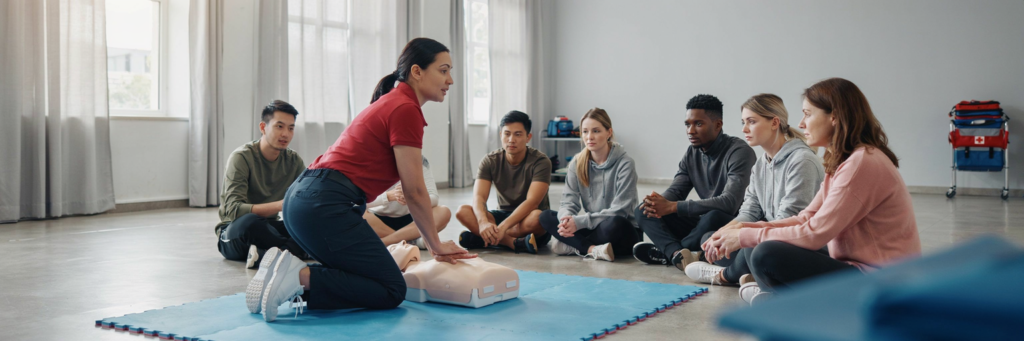
A first aid course covers the essential knowledge and hands-on skills needed to respond confidently in an emergency. Here’s what typically happens on the day:
- Sign-in and welcome — Registration, introduction to your trainer, and a quick overview of the day.
- Theory component — Short, plain-English sessions covering emergency response, CPR, AED use, choking, bleeding, and shock management.
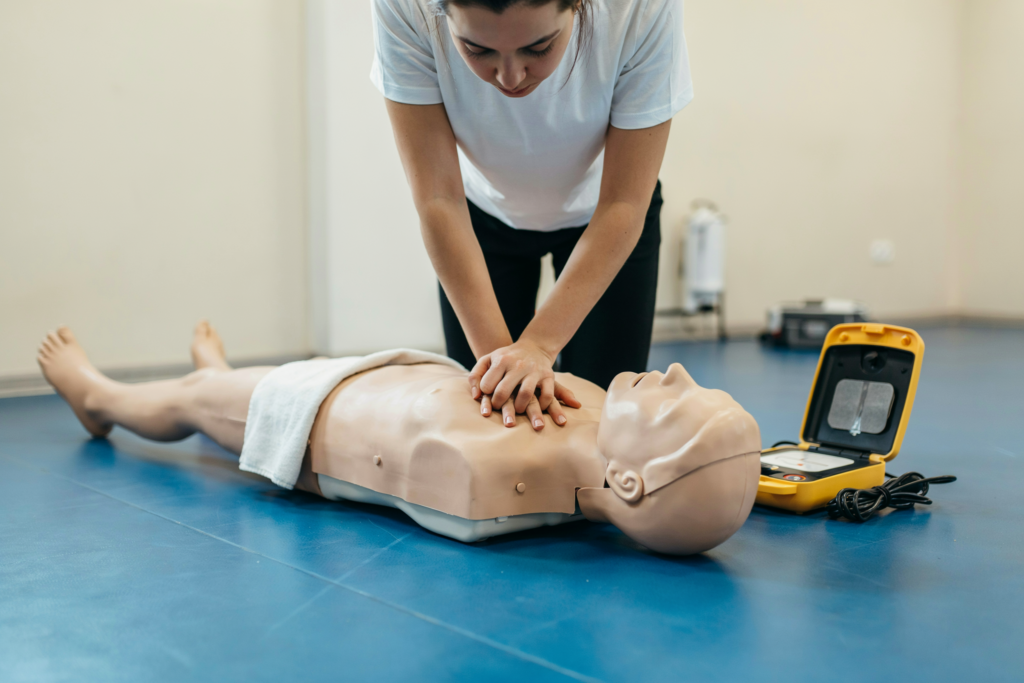
- Practical skills — Hands-on manikin CPR, bandaging, recovery position, and defibrillator practice.
- Assessment — A straightforward, low-pressure skills demonstration observed by your trainer.
- Certification — Upon successful completion, your nationally recognised statement of attainment is issued by First Aid Alive, a registered training organisation.
What Is a First Aid Course and Who Is It Actually For?
Here’s something a lot of people get wrong about first aid training: they assume it’s for someone else. A nurse. A paramedic. Someone who already knows what they’re doing.
It’s not.
HLTAID011 Provide First Aid is Australia’s nationally recognised standard first aid certificate, and it was built for everyday people. Parents, tradies, teachers, office workers, community volunteers. People with zero medical background who just want to know what to do if something goes wrong. Trainers at First Aid Alive start from the absolute basics, so you don’t need any prior knowledge or experience to walk in and get a lot out of the day.
The course sits within the Health Training Package and is recognised across every Australian state and territory. It’s the same qualification whether you’re doing it in Brisbane, Cairns, or Perth which matters when your employer, your industry regulator, or a government body like ACECQA needs to verify your credentials.
Who Should Do a First Aid Course?
Pretty much anyone but here’s who tends to benefit most:
- Parents and carers of young children
- Tradies, construction workers, and site staff
- Workplace designated first aiders
- Teachers, educators, and school staff
- Community volunteers and sporting club officials
- Anyone who wants genuine confidence in an emergency
HLTAID011 vs HLTAID009 Which One Do You Need?
If you’re not sure which course applies to you, this is the question most people have. The short version: HLTAID009 is CPR only, and HLTAID011 is the full first aid package that includes CPR. Most workplaces, schools, and regulators require HLTAID011 but if you already hold a current HLTAID011 and just need your annual CPR refresh, HLTAID009 is what you’re after.
HLTAID009 Provide CPR | HLTAID011 Provide First Aid | |
What’s covered | CPR + AED use | CPR + AED + full first aid skills |
Certificate validity | 1 year recommended | 3 years |
Who needs it | Annual refresher for existing first aiders | Anyone requiring a full first aid certificate |
Both courses are delivered in line with current Australian Resuscitation Council (ARC) guidelines so you can be confident that what you’re learning reflects the latest clinical standards.
Now that you know what HLTAID011 covers and whether it’s the right course for you, here’s exactly what to pack before you arrive.
What to Bring to Your First Aid Course
One of the easiest ways to feel more relaxed on the day is to know you’ve got everything sorted before you arrive. There’s nothing worse than showing up and realising you’ve forgotten your ID or you’re wearing a work shirt that makes it impossible to get down on the floor for CPR practice.
The good news is the list is short.
What to Pack
- Comfortable clothing suitable for floor-based practical work — you'll be kneeling, bending, and getting down on the ground for manikin CPR, so leave the dress pants at home.
- Photo ID for registration.
- Any relevant medical information — if you have a knee injury, a bad back, or any mobility consideration, flag it at the time of booking so your trainer can accommodate you on the day.
- A water bottle and snacks — there are breaks throughout the day but you'll want to stay fuelled.
- Your confirmation email or booking reference.
That’s genuinely it.
What First Aid Alive Provides on the Day
You don’t need to bring any equipment or materials. First Aid Alive takes care of everything:
- Adult, child, and infant manikins for CPR practice.
- AED trainer devices — realistic to use, no live electricity.
- Bandages, gloves, and wound care materials.
- All course workbooks and reference materials.
- A welcoming, well-equipped training environment.
Do I Need to Study Beforehand?
If you’re the type who likes to feel a step ahead, a quick read of what DRSABCD stands for is about as far as you need to go and you’ll cover that in the first session anyway.
Bag packed and ready? Here’s a step-by-step walkthrough of exactly how your course day unfolds from the moment you walk in to the moment you walk out certified.

A Step-by-Step Guide to Your First Aid Course Day
A lot of first-time attendees say the same thing after their course: “I don’t know why I was nervous. That was actually really good.” And that tracks because when you know what’s coming, the anxiety disappears pretty quickly.
Here’s exactly how the day unfolds.
Arrival and Registration
When you walk in, you’ll be greeted by your trainer and signed in for the day. There’s a registration process name, contact details, booking confirmation and you’ll get a quick introduction to how the day is structured. Think of it less like arriving at an exam and more like showing up to a hands-on workshop. The atmosphere is relaxed. People are usually a mix of curious and slightly nervous, and that’s completely normal.
Group sizes at First Aid Alive are kept small so you’re not just a face in a crowd. Your trainer knows who’s in the room and can adjust the pace and content based on the group.
The Theory Component
This is the part people tend to dread most, and it’s almost never as bad as they expect.
Theory at First Aid Alive isn’t delivered as hours of PowerPoint slides read out loud by someone who’d rather be somewhere else. It’s short, focused, and built around real-world scenarios that actually stick. You’ll cover:
- Emergency scene management — how to approach and assess a situation safely.
- The DRSABCD action plan — the step-by-step framework used by first responders across Australia.
- CPR rationale and technique — why it works and how to do it correctly.
- AED overview and operation — what a defibrillator does and how straightforward it actually is to use.
- Choking response — what to do when someone can't breathe.
- Bleeding control — how to manage minor and serious wounds.
- Shock management — recognising and responding to physiological shock.
- Burns and scalds — cooling, covering, and when to call for help.
- Fractures and sprains — immobilisation and patient management.
- Unconscious patient management — keeping someone safe when they can't protect themselves.
Theory is interspersed with practical sessions throughout the day so you’re never sitting still for too long. The trainer uses real scenarios to keep it relevant and memorable. By the end of the day, DRSABCD won’t feel like an acronym you memorised. It’ll feel like something you actually know.
Hands-On Practical Skills
This is where most people find their confidence. There’s something about actually doing the thing, putting your hands on a manikin and feeling what correct CPR compression depth actually feels like that no amount of theory can replicate.
In the practical sessions you’ll work through:
- Manikin CPR — adult, child, and infant variations, so you're prepared regardless of who needs help.
- AED trainer device — a realistic practice unit that walks you through every step of defibrillation without any live electricity involved.
- Bandaging techniques — pressure immobilisation, wound management, how to apply a bandage that actually does something useful.
- Recovery position — when to use it, how to position someone safely, and why it matters for an unconscious patient.
- Choking response — back blows and abdominal thrusts, demonstrated by your trainer and then practised by you.
Your trainer circulates throughout every practical session, giving individual feedback and making sure no one gets left behind. If something doesn’t click straight away, they’ll work through it with you. That’s what small group sizes are for.
The Assessment
Here’s what the assessment is not: a written exam. There’s no multiple choice paper, no memorisation test, and no one timing you with a stopwatch while you panic.
What it actually is: your trainer observes you performing key skills and confirms you’ve demonstrated competency. That’s it. They’re watching for things like correct hand placement during CPR, proper use of the AED device, and safe management of a simulated casualty.
“You won’t be put on the spot. Trainers are there to support you through every skill.”
If you don’t nail something on the first attempt, your trainer will support you through it. The goal of the assessment is to confirm you can actually do this not to catch you out. And if you’ve participated genuinely throughout the day, you’ll be fine.
Getting Your Certificate
Once you’ve successfully completed the course and demonstrated competency, First Aid Alive issues your statement of attainment as a registered training organisation RTO No.
Your HLTAID011 certificate is valid for 3 years though the embedded CPR component (HLTAID009) should be renewed annually in line with Australian Resuscitation Council recommendations. Certificate delivery is via [CERTIFICATE_DELIVERY_METHOD], and you can expect to receive it within [CERTIFICATE_TURNAROUND_TIME] of completing the course.
The qualification is nationally recognised under the Australian Qualifications Framework and accepted across every Australian state and territory by employers, ACECQA, WorkSafe Queensland, AHPRA, and any other body that requires a current first aid certificate. You can verify the unit listing directly at training.gov.au.
🗓️ Need your first aid ticket before your next site start? Check available weekend and weekday sessions and book online in minutes.

Why Your First Aid Skills Could Save Someone’s Life
It’s easy to think of a first aid certificate as just another box to tick. Something you need for work, or for compliance, or because someone told you that you had to have it.
But here’s the thing that tends to hit people during training usually somewhere around the CPR practical session, when they’ve got their hands on a manikin and they’re actually doing it for the first time. This isn’t abstract. This is a skill you could use on someone you love.
Most cardiac arrests don’t happen in hospitals. They happen at home, in backyards, at weekend sport, in shopping centres, and on construction sites. The people closest to the person who collapses are almost never paramedics. They’re family members, neighbours, workmates, and bystanders people exactly like you.
💡 "Bystander CPR can double or triple survival rates from out-of-hospital cardiac arrest."
That stat isn’t there to frighten anyone. It’s there because it’s true, and because it changes how you think about first aid training. Every minute without CPR after a cardiac arrest reduces survival chances significantly. Paramedics are exceptional but they can’t be everywhere at once. The person who acts in those first few minutes is almost always someone who happened to be there and happened to know what to do.
The Heart Foundation Australia puts it plainly: the majority of out-of-hospital cardiac arrests occur in the home. Which means the most likely person to use your first aid skills isn’t a stranger in a public place. It’s someone sitting across from you at dinner tonight.
First aid skills don’t evaporate the moment you leave the course either. The muscle memory from manikin CPR, the confidence from having actually used an AED trainer device, the calm that comes from knowing your DRSABCD those things stay with you. People who’ve done the course describe it as a shift in how they move through the world. Less anxious. More capable. Ready.
And that readiness matters more than most people realise until they actually need it. A choking child. A colleague who collapses on a construction site. A parent who goes down at a backyard birthday party. These aren’t unlikely scenarios; they happen every single day across Australia, to ordinary people who weren’t expecting it. The difference between a good outcome and a devastating one is almost always whether someone nearby knew what to do and had the confidence to do it.
Picture a Saturday afternoon at a community football club. Someone on the sideline, a parent, a coach, a volunteer collapses suddenly. The person who acts in that moment isn’t the one who meant to do their first aid course. It’s the one who did.
How to Book Your First Aid Course
Taking the step to get certified is one of the most practical things you can do for the people around you. Whether the motivation is a workplace requirement, a personal close call, or simply the quiet feeling that you’d like to know what to do if something goes wrong, the decision to book is the hardest part. Everything after that is straightforward.
Public sessions run throughout the year and are open to individual bookings. You don’t need to come as part of a group, and you don’t need any prior training or experience to attend. If you’re booking on behalf of a workplace, school, or organisation, group and on-site options are available separately through a dedicated inquiry process.
Once you’ve booked, you’ll receive a confirmation with everything you need before the day arrives. What to wear, what to bring, where to go, and what to expect when you walk through the door. No guesswork, no scrambling the night before. Just show up ready to learn and your trainer takes care of the rest.
The skills you walk out with are yours to keep. The certificate proves it on paper, but the real value is the confidence that comes from having actually practised in a realistic setting, with a qualified trainer watching and guiding you through every step. That’s not something you forget. It sits with you, ready, for whenever you need it.
If you’re still weighing it up, consider this: the course takes a single day. The certificate is valid for three years. And the skills you gain could be the difference between a tragedy and a recovery. There’s never a perfect time to get around to it, which is exactly why booking now, while the intention is strong, is the only move that actually counts.
Book Your First Aid Training Now
Fast, affordable, and nationally accredited training delivered by professionals who care
Frequently Asked Questions
Q.What happens at a first aid course?
A first aid course takes you through the essential knowledge and hands-on skills needed to respond in an emergency. On the day you can expect a welcome and sign-in, theory sessions covering CPR, AED use, choking, bleeding, and shock management, followed by practical skills on manikins and training equipment, a low-pressure competency assessment observed by your trainer, and issuance of your nationally recognised statement of attainment once you've completed the course.
Q.Is a first aid course hard?
No prior knowledge or experience is needed. Courses are designed for everyday Australians and content is pitched at a beginner level from the start, building your confidence progressively as the day goes on. The skills themselves are designed to be simple and repeatable under pressure, which means you don't need to memorise complicated procedures — you just need to practise them, and that's exactly what the course gives you time to do.
Q.What should I bring to a first aid course?
Bring comfortable clothing you can move around in, photo ID, your booking confirmation, and a water bottle. All course materials including manikins, bandages, gloves, AED trainer devices, and workbooks are provided on the day — you don't need to bring any equipment or printed resources.
Q.Is the certificate nationally recognised?
Yes. Upon completing the course, you receive a statement of attainment issued by a registered training organisation. The qualification is nationally recognised under the Australian Qualifications Framework and accepted by employers, ACECQA, WorkSafe Queensland, AHPRA, and any other body that requires a current first aid certificate across Australia.
Q.What is the difference between HLTAID009 and HLTAID011?
HLTAID009 covers CPR and AED use only, and the certificate is recommended for annual renewal. HLTAID011 is the full first aid qualification that includes everything in HLTAID009 plus a comprehensive range of first aid skills, and the certificate is valid for three years. Most workplaces, schools, and industry regulators require HLTAID011 — HLTAID009 is typically used by people who already hold a current HLTAID011 and need their annual CPR refresh.
Q.What if I have a physical limitation?
Trainers accommodate injuries and mobility considerations wherever possible. If you have a knee injury, a bad back, or any physical consideration that might affect floor-based practical work, flag it when you book or when you arrive on the day. Your trainer will adjust the practical components so you can still participate fully and demonstrate competency in a way that works for you.
Making first aid training more affordable for
every classroom
We believe every student deserves access to life-saving first aid knowledge. That’s why we offer specially reduced pricing for schools and educational groups. Whether you’re booking for a single class, a year group, or your entire school, our flexible packages make training more accessible and cost-effective — without compromising quality.
