
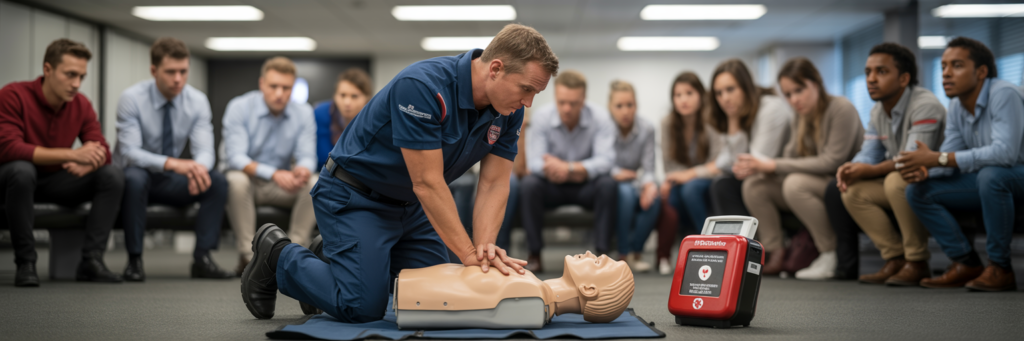
What would you do if a colleague collapsed at work right now?
Not the polished version you’d tell in a job interview – the honest answer. Would you know exactly what to do, or would you stand there for 5, maybe 7 seconds, watching someone’s brain cells die while your mind races through half-remembered CPR videos you watched at 2am on YouTube?
Most people think they’d “figure it out” when it matters. But there’s this thing that happens in real emergencies that nobody talks about – your brain sort of… stutters. Everything you thought you knew disappears behind this wall of adrenaline and panic.
Last month, a guy in my office had a seizure during lunch. Just dropped right there next to the microwave. Seven people in that break room. You know how long we all stood there, completely frozen? Long enough that I’m still embarrassed about it. Long enough that the admin officer who’d taken a first aid course six months ago had to push past all of us to actually help.
That’s the gap nobody prepares you for – the space between knowing something theoretically and being able to actually do it when someone’s life is hanging in the balance.
Here’s what paramedics will tell you: there’s five specific skills that separate people who can actually help from people who just stand there wishing they could. These aren’t the full list of things you might learn in a first aid course – they’re the ones that actually save lives in those critical minutes before the ambulance arrives.
Brain damage starts at around 4-6 minutes without oxygen. Average ambulance response time is 8-12 minutes. Do the math. That gap? That’s your window. That’s where you either know what to do, or you don’t.
In this guide, we’re breaking down the exact first aid for emergencies that paramedic students learn in their first week of training. Not theory. The hands-on techniques that work in real emergencies – in offices, homes, shopping centers, wherever people suddenly need help and you’re the only one there who might know what to do.
Because here’s the thing nobody says out loud: the difference between someone surviving a cardiac arrest and not surviving often comes down to whether one trained person happened to be there. Just one person who’d practiced enough times that their hands knew what to do even when their brain was panicking.
What Are the 5 Basic First Aid Skills Everyone Should Know?
When paramedics talk about the skills that actually matter in emergencies, they’re talking about interventions that keep people alive when everything’s gone wrong.
| Skill | What It Does | When You Use It |
|---|---|---|
| CPR | Manually pumps blood to brain and organs | Person unresponsive and not breathing normally |
| Bleeding Control | Stops severe blood loss before shock develops | Rapid bleeding that won't stop on its own |
| Choking Response | Clears blocked airway | Person can't cough, speak, or breathe |
| Recovery Position | Protects unconscious person's airway | Unconscious but breathing normally |
| AED Operation | Resets chaotic heart rhythms | Cardiac arrest with available defibrillator |
These skills align with Australian Resuscitation Council guidelines and form the foundation of HLTAID011 (Provide First Aid) certification. The difference between knowing these skills and not knowing them? It’s the difference between someone’s family getting a phone call saying “they’re in ICU but stable” versus getting a very different kind of phone call.
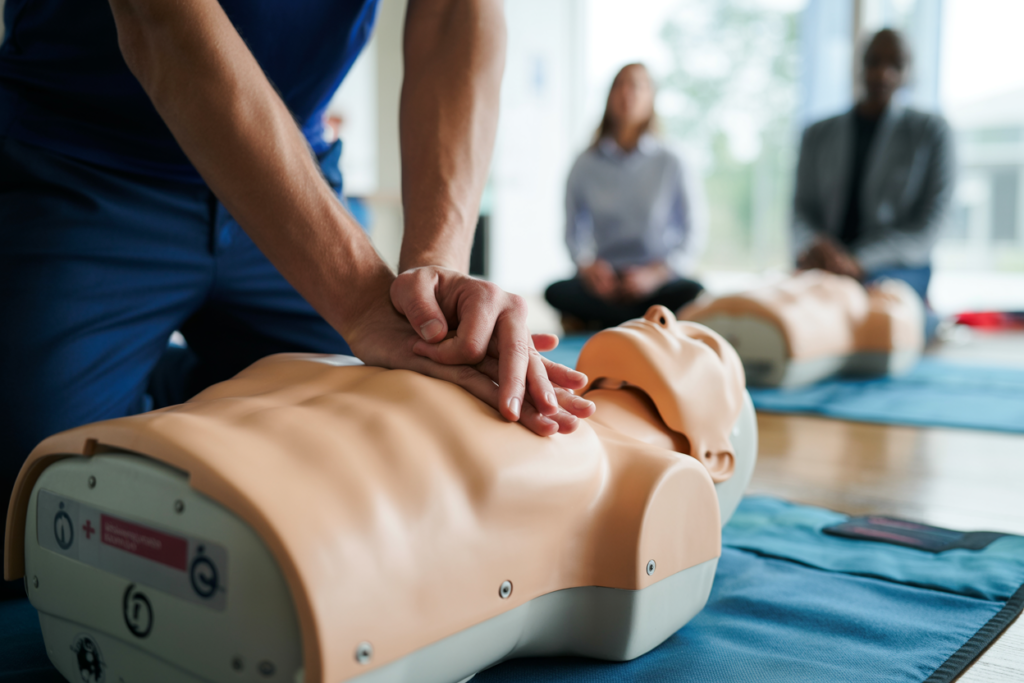
Why These 5 First Aid Skills Matter Most
Brain damage begins after 4-6 minutes without oxygen. Average ambulance response time is 8-12 minutes. There’s this gap between when someone’s brain starts dying and when professional help arrives. That gap is where you come in.
The statistics are sobering: bystander CPR doubles cardiac arrest survival rates from 10% to 40% in metro areas, according to Australian Resuscitation Council data. Every minute without CPR or defibrillation reduces survival probability by 7-10%.
That’s not a gradual decline. That’s a cliff. Every minute you stand there unsure what to do, someone’s chances of surviving drop by nearly 10%.
Think about that timeline:
- 0-2 minutes: Someone recognizes there’s an emergency and calls 000
- 2-8 minutes: This is YOUR window. Where you either know what to do or you don’t
- 8-12 minutes: Paramedics arrive with proper equipment
- 12+ minutes: If no intervention happened during minutes 2-8, the outcome’s probably already been decided
Here’s what’s actually happening while you’re reading this: cardiac arrests in office buildings during lunch breaks. Choking incidents at restaurants when someone’s laughing while eating. Home accidents where someone’s doing DIY work or cooking dinner. Medical emergencies at shopping centers.
None of these are rare events. They’re daily occurrences. Only 32% of out-of-hospital cardiac arrests receive bystander CPR. The 68% who didn’t get bystander CPR had an 8% survival rate. The 32% who did get immediate intervention had a 42% survival rate. Five times more likely to survive. Because someone knew what to do and actually did it.
Beyond Basic Awareness: Hands-On Competency
Knowing about CPR and being able to perform CPR when someone’s dying in front of you are completely different things. Your brain does weird stuff under stress. Things you thought you remembered just… vanish.
Meanwhile, the person who practiced CPR on a mannequin 50 times during training? Their hands know what to do even while their brain’s panicking. The muscle memory takes over. The 5-6cm depth feels automatic. The 100-120 compressions per minute rhythm is just there in their body.
This is why paramedic students spend their first week doing compressions on mannequins until their arms hurt. Until the technique becomes automatic. You can’t build that kind of automatic response from watching videos. Your brain needs to practice the physical skill enough times that it becomes instinctive.
Skill #1 – CPR: Your First Response to Cardiac Arrest
CPR is the big one. When someone’s heart stops beating effectively, your chest compressions literally become their heart – you’re manually pumping blood through their body, keeping oxygen flowing to their brain and organs until help arrives.
Here’s what makes CPR different: it’s the one where doing something imperfectly is infinitely better than doing nothing. Perfect CPR doesn’t exist outside of training mannequins. Real CPR is messy and exhausting and you’ll second-guess yourself the entire time. And it still works.
The DRSABCD Protocol
D – Danger – Check scene safety before touching anyone
R – Response – Tap shoulders, call their name loudly
S – Send for Help – Point at someone specific: “You – call 000 now”
A – Airway – Head tilt, chin lift to open airway
B – Breathing – Check for normal breathing for 10 seconds
C – CPR – If not breathing normally, start immediately
D – Defibrillation – Apply AED as soon as available
The Technique
- Kneel beside their chest
- Hand placement: center of chest, lower half of breastbone
- Lock elbows straight, shoulders directly over hands
- Push hard and fast: 5-6cm depth, 100-120 per minute (rhythm of “Stayin’ Alive”)
- Let chest recoil completely between compressions
- 30 compressions, then 2 rescue breaths
- Continue 30:2 ratio until help arrives or person shows signs of life
Most people don’t push hard enough. They’re worried about hurting the patient. Reality check: the patient is clinically dead. You cannot make them more dead by pressing too hard. But you can fail to save them by pressing too softly.
Compression-Only CPR
If you can’t or won’t do rescue breaths, compression-only CPR is still incredibly valuable. Just do chest compressions. Center of the chest, 5-6cm deep, 100-120 per minute, don’t stop. There’s still oxygen in the patient’s blood for the first several minutes, and your compressions are circulating that oxygen to their brain.
Good Samaritan laws protect you. If you’re acting in good faith to help someone in an emergency, you’re legally protected even if you’re not certified, even if you make mistakes.
Skill #2 – Bleeding Control: Stopping Severe Hemorrhage
Severe bleeding can kill someone in minutes, long before shock even has time to fully develop. The good news is that bleeding control is more intuitive than CPR. Your instinct to “put pressure on it” is basically correct.
Recognizing Severe Bleeding
Minor bleeding: Oozing slowly, stops within minutes, doesn’t soak through bandaging, person remains alert
Severe bleeding: Spurting or flowing rapidly, bright red (arterial) or dark red in large quantities, soaks through bandages quickly, pooling blood, person becomes pale/sweaty/confused
Arterial bleeding spurts in rhythm with the heartbeat. That’s the kind that can kill someone in minutes.
Direct Pressure Technique
- Expose the wound – cut away clothing if necessary
- Apply direct pressure with absorbent material (gauze, towels, clothing, even bare hands)
- Maintain pressure for at least 10 minutes without peeking
- Add more material on top if blood soaks through (don’t remove original layer)
- Keep pressure until help arrives
The pressure needs to be significant. If your arms aren’t getting tired after a few minutes, you’re probably not pressing hard enough.
Recognizing Shock
Early shock: Pale cool skin, mild anxiety, slightly increased heart rate
Moderate shock: Very pale skin, cold clammy sweating, rapid weak pulse, confusion
Severe shock: Extremely pale/gray skin, barely detectable pulse, altered consciousness
Lay the person flat. If no spinal injury suspected, elevate their legs about 30cm. Keep them warm. Don’t give them anything to eat or drink.
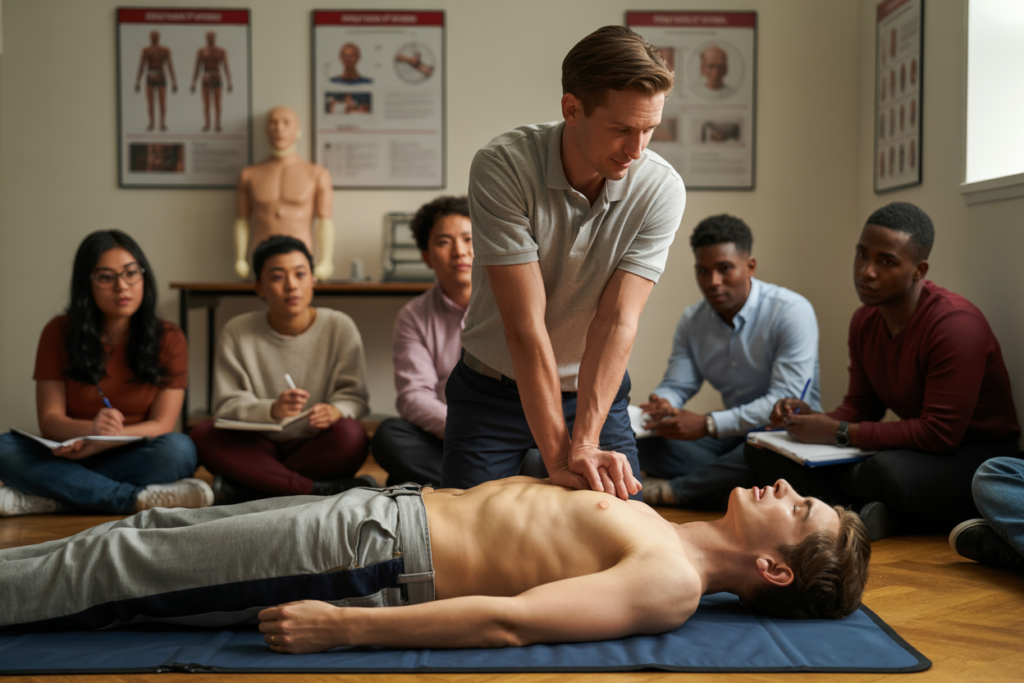
Skill #3 – Choking Response: Clearing Airway Obstructions
Choking goes from “probably fine” to “definitely not fine” in about 10 seconds. Someone’s laughing at dinner, takes a bite, and suddenly they’re grabbing at their throat with both hands, can’t make sounds, face changing color.
You’ve got maybe a minute before they lose consciousness. The key is recognizing it fast and responding based on whether they’re conscious or not.
Recognizing Severe Choking
Mild obstruction: Can still cough forcefully, can speak, breathing is noisy but present
Severe obstruction: Cannot cough or make sounds (silent choking is deadly), cannot speak, clutching throat with both hands, face turns red then purple, cannot breathe at all
If they can cough, let them cough. Don’t interfere. If they cannot cough and cannot speak, act immediately.
Response for Conscious Adult
- Tell them: “You’re choking, I’m trained, I’m going to help you”
- Stand to their side, lean them forward, support their chest
- Deliver 5 sharp back blows between shoulder blades (forceful, upward and inward)
- If that doesn’t work: 5 abdominal thrusts (stand behind, fist above navel below breastbone, pull inward and upward sharply)
- Alternate 5 back blows and 5 abdominal thrusts until obstruction clears or person becomes unconscious
The technique feels violent when you’re doing it correctly. That’s okay. The person is dying. You need to generate enough force to dislodge something stuck in their airway.
When Patient Becomes Unconscious
- Lower them carefully to the ground
- Call 000 if not already called
- Open mouth and look for obstruction (only remove if you can see it)
- Start 30 chest compressions
- Check mouth again after compressions
- Attempt 2 rescue breaths (if chest doesn’t rise, obstruction still blocking)
- Continue cycle: 30 compressions, check mouth, 2 breaths
The compressions create pressure that might dislodge the obstruction while maintaining blood circulation.
Skill #4 – Recovery Position: Protecting Unconscious Patients
Recovery position doesn’t look impressive but can absolutely save someone’s life. If someone’s unconscious but still breathing normally, leaving them on their back can kill them. Their tongue can block the airway, or they can vomit and aspirate that vomit into their lungs.
When to Use Recovery Position
For people who are:
- Unconscious (not responding)
- Breathing normally
- Not in cardiac arrest
- No suspected spinal injury
How to Position
- Kneel beside them
- Straighten their legs
- Place nearest arm at right angle, bent at elbow, palm up
- Bring far arm’s hand across to their near cheek
- Bend far leg up, foot flat on ground
- Roll them toward you using bent leg
- Adjust: top leg bent at hip and knee, head tilted back, mouth angled downward
Monitor their breathing constantly. If breathing changes, roll them back and assess for CPR.
Skill #5 – AED Operation: Using Automated Defibrillators
AEDs are those machines in shopping centers with the heart and lightning bolt. They’re designed for panicked, untrained people to use. The machine talks you through every step. It analyzes the heart rhythm and won’t let you shock unless a shock is actually needed.
What AEDs Do
AEDs treat ventricular fibrillation (chaotic quivering) and ventricular tachycardia (beating too fast). They briefly stop all electrical activity in the heart, hoping it reboots into a normal rhythm.
If the AED says “no shock advised,” the heart rhythm isn’t one that responds to defibrillation. They still need CPR. The AED just can’t help with that particular problem.
How to Use an AED
- Turn on the AED (opens automatically or press button)
- Bare patient’s chest completely
- Apply electrode pads (pictures show placement – upper right chest, lower left chest)
- Stop CPR when machine says “analyzing rhythm”
- Nobody touches patient during analysis
- If “shock advised”: Clear everyone (“I’m clear, you’re clear, everyone’s clear”), push shock button
- If “no shock advised”: Resume CPR immediately
- After shock: Resume CPR immediately
- Continue CPR for 2 minutes until AED prompts another analysis
- Repeat cycle until help arrives
Don’t delay CPR to apply the AED. If you’re alone, do CPR first. When the AED arrives, then apply it. Once pads are on, leave them on. Don’t remove them until paramedics tell you to.
When to Call 000
Call immediately for:
- Cardiac arrest
- Severe bleeding not stopping with pressure
- Choking that doesn’t clear quickly
- Unconsciousness
- Seizures lasting more than 5 minutes
- Severe allergic reactions
- Chest pain that might be heart attack
- Stroke symptoms
- Severe injuries
- Poisoning or overdose
The cost of calling when you didn’t absolutely need to: minor embarrassment. The cost of not calling when you should have: someone dies who might have been saved.
Stay on the line until they tell you to hang up. The operator can provide real-time guidance while you wait.
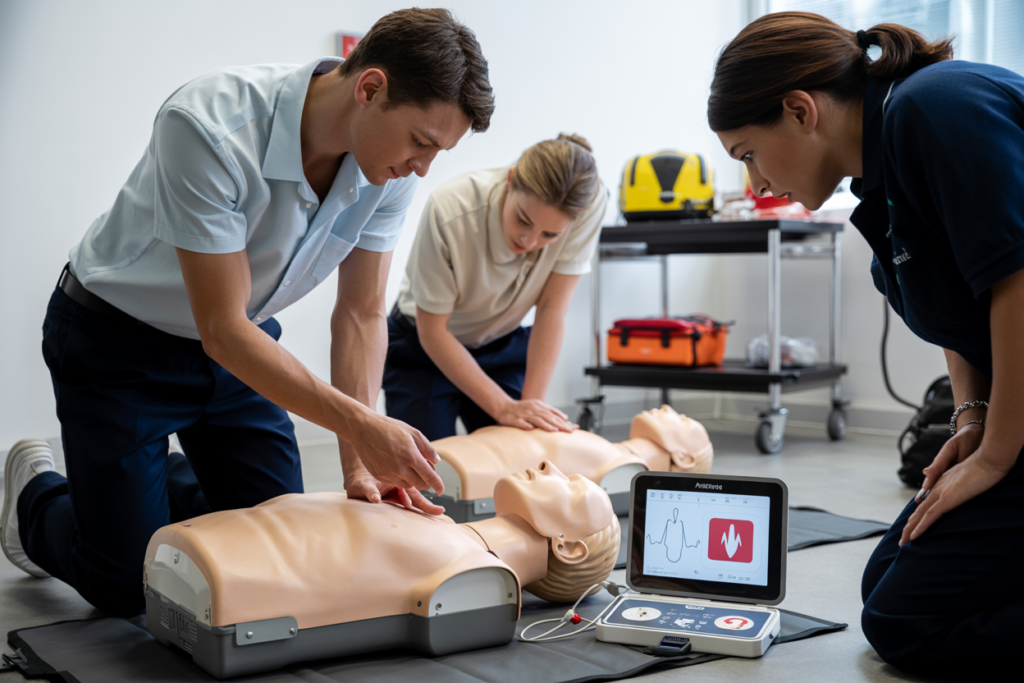
Building Confidence Through Practice
Reading this guide gave you knowledge. But knowledge alone doesn’t prepare you for the actual moment when someone needs help.
Your brain works differently under stress. The thinking, reasoning part basically goes offline when adrenaline spikes. If you’ve only read about CPR, you don’t have muscle memory. You have information stored in the exact part of your brain that stops working effectively during emergencies.
If you’ve done compressions on a mannequin 50 times during training, your body knows what 5-6cm depth feels like. Your arms know the rhythm. Your hands know where to position themselves. That’s stored in a different part of your brain – the part that still functions when you’re panicking.
This is why paramedic students spend their first week doing repetitive skills practice. Not because they don’t understand the concepts – because understanding isn’t enough. They need the physical memory of having done it correctly dozens of times.
Proper training includes:
- Hands-on mannequin practice for all five skills
- Scenario-based practice with realistic stress conditions
- Timed practice to understand exhaustion
- Group practice coordinating with other rescuers
CPR certification should be renewed annually. Skills fade quickly without practice – studies show significant decay in CPR quality within 6 months of training.
Conclusion: Your Next Step Could Save a Life
You’ve now got the knowledge part sorted. You understand the five critical first aid skills for emergencies. You know when to use each one, how they connect, what mistakes to avoid.
But here’s the reality: reading this article didn’t make you capable of saving someone’s life. It made you informed about how it’s done. There’s a difference.
The colleague who collapses during tomorrow’s meeting. The stranger who starts choking at lunch. Your family member who has a cardiac arrest at the dinner table. These things happen every single day. The question isn’t whether emergencies happen – the question is whether you’ll be ready when one happens in front of you.
The gap between knowing and doing is practice.
You know what the worst feeling is? It’s not being in an emergency and not knowing what to do – that’s ignorance, and ignorance is a fixable problem. The worst feeling is being in an emergency and knowing exactly what you should be doing, but you’ve never actually practiced it, so you stand there frozen while someone dies and all that knowledge in your head is completely useless because you can’t translate it into action.
Don’t be that person.
Every week, someone stands next to a person in cardiac arrest and doesn’t do CPR because they’re not confident enough. They’re not confident because they never practiced. They never practiced because they kept meaning to take a course but never actually booked it.
Your investment in proper first aid training could be worth someone’s entire life. The skills you practice on a mannequin could be the skills that bring someone’s dad home from the hospital, or someone’s partner, or someone’s kid.
The training exists. The courses run regularly. The investment is minimal. The only thing stopping you from being prepared is the decision to actually book it.
Because emergencies don’t send calendar invitations. They don’t wait for when you’re ready. They happen during normal days when you’re thinking about normal things, and suddenly nothing’s normal anymore and someone needs help right now.
Be the person who can help. Not the person who wishes they could.
Book Your First Aid Training Now
Fast, affordable, and nationally accredited training delivered by professionals who care
Frequently Asked Questions
Q.How long can someone survive without CPR during cardiac arrest?
Brain damage begins after 4-6 minutes without oxygen. Survival probability drops 7-10% for every minute without CPR or defibrillation. After 10 minutes with no intervention, survival becomes extremely unlikely even with advanced medical care. This is why bystander CPR is so important - you're maintaining blood flow to the brain during those critical first minutes before paramedics arrive.
Q.Can I be sued for performing CPR or first aid?
No. Good Samaritan laws in Australia protect anyone who provides emergency assistance in good faith. You're legally protected even if you're not certified, even if you make mistakes, and even if the person doesn't survive. The law recognizes that attempting to help is better than doing nothing. These protections apply whether you're trained or untrained, as long as you're acting reasonably to help someone in an emergency.
Q.Should I do CPR if I'm not certified?
Yes, absolutely. If someone is in cardiac arrest (unresponsive and not breathing normally), immediate CPR is their only chance of survival. Even if you've never been trained, compression-only CPR (just pushing hard and fast on the center of the chest) is better than doing nothing. Call 000 first, then start compressions at about 100-120 per minute. The 000 operator can also guide you through the process in real-time.
Q.What's the difference between a heart attack and cardiac arrest?
A heart attack is a circulation problem - blood flow to part of the heart is blocked, usually by a clot. The person is typically conscious, breathing, and complaining of chest pain. Cardiac arrest is an electrical problem - the heart stops beating effectively and the person collapses, becomes unconscious, and stops breathing normally. Heart attacks can lead to cardiac arrest, but they're different emergencies requiring different responses. Heart attack = call 000, keep them calm and still. Cardiac arrest = call 000, start CPR immediately.
Q.Can I use an AED on someone with a pacemaker?
Yes, but place the AED pads at least 8cm (about 3 inches) away from the pacemaker. You can usually feel a hard lump under the skin on the upper chest where the pacemaker is implanted. The pads might need to be positioned slightly differently to avoid the device, but you can and should still use the AED. If the person's in cardiac arrest despite having a pacemaker, their implanted device isn't working - your external AED might succeed where their internal device failed.
Q.How often should I renew my first aid certification?
CPR certification should be renewed annually - skills decay significantly within 6-12 months without practice. HLTAID011 (Provide First Aid) certification is valid for 3 years, but your actual competency depends on whether you've practiced since your course. Many workplaces and healthcare settings require annual CPR updates even if your full first aid certificate hasn't expired. Consider taking refresher courses whenever available, even if not required.
Making first aid training more affordable for
every classroom
We believe every student deserves access to life-saving first aid knowledge. That’s why we offer specially reduced pricing for schools and educational groups. Whether you’re booking for a single class, a year group, or your entire school, our flexible packages make training more accessible and cost-effective — without compromising quality.
