

You’re three months into your new position at a Brisbane hospital when HR sends the email: “All staff must provide current first aid certification by end of month for compliance audit.” You check your certificate drawer and discover it expired two months ago. Sound familiar?
First aid requirements for hospital workers can be surprisingly complex. While you might assume that working in a hospital environment means you’re automatically covered, most healthcare facilities require specific certifications beyond basic clinical training. Whether you’re a registered nurse, allied health professional, or patient service assistant, understanding which first aid course you need—and when you need to renew it—matters for maintaining employment compliance and providing the safest possible patient care.
This guide breaks down exactly what first aid certifications Brisbane hospital workers need, which roles require which qualifications, how often renewals are necessary, and where the confusion typically happens.
What First Aid Certification Do Hospital Workers Need?
Hospital workers in Brisbane require different first aid certifications depending on their role and department. Here’s what’s required:
| Hospital Role | Required First Aid Certification | Renewal Frequency | Additional Requirements |
|---|---|---|---|
| Support Staff (wardspersons, patient service assistants) | HLTAID011 Provide First Aid | 3 years (CPR annually) | None typically required |
| Allied Health (physios, OTs, radiographers, dietitians) | HLTAID011 Provide First Aid | 3 years (CPR annually) | Some roles may require BLS |
| Registered Nurses (RN, EN) | HLTAID011 + BLS (Basic Life Support) | BLS: 1–2 years, First Aid: 3 years | ACLS for ICU/ED/CCU |
| Emergency Department Staff | HLTAID011 + BLS + ACLS | ACLS: 2 years, BLS: 1–2 years | Trauma certifications may apply |
| Administration/Non-Clinical | HLTAID011 Provide First Aid | 3 years (CPR annually) | None typically required |
🔑 Key Compliance Note: While clinical staff receive BLS and ACLS training for patient care, most Brisbane hospitals still require HLTAID011 Provide First Aid for workplace health and safety compliance. This covers general workplace emergencies (injuries, burns, anaphylaxis) that aren't cardiac-related.
Why Hospital Workers Need Two Different Types of First Aid Training
Here’s where things get confusing for a lot of healthcare workers. You’d think that if you can handle a code blue, you’re covered for everything first aid related, right? Not quite.
Clinical Emergency Response (BLS/ACLS) vs. Workplace First Aid (HLTAID011)
The confusion happens because there’s actually two completely separate categories of emergency training in hospitals—and they serve different purposes under different regulations.
BLS and ACLS exist for patient care. These are your clinical emergency protocols. When a patient goes into cardiac arrest, when you need to manage advanced airways, when you’re administering emergency medications—that’s what BLS and ACLS cover.
HLTAID011 exists for workplace safety. This covers what happens when someone—staff member, visitor, contractor—has a non-cardiac emergency anywhere in the hospital. And here’s what catches people off guard: the Work Health & Safety Act requirements apply to ALL workplaces in Australia, including hospitals. Your clinical certifications don’t exempt you from WHS compliance.
Think about it this way:
- A patient codes in the ward? That’s BLS/ACLS territory.
- A staff member burns their hand badly on hot water in the kitchenette? That’s HLTAID011.
- A visitor has an anaphylactic reaction in the waiting room? HLTAID011.
- A wardsperson falls down stairs and fractures their wrist? HLTAID011.
HLTAID011 covers injuries, burns, fractures, anaphylaxis, asthma management, bleeding control—all the scenarios that happen in workplaces but aren’t cardiac arrests. BLS and ACLS cover cardiac arrest, advanced airways, medication administration during codes.
Different regulatory bodies govern each type of training. Your nursing board cares about your clinical certifications. WorkSafe Queensland and your hospital’s WHS compliance team care about your HLTAID011.
First Aid Requirements by Hospital Role
Let’s break this down by role, because the requirements change depending on what you actually do in the hospital.
Registered Nurses (RN) and Enrolled Nurses (EN)
BLS is mandatory. Your hospital will usually require this renewed annually, sometimes every two years depending on their policy. Most hospitals won’t even let you on the floor without current BLS.
HLTAID011 is often required separately for WHS compliance, even though it seems redundant. Your hospital’s compliance team needs to tick the box that says you’re trained in workplace first aid scenarios.
ACLS depends on your unit. If you’re working in ICU, ED, CCU, or theatre, you’ll need ACLS on top of everything else.
Allied Health Professionals
HLTAID011 is standard across the board. Pretty much every allied health role in a hospital environment requires current HLTAID011.
BLS requirements vary significantly depending on your role and where you work. Physiotherapists working in acute care or rehabilitation often need BLS because they’re working with medically complex patients. Radiographers might need BLS if they’re in interventional radiology or working in ED. Dietitians in outpatient clinics usually don’t need BLS beyond HLTAID011.
Support Staff and Administration
HLTAID011 is your main requirement. This covers the workplace first aid scenarios you might encounter while doing your job. BLS and ACLS typically aren’t required for support staff roles unless you’re in a specialized department.
For administration staff, HLTAID011 is still commonly required even for office-based roles. Many hospitals require a certain percentage of staff in each area to be certified.

🚨 Compliance Pitfalls: The most common mistakes: assuming BLS covers everything, letting certificates expire "just a few weeks," confusing CPR renewal with full first aid renewal, and booking the wrong course code. These mistakes can get you sent home from shifts or flagged in audits.
Common Compliance Mistakes That Get Hospital Workers in Trouble
Mistake #1: Assuming Your Clinical Certs Cover Everything
Your compliance team doesn’t care that you can run a code. They care that you meet WHS requirements. And WHS requirements specifically ask for HLTAID011 or equivalent workplace first aid certification.
I’ve seen RNs with 20 years experience get pulled up in audits because they never completed HLTAID011.
The fix: Check your employment contract right now. If it mentions HLTAID011 or “workplace first aid,” don’t assume your BLS covers it.
Mistake #2: Letting Your Certificate Expire
A lot of hospitals now have systems that automatically flag expired certifications and can literally lock you out of rostering. I know one EN who turned up for a shift and was sent home because her HLTAID011 had expired three weeks earlier.
The fix: Set a calendar reminder for 2-3 months before your expiry date.
Mistake #3: Confusing CPR Renewal with Full First Aid Renewal
HLTAID011 is valid for three years. But the CPR component needs annual renewal. Some people see “valid until 2027” on their certificate and think they’re fine for three years. Then they get pulled up because their CPR component lapsed.
The fix: Track both dates separately. Set two reminders—one for 12 months (CPR renewal) and one for 3 years (full renewal).
Mistake #4: Booking the Wrong Course
Someone searches “first aid course,” books the first thing they see, and shows up to find out they’ve booked HLTAID009 (CPR only) when they need HLTAID011 (full first aid).
Here’s what the codes mean:
- HLTAID009 = CPR only (used for annual CPR renewal)
- HLTAID011 = Provide First Aid (full first aid, includes CPR plus injuries, burns, medical emergencies)
- HLTAID012 = First Aid in Education & Care (childcare-specific)
Hospital workers need HLTAID011.
Understanding Renewal Timelines
The HLTAID011 Three-Year Cycle (With a Catch)
Your full HLTAID011 Provide First Aid certification is valid for three years from the date you complete it. But here’s the catch that trips everyone up: the CPR component only lasts one year.
So if you complete HLTAID011 on February 15, 2025:
- Your full first aid certificate is valid until February 15, 2028
- Your CPR component expires February 15, 2026
What this means in practice:
- Year 1: You’re fully current, nothing needed
- Year 2: You need to complete a CPR renewal course (HLTAID009)
- Year 3: You need another CPR renewal
- Year 4: You need to complete the full HLTAID011 course again
BLS and ACLS Renewal
BLS expires every 1-2 years depending on your hospital’s policy. Your hospital usually runs these in-house. Don’t let this one lapse—expired BLS can get you taken off the roster immediately in most clinical settings.
ACLS is valid for two years if you work in ED, ICU, CCU, or another area requiring it.
Tracking Multiple Certifications
When you’ve got HLTAID011, CPR renewals, BLS, and maybe ACLS all on different schedules, keeping track becomes a job in itself.
Set up a digital calendar:
- Add each certification with its exact expiry date
- Set THREE reminders for each: 3 months before, 6 weeks before, 2 weeks before
What Happens If You Let Something Lapse
You might not be able to work. Some hospitals have systems that flag expired certifications and prevent rostering until you’re current again.
You’re operating out of compliance. If something happens and your certification is expired, you’re potentially liable. Your hospital could face penalties.
You lose income. Every shift you can’t work because you’re not compliant is money you’re not earning.
Hospital-Specific Policies You Need to Know
Not all Brisbane hospitals have identical first aid requirements. Public hospitals (Metro North, Metro South, West Moreton health services) generally have more standardized requirements. Private hospitals (Mater, St Vincent’s, Wesley) set their own policies.
Pre-Employment Requirements
Most Brisbane hospitals want to see current certifications before your first shift. When you’re applying for a new hospital position, have current certificates ready to attach to your application.
Ongoing Compliance Monitoring
Many hospitals now have credentialing systems that automatically flag expiring certifications. You might get an email 3 months out, another at 6 weeks, then escalating reminders. Don’t ignore these emails.
Consequences of Non-Compliance
- Verbal or written warning from your manager
- Removal from roster until you’re compliant again
- Disciplinary action for repeated non-compliance
- Impact on performance reviews and promotion opportunities
What to Do If You’re Unsure
Check your employment contract: Your specific requirements should be listed in your contract or position description.
Ask HR directly: Email or call your hospital’s HR department and ask specifically what first aid certifications are required for your role.
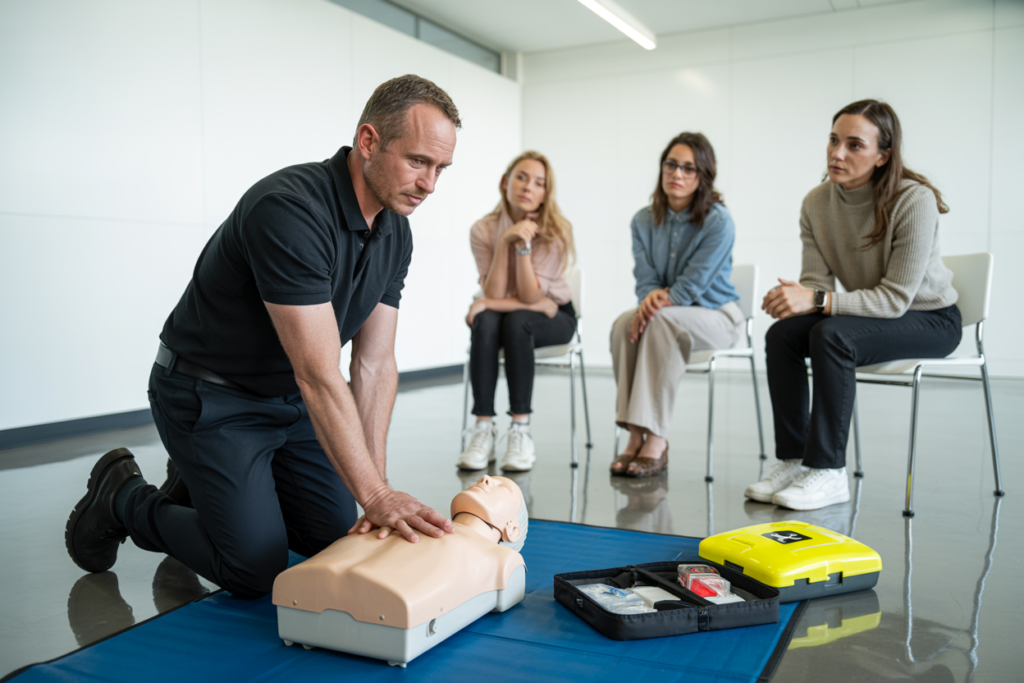
✅ Quick Reference: Save this section—it's your at-a-glance guide for what you need, when you need it, and what to do if you're out of compliance. Print it and stick it in your locker.
Quick Reference Guide
Essential Certifications by Role
Support Staff: HLTAID011 Provide First Aid (renewed every 3 years, CPR annually)
Allied Health: HLTAID011 Provide First Aid (renewed every 3 years, CPR annually) + BLS sometimes required
Registered Nurses: HLTAID011 + BLS + ACLS if in ICU/ED/CCU
Emergency Department Staff: HLTAID011 + BLS + ACLS
Administration: HLTAID011 Provide First Aid (often required, check your hospital policy)
Emergency Action Plan (Your Certificate Expired)
- Search for HLTAID011 providers with courses in the next 7 days
- Call providers directly and explain you need urgent certification
- Be flexible with day and time
- Book immediately—don’t wait to check your roster
- Inform your manager you’ve booked a course
- Upload to your hospital’s system as soon as you receive it
Final Thoughts
First aid certification requirements for hospital workers are just one of many compliance things you’re juggling. But HLTAID011 is actually one of the easiest to manage—it’s only every three years, and the renewal process is straightforward.
The only time it becomes a problem is when you ignore it until it’s urgent.
You’re a healthcare worker. You know better than anyone what happens when people ignore important health stuff until it becomes an emergency. Don’t do that with your professional compliance.
Take 20 minutes today to check your certification status, set up proper reminders, and book your next course if needed. Then forget about it and focus on the actual work you do—caring for patients.
Ready to get compliant? Check your certificate expiry dates now and book your HLTAID011 renewal before it becomes urgent. When in doubt, HLTAID011 is the standard workplace first aid certification that covers most hospital worker requirements.
Book Your First Aid Training Now
Fast, affordable, and nationally accredited training delivered by professionals who care
Frequently Asked Questions (FAQ)
Q.Do I need HLTAID011 if I already have BLS?
Yes, you need both. BLS is for patient care emergencies and is governed by clinical standards, while HLTAID011 is for workplace safety and is required under Work Health & Safety regulations. They serve different purposes and most hospitals require both for clinical staff—check your employment contract to confirm.
Q.How long does HLTAID011 last before I need to renew it?
HLTAID011 is valid for 3 years from the date you complete it, but the CPR component only lasts 1 year. You'll need to complete a CPR renewal course (HLTAID009) annually in years 2 and 3, then complete the full HLTAID011 course again in year 4.
Q.What's the difference between HLTAID009 and HLTAID011?
HLTAID009 is CPR-only training used for annual CPR renewals. HLTAID011 is the full Provide First Aid course that includes CPR plus treatment for injuries, burns, fractures, and medical emergencies. Hospital workers need HLTAID011 as their primary certification, then HLTAID009 for annual CPR updates.
Q.Can I lose my job if my first aid certificate expires?
You won't typically be fired immediately, but you can be removed from the roster until you're compliant again, meaning lost shifts and income. Repeated non-compliance can lead to formal disciplinary action and may affect performance reviews and promotions.
Q.What happens if I book the wrong first aid course?
If you book HLTAID009 (CPR only) when you need HLTAID011 (full first aid), you'll need to complete the correct course separately—costing extra time and money. Always confirm you're booking HLTAID011 Provide First Aid for initial certification or 3-year renewal.
Q.Can I do HLTAID011 online or does it have to be in person?
HLTAID011 requires hands-on practical assessment in person, including CPR on mannequins and demonstrating injury treatment skills. Some providers offer blended learning where theory is completed online and practical assessment is done face-to-face.
Q.My certificate expired last month—can I still work while I book a course?
This depends on your hospital's compliance policy. Some hospitals have automated systems that flag expired certifications and prevent rostering. Inform your manager immediately and book a course as soon as possible to demonstrate proactive compliance.
Q.Where can I find my HLTAID011 certificate if I've lost it?
Contact the training provider who issued your certificate—most can resend a digital copy within 24–48 hours. If unsure who issued it, search your email for "HLTAID011" or "first aid certificate." Save future certificates in a dedicated folder and upload them to your hospital's credentialing system.
Q.Do I need a different first aid course if I work in pediatrics?
For general hospital pediatrics, HLTAID011 is usually sufficient as it covers adult, child, and infant CPR and first aid. However, if working in childcare or education settings, you may need HLTAID012 First Aid in Education & Care—confirm with your department.
Making first aid training more affordable for
every classroom
We believe every student deserves access to life-saving first aid knowledge. That’s why we offer specially reduced pricing for schools and educational groups. Whether you’re booking for a single class, a year group, or your entire school, our flexible packages make training more accessible and cost-effective — without compromising quality.
