

Ever wondered if there’s a faster way to complete your first aid certification without sacrificing an entire day off?
If you’re a busy Brisbane professional juggling work commitments, you’re not alone—70% of our students say their biggest barrier to getting certified is finding a full day for training.
I get it. You’ve probably been in this position before: your certificate expired two months ago (life got busy, it happens), your boss mentioned an audit coming up, and now you’re scrambling to find time in your schedule. Or maybe you’re a personal trainer who can’t afford to cancel clients for a whole day, or you’re exploring a career change and every day off counts.
Here’s the solution: many first aid courses now offer an online theory component that lets you complete the classroom learning at your own pace, before attending a shorter practical session in person. This blended learning approach can cut your in-person training time significantly, giving you back precious time while still earning your nationally recognized HLTAID011 Provide First Aid certificate.
Think about it this way—instead of blocking out your entire Tuesday, you could study theory over a few evenings after work, then just show up for a practical session. Same certificate, same recognition, half the time commitment.
In this guide, you’ll discover exactly how the online theory component works, what you’ll learn online versus in-person, and whether this blended format is right for your situation.
Can You Do First Aid Training Online?
Yes, you can complete the theory component of first aid training online, but not the entire course. Australian first aid certification requires hands-on practical assessment that must be done in person. Here’s how it works:
What You Can Do Online:
- Complete theory modules (medical emergencies, injury management, CPR knowledge)
- Study at your own pace
- Access course materials 24/7
- Pass online assessment questions
What Must Be Done In-Person:
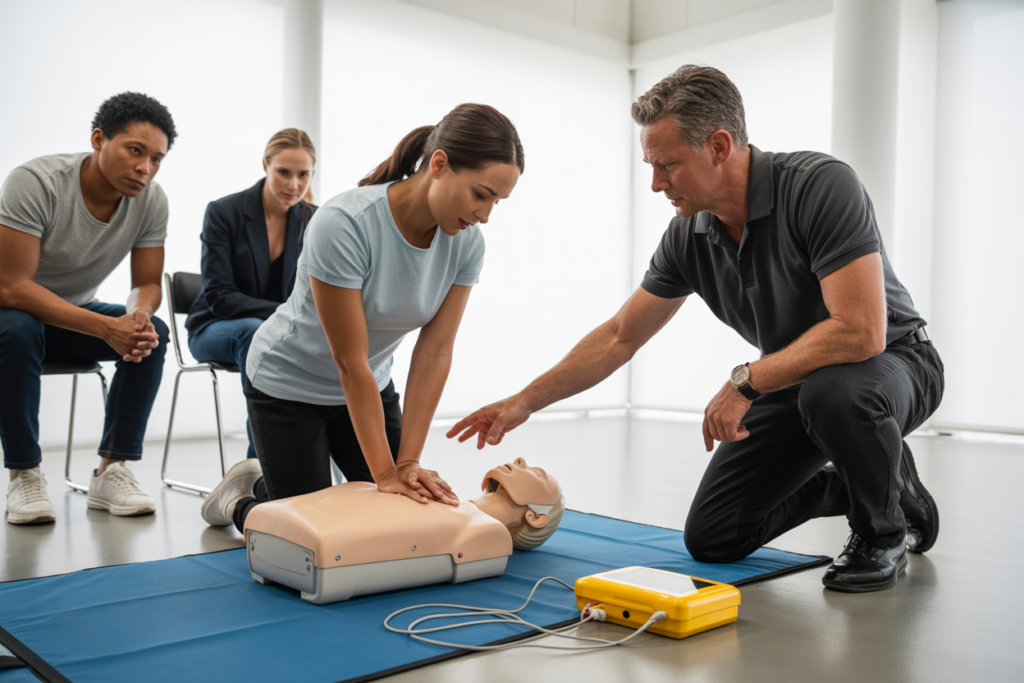
- CPR practical demonstration on mannequins
- Bandaging and injury treatment techniques
- Use of defibrillator (AED)
- Scenario-based assessments
- Final practical evaluation
This blended learning format combines online theory with face-to-face practical training, reducing your in-person time while maintaining full national recognition.
Look, I know what you’re thinking—”Can I just do everything online and skip the practical?” I wish I could tell you yes, but that’s not how it works in Australia. And honestly? That’s a good thing. You can’t learn CPR compressions from watching a video. You need to actually press down on a mannequin, feel the resistance, hear the feedback about depth and rate, and get real-time coaching from an instructor.
The online theory component isn’t a shortcut—it’s a smarter way to structure your learning. You absorb the knowledge part when it suits you, then you show up for the hands-on stuff already knowing what to do.
🎯 Key Takeaway: Blended learning splits your certification into two parts — online theory (self-paced) and in-person practical (instructor-led). You've got 30 days between completing theory and attending your practical session.

How Blended First Aid Training Works
The Two-Part Learning Structure
Blended first aid training splits your certification into two chunks: online theory (self-paced) and in-person practical (instructor-led). You’ve got 30 days after completing the online theory to attend your practical session.
Here’s why this matters: you can’t just do the theory and call it done. Both parts are required for your certificate. But you also can’t leave it too long between theory and practical.
The system’s designed to keep the knowledge fresh while giving you flexibility. Complete your theory over several evenings, then book your practical session for the following weekend. Or do it all in one week if you’re in a rush.
Your Online Theory Experience
- Book your practical session first You need to lock in your practical date before you get access to the online theory. This prevents people from completing theory then never showing up for practical.
- Receive login details Once you’ve booked, you’ll get an email with your login credentials for the online learning platform.
- Complete online modules at your pace Log in whenever you want. Could be 10pm after the kids are asleep. Could be Sunday morning with your coffee. The modules are broken into sections—you don’t have to do it all in one sitting.
- Pass online assessment At the end of the theory, there’s a multiple choice assessment. If you don’t pass first time, you can retake it as many times as you need.
- Attend practical session Show up on your booked date with your completion certificate. Bring it printed or on your phone—either works.
- Demonstrate hands-on skills This is where you actually do CPR on mannequins, practice bandaging, use the defibrillator, and work through scenarios. Your instructor coaches you through everything.
- Receive your certificate Pass your practical assessment, and your full HLTAID011 certificate gets emailed to you. Physical card arrives in the mail within a few days.
What Makes This Different From Fully Online Courses
You’ll see ads online for “100% online first aid courses” or “complete your first aid from home.” These are not the same thing as blended learning.
Legitimate blended learning combines approved online theory with mandatory in-person practical assessment. This is compliant with Australian regulations and results in a nationally recognized certificate.
Non-compliant “fully online” courses promise you can do everything from your couch. These are either overseas qualifications not recognized in Australia, outdated course codes, or scams.
Why do Australian regulations require practical assessment? Because CPR and first aid are physical skills. You need to demonstrate you can actually do them, not just answer questions about them.
What You’ll Learn in the Online Theory Component
HLTAID011 Theory Modules
| Module | What You'll Learn | Why It Matters |
|---|---|---|
| 1. DRSABCD Protocol | Step-by-step emergency response system | Your foundation for every emergency scenario |
| 2. CPR Theory | Adult, child, infant differences | Know the right technique before practical |
| 3. AED Operation | When and how to use defibrillators | Removes panic factor in real emergencies |
| 4. Medical Emergencies | Heart attack, stroke, asthma, anaphylaxis | Recognition saves lives — most relevant to daily life |
| 5. Injury Management | Bleeding, burns, fractures, sprains | Practical skills you'll use most often |
| 6. Legal & Duty of Care | Good Samaritan laws, workplace obligations | Removes "what if I get sued" fear |
| 7. Infection Control | Gloves, disposal, bloodborne diseases | Protect yourself while helping others |
What You WON’T Learn Online
Hands-on CPR compressions Watching someone do compressions is different from feeling how hard you need to push. The mannequins give feedback. You need that physical feedback to develop muscle memory.
Physical bandaging techniques You need to practice the wrapping technique, the tension, the securing. You’ll fumble through it the first few times.
Real-time instructor feedback An instructor can see if your hand placement is slightly off, if you’re not tilting the head back enough for airway. They’ll correct you immediately.
Mannequin-based assessments The mannequins actually measure your compression depth, rate, and release. The instructor sees the data in real-time.
Scenario role-playing The practical session includes scenarios where you work through emergencies with other students. You practice communication, delegation, staying calm under pressure.
Benefits of Online Theory for Brisbane Professionals
Time Savings That Actually Matter
For Sarah (Retail Manager): Sarah works Tuesday through Saturday. Tuesday’s her only weekday off, and she’s protective of that time—Pilates, errands, lunch with friends.
With blended learning, Sarah completes theory over three evenings after work. Then attends a Sunday morning practical session. Still has her Tuesday completely free. Still gets certified.
For Luke (Personal Trainer): Luke trains clients from early morning and evening daily. Those are his income hours. Taking a full day off means losing that income.
Blended learning lets Luke study theory during his midday gaps when he has no clients. Then books practical for a time that minimizes lost income.
For Claire (Career Changer): Claire’s 42 and transitioning from corporate marketing to allied health. She hasn’t done hands-on training in 20+ years and she’s nervous.
Online theory lets her learn without that pressure. She can rewatch videos, take breaks when concepts are confusing, review material multiple times.
Flexibility for Shift Workers and Parents
Study at 10pm after kids are asleep Parents get this. Your evenings aren’t yours until after bedtime routines. Traditional courses don’t run at 10pm. Online learning does.
Break modules into smaller sessions The platform saves your progress. You’re not locked into finishing a module in one sitting.
No pressure to keep pace with fastest learner You move at your own speed. If you need to pause a video and think about it, you can.
Pause and rewind video demonstrations “Wait, where exactly do you place your hands for CPR?” Rewind. Watch again. Still not sure? Watch it a third time.
Better Knowledge Retention
Research shows self-paced learning improves retention compared to instructor-led classroom learning.
Review challenging concepts multiple times In a classroom, the instructor explains CPR ratios once, maybe twice. Online, you can review that section five times if needed.
Less pressure = better focus during practical When you show up for practical already knowing the theory, your brain can focus entirely on technique.
Arrive at practical already familiar with theory The practical session becomes reinforcement rather than first exposure.
Who Should Choose Blended Learning (And Who Shouldn’t)
Ideal Candidates for Online Theory Format
✅ Time-pressured professionals with irregular schedules If finding a consistent full day is nearly impossible—blended learning was designed for you.
✅ Self-employed contractors who can’t lose full-day income Personal trainers, tradies, freelancers, consultants—anyone who doesn’t earn if they’re not working.
✅ Visual learners who benefit from rewatching videos If you need to see things demonstrated multiple times before it makes sense, online theory is perfect.
✅ Anxious learners who prefer studying before practical If the thought of walking into a training room knowing nothing makes you nervous, online theory removes that anxiety.
✅ Those with expired certificates If you did first aid three years ago and just need to renew, the theory component is mostly revision.
When Traditional Full-Day Format Is Better
❌ You prefer all training in one session Some people like to get things done in one hit. Show up, do the training, leave certified.
❌ You struggle with online learning platforms If technology frustrates you—don’t force it. You’ll learn better in a classroom.
❌ You need external structure and accountability Self-paced learning requires self-discipline. If you know you’ll keep putting it off, traditional format forces you to just get it done.
❌ You’re hands-on learner who finds theory boring without practical context Some people learn better when theory and practical are integrated.
Honest assessment: There’s no “better” format—just what works for your learning style and schedule.
Industry-Specific Considerations
Personal Trainers (Fitness Australia): Both formats meet registration requirements. Blended is recommended because you can study theory around client sessions.
Retail/Hospitality Managers: Blended is usually the better choice. Complete theory outside work hours, attend practical on your day off.
Teachers/Childcare Educators: You might need HLTAID012 instead of HLTAID011. That’s “Provide First Aid in Education and Care Setting” which includes child-specific content. Check with your employer.
Career Changers: Traditional might be better if you want maximum instructor support. Blended is viable if you’re confident with online learning.
✅ Common Concerns Addressed: Online theory delivers the same quality as classroom learning, employers can't tell which format you chose, and research shows you'll actually retain more information with self-paced study.
Getting Started: Your Next Steps
Confirm You Need Blended Learning
Choose blended if you:
- Have limited availability for full-day training
- Prefer self-paced theory learning
- Want to minimize in-person time
- Are comfortable with online platforms
Choose traditional if you:
- Prefer all training in one session
- Want maximum instructor face-time
- Need external structure and accountability
Check Your Employer Requirements
Quick email to your HR department: “I’m booking first aid training. Any specific course requirements I should know about?”
They might specify:
- Course code (usually HLTAID011, but childcare needs HLTAID012)
- Completion deadline
- Certificate delivery format
Book and Complete Your Training
- Book your practical session date
- Receive online theory access
- Complete modules at your own pace
- Pass online assessment
- Attend practical session
- Demonstrate hands-on skills
- Receive your certificate
Set calendar reminder for renewal—annual CPR renewal required, full certificate valid for 3 years.
Final Thoughts
Should you choose blended learning with online theory, or traditional full-day format?
Here’s the honest answer: it depends on you.
Blended learning excels at flexibility. If time is your primary constraint—you can’t find a full day, you work irregular hours, you have family commitments—online theory removes that barrier.
Traditional format excels at structure. If you need accountability to actually complete training—traditional format forces you to just show up and get it done.
Both result in identical HLTAID011 certificates. Both meet Australian training standards. Both prepare you to respond to emergencies.
For most Brisbane professionals—retail managers like Sarah, personal trainers like Luke, career changers like Claire—blended learning makes training more accessible. It removes the “I don’t have a full day” excuse.
But if that delivery method doesn’t suit how you learn, don’t force it.
The goal isn’t just getting certified. The goal is learning skills that could save someone’s life. What matters is walking out confident you know what to do if someone collapses in front of you.
Choose the learning format that gets you to that point. For many people, that’s blended learning. For some people, it’s traditional. Only you know which fits better.
Don’t put it off another week. Book it today.
Book Your First Aid Training Now
Fast, affordable, and nationally accredited training delivered by professionals who care
Frequently Asked Questions
Q.What happens if I fail the online assessment?
You can retake the online assessment as many times as you need — most providers allow unlimited attempts. The system typically shows you which questions you got wrong, and you can review those topic areas before trying again. Very few people fail multiple times if they've actually worked through the content. The assessment tests understanding of basic concepts, not obscure details, and you're not being timed or pressured.
Q.Can I complete the entire first aid course 100% online?
No, Australian regulations require hands-on practical assessment that must be done in person. You can complete the theory component online, but you'll need to attend an in-person practical session to demonstrate CPR, bandaging, and other physical skills. Any provider claiming you can do everything online is either offering an overseas qualification not recognized in Australia or running a scam — legitimate Australian first aid certification always requires face-to-face practical assessment.
Q.What if I don't complete the online theory within 30 days?
You've got 30 days from booking to complete the online theory before your scheduled practical session. If you're cutting it close, contact your provider — most will extend your access or let you reschedule your practical session to a later date. If you don't complete it at all and your practical date arrives, you'll likely need to rebook (and might forfeit your course fee depending on the provider's cancellation policy), so it's better to communicate early if you're running behind.
Making first aid training more affordable for
every classroom
We believe every student deserves access to life-saving first aid knowledge. That’s why we offer specially reduced pricing for schools and educational groups. Whether you’re booking for a single class, a year group, or your entire school, our flexible packages make training more accessible and cost-effective — without compromising quality.
