

You’ve booked in. The session’s on your calendar, HR’s off your back for now, and then it hits you: there’s a first aid practical assessment involved, and the last time you did anything like this was years ago. Maybe you’re picturing being watched like a hawk while your hands shake trying to remember compression depth. Maybe you’re just dreading looking silly in front of a room full of strangers.
Here’s the bit that actually matters: it’s not designed to catch you out. Your trainer is coaching you through it, not testing you to fail. There’s nothing to revise beforehand, nothing to cram the night before, and almost everyone who turns up walks out with their certificate the same day. This isn’t your first rodeo with first aid either, you’re brushing up on skills you’ve had before, not learning from a blank page.
Chances are you’ve done a version of this course before, back when you started a job years ago, or when a workplace policy first asked for it. Whatever you remember about the practical bit has probably grown a bit bigger and scarier in your head over the years, the way most things do when you haven’t had to think about them in a while. That gap between the memory and the reality is usually where all the dread is actually sitting.
By the time you finish reading this, you’ll know exactly what happens, step by step, what gets assessed, what to bring, and what actually happens if a skill doesn’t click on the first go. No guesswork left, no vague warnings from someone who did the course five years ago, just what’s actually in front of you on the day.
What Happens in a First Aid Practical Assessment?
A first aid practical assessment is a hands-on, one-on-one check where your trainer watches you demonstrate the skills you’ve covered in the course. It’s supportive, not exam-style, and the vast majority of candidates pass without any drama. There’s no separate exam room, no written test to sit afterwards, and nobody handing you a mark out of ten. It’s simply your trainer confirming, in real time, that you can do the basics when it counts. Here’s what it typically covers:
- 1. CPR demonstration: hand placement, compression depth and rate on a training manikin, so your trainer can see you've got the technique down
- 2. DRSABCD response: talking through how you'd assess and respond to someone who's unconscious or not breathing
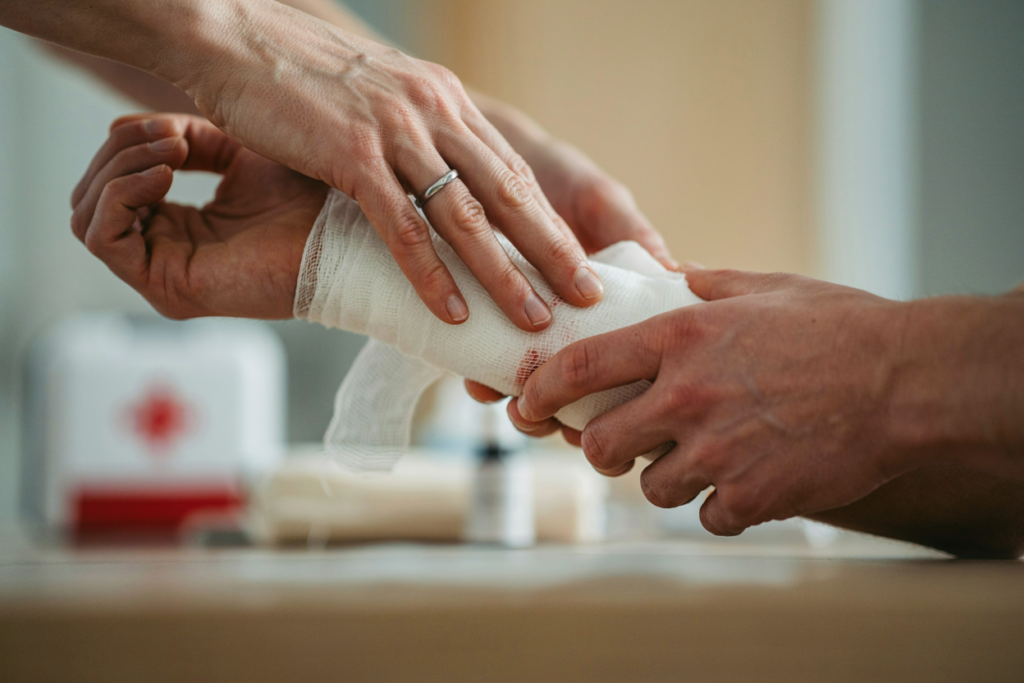
- 3. Bandaging and wound care: treating a simulated injury, like heavy bleeding, with whatever's in the kit in front of you
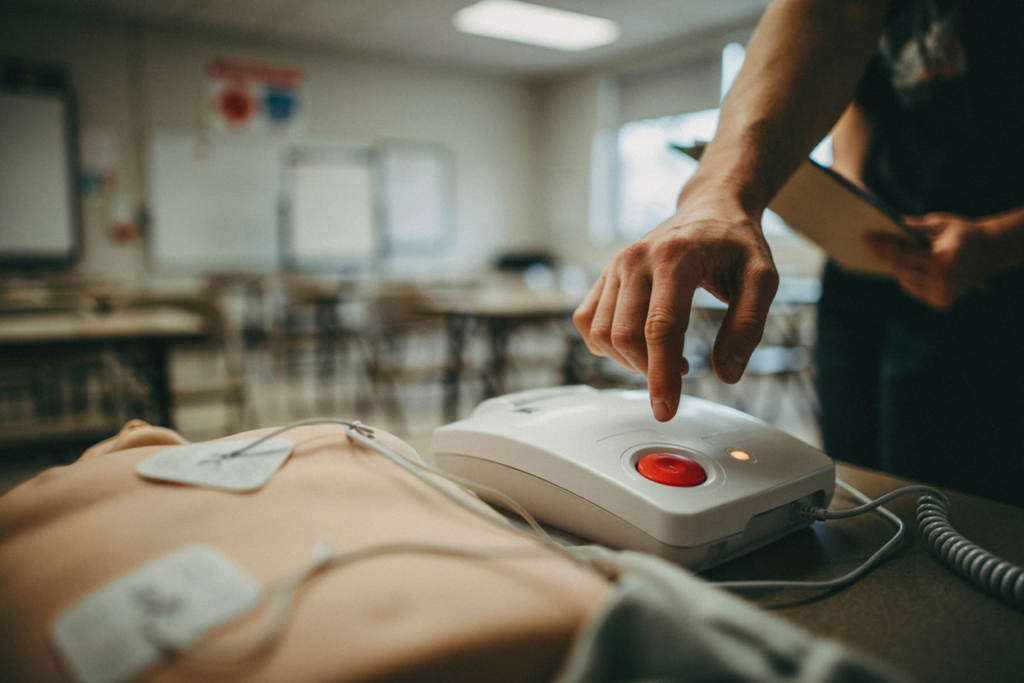
- 4. AED use: applying the pads and following the prompts, no guesswork required
- 5. Trainer feedback: on-the-spot coaching if something needs adjusting, not a pass or fail moment on the spot
That’s the whole shape of it. No surprises, no trick questions, no sitting an exam paper afterwards.
💬 Quick answer: If you've got five minutes before this session starts running through your head on loop, this bit answers it straight up.
What Actually Happens During the Practical Assessment
This part isn’t a group exam where everyone’s watching you fumble. It’s one-on-one with your trainer, usually pulled aside for a few minutes while the rest of the group is working through something else. Nobody’s lining up to judge you, and there’s no audience. Most people find this bit almost anticlimactic once it’s actually happening, it’s a quiet few minutes with your trainer, not the nerve-racking spotlight moment they’d built up in their head on the drive in.
There’s no set order you need to memorise beyond what feels natural after the practice run-throughs, and there’s no penalty for pausing to think for a second before you start. There are four core skills your trainer’s looking for during the hands-on assessment:
- CPR: compressions at the right rate and depth on the manikin
- DRSABCD response: walking through the steps out loud as you go
- AED use: applying pads correctly and following the device's prompts
- Basic wound care: treating a simulated injury with confidence, not perfection
For CPR specifically, ANZCOR guidelines call for compressions at 100 to 120 per minute, at a depth of 5 to 6 centimetres. Your trainer’s watching for you to land in that range, not for textbook perfection every single time. It’s less about hitting an exact number and more about showing you understand the rhythm and the pressure required, the kind of thing that comes back to you quickly once you’re actually doing it rather than just thinking about it.
The same goes for DRSABCD and wound care. Your trainer isn’t after word-perfect recitation, they’re checking you understand the order of things and can work through a scenario calmly, which is exactly what the assessment is designed to build confidence in.
If you’re still not sure whether HLTAID011 is even the right course for you, our Provide First Aid explained page breaks down what it actually covers and who needs it, in plain language, before you get anywhere near a booking page.
What to Bring and How to Actually Prepare (Spoiler: No Study Required)
Here’s the thing nobody tells you until you’re already stressing about it: there’s genuinely nothing to study before you turn up. Every skill gets taught and practised in the session, well before your trainer asks you to demonstrate it. You’re not walking in cold. If you’ve been quietly wondering whether you should be watching videos or reading through old notes the night before, you can stop. There’s nothing to prep, and turning up with an open mind is more useful than turning up having crammed anything.
What to wear
You’ll be on the floor at some point, kneeling for CPR practice or working through a scenario at ground level, so comfortable clothing and closed shoes matter more than you’d think. Skip anything restrictive or anything you’d hate to get a bit dusty. Think of it more like something you’d wear to a casual errand day than an office outfit, you want to be able to move freely and get down on the floor without thinking twice about it.
Do you need to revise beforehand?
No. Genuinely, no. The course is built so the skills are taught first, then practised as a group, and only then assessed. You’re not expected to remember anything from years ago before you arrive. Whatever you’ve forgotten since your last certificate is completely normal, and it’s exactly what this session is there to refresh.
📋 What to bring:
- Photo ID
- Your prior Statement of Attainment, if you're renewing an existing certificate
- Comfortable clothing and closed shoes
- That's it. No textbooks, no study notes, nothing else required.
What Happens If You Don’t Get a Skill Right First Time
This is the bit that worries people most, and it’s the bit that matters least in practice. If a skill doesn’t quite click the first time, your trainer coaches you through it right there and then. It’s not a pass or fail moment on the spot, it’s more like practice with feedback until you’ve got it. Compressions a bit shallow, hands slightly off placement, forgot a step in DRSABCD, none of that ends the session. Your trainer simply talks you through the adjustment and has you go again.
The assessment is criterion-based, not competitive. Nobody’s ranked against anyone else in the room, and there’s no cut-off where only a certain number of people can succeed. Your trainer’s simply checking that you can do the skill safely and correctly, in your own time, with as many goes as it takes within the session.
The large majority of people pass without needing much extra coaching at all, and the ones who do need a bit more time get it, on the spot, without any fuss or awkwardness.
How This Fits Into Your Full Session
The practical assessment isn’t a separate appointment you need to block out extra time for. It’s built into the same session as everything else, woven in as you go rather than tacked on at the end. You won’t need to return on a different day, or squeeze in a second booking just for the hands-on component, it’s all covered in the one session you’ve already got on your calendar.
Sessions run as either a half-day or full-day format depending on the course, with a mix of theory and hands-on practice throughout. The practical component sits toward the latter part of the day, after you’ve had a proper run-through of each skill, not sprung on you first thing before you’ve even had a coffee. By the time it comes around, you’ve already sat through the theory, watched the skills demonstrated, and had a go yourself alongside the rest of the group, so it feels like a natural next step rather than an abrupt shift into test mode.
Here’s roughly how the time breaks down:
Part of the session | What happens |
Theory and discussion | Covering DRSABCD, CPR principles, wound care basics |
Guided practice | Working through each skill as a group, with trainer support |
Practical assessment | One-on-one demonstration of the four core skills |
If you’re still weighing up which session time suits your work week, our booking page shows the next available evening and weekend dates so you can plan around your actual schedule, not the other way around.
Will Your Employer Accept This Certificate?
This is probably the question sitting under everything else. You’re not doing this course for yourself, you’re doing it because someone asked you to, and the last thing you want is to hand over a certificate and have HR send it back, or worse, be told you need to do the whole thing again with a different provider.
Here’s the plain answer: yes. What you walk away with is a nationally recognised Statement of Attainment, the same standard certificate accepted across Queensland workplaces, regardless of which RTO issued it. You can check HLTAID011 directly on training.gov.au if you want to see the unit verified for yourself.
Certificates are delivered fast, often the same day, as a digital copy you can forward straight to HR without waiting around or chasing anyone up. That’s one less thing sitting on your to-do list, and one less thing you need to follow up on days later wondering where it’s got to.
📩 Worth knowing: And since this is the exact situation that got you here in the first place, a lapsed certificate nobody warned you about, we offer a renewal reminder so you're not caught out again in three years' time. It gets set up at the point your certificate is delivered, so there's nothing extra for you to remember, no calendar entry to create yourself, no note to leave in your phone that you'll forget about long before the expiry date rolls around.
Conclusion
You’ve probably built this up in your head far more than it deserves. Most people do. The gap between what a practical assessment feels like from the outside, some vague memory of being tested and judged, and what it actually is, a trainer quietly checking you can do the basics safely, is bigger than most people expect. It’s the kind of thing that feels much larger in the anticipation than it ever does once you’re actually standing in the room.
Nobody’s handing out a grade at the end of the day. Nobody’s comparing you to the person next to you. Your trainer’s only real job is making sure you can respond if something ever happens in front of you, and that job gets done through coaching, not through catching people out.
The parts you’ve been dreading, the CPR, the AED, the scenario with the bandages, are the parts you’ve already been shown how to do earlier in the same session. By the time your trainer asks you to demonstrate anything, you’ve had a run through it already, more than once, with someone standing right there to correct you if you’re off track. None of it is sprung on you cold, and none of it relies on memory from years ago holding up under pressure.
If a skill doesn’t come together the first time, that’s not a failure, it’s just part of how the day works. Adjust, try again, move on. Nobody’s watching the clock waiting for you to slip up, and nobody’s going home with a certificate withheld because one compression felt a bit shallow.
What you walk away with at the end is a certificate that does exactly what it needs to do, satisfies your employer, gets you back in compliance, and stops this from sitting on your mind. That’s really all this was ever about for you, ticking the box and getting on with your week, not chasing some deeper transformation or turning yourself into an expert overnight.
So if you’ve been putting off booking because the practical assessment felt like the hard part, it isn’t. It’s the part that’s already been thought through on your behalf, built to be straightforward for someone who’s busy, who’s done this before, and who just needs it sorted without any fuss. The hardest part of this whole process was probably reading this far and still not having booked in yet, everything after that is just showing up and letting the session do what it’s designed to do.
Book Your First Aid Training Now
Fast, affordable, and nationally accredited training delivered by professionals who care
Frequently Asked Questions
Q.Do I need to study before my first aid practical assessment?
No. Every skill covered in the practical assessment is taught and practiced in the session itself, well before your trainer asks you to demonstrate it, so there's nothing to revise or prepare beforehand.
Q.Is the practical assessment done in front of the whole group?
No. It's a one-on-one check with your trainer, usually done quietly while the rest of the group works through something else, so there's no audience watching you.
Q.What happens if I don't get a skill right the first time?
Your trainer coaches you through it on the spot and has you try again. It's not a pass or fail moment in the moment, it's treated as part of the normal learning process within the session.
Q.How long does the practical assessment take?
It's built into your full session rather than run as a separate appointment, sitting toward the latter part of the day after you've had a proper run-through of each skill with the group.
Q.Will my employer accept the certificate from this assessment?
Yes. You receive a nationally recognized Statement of Attainment, the same standard certificate accepted across Queensland workplaces, delivered digitally so you can forward it straight to HR.
Making first aid training more affordable for
every classroom
We believe every student deserves access to life-saving first aid knowledge. That’s why we offer specially reduced pricing for schools and educational groups. Whether you’re booking for a single class, a year group, or your entire school, our flexible packages make training more accessible and cost-effective — without compromising quality.
