

You’ve just been told your first aid certificate needs renewing and you’re already wondering if you can get it done online without taking a day off work.
It’s a fair question. And in 2026, the answer is: it depends. Some parts of first aid recertification can be completed online. Others legally cannot, no matter what a provider’s website might suggest. For aged care workers, NDIS support staff, and community care professionals in Queensland, booking the wrong type of course could mean your certificate gets rejected before you’ve even started your next shift.
This guide cuts through the confusion. You’ll find out exactly what Australian first aid recertification involves in 2026, which components require face-to-face attendance, what to look for in a registered provider, and how to get your renewal done quickly with a certificate your employer will actually accept.
Can You Do First Aid Recertification Online in Australia?
In Australia, first aid recertification cannot be completed entirely online. National training standards set by ASQA require that the practical assessment component including CPR be completed face-to-face with a qualified trainer from a registered RTO (Registered Training Organisation).
Here’s what the recertification process typically involves:
- Online pre-learning (permitted): Theory modules, legislation overview, and knowledge assessments completed online before your session.
- Face-to-face practical (mandatory): CPR, scenario-based assessments, and AED use must be completed in person.
- Statement of Attainment: Issued only after successful completion of the face-to-face component, same day.
- Renewal frequency: Full recertification every 3 years; CPR component recommended annually by ANZCOR.
Any provider offering a fully online first aid certificate is not delivering a nationally recognised qualification. Aged care providers, NDIS organisations, and most Queensland employers will not accept it.
What Does First Aid Recertification Actually Involve in Australia?
A lot of care workers come into recertification expecting a quick refresher. The reality is more structured than that but also more manageable than people expect. For anyone who’s held the qualification before, the face-to-face session moves quickly.
What the Practical Component Covers
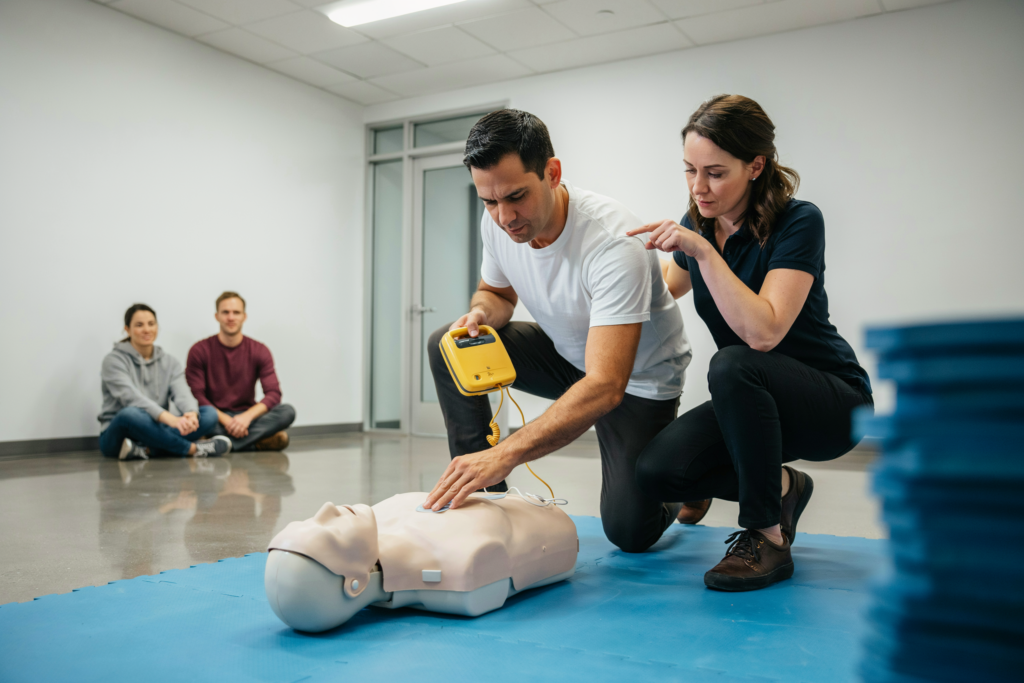
You need to physically demonstrate the skills to a qualified trainer before you can be signed off as competent. The practical component covers:
- CPR on adult and infant manikins
- AED (defibrillator) use
- Recovery position and airway management
- The DRSABCD emergency action plan
- Scenario roleplay relevant to care settings
Lorem ipsum dolor sit amet, consectetur adipiscing elit. Ut elit tellus, luctus nec ullamcorper mattis, pulvinar dapibus leo.
Good training uses scenarios that reflect your real work context. Practicing what you’d actually do if a client collapsed during a home visit is very different from working through a generic manikin drill.
The Renewal vs Recertification Distinction
Technically, there’s no such thing as “renewing” a first aid certificate under the Australian training system. When your HLTAID010 or HLTAID011 comes up, you’re not topping up an existing qualification, you’re completing a brand new enrolment and assessment against the unit of competency. The word “renewal” is colloquial. Experienced care workers move through the content quickly and most find the session genuinely useful, not a box-tick.
What Can and Can’t Be Done Online
This is the section that could save you a lot of money and a lot of stress. The rise of fully online providers has created a real problem in Australia. The websites look professional, the certificates arrive fast, and then your employer’s compliance team runs the RTO number and finds it either doesn’t exist or isn’t scoped to deliver health training. Back to square one, still unqualified.
What’s Legitimately Completed Online
There is a legitimate online component, it just isn’t the whole thing. Before your face-to-face session, a registered RTO will send you pre-course theory modules to complete at home. These cover legislation, basic anatomy, emergency response principles, and knowledge check quizzes. Most RTOs deliver this through a simple online portal you can access on your phone. That’s the legitimate online component preparation for the face-to-face session, not a replacement for it.
What Must Be Completed Face-to-Face No Exceptions
Under the ASQA Standards for RTOs 2015 (Clauses 1.1–1.4), certain components of first aid training cannot be delivered or assessed remotely. No workarounds, no exemptions for experienced workers. A qualified trainer must observe and sign off on your competency in person including CPR competency, AED use, scenario-based assessment, and all practical skills.
ANZCOR Guideline 11.1 is direct on CPR training currency. CPR is a physical skill. Depth, rate, recoil these have to be assessed in person. Watching a video doesn’t count.
The Red Flags of a Non-Compliant Online Provider
If a provider is offering a fully online first aid certificate, check for these warning signs before you hand over your money:
- No RTO number listed anywhere on the website making it impossible to verify the provider's registration status through official government records.
- Certificate issued without any face-to-face component required despite practical assessment being mandatory for nationally recognised HLTAID010 training.
- No trainer named or credentialled on the site reducing transparency about who delivers and assesses the training.
- Certificate does not display the NRT (Nationally Recognised Training) logo which is a key indicator of an officially recognised Australian qualification.

🔍 RTO Verification Tip: Check whether a provider is a legitimate Registered Training Organisation (RTO) by visiting training.gov.au, searching their provider name or RTO number, and confirming their registration status and scope includes the HLT Health Training Package. It takes about 60 seconds and could save you from receiving a certificate your employer won't accept.
What Aged Care and NDIS Workers Specifically Need in Queensland
Now that you know what the rules are nationally, here’s what they mean specifically for aged care and NDIS workers in Queensland.
Aged Care Sector Requirements
The Aged Care Quality Standards administered by the Aged Care Quality and Safety Commission require that workers hold current first aid qualifications appropriate to their role. That applies to both residential and home care settings, with no carve-out for casual or part-time staff. Most Queensland aged care employers require HLTAID010 at minimum for personal care workers, and HLTAID011 for team leaders and senior staff. If you’re unsure what your employer requires, check your employment contract or ask your coordinator. Getting the wrong unit code is one of the most common reasons certificates get rejected.
NDIS Worker Requirements
The NDIS Practice Standards updated in 2022 by the NDIS Quality and Safeguards Commission don’t mandate a specific first aid unit code at the national level. Registered providers set their own policy, and most require either HLTAID010 or HLTAID011. The Commission examines training currency during audits, so an expired or non-compliant certificate is a risk for your employer and your employment.
If you’re a self-managed support worker, you’re responsible for your own compliance. No one is going to send you a reminder. Your certificate lapses, your coverage lapses with it.
CPR Annual Refresher What Queensland Employers Actually Enforce
Your HLTAID010 is valid for three years, but your CPR component may need refreshing every twelve months. ANZCOR recommends annual CPR skills refreshes, and many Queensland aged care and NDIS employers enforce this regardless of when your full recertification is due. You could be twelve months into a valid HLTAID010 and still get a call saying your CPR needs updating before your next shift.
The course for that annual refresh is HLTAID009 a CPR-only qualification available on weekends, separate from your three-yearly full recertification cycle.
⏰ Renewal Reminder: Don't get caught out at renewal time. Sign up for a free reminder and we'll let you know when your certificate is coming up for renewal.
How to Choose a Legitimate First Aid Recertification Provider in Brisbane
Knowing what you need is only half the equation the other half is making sure the provider you choose can actually deliver it. The first aid training market in Australia has a real problem with non-compliant providers who look legitimate right up until the moment your employer’s compliance team runs a check.
The Five Things to Check Before You Book
Run through this list before you hand over your card details:
- 1. RTO number visible on the website verify it at training.gov.au and confirm the provider's scope of registration includes the HLT Health Training Package.
- 2. Statement of Attainment carries the NRT logo a legal requirement for nationally recognised training; ask to see a sample certificate if it's not displayed on the provider's website.
- 3. Course includes a face-to-face practical component if the entire course is completed online, it is not nationally recognised.
- 4. Trainer credentials listed with a Certificate IV in Training and Assessment (TAE40116 or TAE40122) at a minimum.
- 5. Same-day digital certificate delivery confirmed know the turnaround time before you book, not after training is completed.
Why Certificate Rejection Happens and How to Avoid It
Certificate rejection almost always comes down to one of three things: a non-RTO provider, an expired RTO scope, or the wrong unit code for the role. When your employer’s compliance team receives your certificate, they cross-reference the RTO number and unit code against training.gov.au. If anything doesn’t match scope lapsed, wrong unit code, missing NRT logo the certificate gets rejected.
How to Get Your First Aid Recertification Done Quickly
You know what to look for. Here’s how to get it done this week. For most care workers in Brisbane and South East Queensland, the two biggest barriers are time and scheduling, weekday courses don’t work around shift rosters, and casual workers can’t afford to lose a day of income for training.
Weekend and Flexible Scheduling Options
Weekend sessions every week across Brisbane and South East Queensland. The online pre-learning component keeps the face-to-face portion tight on a Saturday morning and has your certificate in your inbox by afternoon.
Same-Day Certificate How It Works
Your Statement of Attainment is issued digitally on the day of training and emailed directly to you once your trainer signs off. No waiting for a physical certificate. You walk out and it’s in your inbox, ready to forward to HR or upload to your compliance portal.
What to Bring and How to Prepare
A few things to have ready on the day:
- 1. Comfortable clothing suitable for floor-based CPR practice allowing you to kneel, move freely, and participate in practical assessments.
- 2. Government-issued photo ID required to verify your identity before training and certification can be issued.
- 3. Pre-learning module completed using the link provided in your booking confirmation email before attending the practical session.
- 4. Physical limitations noted at booking trainers can make reasonable accommodations when informed in advance.
Wrapping Up
First aid recertification in Australia isn’t complicated but it is specific. The rules exist for good reason, and understanding them before you book is what separates a certificate that gets accepted on the first try from one that gets rejected and sends you back to square one. The practical component has to be done in person. That’s not a technicality. It applies to every provider, every course, and every worker regardless of experience level.
For aged care and NDIS workers in Queensland, the stakes are higher than in most other professions. Your certificate isn’t a personal achievement sitting in a drawer, it’s an active compliance document that your employer checks, your coordinator tracks, and your registration depends on. An expired or rejected certificate doesn’t just create paperwork. It pulls you off the roster, cuts your income, and puts you in the uncomfortable position of explaining to your employer why your training isn’t current.
What it really comes down to is this: the people you care for deserve someone in the room who knows exactly what to do when something goes wrong. Not someone who’s technically compliant on paper, but someone who’s genuinely prepared. That’s what good first aid training gives you not just a certificate, but the confidence to act when it counts. Get the right course, from the right provider, and you walk away with both.
Book Your First Aid Training Now
Fast, affordable, and nationally accredited training delivered by professionals who care
Frequently Asked Questions
Q. Can I do my first aid recertification entirely online in Australia?
No. Under the ASQA Standards for RTOs 2015, the practical component of first aid recertification including CPR must be completed face-to-face with a qualified trainer from a registered RTO. Theory modules and knowledge quizzes can be completed online before your session, but no nationally recognised Statement of Attainment can be issued without in-person assessment. Any provider offering a fully online first aid certificate is not delivering a qualification your aged care or NDIS employer will accept.
Q. How often do I need to renew my first aid certificate?
Your full HLTAID010 or HLTAID011 is valid for three years, but ANZCOR recommends CPR skills be refreshed annually and many Queensland aged care and NDIS employers enforce this as a condition of employment. That means you may need to complete HLTAID009 each year in addition to your three-yearly full recertification. Check your employer's training policy to confirm what they require before your certificate comes up for renewal.
Q. What's the difference between HLTAID010 and HLTAID011?
HLTAID010 (Basic Emergency Life Support) is the qualification most commonly required for personal care workers, support workers, and community care aides in Queensland. HLTAID011 (Provide First Aid) covers a broader scope and is typically required for team leaders, senior staff, and designated first aid officers. If you're unsure which one applies to your role, check your employment contract or ask your coordinator before you book. Getting the wrong unit code is one of the most common reasons certificates get rejected.
Q. How do I know if a first aid provider is a registered RTO?
Go to training.gov.au, search by the provider's name or RTO number, and confirm their registration is current and their scope includes the HLT Health Training Package. This takes about sixty seconds and is the single most reliable way to verify a provider is legitimate before you hand over any money.
Q. Does HLTAID010 meet the first aid requirements for aged care workers in Queensland?
Yes, for most personal care worker roles. The Aged Care Quality Standards require workers to hold current first aid qualifications appropriate to their role, and HLTAID010 satisfies that requirement for the majority of direct care positions across both residential and home care settings in Queensland. Senior roles and designated first aid officers will typically require HLTAID011 instead.
Making first aid training more affordable for
every classroom
We believe every student deserves access to life-saving first aid knowledge. That’s why we offer specially reduced pricing for schools and educational groups. Whether you’re booking for a single class, a year group, or your entire school, our flexible packages make training more accessible and cost-effective — without compromising quality.
