
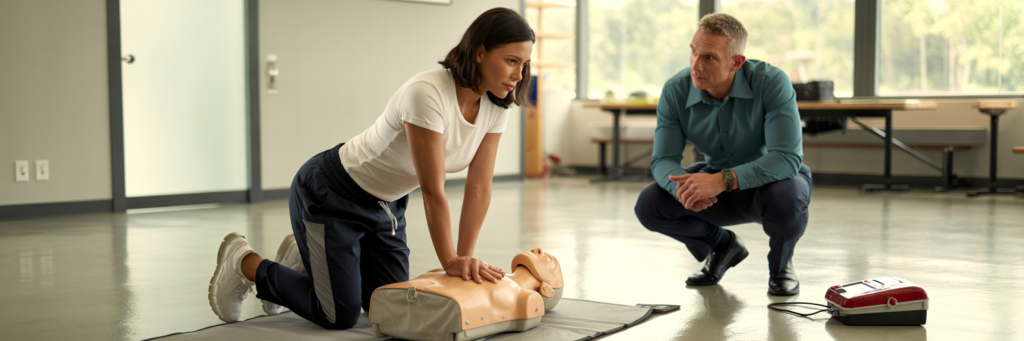
The main difference between online and face-to-face HLTAID009 comes down to how and where you complete the theory component. In a fully face-to-face course, both theory and practical assessment happen in the classroom on the same day. In a blended delivery model, you complete the theory online at your own pace before your booking, then attend a shorter face-to-face session where a qualified assessor observes your CPR technique on a manikin. Under current Australian Resuscitation Council (ARC) guidelines, the face-to-face practical component is mandatory for all HLTAID009 candidates regardless of delivery method. Online-only CPR certification is not nationally recognised.
Feature | Full Face-to-Face | Blended (Online + Face-to-Face) |
Theory delivery | In classroom | Online, self-paced |
Practical assessment | In classroom | In classroom |
Schedule flexibility | Fixed session time | Complete theory any time before booking |
Same-day certificate | Yes | Yes |
Nationally recognised | Yes | Yes |
ARC compliant | Yes | Yes |
Best for | Those who prefer structured learning | Time-poor workers, parents, shift workers |
Traditional CPR courses ask you to block out a significant portion of a weekday or weekend. For anyone juggling work, family, or shift schedules, that is often the real barrier to getting certified, not motivation. The blended HLTAID009 delivery model solves this: complete the theory component online at your own pace, then attend a face-to-face practical session in Brisbane to demonstrate your skills and receive your assessment.
This article explains how the blended format works, what you will cover in each component, and what to look for when choosing a registered training organisation (RTO) that offers it. Whether you are renewing an expired certificate, meeting a workplace compliance requirement, or getting certified for the first time, this guide gives you what you need to book with confidence.
How the Blended HLTAID009 Format Actually Works
The blended HLTAID009 course has two distinct stages. Here is exactly what each one involves.
Stage 1 – Online Theory (Complete Before Your Booking)
Before you set foot in a Brisbane training venue, you will work through the theory component online. This covers everything you need to understand before you pick up a manikin:
- ●The chain of survival and why early CPR matters
- ●How to recognize a cardiac arrest
- ●ARC compression guidelines, including the correct ratio, depth, and rate
- ●The recovery position and when to use it
- ●Queensland bystander legal protections and what the law says about stepping in to help
You can work through it on your phone, tablet, or laptop, whatever you have handy. Most people do it the evening before their practical session, which is honestly the smartest approach. It gives the content time to settle before you apply it hands-on.
You must complete the online theory before arriving at your face-to-face session. Providers confirm this on entry, so do not leave it until the morning of.
Stage 2 – Face-to-Face Practical Assessment (Brisbane)
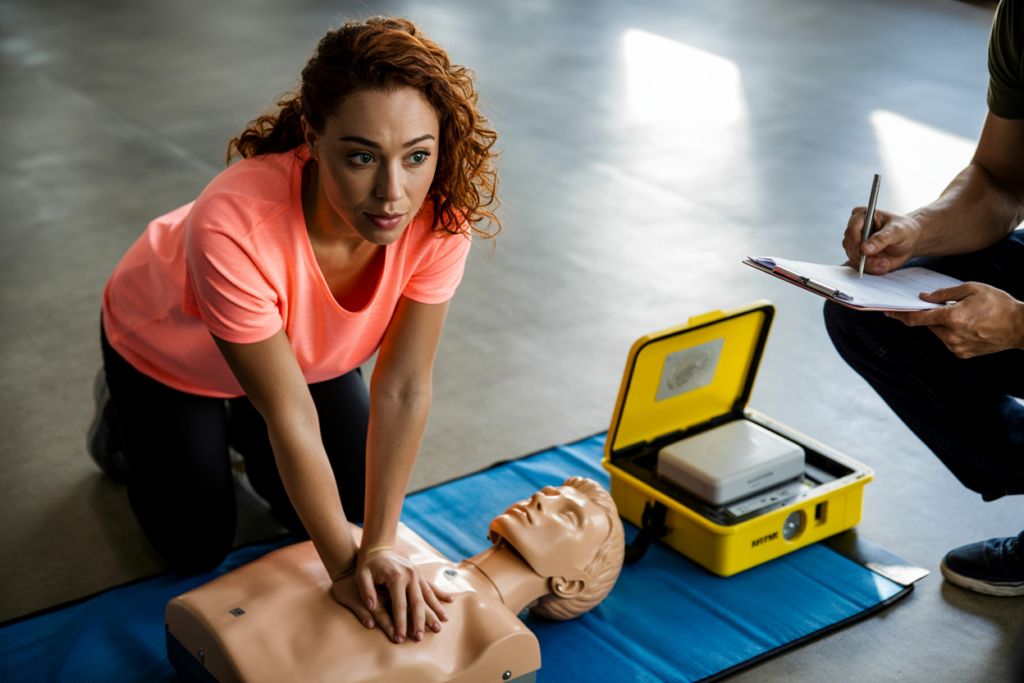
This is where the certificate actually gets earned. Your assessor will observe you performing CPR on a manikin, checking compression depth, compression rate, correct hand placement, and your ability to maintain technique through the assessment. You will also demonstrate the recovery position and get familiar with an AED trainer unit.
What to expect in the room:
- ●Manikins on mats, AED trainer unit, qualified assessor
- ●Manikin CPR observed by your assessor (ARC requirement)
- ●Same-day digital certificate
Most participants arrive nervous about performing in front of others. Most leave surprised by how quickly the practical clicks into place.
Now that you know how the format works, the next question most people ask is whether this type of certificate is actually recognized by employers and compliance bodies. Here is the definitive answer.
🏅 Recognition: A blended HLTAID009 certificate carries exactly the same national recognition as a fully face-to-face certificate - provided the RTO is ASQA-registered and the practical was completed in person. The delivery method does not affect recognition.

Is Blended HLTAID009 Nationally Recognised?
Yes, and this is worth being clear about because there is a lot of confusion on this point.
A blended HLTAID009 certificate is fully nationally recognised, provided the RTO is registered with ASQA and the practical assessment is completed in person. The way the theory is delivered does not change the recognition status of the certificate.
The Australian Resuscitation Council sets the guidelines all RTOs must follow regardless of delivery format. Those guidelines require a face-to-face practical component. Any RTO offering blended delivery meets exactly the same ARC standards as a fully face-to-face provider.
Online-only CPR courses with no face-to-face component are not nationally recognised under current ARC guidelines. Some platforms market CPR certification completed entirely online with no in-person practical. That certificate will not be accepted by ACECQA, NDIS quality auditors, construction site managers, or any employer who knows what they are looking for. Always confirm your provider includes an in-person practical assessment before booking.
When a certificate is nationally recognised, it means:
- ●It was issued by an ASQA-registered RTO
- ●It carries the unit code HLTAID009
- ●The practical component was completed in person
Employers across Queensland who accept HLTAID009 include [KEY EMPLOYER TYPES]: childcare centres under ACECQA compliance requirements, NDIS providers, construction and trades businesses under the WHS Act, healthcare facilities, and hospitality and events operators.
You can verify any provider’s registration status at training.gov.au before you commit.
What to Check Before You Book
Run through this before committing to any provider:
- ●Is the provider registered with ASQA? (Check training.gov.au)
- ●Does the certificate clearly state HLTAID009?
- ●Is a face-to-face practical component included?
- ●Is the RTO number visible on the website and certificate?
- ●Are Google reviews recent and specific about trainer quality?
If any of those boxes cannot be ticked, keep looking. There are good providers in Brisbane and the checklist above will help you find one quickly.
Recognition confirmed. But is the blended format right for your specific situation? Here is how to tell.
Who Should Choose the Blended Format?
The short answer is: most people. Here are the specific situations where the blended HLTAID009 format makes the most sense.
Parents and Caregivers
If you have kids at home, finding a substantial window on a weekend that does not collide with sport, swimming lessons, or general family commitments is genuinely hard. The blended format fits around that reality in a way a traditional classroom course simply does not.
Do the theory after the kids are in bed. Attend a Saturday morning practical. Be home before lunch. Certificate issued the same day.
This matters even more heading into Brisbane’s swimming season, October through March, when families are spending more time at backyard pools, Moreton Bay, and beaches across South East Queensland. Queensland records some of Australia’s highest rates of childhood drowning. CPR-trained adults in poolside and beachside environments significantly improve survival outcomes. If you have children spending time near water this season, getting certified is the highest-return safety investment you can make right now.
Workplace and Compliance Buyers
If your HR department has flagged a compliance deadline, or your ACECQA registration is coming up for review, the blended format gives you a meaningful advantage. You can complete the theory component immediately after booking, then slot into the next available face-to-face session.
This applies across a wide range of Brisbane workplaces:
- ●Childcare workers and directors meeting ACECQA compliance requirements
- ●NDIS support workers maintaining registration conditions
- ●Construction and trades workers under WHS Act obligations
- ●Hospitality and events staff with employer-mandated renewal requirements
It is also worth looking at whether an HLTAID011 First Aid course or HLTAID012 childcare first aid makes sense. Both build directly on HLTAID009 and open up broader compliance coverage.
Shift Workers and Irregular Schedules
This is the group that traditional classroom courses fail most consistently. If you are working rotating shifts, nights, or irregular hours, a fixed Saturday classroom session is not always realistic. The online theory component has no fixed hours. Complete it whenever your roster allows.
If you have identified yourself in one of those groups, the next practical question is time. Here is exactly how long the full process takes.
How Long Does HLTAID009 Take With the Blended Format?
The blended format saves meaningful classroom time without reducing the quality or recognition of your certificate. You are not getting a shorter course. You are getting the same course with the theory shifted to a time and place that suits you. For most Brisbane residents, that flexibility is the difference between a course that fits the calendar and one that keeps getting pushed back.
CPR skill retention is also worth understanding here. Research shows that technique begins to fade after six to twelve months without refresher practice. That is why the ARC renewal cycle is set at one year, and why the face-to-face practical component matters. Reading about CPR online does not build the muscle memory that gets activated under pressure. The practical is where the real skill transfer happens, and it is identical in both the blended and full face-to-face formats.
With the time commitment clear, here is a step-by-step picture of what actually happens when you walk into your Brisbane face-to-face session.
What to Expect on the Day – Your Face-to-Face Session in Brisbane
A lot of people arrive at their first CPR session not quite knowing what to expect, which is completely normal. Here is exactly what the face-to-face component looks like, so you can walk in prepared rather than guessing.
Before You Arrive
Your online theory needs to be done before you get there. Not on the way. Not in the car park. The provider will confirm completion on entry, so give yourself enough time the evening before. Completing it the night before means you arrive with the content still fresh, which makes the practical click into place faster.
What to bring on the day:
- ●Photo ID
- ●Your booking confirmation email
- ●Employer purchase order if your workplace is covering the cost
What to wear: comfortable clothing and flat shoes. You will be kneeling on a mat to perform compressions, so anything that restricts movement is going to make the practical harder than it needs to be.
What Happens in the Room
You will walk into a training room with manikins on mats and an AED trainer unit. There is no intimidating setup. It is a practical workspace designed for skill transfer, not performance.
Your assessor holds and has worked with everyone from first-time learners to experienced healthcare workers. The goal is genuine skill transfer, not catching people out.
If You Need a Second Attempt
Most participants pass on their first attempt. The manikin assessment is designed to confirm your technique is solid enough to be effective in a real situation, not to trip people up. If your assessor identifies something that needs adjustment, they will work with you on it before reassessing.
Your Certificate
Once you have been signed off, your digital certificate is issued the same day, in most cases before you leave the venue. The certificate carries unit code HLTAID009 and your provider’s RTO number, both of which your employer or compliance body will be looking for when you submit it.
You now know what to expect on the day, which makes it much easier to evaluate whether a provider is set up to deliver that experience well.
🔍 Choosing a provider: ASQA registration, the HLTAID009 unit code, and a genuine face-to-face practical are the three things that matter most. Check all three before you pay.
How to Choose the Right Brisbane Provider
Not all RTOs are the same. The certificate might look identical on paper, but the experience and the actual skill you walk away with can vary significantly. Here is what to look for.
The Non-Negotiables
Before anything else, confirm these:
- ●ASQA registration - the RTO number should be visible on the website, on the certificate, and verifiable at asqa.gov.au. If you cannot find it easily, that is a red flag.
- ●HLTAID009 unit code on the certificate - not a generic CPR course description. The unit code is what your employer's compliance team will check.
- ●A genuine face-to-face practical component - the blended format is fine, fully online is not. Confirm this before you book.
Practical Logistics That Signal a Quality Operation
A good Brisbane RTO will have these sorted without you needing to ask:
- ●Same-day digital certificate issuance
- ●A clear cancellation and reschedule policy stated upfront
- ●Weekend and early morning sessions available
- ●A Brisbane-based venue, not a national platform routing you to a random location
Complete Your HLTAID009 in Brisbane – Online Theory + Face-to-Face, Same Day
The blended HLTAID009 format exists because the old version of CPR training was not working for most people. Not because they did not care about getting certified, but because handing over four to six hours of a weekend, consistently, every single year, is genuinely hard when you have a job, a family, or a roster that does not cooperate. The blended model respects that reality without cutting corners on what actually matters.
What you get at the end of this process is not a watered-down certificate. It is the same nationally recognised HLTAID009 qualification, issued by an ASQA-registered RTO, compliant with current ARC guidelines, and accepted by every employer in Queensland who requires it. The theory happens on your terms, online, at whatever hour suits you. The practical happens in person, with a qualified assessor, where you actually get to practise the skill until it sticks.
That second part matters more than most people expect before they attend. There is a significant difference between knowing what CPR looks like and being able to perform it under pressure. The manikin assessment is not a box-ticking exercise. It is the part of the course that builds the kind of muscle memory that might actually save someone’s life, whether that is a colleague at work, a child near a pool, or a stranger who collapses in front of you at the shops.
If you have been putting this off, the blended format removes almost every practical reason to keep waiting. The theory does not require a Saturday. The practical does not require a full day. The certificate is issued before you leave. And the renewal cycle at twelve months means the skill stays current rather than quietly fading back to zero while your card sits untouched in your wallet.
Book Your First Aid Training Now
Fast, affordable, and nationally accredited training delivered by professionals who care
Frequently Asked Questions
Q. Can I complete the HLTAID009 theory component fully online?
Yes - the theory component of HLTAID009 can be completed entirely online, on any device, at any time before your face-to-face session. The module covers the chain of survival, ARC compression guidelines, the recovery position, and Queensland bystander legal protections. You must complete it before arriving at your practical session, as providers confirm completion on entry.
Q. Is a blended HLTAID009 certificate accepted by employers in Queensland?
Yes - a blended certificate carries exactly the same national recognition as a fully face-to-face certificate, provided it is issued by an ASQA-registered RTO and includes the unit code HLTAID009. The delivery method does not affect recognition. The certificate is accepted by childcare centres under ACECQA requirements, NDIS providers, construction and trades businesses under the WHS Act, healthcare facilities, and hospitality and events employers across Queensland.
Q. What if I don't pass the practical assessment on my first attempt?
Most participants pass on their first attempt. The manikin assessment is designed to confirm your technique is effective, not to catch people out. If your assessor identifies something that needs work, they will practise with you before reassessing on the same day.
Q. How do I access the online theory module after booking?
Once your booking is confirmed, you will receive an email with access to the online theory module. Complete it before your face-to-face session - most people find the evening before works best, leaving the content fresh for the practical.
Q. How long does a CPR certificate last in Australia?
Under current Australian Resuscitation Council (ARC) guidelines, an HLTAID009 certificate is valid for one year. Annual renewal is required to keep the certificate current and accepted by employers. Most RTOs will send a renewal reminder as your expiry date approaches. Staying current means your skill stays sharp, not just your paperwork.
Making first aid training more affordable for
every classroom
We believe every student deserves access to life-saving first aid knowledge. That’s why we offer specially reduced pricing for schools and educational groups. Whether you’re booking for a single class, a year group, or your entire school, our flexible packages make training more accessible and cost-effective — without compromising quality.
