
You’re searching for HLTAID010 face to face training because you already know what’s at stake.
Maybe your certificate expired a couple of weeks ago and you’ve been quietly dreading the moment your manager asks you to upload it. Maybe you haven’t practiced CPR on a manikin in over a year and the thought of freezing in front of a collapsing resident keeps you up at 3am. Or maybe you’re just the kind of nurse who refuses to be non-compliant — not even for a day — because you’ve seen what happens when someone isn’t properly prepared when it counts.
Whatever brought you here, here’s the reality: online theory modules can walk you through the steps of emergency life support, but they can’t tell you if your compressions are deep enough. They can’t correct your hand placement. They can’t build the muscle memory that means your hands move automatically when a 78-year-old resident hits the floor without warning.
That’s exactly what HLTAID010 face-to-face training is designed to deliver.
This guide covers everything Brisbane healthcare professionals need to know — why hands-on training builds competence that online courses simply can’t, what your course day actually looks like, how same-day digital certificates solve compliance emergencies, and how to book training that fits around a rotating roster.
What Is HLTAID010 Face-to-Face Training?
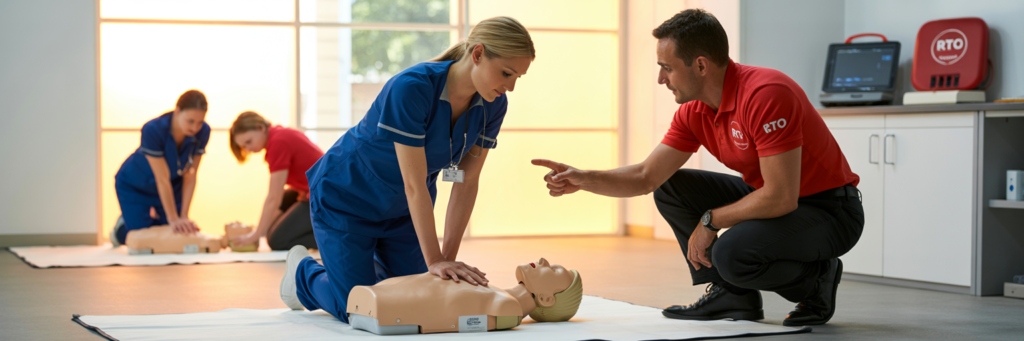
HLTAID010 face-to-face training is a nationally accredited course teaching Basic Emergency Life Support through hands-on practical instruction. Unlike online-only courses, face-to-face training requires physical attendance where you practice life-saving skills on manikins under direct instructor supervision.
Key components include:
- CPR practice — performing chest compressions and rescue breaths on manikins with real-time feedback on depth, rate, and technique
- AED operation — hands-on practice using automated external defibrillators across multiple device types
- Casualty assessment — physically identifying emergency conditions through touch, observation, and response
- Oxygen administration — practical skills using emergency oxygen equipment
- Communication practice — realistic scenarios practicing calls to emergency services under pressure
- Physical demonstrations — recovery position, bleeding control, and shock management
Upon successful completion, you receive nationally recognized certification valid for 3 years, satisfying AHPRA requirements for registered nurses and aged care compliance standards. The course also includes HLTAID011 and HLTAID009 within the curriculum — you don’t need to book those separately.
⚠️ Important: Face-to-face attendance isn't optional. Australian regulations require physical skill demonstration that cannot be assessed online. Any provider claiming to offer a fully online HLTAID010 is not issuing a nationally recognized qualification.
Why Face-to-Face Training Is Essential for HLTAID010
The Limitation of Online-Only Emergency Training
Online platforms can teach you the theoretical steps of emergency life support. You can watch videos demonstrating CPR technique, read through ARC guidelines, and pass multiple-choice assessments. But when a patient collapses in front of you, theoretical knowledge isn’t what saves them.
Knowing that chest compressions should be 5-6cm deep at 100-120 compressions per minute is vastly different from physically performing compressions at that depth and rate — with fatiguing arms, in an unfamiliar environment, under genuine pressure.
Without hands-on practice, you don’t develop the muscle memory needed for consistent compression depth. You can’t feel what adequate compression actually feels like on a human torso. You’ve never experienced the physical fatigue that sets in during continuous CPR. And you’ve never received real-time feedback from someone watching your hands in person.
Studies show CPR quality degrades significantly within months without physical practice. If your baseline was watching a video rather than practicing on a manikin, your starting point was already fragile.
ASQA — the Australian Skills Quality Authority — mandates that HLTAID010 competency must be demonstrated through physical skill assessment. This can’t be achieved via webcam or online simulation. The regulations exist because emergency life support is a physical skill, and physical skills require physical verification.
What You Cannot Learn Without Physical Practice
Your first real emergency won’t happen in perfect conditions. The person won’t collapse on a clean floor in good lighting with all equipment nearby. They’ll collapse in a bathroom, between beds, or in a hallway during a shift change.
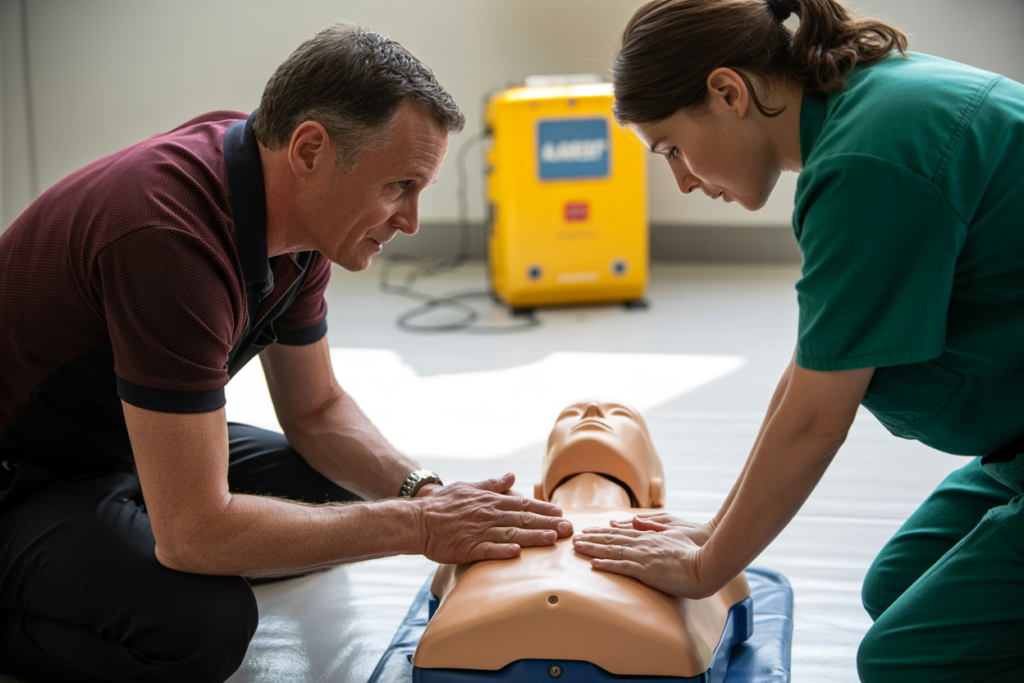
Proper compression technique requires physical feedback the screen simply can’t provide. Correct hand placement has to be verified by observation. Adequate depth requires feedback from the manikin itself. Full chest recoil must be felt, not described. Maintaining the right rate without stopping to count only develops through repetition.
AED confidence works the same way. Pad placement changes with different body types and clothing. Following voice prompts under genuine pressure — when your heart rate is elevated and someone is watching — is a different experience than clicking through a simulation. Clearing casualties before shock delivery requires spatial awareness you only develop by physically moving around a scenario.
During HLTAID010 face-to-face courses at our Brisbane facility, we simulate a cardiac arrest in a cluttered aged care resident room. Students move furniture, position themselves awkwardly, manage the AED in tight spaces, and coordinate with a second responder arriving mid-scenario. That chaos simply cannot be replicated online.
When you practice CPR on a manikin repeatedly during your course day, your hands develop automatic muscle memory. When the real emergency happens, you don’t think about hand placement — your hands know where to go. That’s what face-to-face training delivers.
AHPRA and Regulatory Requirements for Healthcare Workers
If you’re a registered nurse in Australia, your AHPRA registration requires you to maintain current emergency life support skills as part of your Continuing Professional Development. But here’s what many nurses don’t realize — not all HLTAID010 certifications satisfy AHPRA requirements.
AHPRA specifically requires training delivered by a nationally accredited RTO, face-to-face practical skill assessment, competency verified by a qualified assessor, and a certificate issued as a Statement of Attainment rather than a Certificate of Participation.
For aged care workers, the Aged Care Quality Standards require that staff providing personal care hold current emergency response training with face-to-face verified competency from an accredited RTO. During ACQSC audits, facilities must demonstrate evidence of competency-based assessment — not just attendance records.
The legal protection dimension matters too. In the event of a patient death or serious injury, investigations examine whether your certification was current, whether training was delivered by an accredited provider, and whether you demonstrated physical competency during assessment. Face-to-face HLTAID010 training provides that legal evidence. Online-only certificates may not.

What Happens During Your HLTAID010 Face-to-Face Course
Course Structure and How the Day Flows
Your HLTAID010 course is structured to maximize hands-on practice while staying efficient for nurses and aged care workers who can’t afford to waste a Saturday sitting through slides.
The course uses blended learning — combining online theory with face-to-face practical training. After booking, you receive access to online learning modules covering basic anatomy and physiology, legal and ethical considerations, infection control procedures, and emergency response procedures. You complete these at your own pace in the week before your course — during a night shift if that’s when you have time, across a few evenings, or in one sitting.
This pre-learning is what makes the face-to-face day about physical skills rather than classroom theory. You arrive ready to practice, not ready to listen to information you could have read faster at home.
The face-to-face day itself covers:
The morning focuses on CPR skills practice — the core component of the course. Your instructor demonstrates proper technique and then you practice. And practice. And practice again. Each student performs CPR multiple times with the instructor providing real-time feedback on every single attempt. You practice until muscle memory starts to develop, not until the clock runs out.
The late morning moves into advanced life support skills — AED operation, oxygen therapy administration, and recovery position practice. You handle actual AED trainer units of the same brands you’ll encounter in Brisbane healthcare facilities.
After lunch, scenario-based training puts everything together. Medical emergencies including cardiac arrest, stroke, and seizures. Trauma scenarios covering bleeding, shock, and fractures. Group practice managing multiple casualties. Communication with emergency services under realistic conditions. This isn’t a neat demonstration — it’s a deliberately imperfect scenario designed to replicate what real emergencies actually look like, which is almost never straightforward.
The afternoon wraps with practical assessment, followed by theory assessment and certificate processing. You leave with your certificate in your inbox, not in the post.
Individual Attention and Instructor Quality
Individual attention during practice is what separates genuine competency development from certificate processing. When each student gets extensive time on a manikin with personalized instructor feedback on every attempt, they leave with muscle memory. When students spend most of their time waiting and watching, they leave with a certificate and not much else.
Our instructors aren’t minimum-qualified trainers who learned CPR from courses. They’re ex-paramedics and intensive care clinicians with years of real emergency medicine experience.
There’s a meaningful difference in how that teaching lands:
Minimum-qualified trainer: “Perform 30 chest compressions at 5-6cm depth, then give 2 rescue breaths. Repeat this cycle.”
Ex-paramedic instructor: “You’ll start compressions and immediately feel exhausted — that’s normal. Quality CPR is physically demanding. Your arms will burn. When someone offers to swap, let them. In real emergencies, I’ve seen single rescuers become too proud to accept help and their compression quality drops off completely. Swapping rescuers maintains effectiveness. I learned that across hundreds of cardiac arrests in Brisbane ambulances.”
Those aren’t the same lesson. One teaches you to pass an assessment. The other teaches you what actually happens in emergencies and how to manage it.
Our lead instructor David spent over a decade as a paramedic with Queensland Ambulance Service. He teaches from that direct experience — including insights that don’t appear in any textbook, like the fact that most aged care residents have fragile ribs and you’ll likely hear cracks during CPR, that effective compressions matter more than broken ribs, and that you should keep going.
Same-Day Digital Certificate Process
Why Certificate Timing Matters
Here’s a situation that plays out for Brisbane nurses more often than it should.
You finally book your HLTAID010 renewal, attend on Saturday, work hard, pass your assessment, and leave feeling relieved. Certificate sorted. Then you wait. Day one: nothing. Day three: still nothing. Day ten: you email to ask. Day fourteen: a physical certificate arrives in the post.
For fourteen days after completing your training, you’re technically still non-compliant. If your facility receives an audit during that window, or your manager runs a compliance check, you have no proof of current certification — despite having literally just completed the course.
This is the standard certificate delivery timeline for many Brisbane HLTAID010 providers. It causes genuine anxiety for conscientious healthcare workers who’ve done everything right but are still exposed.
How It Works
When you complete your practical assessment, your instructor immediately enters your competency verification into our RTO student management system. That system generates your Statement of Attainment with a unique certification number, records completion on your USI, creates an employer-ready PDF with our RTO digital seal, and sends an automated email to your nominated address.
Your digital certificate includes your full name, unit codes for HLTAID010, HLTAID011, and HLTAID009, date of completion, expiry date, our RTO name and registration number, and a unique certificate number for independent verification.
For AHPRA CPD portfolio: Your HLTAID010 certificate qualifies as a Continuing Professional Development educational activity — face-to-face delivery, from a nationally accredited RTO. Upload to your AHPRA portal and set a renewal reminder for well before your expiry date.
For employer submission: Log into your facility’s HR compliance portal, upload the PDF under Training and Certifications, enter the expiry date, save, and confirm. Monday morning, your compliance dashboard shows current. Green status. Done.
✅ Shift Worker Guarantee: Free unlimited rescheduling with 48-hour notice. Your roster changed? Email us and we'll move you to any future date at no charge. No rebooking fees, no penalties, no questions asked. We've trained thousands of Brisbane healthcare professionals — we understand that rosters change and you shouldn't be penalized for circumstances outside your control.
How to Choose the Right HLTAID010 Provider in Brisbane
Verify RTO Accreditation First
Not all first aid training in Brisbane is nationally accredited. Some providers operate in a grey zone that produces certificates that look official but won’t satisfy AHPRA requirements, aged care compliance, hospital credentialing, or legal liability protection.
The verification process takes three minutes on training.gov.au — the Australian Government’s national training register. Search the provider’s RTO number, confirm their status shows “Current,” and confirm HLTAID010 appears in their current scope of registration. If a provider doesn’t display their RTO number on their website, that alone is a significant red flag.
What you must receive upon completion is a Statement of Attainment — the official ASQA term for a nationally recognized qualification. Not a Certificate of Attendance, not a Training Completion Award, not a Certificate of Participation. A Statement of Attainment, issued by a registered RTO, containing the unit codes, recorded on your USI.
If a provider can’t clearly confirm they issue Statements of Attainment from a registered RTO, don’t book.
Instructor Experience and Course Quality
Ask any provider you’re considering: what are your instructors’ clinical backgrounds? How many years of emergency medicine experience do they have?
A provider confident in their instructors will answer without hesitation. One who deflects or gives vague answers about “qualified trainers” is telling you something.
Also ask about how much individual manikin practice time each student receives. The answer to that question tells you whether you’re going to leave with genuine competency or just a piece of paper.
Book Your HLTAID010 Face-to-Face Training Today
You’ve done the research. You know what quality HLTAID010 face-to-face training looks like, what separates a genuinely useful course from one that just processes you through an assessment, and what to check before booking.
Here’s where it gets simple.
Every day your certificate sits expired is a day you’re carrying professional risk that doesn’t need to be there. One Saturday resolves that for three years.
One Saturday. A same-day certificate in your inbox. Three years of compliance sorted.
Book HLTAID010 Face to Face Training Today — and be compliant before Monday morning.
Book Your First Aid Training Now
Fast, affordable, and nationally accredited training delivered by professionals who care
Frequently Asked Questions About HLTAID010 Face-to-Face Training
Q.How long is HLTAID010 certification valid?
Your HLTAID010 certification is valid for 3 years from the date of completion. For example, if you complete your course on March 15, 2026, your certificate is current until March 15, 2029. During those three years, it satisfies AHPRA CPD requirements for registered nurses, aged care facility compliance, and hospital employment credentialing. After 3 years, you must complete the full HLTAID010 course again — not just a refresher. The Australian Resuscitation Council recommends annual CPR refreshers even though the full certification lasts three years, as physical skills degrade faster than the certification expires.
Q.What's the difference between HLTAID010 and HLTAID011?
HLTAID010 (Provide Basic Emergency Life Support) includes everything in HLTAID011 (Provide First Aid) plus advanced life support skills like oxygen administration. When you complete HLTAID010, your Statement of Attainment lists all three unit codes — HLTAID010, HLTAID011, and HLTAID009 (Provide CPR) — you don't need to book them separately. For healthcare workers including nurses and aged care staff, you need HLTAID010 to satisfy AHPRA requirements and workplace compliance. For general workplaces like offices or retail, HLTAID011 is typically sufficient, but if there's any chance you'll work in healthcare, complete HLTAID010 from the start.
Q.Can I do HLTAID010 partially online?
Yes and no. The theory component can be completed online at home before your course day — covering anatomy, legal considerations, infection control, and emergency procedures — but the practical skills component must be completed face-to-face. Australian regulations require physical demonstration of CPR, AED operation, casualty assessment, and other emergency skills that simply cannot be verified via webcam. The blended learning model (online theory + face-to-face practical) maximizes efficiency while maintaining the hands-on training that regulations require and that genuinely builds competency.
Q.What if I fail the practical assessment?
HLTAID010 uses competency-based assessment, not pass/fail grading, and 99.8% of students demonstrate competency on their first attempt. The course is designed so that by the time you reach assessment, you've already practiced the skills multiple times with instructor feedback. If your technique needs improvement during assessment, your instructor provides specific feedback, you practice for an additional few minutes with direct coaching, and then re-attempt — at no extra charge. The assessment verifies you can perform skills at the required standard, not that you perform them perfectly, and instructors provide whatever support you need to demonstrate competency.
Q.Do I need to be physically fit to complete HLTAID010?
You need to be able to kneel on the floor for CPR practice, perform chest compressions with adequate force, and move around during scenario-based training, but you don't need to be an athlete. We provide knee pads for older students or anyone who finds floor work uncomfortable, allow frequent breaks during physically demanding practice, and can modify techniques where needed. If you have a back injury, wrist injury, or other physical limitation that might affect your ability to perform certain skills, contact us before booking so we can discuss specific accommodations — ASQA allows reasonable adjustments and we can modify assessment approaches in many cases while still verifying competency.
Q.How do I verify a provider is properly accredited?
Visit training.gov.au (the Australian Government's national training register), search the provider's RTO number (which should be displayed on their website), confirm their status shows "Current" not "Cancelled" or "Suspended," and verify that HLTAID010 appears in their scope of registration. This three-minute check confirms they're legally authorized to issue nationally recognized HLTAID010 qualifications. If a provider doesn't display their RTO number anywhere on their website, that's a major red flag — legitimate RTOs are proud of their accreditation and display it prominently.
Making first aid training more affordable for
every classroom
We believe every student deserves access to life-saving first aid knowledge. That’s why we offer specially reduced pricing for schools and educational groups. Whether you’re booking for a single class, a year group, or your entire school, our flexible packages make training more accessible and cost-effective — without compromising quality.
