
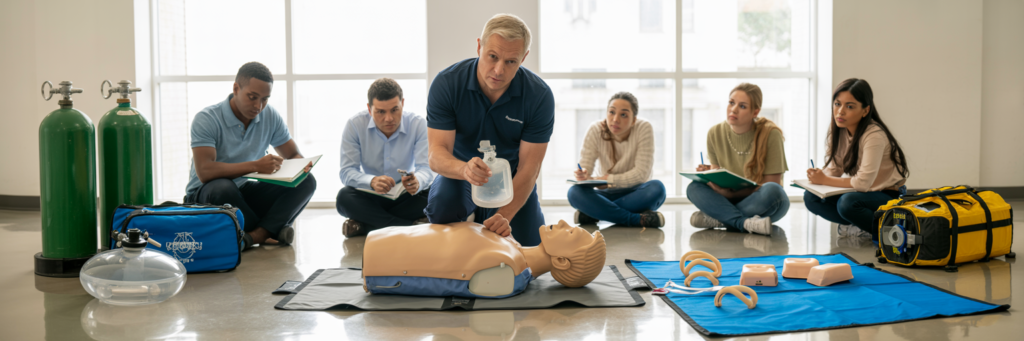
487 applicants competed for just 32 QAS paramedic positions in the last intake—and HLTAID010 certification was listed on every successful candidate’s application. If you’re serious about a paramedic career, patient transport role, or any healthcare position requiring advanced emergency skills, understanding what happens in an HLTAID010 lesson isn’t optional—it’s strategic.
You search “HLTAID010 lesson” and what comes up? Generic course descriptions that don’t answer your actual questions. What equipment will you actually touch during training? How hands-on is it really? Will this genuinely prepare you for emergency scenarios, or are you just ticking a certification box? And the question that keeps you up at 3am—can you talk about this training confidently in a QAS interview, or will you sound like every other applicant who’s just got the certificate but zero practical understanding?
This guide breaks down everything you’ll actually learn in your HLTAID010 lesson—from oxygen delivery systems to advanced airway management. Whether you’re applying for QAS paramedic positions, working towards patient transport, or you want genuine emergency response capabilities, you’ll discover exactly what to expect, how to prepare, and why this certification separates serious applicants from
💡 QUICK REALITY CHECK: HLTAID011 (basic first aid) teaches you what to do while waiting for help. HLTAID010 (BELS) teaches you what to do when YOU ARE the help. For paramedic pathways, that difference is everything.
Understanding HLTAID010 – What Makes This Course Different
HLTAID010 vs HLTAID011 – Why Basic Emergency Life Support Goes Beyond First Aid
Right, so here’s where most people get confused. They see “HLTAID010” and “HLTAID011” and think “okay, they’re just different numbers, probably pretty similar courses.” Wrong. Dead wrong, actually.
HLTAID011 is your standard Provide First Aid certificate. That’s the one everyone gets for workplace compliance. You learn CPR on a mannequin, how to bandage wounds, basic splinting, maybe some burn care. There’s nothing wrong with HLTAID011—it’s a solid foundation. But here’s what it doesn’t teach you.
It doesn’t teach you how to set up an oxygen cylinder and calculate flow rates. It doesn’t teach you how to insert an oropharyngeal airway into an unconscious patient whose tongue is blocking their airway. It definitely doesn’t teach you two-person bag-valve-mask ventilation technique. And when you’re sitting across from that QAS interview panel and they ask about your emergency equipment experience, “I know CPR and how to apply a bandage” isn’t gonna cut it against someone who can discuss oxygen therapy protocols and advanced airway management.
That’s the HLTAID010 lesson difference. Basic Emergency Life Support picks up where first aid stops and teaches you the equipment-based interventions that bridge the gap between basic first aid and actual paramedic skills.
| Equipment Type | HLTAID011 (First Aid) | HLTAID010 (BELS) |
|---|---|---|
| CPR mannequins | ✓ Basic | ✓ Advanced with feedback |
| Oxygen cylinders | ✗ Not covered | ✓ Full setup training |
| Airway devices (OPA/NPA) | ✗ Not covered | ✓ Insertion practice |
| Bag-Valve-Mask (BVM) | ✗ Not covered | ✓ Two-person technique |
| Suction equipment | ✗ Not covered | ✓ Manual & mechanical |
HLTAID011 focuses on care you can provide without equipment. HLTAID010 focuses on operating the advanced equipment that emergency services use every single day. That’s why every paramedic pathway in Queensland requires BELS certification, not just first aid.
Who Needs HLTAID010 Certification in Queensland?
Aspiring Paramedics: If you’re applying for QAS paramedic positions, BELS certification is basically non-negotiable. Not technically required on paper, but go through any aspiring paramedic Facebook group and count how many successful applicants didn’t have it. The competition is fierce. 487 applicants for 32 positions means every certification matters.
Patient Transport Officers: Most companies require HLTAID010 as a condition of employment because you’re transporting patients who might deteriorate en route, and you need to respond with more than just basic first aid.
Healthcare Workers: Nursing assistants, enrolled nurses, allied health professionals moving into roles with more clinical responsibility often need HLTAID010 for emergency response teams.
Industrial and Remote Workers: Mining sites, construction projects, remote locations in regional Queensland—anywhere more than 30 minutes from an ambulance response. These sites require BELS certification because you need someone who can manage airways, provide oxygen, and keep a patient stable until evacuation.
Complete HLTAID010 Lesson Breakdown – Skills You’ll Practice
Here’s what you actually came here for. Not vague descriptions—actual specifics about what happens during your HLTAID010 lesson. What equipment you’ll touch, what scenarios you’ll practice, what you’ll walk out knowing how to do.
Oxygen Therapy Systems
During your HLTAID010 lesson, you’ll learn how to operate oxygen delivery systems from scratch. Starting with reading the cylinder gauge to check how much oxygen you’ve got, calculating how long your supply will last at different flow rates, and safely opening the cylinder valve without damaging the regulator.
You’ll learn the different delivery devices and when to use each one. Nasal cannulas for low-flow oxygen (1-6 litres per minute). Simple face masks for moderate delivery (5-10 litres per minute). Non-rebreather masks with reservoir bags for high-concentration oxygen (10-15 litres per minute) in serious respiratory emergencies.
The practical component is where this gets real. You’ll actually attach regulators to cylinders, set flow rates, check for leaks, and apply oxygen delivery devices to training mannequins while your instructor watches your technique. You’ll learn troubleshooting—cylinder won’t open? Flow meter not registering? Mask fogging indicating poor seal? These aren’t theoretical problems, they happen in real emergency responses.
Quality training providers use actual medical-grade oxygen cylinders, not demonstration equipment. That’s important because when you’re using this equipment for the first time in a genuine emergency, it’s not actually your first time.
Advanced Airway Management (OPA/NPA)
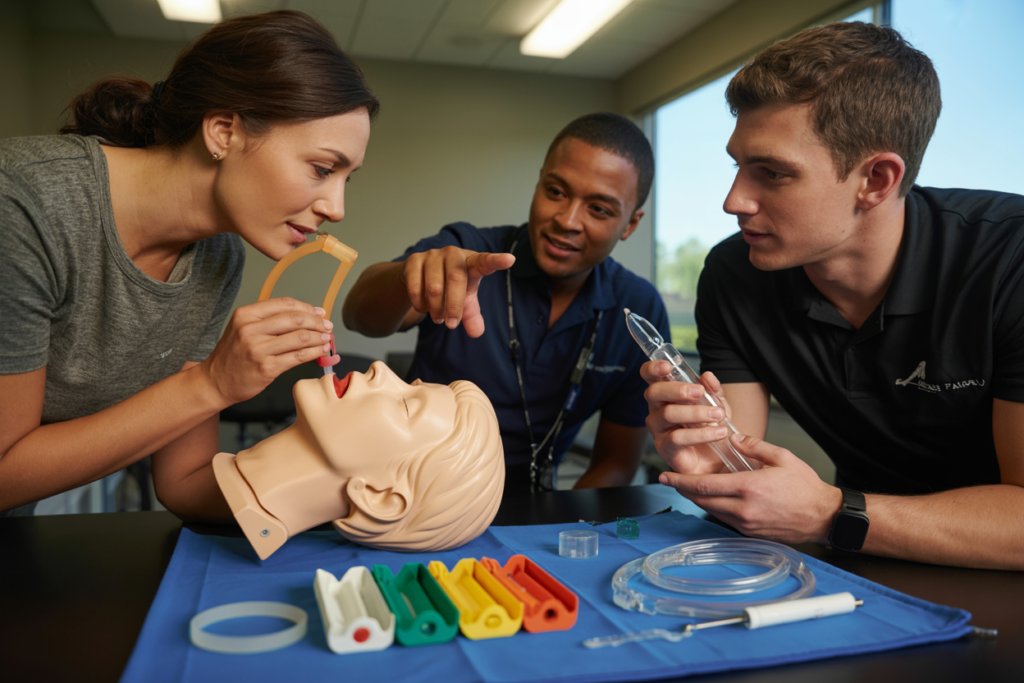
Oropharyngeal Airways (OPA): These are the curved plastic tubes that sit in an unconscious patient’s mouth and prevent their tongue from blocking their airway. You’ll learn how to select the correct size by measuring from the patient’s earlobe to the corner of their mouth. You’ll practice the insertion technique—inserting it upside down initially, then rotating it 180 degrees as you advance it.
Here’s what they won’t tell you: inserting an OPA on a mannequin feels weird the first time. The resistance is different than you expect. The rotation technique feels awkward. You’ll probably fumble it on your first attempt. That’s normal and exactly why you’re practicing in a training environment.
Nasopharyngeal Airways (NPA): These soft rubber tubes go through the nose and sit in the back of the throat. You’ll learn sizing technique (measure from the nostril to the earlobe), lubrication requirements, and the correct insertion angle following the floor of the nasal cavity.
When you’re in that QAS interview and they ask about your airway management experience, “I’ve practiced OPA and NPA insertion on training mannequins during my HLTAID010 lesson, including appropriate sizing and correct insertion technique” sounds a hell of a lot better than “Um, I know what they are from reading about them.”
Bag-Valve-Mask (BVM) Ventilation
BVM ventilation separates “I’ve done a first aid course” from “I’ve done proper emergency life support training.”
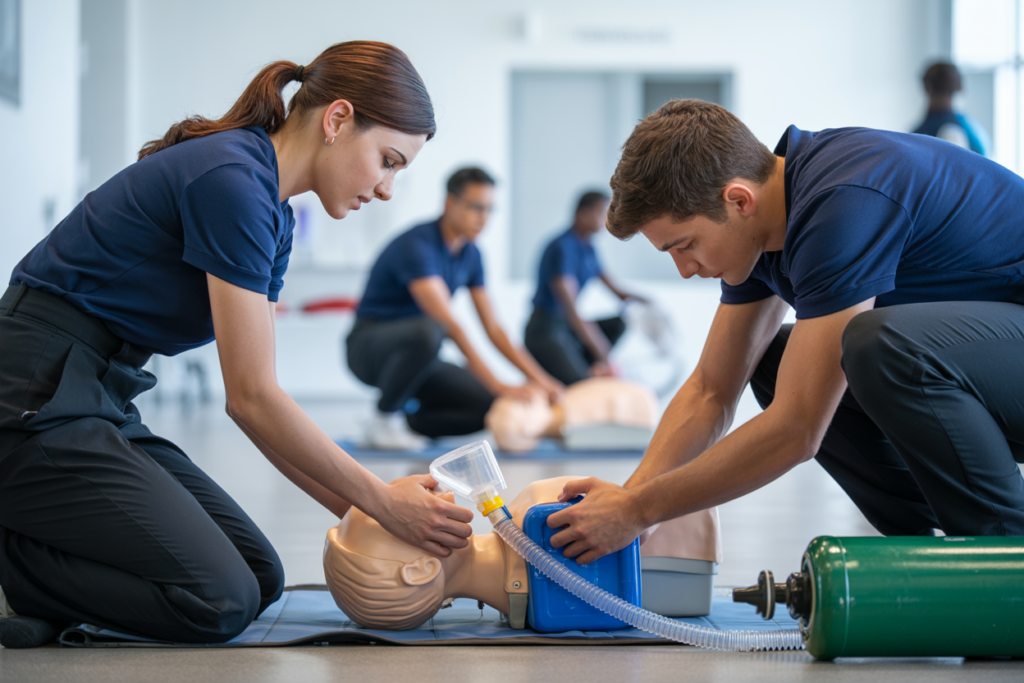
Your HLTAID010 lesson covers single-person BVM technique, but two-person BVM is the gold standard. One person uses both hands to maintain mask seal and jaw position—way easier and gets a much better seal. The second person operates the bag, watching for chest rise and maintaining proper ventilation rate.
You’ll practice two-person BVM extensively, rotating roles so you understand both positions. Your instructor will watch for common errors: inadequate seal (air hissing around mask edges), hyperventilation (squeezing too fast), and poor team communication.
The scenarios get progressively realistic. You’ll practice BVM on mannequins in different positions, while someone else is doing chest compressions, and troubleshooting when you’re not getting chest rise.
This is exactly what QAS paramedics do in cardiac arrest situations. When you can demonstrate proper technique and discuss troubleshooting steps, you’re showing the interview panel that you understand basic life support the way working paramedics understand it.
Suction Equipment and Casualty Assessment
Suction: Sometimes airways aren’t just blocked by the tongue—they’re blocked by vomit, blood, or secretions. Your HLTAID010 lesson covers manual suction (hand-powered devices) and mechanical suction units. You’ll practice the technique, learn time limits (no more than 15 seconds of active suctioning), and understand when to use rigid versus flexible catheters.
DRSABCD Plus Equipment: Your HLTAID010 lesson builds on the basic first aid framework by integrating equipment-based interventions at each decision point. When you reach the Airway step, you’re making decisions about OPA or NPA insertion. When you assess Breathing, you’re evaluating whether this patient needs oxygen therapy and what delivery device is appropriate.
Your instructor will run through multiple scenarios—cardiac arrest, respiratory distress, anaphylaxis with airway compromise—and you’ll practice complete responses integrating everything you’ve learned. These scenarios mirror the complexity of real emergencies where nothing’s ever just one problem.
What to Expect During Your HLTAID010 Lesson
Most HLTAID010 courses run either as a full-day format or a split format combining theory and practical sessions. Here’s what your training day actually looks like:
Theory Component: Your instructor covers the theoretical foundations—when and why you’d use each intervention, legal responsibilities, infection control. Good instructors make this interactive with case examples and questions.
Equipment Demonstrations: Your instructor demonstrates each skill—oxygen therapy setup, airway insertion, BVM technique, suction operation—then you practice in small groups. This is learning time. You’ll fumble stuff. That’s expected.
Scenario Practice: You’ll work through multiple emergency scenarios, rotating through different roles—primary responder, assistant, observer. Your instructor circulates, provides feedback, corrects technique. This is where the learning really happens.
Assessment: Your instructor assesses your competency through observed scenarios. You’ll demonstrate each skill correctly—oxygen therapy setup, airway management, proper BVM technique, effective suctioning. The standard is “competent” or “not yet competent.” Most people pass on the first go if they’ve been engaged during practice.
Equipment Quality Matters: Quality BELS courses use medical-grade equipment—actual oxygen cylinders with real regulators, various sizes of airways, multiple BVM resuscitators, manual and mechanical suction units, advanced CPR mannequins with feedback systems. If your training provider is using equipment that’s ten years old or broken, you’re not getting proper training.
HLTAID010 for Paramedic Pathways
Let’s get real about why you’re actually here. You’re not researching HLTAID010 lessons because you’re passionate about oxygen cylinders. You’re here because you want to be a QAS paramedic and you’re trying to figure out if BELS certification will actually make a difference.
So here’s the honest answer: HLTAID010 won’t guarantee you a QAS position. Nothing will. But it’s become one of those unofficial requirements that separates competitive applicants from everyone else.
What QAS Actually Looks For
Go through the last three QAS recruitment rounds on LinkedIn. Find the people who posted “So excited to announce I’ve been accepted into the QAS Graduate Paramedic Program!” Look at their profiles. Check their certifications section. You’ll find a pattern pretty quickly—almost everyone who got accepted had HLTAID010, not just basic first aid.
Is that correlation or causation? Probably both. People who are serious enough to complete BELS training are also preparing thoroughly in other areas—volunteering, gaining relevant work experience, maintaining fitness. HLTAID010 is part of a pattern of preparation that QAS recruitment panels recognize.
How BELS Training Changes Your Interview
Before BELS Training: Panel: “Tell us about your emergency response training.” You: “Um, I hold current first aid certification. I’m really interested in learning more about advanced interventions.” Panel: [writes nothing, moves to next question]
After BELS Training: Panel: “Tell us about your emergency response training.” You: “I hold HLTAID010 Basic Emergency Life Support certification, which covered oxygen delivery systems, advanced airway management including OPA and NPA insertion, bag-valve-mask ventilation technique, and suction equipment operation. During my training I practiced these skills in realistic scenarios using hospital-grade equipment.” Panel: [leans forward, makes detailed notes] “Good. Tell us more about the oxygen therapy component.”
See the difference? You’re not just saying you’re interested—you’re demonstrating you’ve already started learning it. You’re speaking the language. You’re showing initiative.
When they ask scenario-based questions like “How would you respond to a patient who’s unconscious with noisy breathing?” you can walk them through your assessment process, discuss equipment decisions, and demonstrate systematic thinking. That sounds like someone who’s actually practiced emergency response, not someone who memorized textbook definitions.
Building Competency Beyond the Certificate
Here’s the thing about HLTAID010 that matters: it’s not just about getting a certificate to list on your application. It’s about building genuine competency that carries forward into your QAS graduate program.
If you get accepted into the QAS Graduate Paramedic Program, the first week covers oxygen therapy, airway management, BVM ventilation, suction techniques. Exactly what your HLTAID010 course taught you. The students who’ve done BELS training before aren’t learning from scratch—they’re refining skills they already have basic competency in. That confidence compounds throughout the program.
Choosing the Right Training Provider
Your HLTAID010 certificate looks identical whether you got it from a quality training provider with experienced instructors and proper equipment, or from a cheap provider who rushed 30 people through a warehouse with broken mannequins. Same piece of paper. Completely different learning experience.
What to Look For:
Instructor Background: Look for providers whose instructors are current or former QAS paramedics, intensive care paramedics, or emergency nurses. These people can answer your questions about how BELS skills apply in real-world emergency response and share experiences about troubleshooting under pressure. If the training provider won’t tell you anything about their instructors’ backgrounds, that’s a red flag.
Class Size: Providers who cap their courses at 12-16 students are prioritizing quality instruction. During scenarios and assessments, your instructor needs to actually watch your technique. That’s impossible with 25 students and one instructor.
Equipment Quality: Ask what equipment they use. Do they use actual medical oxygen cylinders or demonstration models? How many sets of equipment per student? Is their equipment current? Providers using proper medical-grade equipment will be proud to tell you about it.
Red Flags to Avoid:
- They promise “easy” certification (HLTAID010 should assess competency properly)
- They can’t provide RTO details (verify on training.gov.au)
- Unclear assessment process or suggest “everyone passes”
- No refund or rescheduling policy
- High-pressure booking tactics
- Can’t answer questions about instructors or equipment

Preparing for Your HLTAID010 Lesson
Most providers will send you pre-course materials before your training. Actually do them. Review respiratory anatomy basics—understanding the pathway from nose/mouth to lungs helps you understand why airway management matters. Familiarize yourself with DRSABCD since your training builds on this framework. Watch a few equipment demonstration videos on YouTube so the gear isn’t completely foreign when your instructor demonstrates it.
What to Bring: Photo ID, your unique student identifier (USI) number, completed pre-course materials, lunch and snacks, water bottle, comfortable clothes you can move in, layers for temperature changes.
During Your Course: Ask questions immediately when something doesn’t make sense. Practice deliberately—talk yourself through what you’re doing and why. Rotate roles during scenarios to experience every perspective. Take notes on your own mistakes so you don’t repeat them.
After Your Course: Within a couple days, review your course materials while everything’s fresh. Watch a couple YouTube videos of the techniques you learned to reinforce correct technique. Do regular mental rehearsals of scenarios and equipment procedures. Before QAS interviews, refresh your memory on equipment specifications and technique details so you can discuss your training confidently.
Your Next Steps
You’ve made it through this complete guide to HLTAID010 training. You understand what the course actually teaches, how it differs from basic first aid, what to look for in training providers, and why this certification matters for your paramedic pathway.
Now you’ve got a decision to make.
You can keep researching—keep reading forums, keep watching YouTube videos, keep telling yourself you’ll book the course “soon.” Or you can actually book it. Get the training done. Add that certification to your QAS application. Have genuine emergency equipment experience to discuss in your interview instead of theoretical knowledge from internet research.
If QAS recruitment is coming up, complete your HLTAID010 lesson so the skills are fresh when you’re writing your application and preparing for interviews. Every week you delay is a week closer to recruitment where you’re competing against candidates who’ve already completed their BELS certification and have been practicing those skills.
Find a quality provider with experienced instructors, reasonable class sizes, and proper equipment. Book your course. Show up prepared. Practice deliberately. Walk out with genuine competency in advanced emergency skills.
That’s how you move from “aspiring paramedic researching qualifications” to “competitive QAS applicant with demonstrated preparation.”
The choice is yours. Make it count.
Book Your First Aid Training Now
Fast, affordable, and nationally accredited training delivered by professionals who care
Common Questions About HLTAID010 Lessons
Q.How long is HLTAID010 certification valid for?
Your HLTAID010 certificate is valid for 12 months from the date of issue. After that, you need to complete a refresher course to maintain current certification. Most training providers offer shorter refresher courses that focus on updating skills and knowledge rather than teaching everything from scratch. If you're planning to use this for QAS applications, make sure your certificate will be current throughout the entire recruitment process—including interviews which might happen months after applications close.
Q.Do I need HLTAID011 (basic first aid) before doing HLTAID010?
No, HLTAID011 isn't a prerequisite for HLTAID010. You can go straight into BELS training without having completed basic first aid first. That said, having foundation first aid knowledge does make the HLTAID010 lesson easier to understand because you're building on concepts like DRSABCD and basic casualty assessment rather than learning them for the first time. Some providers include basic first aid components in their BELS courses, while others assume you've got that knowledge. Check with your training provider about what's included.
Q.Can I do HLTAID010 online or does it have to be in-person?
HLTAID010 requires face-to-face practical training with an instructor—you can't do it fully online. Some providers offer blended learning where you complete theory components online before attending an in-person practical session, but the hands-on skills training with actual equipment is mandatory. This makes sense when you think about it—you can't learn oxygen cylinder setup, airway insertion, or BVM technique by watching videos. You need to physically practice these skills with proper equipment and get feedback from a qualified instructor watching your technique.
Q.What happens if I don't pass the HLTAID010 assessment first time?
If you're assessed as "not yet competent" in any skill area, reputable training providers will give you additional coaching and another opportunity to demonstrate competency. Sometimes this happens on the same day if time permits, sometimes you'll need to return for reassessment. Most providers don't charge extra for first-time reassessment if you made a genuine effort during the original course. The instructors want you to succeed—they're not trying to fail people. If you're struggling with a particular technique, they'll work with you to identify what's going wrong and help you get it right.
Q.Do I need medical experience to do HLTAID010?
No medical background required. HLTAID010 is designed for people without clinical experience—that's the whole point. The course teaches you equipment-based emergency skills from scratch, assuming you're starting with basic first aid knowledge at most. Whether you're a QAS admin officer like Pete, a retail worker, a tradie, or a university student, you can complete BELS training. Your instructor will demonstrate each skill, you'll practice in a safe environment, and you'll get feedback until you're competent. The only real requirement is being willing to learn and practice.
Q.How is HLTAID010 different from HLTAID009 (CPR only)?
HLTAID009 is just CPR and basic life support—you learn cardiopulmonary resuscitation technique, AED use, and managing unconscious casualties. HLTAID010 includes all of that plus oxygen therapy, advanced airway management (OPA/NPA), bag-valve-mask ventilation, and suction equipment. Think of HLTAID009 as the absolute minimum for emergency response, while HLTAID010 adds the equipment-based interventions that emergency services actually use. For paramedic pathways, patient transport, or healthcare roles, HLTAID009 alone isn't enough—you need the advanced skills that BELS provides.
Making first aid training more affordable for
every classroom
We believe every student deserves access to life-saving first aid knowledge. That’s why we offer specially reduced pricing for schools and educational groups. Whether you’re booking for a single class, a year group, or your entire school, our flexible packages make training more accessible and cost-effective — without compromising quality.
