

Not sure whether your employer wants HLTAID010 or HLTAID011 and too nervous to ask in case you should already know?
You’re not alone. It’s one of the most common questions we hear from aged care workers and NDIS support staff across Brisbane and South East Queensland. Both courses are nationally recognised first aid qualifications delivered by ASQA-registered RTOs. Both involve hands-on training. And both have very similar-sounding names. But they are not the same and booking the wrong one can mean starting over from scratch.
This guide cuts through the confusion. By the time you’ve finished reading, you’ll know exactly which certificate your role requires, what each course covers, and how to book the right one without wasting a day off or a dollar. Whether you’re renewing an existing qualification, onboarding into a new role, or just trying to stay ahead of your employer’s compliance deadline, you’re in the right place.
What Is the Difference Between HLTAID010 and HLTAID011?
HLTAID010 (Basic Emergency Life Support) and HLTAID011 (Provide First Aid) are both nationally recognised first aid qualifications, but they differ in scope and the roles they’re designed for.
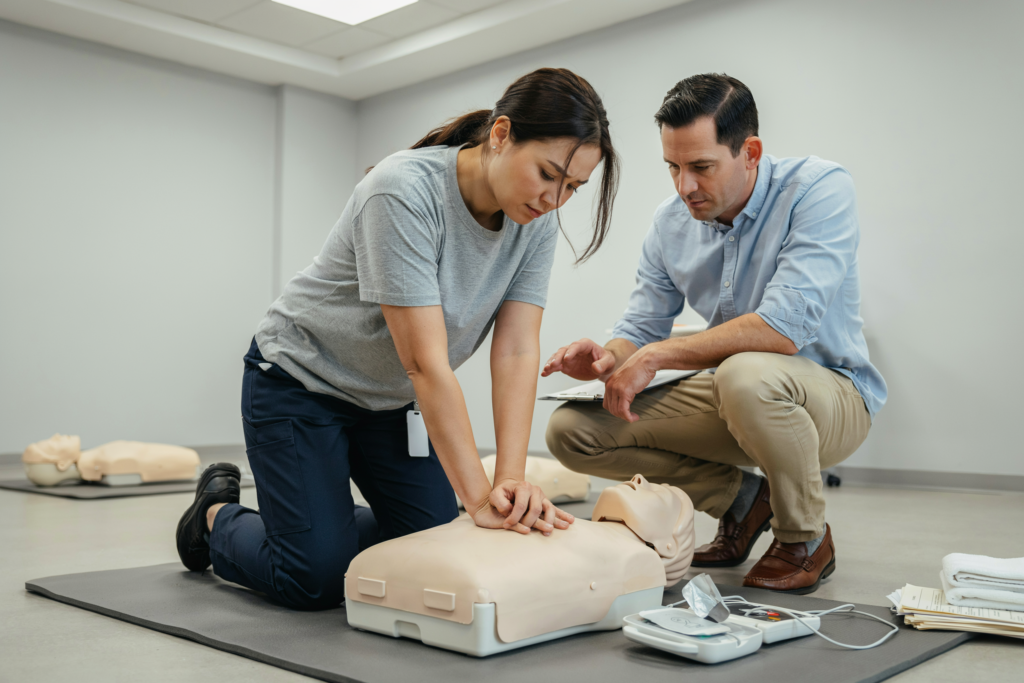
HLTAID010 covers emergency response fundamentals: CPR, AED use, and basic life support while waiting for emergency services. It is the standard requirement for aged care workers, NDIS support staff, and community care workers in Queensland.
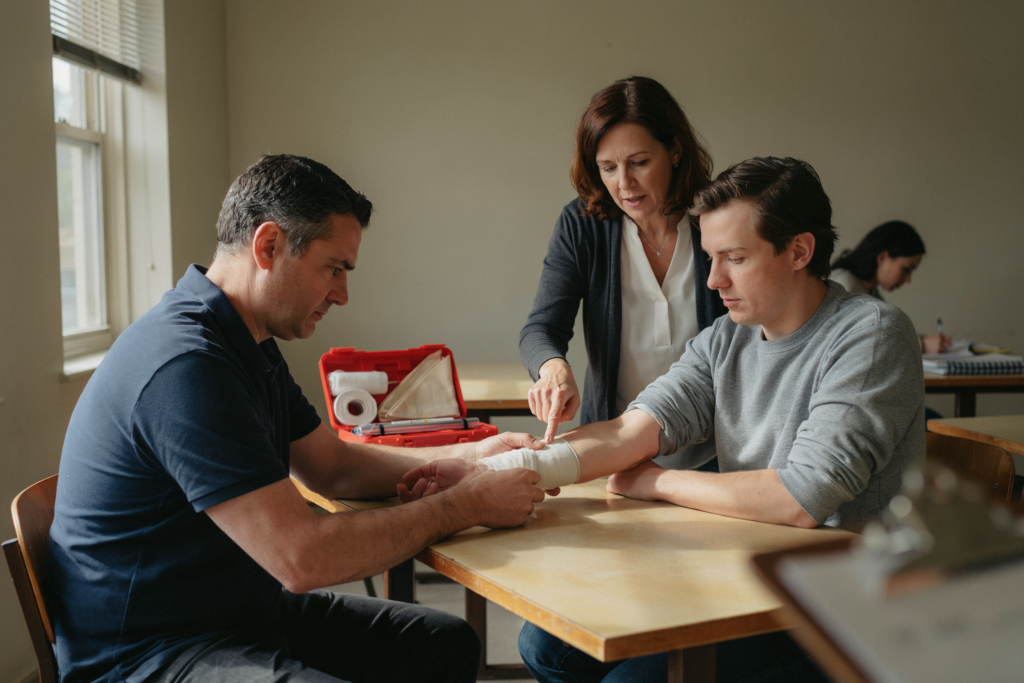
HLTAID011 includes everything in HLTAID010, plus a broader range of first aid skills: wound management, fractures, burns, allergic reactions, and more complex medical emergencies. It is typically required for first aid officers, team leaders, and higher-risk workplace roles.
Key differences at a glance:
- Scope HLTAID010 focuses on life support and CPR; HLTAID011 adds a comprehensive first aid response
- Who needs it HLTAID010 suits most care sector workers; HLTAID011 is required for designated first aid officers
- Certificate validity Both are valid for 3 years; CPR component is recommended to be refreshed annually
- Prerequisites Neither course has formal prerequisites
What Does HLTAID010 Cover?
HLTAID010, formally titled Provide Basic Emergency Life Support, is a nationally recognised unit of competency on the Australian Qualifications Framework. It’s the foundational first aid qualification for workers whose primary role is care, not clinical treatment.
If you’ve ever sat in a staff meeting and heard your coordinator say “everyone needs their basic life support up to date”, this is the course they’re talking about.
Core Skills Covered in HLTAID010
HLTAID010 trains you to recognise and respond to a life-threatening emergency in the critical minutes before Queensland Ambulance Service (QAS) arrives. The course covers:
- Cardiopulmonary resuscitation (CPR) using current ANZCOR guidelines
- Automated External Defibrillator (AED) use including recognising when and how to apply an AED safely
- Unconscious casualty management including recovery position and airway management
- DRSABCD protocol Danger, Response, Send for help, Airway, Breathing, CPR, Defibrillation
- Recognition of life-threatening conditions including cardiac arrest, choking, and respiratory distress
- Communication with emergency services including providing accurate information and following instructions
These aren’t abstract textbook skills. For an aged care or disability support worker, every single one of those dot points represents a real scenario that could happen on any shift. A client who doesn’t respond when you call their name. A resident who’s on the floor. The few minutes between you noticing something is wrong and QAS walking through the door, that’s what HLTAID010 prepares you for.
Who Is HLTAID010 Designed For?
HLTAID010 is the appropriate qualification if you are:
- Personal care worker or support worker working in residential aged care
- NDIS support worker providing direct client care
- Home care or community care worker supporting clients in their own environments
- Cert III or IV student completing a placement requirement
- Care worker returning to the workforce after a break
If your job title involves direct, hands-on support of elderly or disabled clients and you are not the designated first aid officer for your workplace, HLTAID010 is almost certainly the qualification your employer requires.
What Does HLTAID011 Cover?
HLTAID011, formally titled Provide First Aid, is the full first aid qualification on the Australian Qualifications Framework. It builds directly on the life support foundations of HLTAID010 and adds a significantly broader range of emergency response skills.
If HLTAID010 is about keeping someone alive until the ambulance arrives, HLTAID011 is about knowing what to do across a much wider range of emergencies before, during, and while you wait for QAS.
Core Skills Covered in HLTAID011
HLTAID011 includes everything taught in HLTAID010 plus:
- Wound management including cuts, lacerations, and bleeding control
- Burns and scalds including appropriate first aid treatment
- Bone, muscle, and joint injuries including fractures and sprains
- Allergic reactions and anaphylaxis including EpiPen use
- Medical emergencies including stroke, seizures, and diabetic emergencies
- Envenomation including Australian snake bite and spider bite protocols
- Eye and ear injuries including immediate first aid responses
- Mental health first aid awareness including recognising and responding to concerns
- Heat and cold emergencies including prevention and response strategies
- Multi-casualty incident management including prioritising care and emergency response
Who Is HLTAID011 Designed For?
HLTAID011 is the appropriate qualification if your role carries additional first aid responsibility beyond direct care. You likely need HLTAID011 if you are:
- Designated first aid officer responsible for workplace or facility emergency response
- Team leader, room leader, or floor supervisor responsible for managing emergency situations
- Workers in higher-risk environments such as construction, manufacturing, or remote community services
- Early childhood educator or childcare worker (note: 22300VIC and 22556VIC may also apply, check your state requirements)
- Employees required by workplace WHS policy to hold a full first aid certificate
The distinction is really about responsibility. If you’re responsible for responding to emergencies across your team or facility, not just your own clients, HLTAID011 is the appropriate level of training for that role.
HLTAID010 vs HLTAID011: Side-by-Side Comparison
Feature | HLTAID010 | HLTAID011 |
Full title | Provide Basic Emergency Life Support | Provide First Aid |
CPR included | Yes | Yes |
AED use included | Yes | Yes |
DRSABCD protocol | Yes | Yes |
Wound and bleeding management | Not covered | Yes |
Burns and fractures | Not covered | Yes |
Anaphylaxis and EpiPen use | Not covered | Yes |
Medical emergencies (stroke, seizure) | Not covered | Yes |
Envenomation (snake, spider) | Not covered | Yes |
Certificate validity | 3 years | 3 years |
CPR renewal recommended | Annually | Annually |
Prerequisites | None | None |
Suitable for aged care workers | Yes, standard requirement | Yes, exceeds minimum |
Suitable for NDIS support workers | Yes, standard requirement | Yes, exceeds minimum |
Required for first aid officers | Generally not sufficient | Yes, standard requirement |
If you provide direct care to elderly or disabled clients and you are not the designated first aid officer for your workplace, HLTAID010 is your course. If you are responsible for first aid response across your team or facility, HLTAID011 is your course.
HLTAID011 encompasses all the competencies of HLTAID010, so if your employer requires HLTAID010 and you complete HLTAID011 instead, you will meet and exceed that requirement. However, HLTAID011 takes longer and unless your employer specifically requires it, HLTAID010 is the more practical choice for most care workers.
A Note on Childcare Workers
Childcare educators in Queensland should be aware that units 22300VIC and 22556VIC may be required under ACECQA regulations in addition to, or in place of, HLTAID010 or HLTAID011. Always confirm your specific requirements with your director or ACECQA before booking.
Which Course Do Aged Care and NDIS Workers Actually Need?
For the vast majority of aged care workers and NDIS support staff in Queensland, HLTAID010 is the course you need.
The aged care sector in Australia operates under the Aged Care Act 1997 and is regulated by the Aged Care Quality and Safety Commission. Most residential aged care providers and home care organizations have standardized on HLTAID010 as the minimum first aid requirement for personal care workers. If your employer has told you that you need “basic emergency life support” or “basic life support,” they are referring to HLTAID010.
Under the NDIS Practice Standards, registered NDIS providers must make sure workers have the skills to respond to health and safety situations affecting the people they support. HLTAID010 has become the de facto standard across the sector. If you are a sole trader or independent support worker, HLTAID010 will satisfy the vast majority of participant service agreements and provider audits.
NDIS workers may need HLTAID011 if their provider designates them as a first aid officer for a supported independent living (SIL) home, if they support participants with complex medical needs, or if they are moving into a team leader role. If any of those apply, confirm with your coordinator before you book.
What Does Your Employer Actually Require?
When your employer’s compliance team reviews your certificate, they are checking the specific unit code on your Statement of Attainment against the code listed in their workforce compliance policy. A certificate that says HLTAID011 when they require HLTAID010 will usually pass. But a certificate that says HLTAID010 when they require HLTAID011 will be rejected. More commonly, workers turn up with a certificate from an unregistered provider and it’s rejected entirely. The certificate isn’t worth anything without a registered RTO behind it.
Here’s how to read the language your employer uses:
If your documentation says any of the following → Book HLTAID010: “Basic Emergency Life Support,” “Basic Life Support,” “BELS,” “HLTAID010”
If it says any of the following → Book HLTAID011: “Provide First Aid,” “First Aid Certificate,” “Senior First Aid,” “HLTAID011,” “First Aid Officer qualification”
If you complete HLTAID010 when your employer requires HLTAID011, you will need to complete HLTAID011 in full with no partial credit. Getting it right the first time is worth the two minutes it takes to confirm the unit code before you book. When you do, have three things ready: the exact unit code required, your employer or provider name, and whether you need your certificate by a specific date.
How to Choose the Right Course in Under 2 Minutes
Step 1: Has your employer given you a specific unit code? Yes, HLTAID010 → Book HLTAID010. Done. Yes, HLTAID011 → Book HLTAID011. Done. No unit code given → continue.
Step 2: Has your employer used any of these phrases? “Basic Emergency Life Support,” “Basic Life Support,” or “BELS” → Book HLTAID010. “Provide First Aid,” “First Aid Certificate,” “Senior First Aid,” or “First Aid Officer” → Book HLTAID011. Still unclear → continue.
Step 3: What is your role? Personal care worker, support worker, community care aide, or NDIS direct support worker → Book HLTAID010. Team leader, senior support worker, floor supervisor, or designated first aid officer → Book HLTAID011. Early childhood educator or childcare worker → Confirm with your director whether you need 22300VIC or 22556VIC before booking.
Step 4: Still not sure? Ask your coordinator: “Can you confirm the unit code, is it HLTAID010 or HLTAID011?” Or contact us and we’ll confirm the standard requirement for your employer in under two minutes.
When renewing, the rule is simple: renew the same unit code you currently hold unless your employer says otherwise. If your certificate has lapsed, don’t stress. It happens constantly for care workers on busy rosters. Just book the session and move forward.
Choosing the Right Course Comes Down to One Thing
When it comes down to it, the question of do I need HLTAID010 or HLTAID011 isn’t actually that complicated once you know what to look for. For the overwhelming majority of aged care workers and NDIS support staff across Queensland, HLTAID010 is the answer. It’s the qualification your employer listed in your onboarding checklist, the code on your last certificate, and the standard your industry has built its compliance frameworks around. The confusion doesn’t come from the courses themselves. It comes from vague employer language, similar-sounding names, and the very human fear of getting it wrong and wasting a day off you can’t afford to lose.
The thing about working in care is that compliance is never just about ticking a box. Support workers renew their HLTAID010 because they might be the only trained person in the room when something goes wrong with a vulnerable client. Having the right certificate, issued by a legitimate ASQA-registered RTO, means you walk into your next shift actually prepared, not just compliant.
If you’ve landed on HLTAID010, book it. Don’t overthink the upgrade to HLTAID011 unless your role genuinely requires it. Same-day certificate, straightforward, and done. If you’ve landed on HLTAID011, the content is broader, the skills are real, and the certificate will be accepted everywhere HLTAID010 is accepted and then some.
Whatever course you need, confirm the unit code with your employer and verify that your training provider is an ASQA-registered RTO before you book. Check the RTO number on the provider’s website. If it’s not visible, that’s a red flag worth paying attention to.
First Aid Alive delivers nationally recognised HLTAID010 and HLTAID011 training to aged care and NDIS support workers across Brisbane and South East Queensland. Weekend sessions run every week. Your Statement of Attainment is emailed to you on the day you complete training. If you’re still not sure which course fits your role, send us a message before you book and we’ll confirm it for you in minutes, no obligation. Because the goal isn’t just to get you certified. It’s to get you certified correctly, the first time, with a qualification your employer will accept without question.
Book Your First Aid Training Now
Fast, affordable, and nationally accredited training delivered by professionals who care
Frequently Asked Questions
Q. What is the difference between HLTAID010 and HLTAID011?
HLTAID010 (Basic Emergency Life Support) covers CPR, AED use, and emergency response while waiting for ambulance services, making it the standard requirement for aged care and NDIS support workers. HLTAID011 (Provide First Aid) includes all of that plus wound management, burns, fractures, anaphylaxis, and a broader range of medical emergencies, and is typically required for designated first aid officers and team leaders.
Q. Do aged care workers need HLTAID010 or HLTAID011?
The vast majority of aged care workers in Queensland need HLTAID010. It's the qualification listed in most residential aged care and home care onboarding requirements, and it meets the minimum standard set by large providers across the sector. HLTAID011 is generally only required if you're the designated first aid officer for your facility or team.
Q. Do NDIS support workers need HLTAID010 or HLTAID011?
Most registered NDIS providers in Queensland require HLTAID010 as their standard worker compliance qualification, and it will satisfy the majority of participant service agreements and provider audits. HLTAID011 may be required if you're designated as a first aid officer for a supported independent living home, if you support participants with complex medical needs, or if your provider's policy specifically calls for it.
Q. Can HLTAID011 replace HLTAID010?
Yes, in almost every case. Because HLTAID011 encompasses all the competencies covered in HLTAID010, completing it will meet and exceed any employer or NDIS provider requirement for HLTAID010, and your certificate will be accepted without question. The only exception is childcare and early childhood education roles, where 22300VIC or 22556VIC may be required under ACECQA regulations regardless of which HLTAID unit you hold.
Q. How long is HLTAID010 valid?
HLTAID010 is valid for 3 years from the date of completion, though the CPR component is recommended for annual renewal by ANZCOR and many Queensland employers enforce this as a mandatory refresher. If you're unsure whether your employer requires annual CPR renewal, check your onboarding documentation or ask your coordinator.
Q. What happens if my HLTAID010 has lapsed?
A lapsed certificate doesn't carry any penalty beyond needing to be renewed before you can return to client-facing duties. The process is the same as a standard renewal and you don't need to start from scratch or complete additional requirements. Book your session, complete the training, and your new Statement of Attainment will be issued on the same day.
Making first aid training more affordable for
every classroom
We believe every student deserves access to life-saving first aid knowledge. That’s why we offer specially reduced pricing for schools and educational groups. Whether you’re booking for a single class, a year group, or your entire school, our flexible packages make training more accessible and cost-effective — without compromising quality.
