
You’ve booked your HLTAID010 course and you should be feeling good about that. But there’s one question keeping you up at night, isn’t there?
What if I freeze during the practical assessment?
If you’re a registered nurse, aged care worker, or healthcare professional in Brisbane, your career literally depends on passing this assessment. An expired certificate means non-compliance, potential AHPRA investigations, and that fear in the back of your mind that if something happened on shift tonight — could you actually help?
Here’s the truth that’s going to calm your nerves: 99.8% of students pass their HLTAID010 practical assessment on the first attempt. Not because the assessment is a walkover — but because you’re being assessed on competence, not perfection. There’s a difference, and it matters.
I’ve seen it so many times. A nurse walks in shaking, convinced she’s going to blank out in front of the assessor, certain that months away from a manikin has erased everything she knew. Hours into the course, she’s doing chest compressions with her eyes closed. By assessment time, she’s focused, calm, and done. Certificate in her inbox before she gets home for dinner.
That nurse is not unusual. She’s typical.
In this guide, you’ll discover exactly what skills you’ll be tested on, how assessors evaluate your performance, what “competent” actually means, and the specific scenarios you’re likely to encounter. By the end, you’ll know precisely what to expect, how to prepare, and why that anxiety you’re feeling right now is completely normal — but unnecessary.
What Is Tested in the HLTAID010 Practical Assessment?
The HLTAID010 practical assessment tests your ability to perform basic emergency life support in simulated scenarios. You’ll be assessed on the following core skills:
| Skill Area | What You Demonstrate |
|---|---|
| CPR performance | Chest compressions, rescue breaths, correct hand placement on adult, child, and infant manikins |
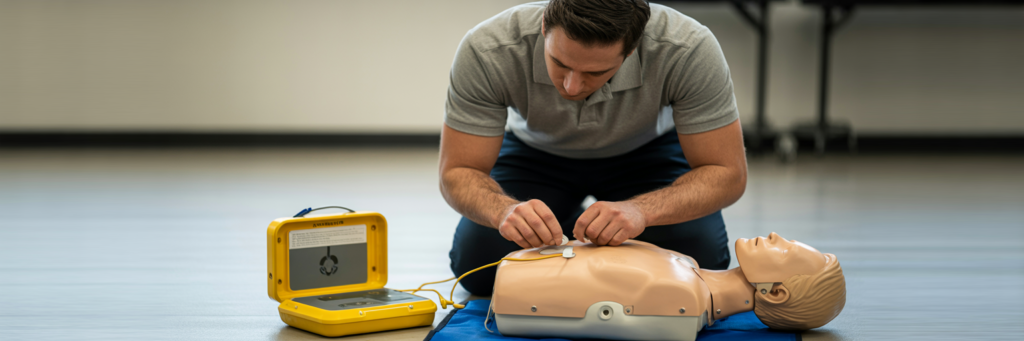
| AED operation | Attaching pads, following prompts, safe defibrillator use |
| Unconscious patient management | DRSABCD protocol, recovery position, airway management |
| Basic life support scenarios | Choking management, severe bleeding control, shock management |
| Communication and safety | Calling for help, scene safety assessment, handover to paramedics |
📊 HLTAID010 Assessment Success Statistics
✅ 99.8% overall pass rate
✅ 85% pass all components first attempt
✅ 14% need one skill re-demonstrated (same day)
✅ Less than 1% require an additional practice session
Understanding the Assessment Structure
Theory vs. Practical Components
The HLTAID010 assessment has two parts, and both need to be completed successfully.
The knowledge assessment is a written or online quiz — usually multiple choice, and open book at most RTOs. It’s testing whether you understand the concepts, not whether you’ve memorized a textbook. Most RTOs let you complete this as pre-learning online before course day, which means you’re walking in with that piece already done.
The practical demonstration is the hands-on component. This is where you physically perform CPR on manikins, work through scenario-based assessments, and demonstrate real-time decision making under simulated pressure. It’s the part people worry about most, and ironically, it’s the part most students find more manageable than the theory.
Both components must be deemed competent. You can’t pass one and fail the other — they both count.
Competency-Based Assessment Explained
The HLTAID010 assessment is competency-based. That means there is no score. No percentage. No grade. The only two outcomes are Competent or Not Yet Competent.
Competent means three things: you performed the skill safely (won’t harm the patient or yourself), effectively (the technique actually achieved the intended result), and appropriately (you chose the right intervention for the situation).
That’s the entire bar.
“Not Yet Competent” is not a failure. It’s a learning checkpoint. It means “practice this a bit more and try again.” It’s not recorded as a fail on any official record, and in most cases it adds about 20 minutes to your day before it’s resolved.
CPR Practical Assessment in Detail
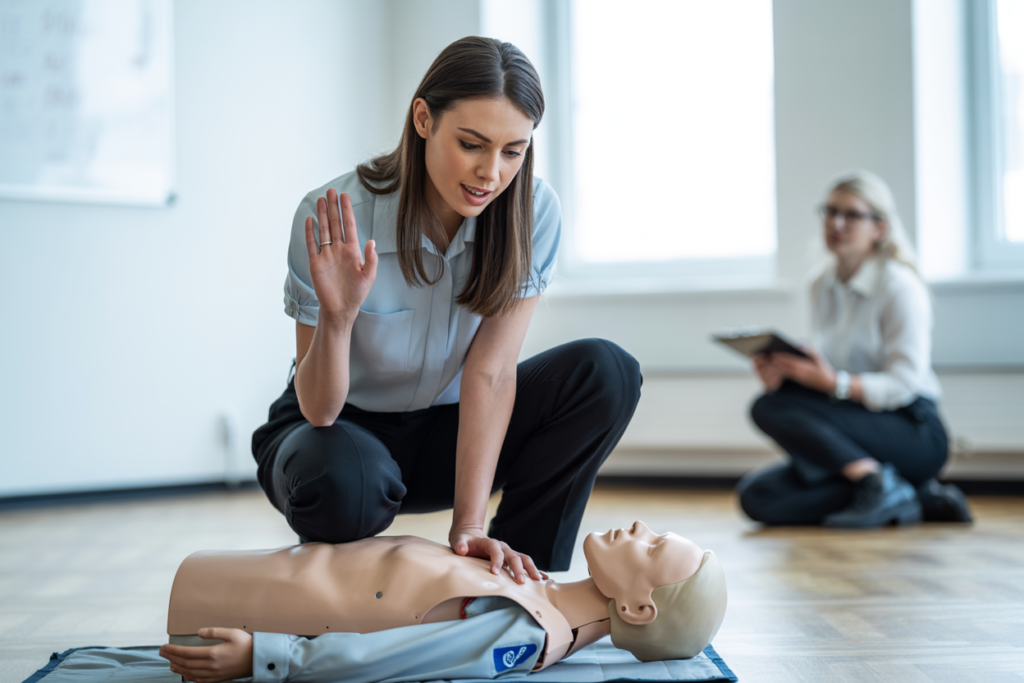
CPR is the centrepiece of the HLTAID010 practical assessment. You’ll spend more time on this than any other skill — and you’ll practice it more times than you can count before an assessor ever watches you do it.
Adult CPR Requirements
The assessor is looking for compressions that are 5-6cm deep — roughly one third of the depth of the chest. On a training manikin, you’ll get audio or visual feedback when you hit the right depth. Rate needs to be 100-120 compressions per minute — roughly two per second. The Bee Gees’ “Stayin’ Alive” is almost exactly right for tempo. The ratio is 30 compressions to 2 rescue breaths, consistent across all age groups.
Hand placement goes on the lower half of the sternum, centre of the chest. Heel of your hand on the chest, second hand on top with fingers interlaced. Shoulders directly over your hands, arms straight — body weight here, not arm strength.
For rescue breaths: head tilt, chin lift to open the airway, pinch the nose, seal your mouth and deliver a one-second breath watching for visible chest rise. Let the chest fall completely before the second breath.
Child and Infant CPR Variations
| Adult | Child (1–8 years) | Infant (under 1 year) | |
|---|---|---|---|
| Depth | 5–6cm | 5cm | 4cm |
| Technique | Two hands | One or two hands | Two fingers |
| Airway seal | Mouth to mouth | Mouth to mouth | Mouth over nose AND mouth |
| Ratio | 30:2 | 30:2 | 30:2 |
| Rate | 100–120 bpm | 100–120 bpm | 100–120 bpm |
Depth decreases with age and size. Technique changes. But the ratio and rate stay exactly the same across all age groups.
Most Common CPR Mistakes
Insufficient compression depth is by far the most common reason for re-demonstration. Students are too gentle. The fix: use your body weight rather than arm strength and listen for the manikin’s feedback. Not allowing full chest recoil is the subtle one — students lean on the chest between compressions instead of lifting completely. Think “push and release” not “push push push.” Interrupting compressions too long — you’ve got a maximum of 10 seconds to deliver two rescue breaths and get back. Move efficiently.
Almost all of these get caught and corrected during practice hours before the assessment begins. That’s what the practice component is for.
AED (Defibrillator) Assessment
The AED is probably the most straightforward part of the entire assessment — because the machine tells you exactly what to do at every step.
You start CPR immediately and attach the AED as soon as it arrives on scene. Then: turn it on, expose the chest, attach pads according to the diagram printed directly on them, and follow voice prompts. The AED analyses heart rhythm automatically, tells you to stand clear, and advises whether a shock is needed. If it advises a shock, press the button. Resume CPR immediately after.
Standard pad placement: upper right chest below the collarbone, lower left ribs below and to the left of the nipple.
The single most critical step assessors watch for is the “stand clear” announcement before shock delivery. Say it out loud, do a visual check, then press. Skipping this stops an assessment.
The good news: the AED gives voice instructions throughout. Modern AEDs won’t deliver a shock unless one is actually needed. And the training AED you practice on is identical in operation to a real one — same prompts, same process. Most students find this the easiest component of the day.
DRSABCD Assessment Scenarios
DRSABCD is the emergency response framework that ties the entire assessment together. Assessors check that you follow the sequence — not just that you know the letters.
| Step | Action | What to Verbalise |
|---|---|---|
| D – Danger | Check scene before approaching anyone | "Checking for danger to myself and others" |
| R – Response | Tap shoulders, speak loudly | "Checking for response" |
| S – Send for Help | Call 000 or direct a specific bystander | "Calling 000 for emergency services" |
| A – Airway | Head tilt, chin lift, check for obstructions | "Opening airway, checking for obstructions" |
| B – Breathing | Look, listen, feel — max 10 seconds | "Checking for normal breathing" |
| C – CPR | Not breathing — start immediately, 30:2 | "Patient not breathing, commencing CPR" |
| D – Defibrillation | Attach AED as soon as available | "Attaching AED" |
What Scenarios Look Like
You’ll receive a scenario card or verbal briefing — “You find an elderly resident collapsed on the floor, unresponsive but breathing” — and work through it methodically, verbalising your thinking the entire time. The assessor isn’t just watching your hands. They’re listening to your decision-making process out loud.
The assessor will interact with you during the scenario, providing updates like “the patient is still not responding” or stepping in as a bystander. There are no time limits. Slow and correct beats fast and wrong every single time.
Additional Skills Assessed
Choking Management
For a conscious choking patient, deliver 5 back blows — lean the patient forward, heel of hand between shoulder blades — then 5 chest thrusts — fist on centre of chest, pull sharply inward and upward. Alternate until the obstruction clears. If the patient loses consciousness, lower them carefully and start CPR. Assessors specifically watch for chest thrusts rather than abdominal thrusts, which is the HLTAID010 standard.
Severe Bleeding Control
Apply direct pressure immediately — this is your first response, always. Don’t remove the first pad if it soaks through, add more on top. Elevate the limb if no fracture is suspected. Apply a pressure bandage. Monitor for shock signs throughout. Assessors watch that you maintain pressure and don’t keep checking the wound.
Shock Recognition and Management
Shock signs: pale, cool, clammy skin, rapid weak pulse, rapid shallow breathing, confusion, nausea, thirst. Lay the patient down, elevate legs approximately 30cm, keep warm without overheating, loosen tight clothing, reassure, monitor continuously, nothing by mouth. Don’t elevate legs if head, spinal, or chest injury is suspected.
Recovery Position
Used when a patient is unconscious but breathing normally with no suspected spinal injury. Roll them onto their side, tilt the head back to keep the airway open, arm supporting the head, knee bent for stability. The position must be stable — they shouldn’t roll. Assessors will check you can return to CPR position immediately if the patient stops breathing.
🗣️ Communication Tip: Communication is assessed across every scenario — not just at the end. Students who work in silence, even with perfect technique, leave assessors uncertain. Verbalise everything.
Communication Throughout
Communication is assessed across every scenario, not just in one dedicated component. You need to verbalise your thinking out loud the entire way through — “checking for danger… scene is safe… checking for response…” — to show the assessor your decision-making process, not just your physical actions.
When calling 000, lead with location, then what happened, patient condition, treatments being given, and your name and callback number. Don’t hang up until the operator tells you to.
When handing over to paramedics, use MIST — Mechanism of injury, Injuries identified, Signs and symptoms, Treatment given. Organised, accurate, professional.
For healthcare workers, infection control statements matter too — “putting on gloves before providing care” and “using a barrier device for rescue breaths” are standard precautions assessors expect nurses and aged care workers to demonstrate.
How to Prepare
Before course day: Complete any pre-learning modules well in advance, not the night before. Review and understand the DRSABCD sequence — write it out, say it out loud. Watch CPR demonstration videos from the Australian Resuscitation Council to build a mental picture before you get hands-on. Get good sleep the night before and eat a substantial breakfast — CPR is more physically demanding than most people expect.
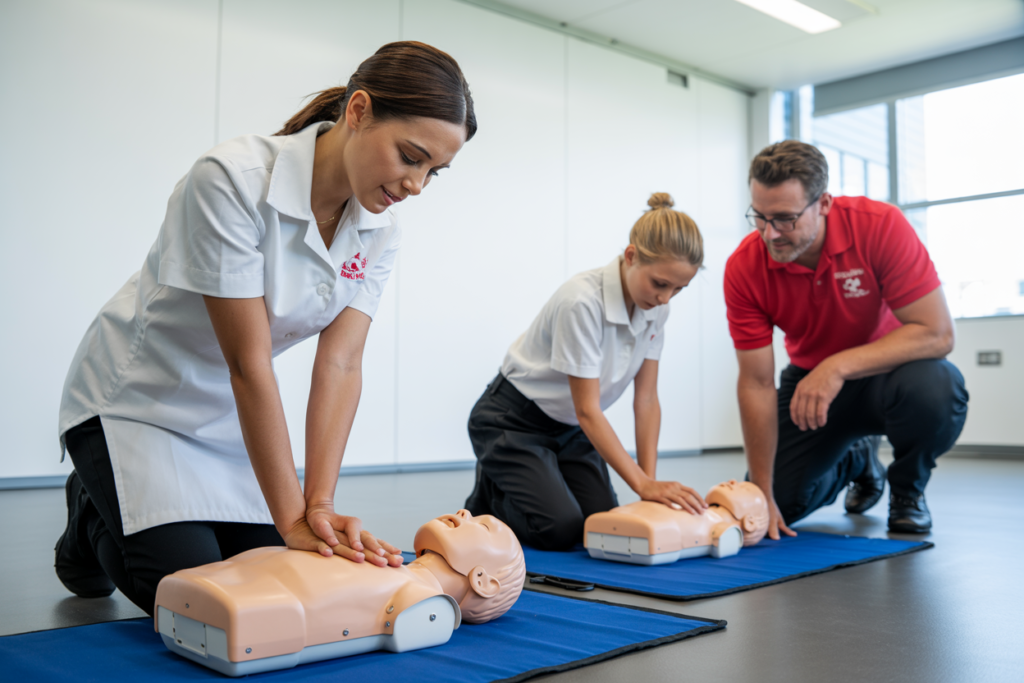
During the course: Get on the manikin every chance you get. Volunteer. Practice actively, not passively. Ask your instructor for feedback directly — “was that compression deep enough?” — rather than waiting for them to come to you. Verbalise your thinking during every practice scenario, not just during assessment. The habit needs to be automatic by the time you’re being watched.
Mindset: Assessors are not setting traps. They’re former paramedics who want you to leave capable of actually helping someone. Competence is not perfection — pausing to think is acceptable, sweating is acceptable, counting out loud is acceptable. And you have extensive practice time before any assessment begins, so by the time an assessor watches you, you’ve already done everything correctly multiple times. Trust that process.
If anxiety spikes right before your turn, use box breathing — inhale for four counts, hold for four, exhale for four. Focus on one step at a time rather than mentally running through the entire scenario before you’ve started. And if you make a mistake mid-scenario, don’t shut down. Self-correct if you catch it, listen if the assessor prompts you, and keep moving forward. The assessor is watching how you respond to difficulty just as much as how you perform when everything goes smoothly.
After Your Assessment
Same-day digital certificates are standard at reputable RTOs — you should receive your PDF by email shortly after completing the course. Download it immediately and save copies in multiple places — email, cloud storage, and your phone. Don’t rely on a single copy.
HLTAID010 is valid for three years. The CPR component — HLTAID011 — requires annual renewal even though it’s included within HLTAID010. Set calendar reminders well before your expiry date. Don’t let the certificate lapse — the day after it expires, you’re non-compliant, and many workplaces will suspend relevant duties immediately.
HLTAID010 satisfies AHPRA’s first aid requirement for registered nurses and enrolled nurses. Upload your digital certificate to the AHPRA portal when requested and keep it in your professional development folder.
Ready to Book Your HLTAID010 Course?
You now know exactly what to expect in your practical assessment — the scenarios, the criteria, what competent actually means, and what happens if a re-demonstration is needed.
The assessment is designed for people like you to pass. The instructors want you to leave certified and confident. The practice component means that by the time anyone is watching you, you’ve already done everything correctly multiple times.
Book Your First Aid Training Now
Fast, affordable, and nationally accredited training delivered by professionals who care
Frequently Asked Questions
Q.What is tested in the HLTAID010 practical assessment?
The HLTAID010 practical assessment covers CPR on adult, child, and infant manikins, AED operation, the full DRSABCD emergency response protocol, choking management, severe bleeding control, shock recognition and management, recovery position, and communication skills including calling 000 and handing over to paramedics using the MIST format. You're assessed on competence — safe, effective, and appropriate performance — not on perfection or any scored percentage.
Q.Is the HLTAID010 practical assessment hard?
It's genuinely not hard, and that's a structural fact rather than a marketing line. You're assessed on competence rather than perfection, there's no minimum score, and you have extensive hands-on practice time before any assessment begins. The standard — safe, effective, and appropriate — is achievable for anyone who engages actively with the practice component, and the 99.8% pass rate reflects that reality.
Q.What does "Not Yet Competent" mean and what happens next?
Not Yet Competent means one specific skill needs more practice and a re-demonstration — it's not a fail, it's not recorded as one, and it's not a judgment on your ability as a healthcare professional. The assessor stops the scenario, gives specific feedback on exactly what needs work, you practice that skill with instructor coaching, and then re-demonstrate only that component. Most re-demonstrations are resolved the same day and add roughly 20 minutes to your course.
Q.How do I prepare for the HLTAID010 practical assessment?
Complete pre-learning modules well before course day, review and understand the DRSABCD sequence out loud, watch CPR demonstration videos from the Australian Resuscitation Council, and get a solid night's sleep and eat a good breakfast on the day. During the course, the single most important thing is active practice — get on the manikin every opportunity you have, ask for instructor feedback proactively rather than waiting for it, and verbalise your thinking during every practice run so it becomes automatic by assessment time.
Q.When do I get my certificate after HLTAID010?
Reputable RTOs provide same-day digital certificates emailed shortly after you complete the course. The PDF contains your name, RTO details, units of competency — HLTAID009, HLTAID010, and HLTAID011 — your achievement date, and a three-year expiry date. It's legally valid for all compliance purposes including AHPRA requirements and employer HR systems. If it doesn't arrive, check your spam folder first before contacting the RTO.
Making first aid training more affordable for
every classroom
We believe every student deserves access to life-saving first aid knowledge. That’s why we offer specially reduced pricing for schools and educational groups. Whether you’re booking for a single class, a year group, or your entire school, our flexible packages make training more accessible and cost-effective — without compromising quality.
