

It’s 11:47pm on a Sunday night.
A registered nurse at a Brisbane aged care facility, is lying in bed scrolling through her phone when it hits her — her HLTAID010 certificate expires in nine days. Her mind immediately starts racing. The compliance audit. The HR meeting. The conversation with her manager she really doesn’t want to have. She grabs her phone and searches desperately: “How long is HLTAID010 valid?”
Sound familiar?
If you’re reading this right now in a mild panic, here’s the one thing you need to know immediately: Your HLTAID010 (Provide Basic Emergency Life Support) certificate is valid for three years from the date of issue.
But knowing the validity period is really just the beginning of the answer you’re looking for. Because the real questions are “when do I actually need to renew?” and “what happens if I let it expire?” — and those answers are a little more involved.
This guide covers everything Brisbane healthcare professionals need to know about HLTAID010 validity periods, renewal timelines, and compliance requirements. You’ll learn exactly when to book your renewal course, what AHPRA expects, how to avoid certification gaps, and where to find same-day courses when you’re genuinely running out of time.
Let’s get you the answers and get rid of that midnight anxiety.
How Long Is HLTAID010 Valid?
HLTAID010 (Provide Basic Emergency Life Support) certificates are valid for three years from the date of issue. This is the maximum validity period set by the Australian Skills Quality Authority (ASQA) and applies nationally across all states including Queensland.
Key validity facts:
- Certificate duration: 3 years from issue date
- CPR component (HLTAID011): Must be renewed annually (every 12 months)
- AHPRA requirement: Must maintain current certification throughout registration period
- Workplace compliance: Most Brisbane healthcare facilities require renewal before expiry
- Grace period: None — certification expires at midnight on the expiry date
- Renewal window: Book your course 2-4 weeks before expiry to ensure continuity
ℹ️ Important: While your HLTAID010 certificate lasts three years, the CPR component (HLTAID011) embedded within it requires annual renewal. This means you'll need to complete HLTAID011 (CPR only) courses at years 1 and 2, then the full HLTAID010 again at year 3.
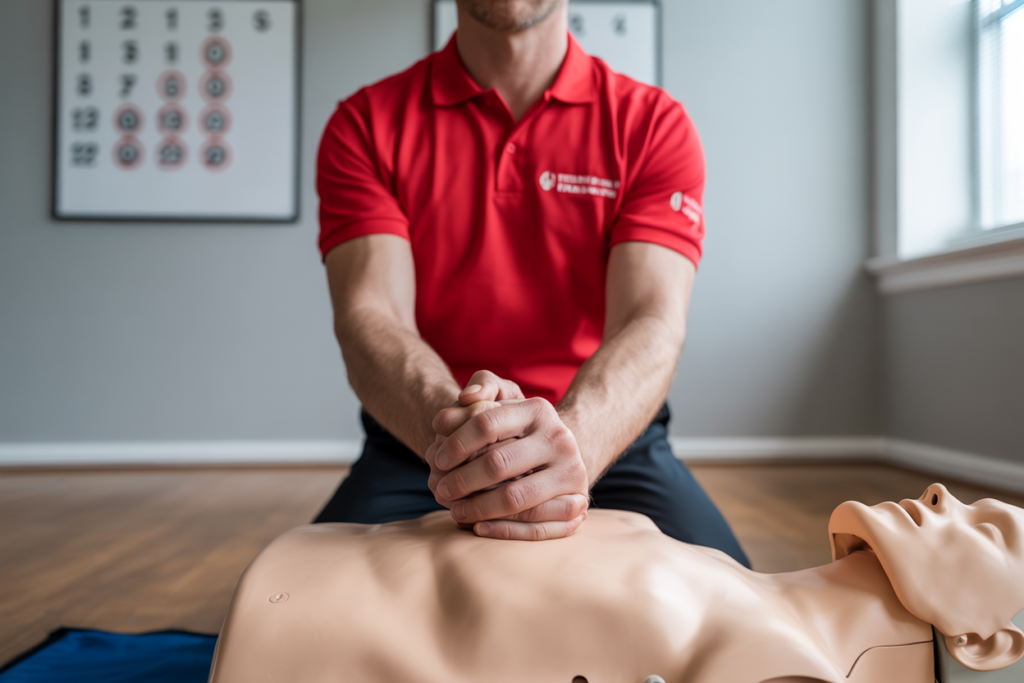
Understanding the 3-Year HLTAID010 Validity Period
Why Is HLTAID010 Valid for 3 Years?
The three-year validity period isn’t arbitrary. ASQA sets national training package requirements based on research into how quickly practical emergency skills degrade without regular practice — and the numbers are pretty sobering.
Studies show CPR skill retention drops by around 50% after just 6-12 months without practice. Think about that for a second. A skill you felt confident performing immediately after your course can deteriorate to the point of being genuinely unreliable within a year. Compression depth wanders off target. Rate speeds up or slows down. The sequencing of steps becomes hesitant. The Australian Resuscitation Council guidelines acknowledge this reality, which is why both the initial certification and the renewal cycle are structured the way they are.
The three-year window reflects a practical balance. Too short, and the administrative burden on healthcare workers becomes unreasonable. Too long, and the skill degradation risk becomes genuinely dangerous. Industry consultation between ASQA, the Australian Resuscitation Council, and healthcare bodies landed on three years as the right call — with the important caveat that the CPR component needs annual attention.
As Michael Chen, an ex-QAS paramedic instructor with over 15 years of emergency response experience, puts it: “As former paramedics, we see firsthand how muscle memory degrades. The 3-year certification with annual CPR renewal balances skill maintenance with practical compliance requirements.”
That expertise matters. When you’re trained by someone who’s actually responded to cardiac arrests in real Brisbane streets — not just read about them in a textbook — the reasoning behind the renewal framework makes a lot more sense.
What Happens on Your Expiry Date?
This is where a lot of people get caught out, because there’s a common myth floating around that there’s some sort of grace period after your HLTAID010 expires.
There isn’t.
Your certificate becomes invalid at 11:59pm on the expiry date. Not the following Monday. Not “a few weeks later.” The literal next day, you are non-compliant.
For a registered nurse, the implications stack up fast. Your AHPRA registration standard requires that you maintain current certification throughout your registration period. An expired certificate — even by a single day — constitutes non-compliance and can trigger a registration review. Meanwhile, your aged care facility or hospital is likely running unannounced quarterly audits checking exactly this kind of thing. And if an emergency occurs while your certificate is expired? Your professional indemnity insurance coverage becomes genuinely murky.
That story has a happy ending because she acted immediately. Not everyone does.
⚠️ NO GRACE PERIOD: Your HLTAID010 certificate becomes invalid at 11:59pm on the expiry date. There is no grace period. Working with an expired certificate is a compliance violation and may affect your AHPRA registration.
The Annual CPR Renewal Requirement
Why CPR Needs Annual Renewal
Here’s the part that catches a lot of nurses off guard — and honestly, it’s the source of more compliance confusion than almost anything else in the HLTAID010 world.
Your HLTAID010 certificate is valid for three years. But the CPR component sitting inside it — HLTAID011 — is only valid for 12 months.
That’s not a typo. Annual. Every year.
The Australian Resuscitation Council’s guidelines (specifically ARC Guideline 8 on Cardiopulmonary Resuscitation) are pretty direct about why. The skill decay data on CPR is genuinely alarming. Research published in the Resuscitation Journal shows that correct compression depth is retained by only about 15% of healthcare workers after 12 months without practice. Not 50%. Not 30%. Fifteen percent.
Look at how quickly the numbers fall off:
| Time Since Training | CPR Compression Accuracy |
|---|---|
| Immediately after training | 95% |
| 3 months | 78% |
| 6 months | 52% |
| 12 months ⚠️ Annual renewal required | 31% |
| 18 months | 18% |
| 24 months | 9% |
That’s not a gentle decline. That’s a cliff. And when you’re performing CPR on an 82-year-old resident who’s not breathing, the difference between 95% accuracy and 31% accuracy is the difference between effective resuscitation and ineffective chest compressions.
There’s also the guidelines change factor. The 2021 ARC updates revised compression depth and rate recommendations. If your technique was locked in from a course three years ago and you haven’t refreshed since, you may be working from outdated muscle memory — and not even know it.
Do I Need Both HLTAID010 AND HLTAID011?
This question comes up constantly, and it creates real anxiety for nurses trying to figure out what they actually need to book.
Here’s the clear answer: HLTAID011 is embedded inside HLTAID010. When you complete the full HLTAID010 course, you automatically receive both qualifications. You don’t need to book them separately.
The confusion arises because while the HLTAID010 certificate lasts three years, AHPRA and most workplace policies require the CPR component to be renewed every 12 months. So in the years between your full HLTAID010 renewals, you complete a shorter HLTAID011-only course to keep your CPR current.
| Course Code | What It Covers | Validity |
|---|---|---|
| HLTAID011 | CPR only | 12 months |
| HLTAID010 | Basic life support (includes CPR) | 3 years |
Think of HLTAID010 as the full package and HLTAID011 as the annual top-up that keeps your CPR component current between full renewals.
Your 3-Year Renewal Cycle Explained
Once you understand the structure, the whole system makes logical sense. Here’s what your renewal cycle looks like:
Certificate issued: March 2024
Year 1 (March 2024):
→ Full HLTAID010 course completed
Year 2 (March 2025):
→ HLTAID011 CPR renewal required
Year 3 (March 2026):
→ HLTAID011 CPR renewal required
Year 4 (March 2027):
→ Full HLTAID010 renewal required
→ Cycle restarts
Not sure which course you need right now? Check the issue date on your current certificate and match it against that guide. If you’re still unsure, call us and we’ll sort it out in about 30 seconds.

AHPRA and Workplace Compliance Requirements
AHPRA Registration Standards for Nurses
One of the biggest sources of confusion for Brisbane nurses is the relationship between AHPRA requirements and HLTAID010 certification. So let’s clear it up properly.
AHPRA itself doesn’t specify HLTAID010 by course code in its registration standards. What the Nursing and Midwifery Board of Australia (NMBA) requires is that registered nurses maintain “current” first aid certification as part of their continuing professional development obligations. In practice, the overwhelming majority of employers, facilities, and AHPRA auditors interpret “current” as meaning HLTAID010 or higher — with an active, non-expired certificate to prove it.
The distinction matters because it means the requirement is real, it’s enforced, and an expired certificate doesn’t get a sympathetic reading during an audit.
As one HR Manager at a major Brisbane hospital (who preferred to remain anonymous) put it: “During AHPRA audits, we’re required to demonstrate current certification. The auditors check expiry dates carefully. An expired certificate — even by one day — constitutes non-compliance and can trigger a registration review.”
One day. That’s how little margin there is.
When AHPRA audits occur, the documentation they’re looking for includes your certificate showing a current expiry date, verification that the issuing RTO is registered on training.gov.au, and evidence the certificate is authentic and hasn’t been revoked. Digital certificates are fully accepted — you don’t need to produce a physical copy.
When to Book Your HLTAID010 Renewal
The Optimal Renewal Window
Most Brisbane nurses book their renewal course somewhere between “way too late” and “dangerously close to the wire.” Around 65% of renewals happen within two weeks of the expiry date — which means the majority of people are booking under genuine stress, competing for limited spots, and hoping nothing goes wrong before the course date.
There’s a better way.
The recommended window for booking your HLTAID010 renewal is 6-8 weeks before your expiry date. Not because you need that much lead time to prepare — the course is designed so you can walk in without studying. But because weekend courses fill up weeks in advance and shift workers sometimes need to reschedule once or twice before finding a date that works. You want your new certificate active before the old one expires, with zero gap in compliance.
The nurses who never end up in a Sunday night panic are almost always the ones who treat their HLTAID010 expiry the same way they treat their car registration or passport — something you sort out well before it becomes urgent, because the consequences of missing it are too disruptive to deal with.
Setting Up Renewal Reminders
Knowing you should renew early is one thing. Actually doing it requires a system — because between rotating shifts and every other demand pulling at your attention, “I’ll remember” is not a reliable strategy.
Here’s a reminder system that works specifically for shift workers:
5-STEP REMINDER SYSTEM:
STEP 1: Photograph Your Certificate
→ Take photo of expiry date immediately after course
→ Save to phone AND cloud storage
STEP 2: Create an Expiry Event
→ Calendar event on expiry date: “HLTAID010 EXPIRED – DO NOT WORK”
→ Set to all-day event, colour code RED
STEP 3: Create Advance Reminders
→ 3 months before: “HLTAID010 renewal in 90 days – research courses”
→ 2 months before: “HLTAID010 renewal in 60 days – book course”
→ 6 weeks before: “HLTAID010 renewal soon – confirm booking”
→ 2 weeks before: “HLTAID010 course this weekend – prepare”
STEP 4: Set Annual CPR Reminders
→ Year 2 (12 months): “CPR renewal required – book HLTAID011”
→ Year 3 (24 months): “CPR renewal required – book HLTAID011”
STEP 5: Professional Development Tracking
→ Add to professional development log
→ Update LinkedIn certifications
→ File in career portfolio
The RED calendar event on the actual expiry date is the one most people skip — and it’s arguably the most important. You want your brain to register that date as a hard wall, not a soft deadline. Labelling it “DO NOT WORK” creates the right level of psychological urgency.

What Happens If Your HLTAID010 Expires
Immediate Consequences
The moment your HLTAID010 expires, you cannot legally function as a first aid officer. Not “shouldn’t” — can’t. The compliance breach is immediate, and the downstream consequences move faster than most nurses expect.
Here’s how a bad Monday morning can unfold:
THE NIGHTMARE SCENARIO:
Monday 7:30am: You arrive at work with an expired certificate
Monday 8:15am: Medical emergency occurs on your ward
Monday 8:16am: You freeze — “Am I allowed to use the AED?”
Monday 8:17am: Another nurse responds instead
Monday 9:00am: HR calls you to their office
Monday 9:30am: Suspended pending compliance resolution
THE REALITY:
→ No income until recertified
→ Professional reputation damaged
→ Potential AHPRA investigation
→ All preventable with timely renewal
The moment that sticks with most people is 8:16am. Because the instinct to help is there — you’re a nurse, responding to emergencies is what you do — but the doubt creeps in. “Am I covered? Is this certificate expired? What happens if something goes wrong and they check?” That hesitation, even for a few seconds, has real consequences for the patient in front of you.
⚠️ LEGAL LIABILITY WARNING: If you respond to a medical emergency with an expired first aid certificate, you may not be covered by professional indemnity insurance. In a worst-case scenario, you could be personally liable for any adverse outcomes. This is why employers suspend staff immediately upon discovering expired certifications.
Getting Back to Compliance
If your HLTAID010 has expired, there is no refresher option. You complete the full course again — same requirements as your very first certification. ASQA mandates it, even if your certificate expired yesterday.
That’s not a punishment. It’s the right call, because skill degradation doesn’t care how recently you expired. If you haven’t practiced on a manikin since your last course, your technique needs rebuilding regardless.
The good news is that getting back to full compliance is genuinely fast when you use a provider with same-day certificate delivery. Marcus, an enrolled nurse at a Brisbane aged care facility, discovered his HLTAID010 had expired during a Monday morning shift handover and was immediately stood down. He called, booked a Saturday course, received his certificate that evening, uploaded it to HR on Sunday, and was back to full duties the following Monday. Seven days total disruption.
Ready to Get Back to Compliance?
You came to this article with a question about how long your HLTAID010 is valid. Hopefully by now the answer is clear — three years for the full certificate, twelve months for the CPR component — and you’ve got a complete picture of what that validity period actually means in practice.
What it means for your AHPRA registration. What it means for your aged care facility’s audit obligations. What happens the morning after your certificate expires. And exactly what to do about it, whether you’ve got three months of runway or three days.
The nurses who sleep well on Sunday nights aren’t the ones who never have compliance anxiety. They’re the ones who built a system — a calendar reminder at three months, a booking at six weeks, a digital certificate filed in Google Drive before the week is out. That system takes about twenty minutes to set up. It eliminates the 11:47pm search panic permanently.
If your certificate is current and your next renewal is months away, use the five-step reminder system from this article right now, while it’s fresh. Set the calendar events, photograph your certificate, add the reminders. Future you will be genuinely grateful.
If your certificate is expiring soon — or has already expired — the pathway back to compliance is straightforward and faster than you probably think.
One Saturday. Same-day certificate. Back to full compliance before Monday morning.
That’s the whole answer Sarah was looking for at 11:47pm. And it’s the same answer whether you found this article in a mild panic or with plenty of time to spare.
Book early, set your reminders, and you’ll never be searching at midnight again.
Book Your First Aid Training Now
Fast, affordable, and nationally accredited training delivered by professionals who care
Frequently Asked Questions About HLTAID010 Validity
Q.Can I renew my HLTAID010 before it expires?
Yes, you can complete your renewal course at any time before your expiry date — and there's no penalty for doing it early. Your new three-year validity period starts from the new course completion date, not from when your old certificate was due to expire, so renewing a month or two early just gives you more breathing room rather than costing you anything.
Q.Do I need to do the full course again or just a refresher?
There is no refresher option for HLTAID010 — you complete the full course regardless of whether your certificate expired yesterday or three years ago. ASQA requires demonstration of all competencies every renewal cycle because skill degradation is real and guidelines change, so even nurses with decades of experience go through the same full practical assessment as everyone else.
Q.Is an online HLTAID010 certificate valid?
No. HLTAID010 requires face-to-face practical assessment and cannot be completed entirely online. ASQA mandates hands-on manikin practice with real-time instructor feedback — if you didn't physically attend a venue and practice on a manikin, the certificate won't be recognised by AHPRA or your employer, regardless of what the provider claims.
Q.What happens if I fail the HLTAID010 assessment?
The assessment is designed to demonstrate competence, not catch people out, and the pass rate at quality providers sits around 99.8%. If you need more practice during the course, instructors provide additional coaching and you re-attempt the assessment the same day at no extra cost — the goal is to leave you genuinely confident responding to emergencies, not just to issue a certificate.
Making first aid training more affordable for
every classroom
We believe every student deserves access to life-saving first aid knowledge. That’s why we offer specially reduced pricing for schools and educational groups. Whether you’re booking for a single class, a year group, or your entire school, our flexible packages make training more accessible and cost-effective — without compromising quality.
