
You’re staring at your expired certificate, and the codes don’t make sense anymore. What you completed three years ago said “HLTAID003 Apply First Aid” but every website now shows “HLTAID011 Provide First Aid” and you’re thinking… is this even the same thing? Will my boss accept it?
Here’s the straight answer: HLTAID011 course content covers everything you need to respond confidently in workplace emergencies and medical situations. It’s the nationally recognized standard that replaces the old HLTAID003, and yes, it’s what your employer wants when they say “get your first aid renewed.”
This isn’t just another compliance checkbox you’re ticking. The skills you’ll learn in HLTAID011 could genuinely save someone’s life – maybe a colleague who collapses at work, a customer having an allergic reaction, or even someone in your family.
Let’s clear up the confusion and show you exactly what the HLTAID011 course content includes.
Understanding HLTAID011 Provide First Aid
What Makes HLTAID011 Different From Other First Aid Courses
HLTAID011 isn’t just “the CPR course” – that’s actually a different qualification called HLTAID009. This is the full package, the one that most employers actually mean when they tell you to “get your first aid certificate.”
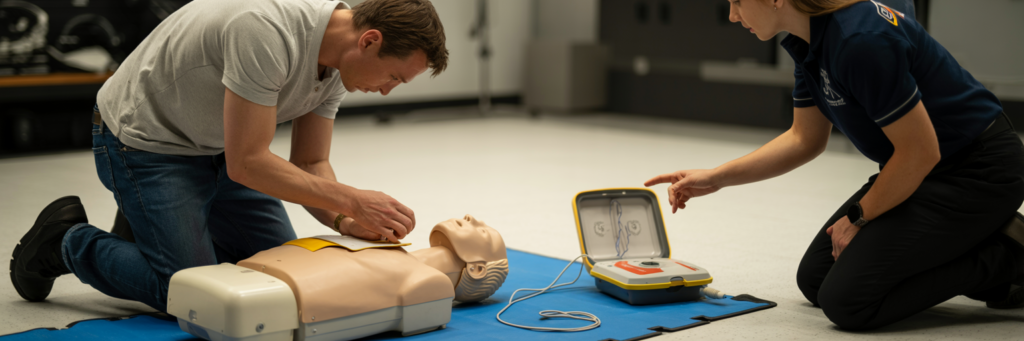
The big difference? You’re spending about 70% of your course day actually doing things, not sitting through PowerPoint presentations. You’ll be on your knees practicing compressions on mannequins, wrapping bandages on your classmates, and working through realistic emergency scenarios.
Comprehensive emergency coverage – You’re not just learning CPR. You’re also training for burns, fractures, severe bleeding, heart attacks, strokes, anaphylaxis, asthma attacks, diabetic emergencies, and seizures. That’s the stuff that actually happens in workplaces every week.
Nationally recognized standard – This qualification gets accepted everywhere in Australia. When you change jobs, move cities, or switch industries, your HLTAID011 certificate comes with you. It meets Safe Work Australia requirements, Fitness Australia standards, and pretty much every employer’s WHS compliance needs.
The course has been updated pretty significantly since that old HLTAID003 you might’ve done years ago. They’ve added more content around recognizing medical emergencies early, better protocols for managing anaphylaxis with adrenaline auto-injectors, and updated compression depth requirements based on the latest Australian Resuscitation Council guidelines.
Who Needs HLTAID011 Certification
If your employer said “you need first aid” without specifying which course code, this is almost definitely what they mean. HLTAID011 covers the standard workplace first aid requirements across most industries.
Retail and hospitality workers – Store managers, duty managers, café supervisors, restaurant floor staff. You’re dealing with customers and team members all day, and stuff happens.
Fitness and gym staff – Personal trainers, gym managers, group fitness instructors. Fitness Australia specifically requires HLTAID011 for registration and insurance purposes.
Office workers and managers – First aid officers, team leaders, anyone responsible for workplace safety.
Tradespeople and field workers – Electricians, plumbers, builders, HVAC technicians working on job sites.
Community and support workers – Youth workers, disability support workers, aged care staff.
The one major exception? If you work in childcare, kindergarten, or school settings, you’ll probably need HLTAID012 (Provide First Aid in an Education and Care Setting) instead. That course includes everything in HLTAID011 plus additional child-specific content.
⚠️ Common Concern: "What if I break someone's ribs doing CPR?" The reality is broken ribs heal, but dead doesn't. If someone needs CPR, they're already clinically dead. You're not making things worse – you're giving them a chance at survival. Current Australian Resuscitation Council guidelines prioritize effective compressions over fear of injury.
Module 1 – CPR and Basic Life Support (DRSABCD)
CPR training has changed significantly – the compression depth is deeper, and there’s more emphasis on just getting started rather than worrying about perfection.
Adult CPR Techniques
Current compression standard: 5-6 centimeters deep for adult CPR. You’re kneeling beside the casualty with hands positioned in the center of their chest, arms straight and locked. You’re using body weight instead of arm strength.
Compression rate: 100-120 per minute (think “Stayin’ Alive” tempo). You’re doing 30 compressions, then 2 rescue breaths, repeating until the person breathes normally or help arrives.
If you’re not comfortable giving rescue breaths, compression-only CPR is still massively better than doing nothing.
Child CPR: One hand, 5cm compression depth.
Infant CPR: Two fingers, 4cm compression depth.
Using an AED
AEDs literally talk you through what to do. Turn it on, apply the pads where shown, let it analyze the rhythm. If shock is needed, press the button. The device only allows shock if a shockable rhythm is detected – you can’t accidentally shock someone who doesn’t need it.
Managing Choking
Conscious choking: Encourage coughing. If they can’t breathe, give five back blows between shoulder blades, then five chest thrusts. Alternate until the object comes out.
Unconscious choking: Start CPR immediately. Chest compressions might dislodge the obstruction.
Module 2 – Injury Management and Wound Care
Controlling Severe Bleeding
Direct pressure is your immediate response. Put something clean against the wound and press firmly for 10-15 minutes. If blood soaks through, add more material on top – don’t remove the original dressing.
Tourniquets are now appropriate for severe limb bleeding that direct pressure can’t control.
Managing shock: Blood loss can cause shock even after bleeding stops. Signs include pale, cold, clammy skin and confusion. Keep them lying down, raise their legs, and keep them warm.
Treating Burns
The 20-minute rule: Cool burns under running water for 20 minutes minimum. Not a quick rinse – twenty full minutes to stop ongoing tissue damage. Use cool water, not ice.
Burn types:
- Superficial: Red, painful, no blisters
- Partial thickness: Red, swollen, blistering
- Full thickness: White, brown, or charred – call 000 immediately
Managing Fractures and Sprains (RICER)
R – Rest the injured part
I – Ice (20 minutes on, 20 minutes off)
C – Compression with firm bandage
E – Elevation above heart level
R – Referral for medical assessment
Bandaging Techniques
You’re learning spiral bandaging for limbs, figure-eight bandaging for joints, and pressure immobilization for snake bites. Practice happens on partners to build functional skills.
Module 3 – Medical Emergency Recognition
Medical Emergency Recognition at a Glance
| Emergency | Key Signs | Immediate Action | Time Critical? |
|---|---|---|---|
| Heart Attack | Chest pressure, arm/jaw pain, sweating | Call 000, give aspirin (300mg chewed) | Very — every minute counts |
| Stroke | Face droop, arm weakness, slurred speech | Call 000 immediately, note time | Extremely — treatment window 4.5 hours |
| Anaphylaxis | Breathing difficulty, throat swelling | Lay flat, EpiPen, call 000 | Life-threatening within minutes |
| Severe Asthma | Can't speak in sentences, blue lips | 4 puffs inhaler, call 000 if severe | Can become critical quickly |
| Low Blood Sugar | Confusion, shaking, sweating | Quick sugar if conscious | Minutes to unconsciousness |
| Seizure | Unconscious, jerking movements | Protect from injury, time it | Call 000 if >5 minutes |
Module 4 – Emergency Scene Management
DRSABCD Action Plan
This is your emergency response framework – the exact sequence you’re following for every emergency.
D – Danger – Check if the scene is safe before approaching
R – Response – Check if the person responds to voice and touch
S – Send for help – Call 000 or assign someone specific to call
A – Airway – Check if airway is open and clear
B – Breathing – Check if they’re breathing normally
C – CPR – Start if they’re not breathing normally
D – Defibrillation – Use AED if available
Communicating with 000
What happens when you call:
First voice: “Emergency. Police, Fire, or Ambulance?”
You: “Ambulance”
They’ll ask: “What’s the location of the emergency?”
Be specific: Street address, suburb, landmark, building name.
Then: “What’s the problem?”
Describe what you see, not diagnosis: “A man has collapsed and isn’t breathing.”
Stay on the line. The dispatcher might give you instructions or ask for updates.
Moving Casualties Safely
Moving someone who’s injured can make their injuries worse. You’re only moving them if:
- Fire, explosion, or chemical hazard
- Risk of building collapse
- In traffic with no way to stop vehicles
- Violent situation
Otherwise, you’re keeping them still and waiting for paramedics.
The HLTAID011 Assessment
The practical assessment is what people worry about most, but here’s the reality: most students pass first time because the course is designed to teach you to competency.
What the Assessment Involves
There’s no separate written exam. Assessment happens throughout the day as you’re practicing, plus a final demonstration at the end.
Continuous assessment: While you’re practicing skills, the instructor is watching and noting whether you’re demonstrating competency. If you’re not getting something right, they’re teaching you again until you do.
Final practical demonstration: At the end, you’re demonstrating key skills one-on-one with the instructor – CPR sequence, medical emergency response, injury management.
The assessment checks for competency, not perfection. You need to demonstrate that you understand the core principles and can perform the essential skills safely.
Why Most Students Pass
The course is designed to teach you. By assessment time, you’ve practiced CPR for probably an hour cumulative, done AED sequences multiple times, worked through realistic scenarios, and received individual feedback.
If you’ve been actively participating all day, you’re ready. The instructor wants you to pass – their job is to teach you first aid skills to the required competency level.
🙌 Extra Practice: The instructor will work with you one-on-one until you're getting it right. This happens same-day.
HLTAID011 vs Other First Aid Courses
HLTAID011 vs HLTAID009 (CPR Only)
HLTAID009: Just CPR, AED use, and choking management. Nothing about injuries or medical emergencies.
HLTAID011: Full first aid including everything in HLTAID009 plus injury management, medical emergencies, bandaging, and scene management.
When you complete HLTAID011, you’ve also met the requirements for HLTAID009 – you don’t need two separate certificates.
Who needs CPR-only:
- People renewing their CPR component in years 2 and 3
- Very specific roles where employer has confirmed CPR-only is sufficient
Who needs full first aid: Pretty much everyone else. Most employers require HLTAID011, not just CPR.
HLTAID011 vs HLTAID012 (Education and Care)
HLTAID012 is HLTAID011 plus additional child-specific content. It includes more detailed infant and child CPR, asthma management in children, anaphylaxis management in children, and specific documentation requirements for education settings.
Who needs HLTAID012:
- Childcare educators and directors
- Kindergarten and preschool teachers
- Anyone working in regulated education and care services
Who needs HLTAID011: Everyone else, including most teacher aides and office staff at schools.
Course Code Changes
The old codes: HLTAID003 Provide First Aid (superseded 2022)
Current codes: HLTAID011 Provide First Aid
The core content is similar, but updates include revised compression depth guidelines, updated anaphylaxis protocols, and more emphasis on early recognition of medical emergencies.
Does your old HLTAID003 still count? If it hasn’t expired yet, yes. But when it’s time to renew, you’re doing HLTAID011.
⚠️ Don't Make This Mistake: Booking HLTAID009 (CPR only) thinking it meets workplace requirements when you actually need HLTAID011 (full first aid). Most employers require the complete qualification, not just CPR. When in doubt, HLTAID011 is the safe choice for 90% of situations.
After Your HLTAID011 Course
Your Certification Details
Your HLTAID011 certificate is valid for three years from completion. But the CPR component expires after 12 months.
What this means:
- Year 1: Fully certified
- Year 2: CPR renewal due
- Year 3: CPR renewal due again
- Year 4: Complete full HLTAID011 again
What Your Certificate Qualifies You to Do
You CAN:
- Provide emergency first aid in workplaces and public spaces
- Administer CPR and use AEDs
- Assist people in using their own medications
- Perform basic wound care and bandaging
- Assess casualties and decide when to call 000
- Manage emergency scenes until paramedics arrive
You CANNOT:
- Diagnose medical conditions
- Prescribe medications
- Provide medical treatment beyond first aid scope
- Perform medical procedures
Good Samaritan laws protect you when providing emergency first aid in good faith. You’re not legally required to provide first aid just because you’re qualified, but once you start, you have a duty to continue until someone with equal or higher training takes over or emergency services arrive.
Conclusion
The HLTAID011 course content covers four main modules that take you from basic life support through to managing complex medical emergencies. You’re learning CPR and AED use, moving into injury management and wound care, then medical emergency recognition and scene management protocols.
The course is designed to teach you to competency through hands-on practice and realistic scenarios. By the end, you’ve practiced each skill multiple times and demonstrated competency to a qualified instructor.
The confusion around course codes makes more sense now. HLTAID011 is the standard workplace first aid that includes CPR. HLTAID009 is just the CPR component. HLTAID012 adds child-specific content for education workers.
For most workers in retail, hospitality, fitness, office roles, or trades, HLTAID011 is what you need.
Your Next Step
Right now, you’ve got all the information you need. You understand what’s covered in the course, what the training looks like, and which qualification you actually need.
The decision’s pretty straightforward: either your certificate’s expired and you need recertification, or you’re starting a job that requires it, or you’re exploring career options where it’s beneficial.
Booking means checking available dates, picking one that works with your schedule, completing the online booking, and receiving instant confirmation.
You get your certificate same day via email, you’re compliant with employer requirements immediately, and you’ve got three years before you need to think about full renewal again.
Six months from now, you probably won’t be thinking about this course much. But there’s a decent chance that at some point – maybe at work, maybe in public, maybe at home – you’re gonna be the person who knows what to do when everyone else is panicking.
You won’t be a paramedic. You won’t be performing miracles. But you’ll know enough to start CPR while someone calls 000. You’ll recognize stroke signs in time to get treatment. You’ll control bleeding until the ambulance arrives.
And that might be the difference between someone living or dying.
Pretty good return on investment for one day of training.
Book Your First Aid Training Now
Fast, affordable, and nationally accredited training delivered by professionals who care
Frequently Asked Questions
Q.What's the difference between HLTAID003 and HLTAID011?
HLTAID003 is the old course code that was superseded by HLTAID011 in 2022. The content is very similar, but HLTAID011 has updated compression depth guidelines, improved anaphylaxis protocols, and more emphasis on early recognition of medical emergencies. If your HLTAID003 hasn't expired yet, it's still valid, but when you renew you'll be doing HLTAID011.
Q.How long does HLTAID011 certification last?
Your HLTAID011 certificate is valid for 3 years, but the CPR component requires annual renewal. This means in year 2 and year 3, you'll do a shorter CPR-only course (HLTAID009) to keep your certification current. In year 4, you'll complete the full HLTAID011 again.
Q.What happens if I don't pass the assessment?
This is extremely rare – most training providers report 98%+ first-time pass rates. The course is designed to teach you to competency, not test you. If you're struggling with a specific skill, the instructor provides additional coaching and practice time on the same day. You're not sent home to rebook and pay again – they work with you until you're ready.
Q.Can I do HLTAID011 online or does it have to be in person?
HLTAID011 must be completed in person because it's a practical skills-based qualification. You can't learn proper CPR compression depth or bandaging techniques through a computer screen. Some providers offer online theory components that you complete before the practical session, but the hands-on training and assessment must be face-to-face.
Q.Do I need to bring anything to the course?
Most training providers supply everything you need – mannequins, bandages, training equipment, and course materials. You just need to bring yourself in comfortable clothing you can kneel in, and lunch or money for nearby food. Some providers include morning tea. Check your confirmation email for venue-specific details.
Making first aid training more affordable for
every classroom
We believe every student deserves access to life-saving first aid knowledge. That’s why we offer specially reduced pricing for schools and educational groups. Whether you’re booking for a single class, a year group, or your entire school, our flexible packages make training more accessible and cost-effective — without compromising quality.
