
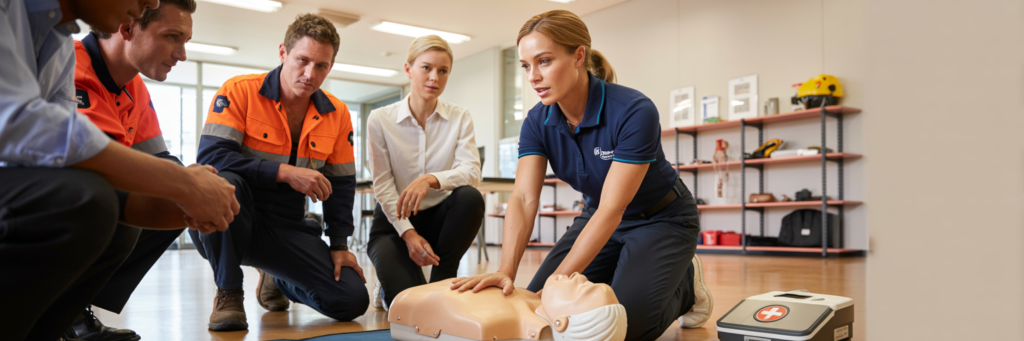
Most students pass their HLTAID011 Provide First Aid course on the first attempt. The ones who struggle? They walked in unprepared and didn’t know what to expect.
If you’re reading this, your certificate probably expired, HR sent you a reminder about compliance, or you’re building qualifications for a new career. Whatever brought you here, you’re likely feeling stressed about it.
HLTAID011 is Australia’s nationally recognized first aid qualification—it’s the course you need when your employer says “get your first aid certificate.” It covers CPR, treating injuries, and recognizing medical emergencies. The actual training is hands-on, practical, and designed for absolute beginners.
You don’t need medical knowledge or peak fitness. You just need to show up, pay attention, and practice the skills.
This guide walks you through pre-course preparation, what happens during training, how the assessment works, and insider tips for passing first time. By the end, you’ll know exactly what to expect.
Understanding HLTAID011 – Course Basics
Let’s clear up the confusion around what HLTAID011 actually is and who needs it.
What HLTAID011 Stands For
HLTAID011 is the national unit code for “Provide First Aid” from the Australian Health Training Package:
- HLT = Health Training Package
- AID = First Aid category
- 011 = Specific unit number
This qualification replaced HLTAID003 “Apply First Aid” in 2022. If you did first aid training a few years ago, your certificate says HLTAID003. When you renew now, you’ll do HLTAID011 instead. The content’s basically the same—just updated to current Australian Resuscitation Council guidelines.
Who Needs This Qualification?
HLTAID011 is the most common first aid course in Australia. If your employer said “get your first aid certificate” without specifying which one, they mean this course.
Industries that typically require HLTAID011:
- Retail and hospitality managers
- Personal trainers and fitness professionals (Fitness Australia requirement)
- Office workers and team leaders
- Event coordinators and venue managers
- Construction and trades supervisors
- Aged care and disability support workers
- Community services and youth workers
- Teachers and education support staff
According to Safe Work Australia, workplaces need appropriate first aid arrangements based on their risk profile. For most workplaces, that means designated employees with current HLTAID011 certification.
HLTAID011 vs Other First Aid Courses
| Course Code | Course Name | Who Needs It |
|---|---|---|
| HLTAID009 | Provide CPR | CPR renewal only (annual) |
| HLTAID011 | Provide First Aid | Standard workplace first aid—most common |
| HLTAID012 | First Aid in Education & Care | Childcare educators, teachers |
| HLTAID014 | Advanced First Aid | Remote workers, FIFO, outdoor guides |
When you might need a different course:
- Your employer specifically said “CPR only” → HLTAID009
- You work in childcare or early education → HLTAID012
- You work in remote locations or high-risk environments → HLTAID014
👍 Rule of Thumb: If your employer asked for "first aid certification" without a specific course code, they mean HLTAID011. Check with HR if you're unsure.
Pre-Course Preparation – What You Need Before Day 1
You’ve booked your course. Here’s what you need to sort out beforehand.
Required Documents & Information
- Unique Student Identifier (USI)
Every Australian student needs a USI—a reference number that creates your national training record. If you’ve done any nationally recognized training since 2015, you already have one.
Get your USI at usi.gov.au by creating an account and verifying your identity with your driver license, passport, or birth certificate. Write down the 10-digit code.
- Photo ID
Bring government-issued photo ID (driver license, passport, or proof of age card). Required for identity verification and certificate issuance.
- Pre-Course Materials
Most providers send materials via email. Reading them beforehand is optional—the course is designed for people who haven’t prepared.
What to Bring on Course Day
Essential items:
✓ Comfortable clothing for kneeling and moving
✓ Enclosed shoes (no high heels or thongs)
✓ Lunch or money for food
✓ Water bottle
✓ Pen for notes
What NOT to bring:
✗ Excessive jewelry (interferes with practical work)
✗ Restrictive clothing
✗ Work laptop or distractions
✗ Strong perfume or cologne
Physical and Mental Preparation
No specific fitness level required. CPR technique relies on proper body positioning rather than strength. Students of all ages and fitness levels successfully complete this qualification.
If you have physical limitations (joint pain, knee problems, recent injury, pregnancy), tell your instructor at the start. They can demonstrate modified techniques that accommodate your needs while meeting assessment requirements.
You don’t need to study beforehand. The course teaches everything from scratch. You’ll practice each skill multiple times before assessment, and instructors don’t assess you until they’re confident you’re ready.
Course Day Breakdown – What Actually Happens
Now you know what to bring and how to prepare—but what actually happens during your HLTAID011 course? Let’s walk through a typical training day so there’s no surprises.
Foundation & CPR Training
Welcome & Course Introduction
Your instructor kicks things off with the basics: welcome and introductions, housekeeping information, course objectives, assessment criteria, and time for questions.
Theory Foundations
Before you get your hands on the mannequins, you’ll learn the essential emergency response principles.
DRSABCD Action Plan:
This is the framework for responding to any emergency situation:
- Danger – Assess if the scene is safe before you approach
- Response – Check if the casualty responds to you
- Send for help – Call 000 or direct someone specific to call
- Airway – Make sure the airway is clear
- Breathing – Check if they’re breathing normally
- CPR – Start CPR if required
- Defibrillation – Apply an AED if one’s available
You’ll also cover legal considerations (duty of care, consent, Good Samaritan protection), and infection control (personal protective equipment, body fluid precautions, safe disposal).
CPR Training Begins
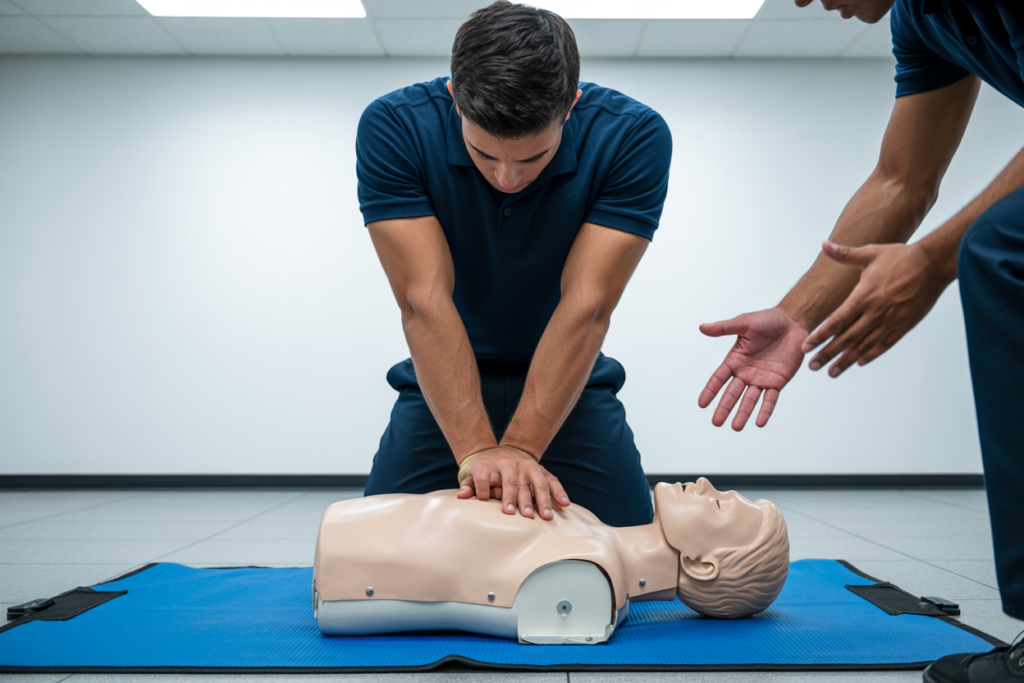
This is where the hands-on practice starts. You’ll learn adult CPR technique first.
Adult CPR Technique:
- Correct hand placement—center of chest, lower half of the sternum
- Appropriate compression depth
- Correct compression rate (think of the Bee Gees “Stayin’ Alive”—that rhythm actually works)
- Allowing full chest recoil between compressions
- Minimizing interruptions to compressions
Rescue Breaths:
- Head tilt, chin lift technique to open the airway
- Maintaining a seal around the mouth
- Watching for chest rise to confirm effective breaths
- When to use face shields or masks
Compression-to-Breath Ratio:
30 compressions to 2 breaths—that’s the standard cycle. You continue until help arrives or the casualty recovers.
AED (Defibrillator) Use:
Most people find the AED surprisingly easy to use because it talks you through everything. You’ll learn when AEDs are needed, how to apply the pads correctly, and how to follow the voice prompts.
Infant & Child CPR Modifications:
The technique changes slightly for different age groups, with adjusted hand positions and compression depths.
You’ll practice CPR multiple times throughout the morning. That repetition builds muscle memory and confidence.
Injuries & Medical Emergencies
After lunch, the focus shifts from CPR to managing various injury and medical emergency scenarios.
Casualty Management
You’ll learn about unconscious casualties (recovery position, monitoring breathing), shock management (recognizing signs, treatment priorities), and when urgent medical help is needed.
Injury Treatment – Hands-On Practice
Serious Bleeding: Direct pressure application, using dressings and bandages correctly, pressure points, tourniquets, and preventing infection.
Wound Management: Assessing wound severity, cleaning minor wounds, proper dressing application, and when someone needs professional medical treatment.
Burns and Scalds: Assessing burn severity, cool running water treatment, appropriate dressing application, and when to call emergency services.
Fractures and Sprains: Recognizing fractures vs sprains, immobilization techniques, splinting basics, and seeking medical assessment.
Bandaging Techniques:
You’ll practice various bandaging methods on each other: roller bandages, triangular bandages for making slings, pressure bandages, and figure-8 technique for joints.
Medical Emergencies Recognition
Heart Attack: Warning signs (chest pain, shortness of breath, nausea, sweating), appropriate response (call 000, help them rest, aspirin if available), and monitoring them until help arrives.
Stroke: F.A.S.T. test (Face drooping, Arms weak, Speech difficulty, Time to call 000), recognizing symptoms quickly, and why immediate action is so important.
Asthma: Recognizing severe attacks, using inhalers correctly, when to call emergency services, and supporting the person.
Anaphylaxis: Signs of severe allergic reaction, EpiPen/adrenaline auto-injector use (they usually have training devices), and why this is always an emergency.
Diabetic Emergencies: Hypoglycemia (low blood sugar—give them something sugary) and hyperglycemia (high blood sugar—different response).
Seizures: Protecting the person during a seizure, what NOT to do (don’t put anything in their mouth!), when to call emergency services, and post-seizure care.
What Makes This Course Effective
This isn’t a lecture where you sit and take notes. You’ll spend the majority of the day practicing CPR on training mannequins, bandaging techniques on fellow students, and using actual first aid equipment.
Experienced instructors often share stories from actual emergency responses, helping you understand why specific techniques matter and how your actions genuinely save lives.
By the afternoon, you’ve practiced every skill multiple times. The practical assessment is simply demonstrating what you’ve been doing all day. That’s why most people pass—the assessment isn’t a surprise test of random skills.
The Practical Assessment – What You’re Actually Tested On
After a full day of learning and practice, there’s one final step: demonstrating your competence through practical assessment.
Assessment Format Explained
Assessment is one-on-one with your instructor (not performed in front of the entire class), scenario-based, and competency-based—you’re either competent or not yet competent. There’s no grading, no percentages. All knowledge is assessed through practical scenarios, and it’s conducted after you’ve practiced skills extensively throughout the day.
CPR Assessment (Primary Component)
This is the most important component because CPR is the most critical life-saving skill.
Scenario example: “You find an unconscious person. Show me how you would respond.”
Your demonstration includes:
- Assess Danger – Check the scene is safe
- Check Response – Tap shoulders, speak loudly
- Send for Help – Direct someone to call 000
- Position Casualty – On back on firm surface
- Check Breathing – Look, listen, feel
- Commence CPR – Correct hand placement, compressions at adequate depth and correct rate, rescue breaths
- Apply AED – Attach pads, follow voice prompts
- Continue – Until help arrives
Instructors assess your hand placement, compression depth and rate, effective rescue breaths, correct AED pad placement, clear communication, and systematic approach.
Casualty Management & Injury Treatment
You’ll demonstrate how to manage unconscious but breathing casualties (recovery position, monitoring), treat serious bleeding (direct pressure, bandaging), manage burns (cool water treatment, appropriate dressing), and handle fractures (assessment, immobilization).
Medical Emergency Recognition
You’ll need to recognize and respond appropriately to scenarios like heart attacks (recognize signs, call 000, assist to rest, monitor), strokes (F.A.S.T. test, immediate response), and severe allergic reactions (anaphylaxis management).
Instructors assess your ability to recognize the emergency, respond appropriately, prioritize life-threatening situations, provide safe treatment, and know when professional medical help is needed.
What “Competent” Actually Means
You don’t need to be perfect. Minor hesitations are fine. Asking for clarification is acceptable. The focus is: “If this were a real emergency, would this person survive because of your actions?”
If the answer is yes—you’re competent.
Instructors aren’t looking for flawless performance or memorized scripts. They’re looking for systematic approach using DRSABCD, appropriate treatment for injuries, recognition of serious medical emergencies, and safe practices.
If You Need More Practice
If you need additional coaching (extremely rare), you receive it immediately on the same day. Your instructor wants you to succeed. The assessment confirms what you’ve been practicing all day.

After the Course – Certification & Next Steps
You’ve completed training and passed assessment. Here’s what happens next.
Certificate Delivery
Modern training providers issue digital certificates via email—official qualification documents accepted by all Australian employers. Your certificate includes your name, course code (HLTAID011), completion date, expiry date (three years), RTO details, and unique certificate number.
Many providers also mail a wallet-sized physical card. Both digital and physical certificates are equally valid.
Certificate Validity & Renewal
Your HLTAID011 certificate is valid for three years. However, the CPR component requires annual renewal.
Renewal timeline:
- Year 1: CPR renewal required (HLTAID009)
- Year 2: Another CPR renewal (HLTAID009)
- Year 3: Complete full HLTAID011 again
CPR guidelines update regularly based on resuscitation research. Annual renewal maintains current best-practice skills.
Set calendar reminders now:
- At 11 months for CPR renewal
- At 2 years 10 months for full renewal
Don’t let your certification lapse.
Submitting to Your Employer
Most employers require proof of certification for HR records. Email your digital certificate (PDF) immediately—don’t wait for the physical card. Keep copies for your records.
USI & National Training Database
Your HLTAID011 qualification is automatically uploaded to the national USI database—a permanent, verifiable record accessible even if you lose certificates. Employers can verify authenticity through the USI system. Log in to usi.gov.au anytime to view all your qualifications.
You’re Ready. Now Book Your Course.
You’ve read this complete HLTAID011 student guide. You know:
✓ What the course covers (CPR, injuries, medical emergencies)
✓ What happens on course day (theory, hands-on practice, assessment)
✓ What the assessment involves (demonstrating what you’ve practiced)
✓ How to pass first time (show up, engage, practice, ask questions)
✓ What happens after (certificate delivery, renewal timeline)
You’re prepared. No more excuses.
Whether your certificate expired months ago, you’re updating your professional registration, or you’re building qualifications for a career change—the time is now.
Stop putting it off. Book your HLTAID011 course and get this sorted.
Book Your First Aid Training Now
Fast, affordable, and nationally accredited training delivered by professionals who care
Frequently Asked Questions About HLTAID011
Q.What's the difference between HLTAID011 and HLTAID003?
HLTAID011 replaced HLTAID003 in 2022 as the current Provide First Aid qualification. The content is essentially the same, just updated to reflect current Australian Resuscitation Council guidelines. If your old certificate says HLTAID003, you'll complete HLTAID011 when renewing.
Q.Do I need to do CPR and First Aid separately?
No, HLTAID011 Provide First Aid includes CPR training. You don't need to book HLTAID009 (CPR only) and HLTAID011 separately—Provide First Aid covers both components in one course.
Q.How long is the HLTAID011 certificate valid?
Your HLTAID011 certificate is valid for three years from completion. However, the CPR component requires annual renewal (HLTAID009) at 12 months and 24 months. At 36 months, you complete the full HLTAID011 course again.
Q.Will I fail if I make mistakes during assessment?
Assessment is competency-based, not perfection-based. Minor hesitations and asking for clarification are acceptable. Instructors assess whether you can respond safely and appropriately in an emergency—not whether you perform flawlessly. If you need additional coaching, it's provided immediately on the same day.
Q.Can I take the HLTAID011 course online?
HLTAID011 requires hands-on practical training and assessment, so it cannot be completed entirely online. Some providers offer blended learning (online theory component plus in-person practical session), but you must attend face-to-face training to complete the qualification.
Q.What happens if I don't pass the assessment?
If you need additional coaching (which is extremely rare), your instructor provides it immediately on the same day at no additional cost. You're then re-assessed once the instructor is confident you're ready. Students don't leave without achieving competency.
Making first aid training more affordable for
every classroom
We believe every student deserves access to life-saving first aid knowledge. That’s why we offer specially reduced pricing for schools and educational groups. Whether you’re booking for a single class, a year group, or your entire school, our flexible packages make training more accessible and cost-effective — without compromising quality.
