
It’s 11:47 AM on a Tuesday. You’re supervising lunch when three-year-old Mia starts coughing violently, clawing at her throat. Her face is turning red, swelling up right before your eyes. Your heart’s pounding so hard you can hear it. The other kids are starting to stare. Your brain’s screaming: Is this choking or anaphylaxis? Where’s her EpiPen? Orange to the thigh—but which one? How hard do I press? Oh god, what if I freeze?
This is every childcare educator’s nightmare.
Look, I get it. You’ve got your HLTAID012 certification hanging on the wall at work. You’re paper-compliant with ACECQA requirements. But here’s the thing—knowing HLTAID012 emergency procedures childcare protocols intellectually is vastly different from executing them confidently when a child’s life depends on your next move.
And that gap? That’s what keeps you up at 3 AM.
In this guide, we’re breaking down the 7 critical HLTAID012 emergency procedures that childcare educators encounter most frequently. We’re talking anaphylactic reactions, asthma attacks, choking incidents, CPR scenarios—the whole lot. But we’re not just covering what to do. We’re getting into how to make split-second decisions under pressure, when to escalate to emergency services, and why these protocols actually work.
By the end, you’ll have the kind of confidence-building knowledge that transforms compliance training into genuine lifesaving competence.
Let’s make sure you’re genuinely prepared for the emergencies that matter most in your childcare setting.
⚡ Quick Reference: HLTAID012 covers 7 life-saving procedures specifically designed for childcare settings. Each procedure addresses real emergencies you'll encounter when caring for children aged 0-12 years.
What Are the Emergency Procedures in HLTAID012?
HLTAID012 emergency procedures cover the critical medical responses you need in education and care settings. These aren’t theoretical—these are the real situations you’ll face when working with kids aged 0-12 in childcare centers.
The seven core emergency procedures included in HLTAID012 certification are:
- Anaphylaxis management – Administering adrenaline auto-injectors (EpiPen) for severe allergic reactions
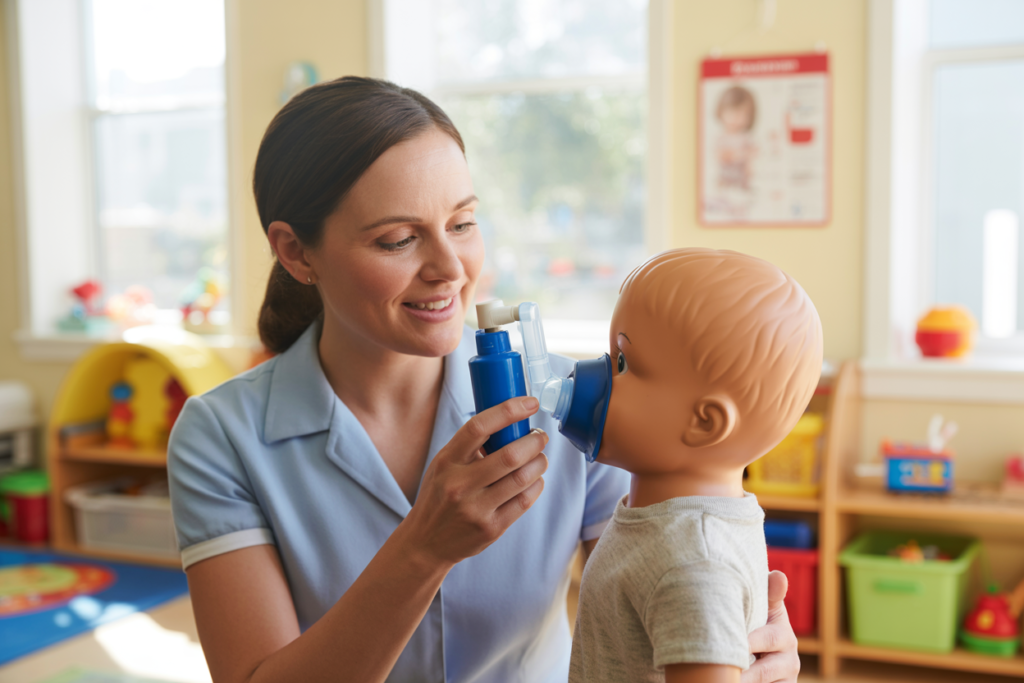
- Asthma emergency response – Managing acute asthma attacks with reliever medication and spacers
- Cardiopulmonary resuscitation (CPR) – Infant and child CPR techniques with correct compression-to-breath ratios
- Choking response – Age-appropriate back blows and chest thrusts for airway obstruction
- Seizure management – Safe positioning and timing protocols for convulsive episodes
- Bleeding control – Direct pressure techniques and shock management
- Emergency services coordination – When and how to call 000, providing critical information to paramedics
These procedures are specifically tailored for childcare educators working with children aged 0-12 years and must be renewed every three years to maintain ACECQA compliance.
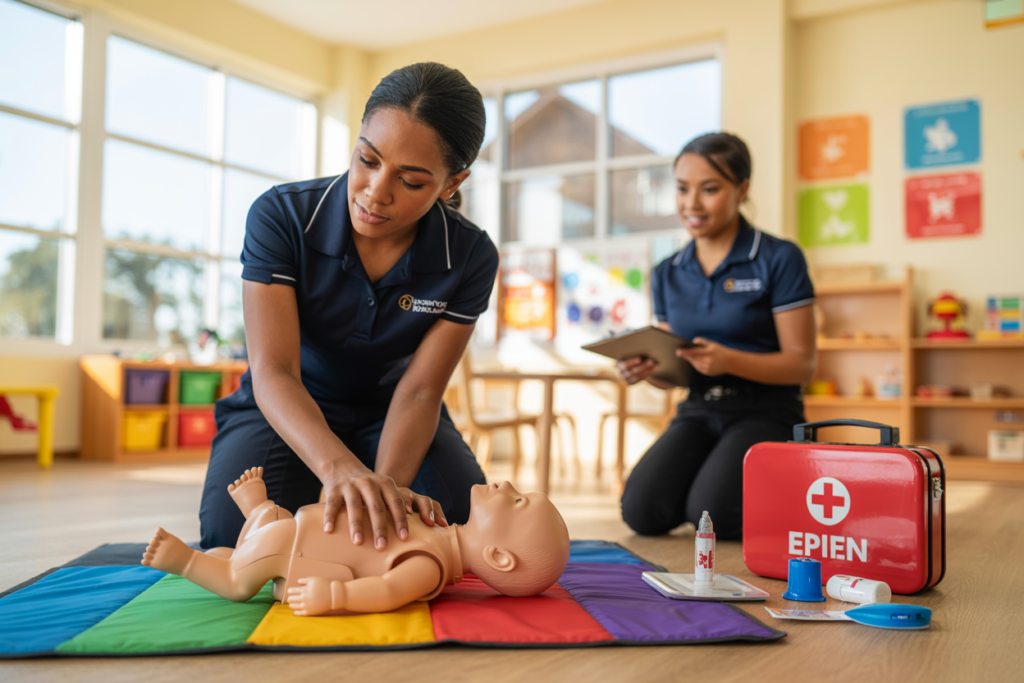
Anaphylaxis Management – The EpiPen Protocol
Here’s what nobody tells you about anaphylaxis in childcare: it doesn’t always look like what you saw in training. Sometimes it’s subtle. Sometimes it’s terrifyingly fast. And when you’ve got 15 toddlers eating lunch and one of them has a severe nut allergy, every cough makes your stomach drop.
Recognizing Anaphylaxis vs. Mild Allergic Reactions
The biggest mistake educators make? Waiting to see if it gets worse. Anaphylaxis can progress from “hmm, that’s concerning” to life-threatening in under 10 minutes.
Here’s the thing that’s gonna save you from second-guessing yourself: if you see hives PLUS any breathing difficulty, that’s anaphylaxis. Full stop. You’re not waiting to see if it gets worse. You’re not calling the parent first to check what they think. You’re grabbing that EpiPen.
The ASCIA criteria are clear—anaphylaxis involves two or more body systems. Skin reaction plus respiratory symptoms? That’s two systems. Skin reaction plus gastrointestinal symptoms (vomiting, abdominal pain)? That’s two systems.
| Mild Allergic Reaction | Anaphylaxis (LIFE-THREATENING) |
|---|---|
| Localized hives or rash | Hives PLUS breathing difficulty |
| Mild facial swelling | Swelling of tongue or throat |
| Itchy mouth or throat | Persistent coughing or wheezing |
| Single body system affected | TWO or more body systems affected |
According to ASCIA data, 1 in 10 Australian children have food allergies, with anaphylaxis cases increasing 350% since 1990. You’re not paranoid for being hypervigilant—you’re being realistic about the odds.
Step-by-Step EpiPen Administration
Let’s talk about the thing that keeps you up at night—actually using the EpiPen.
The EpiPen is designed for panicked people with shaking hands to use in high-stress situations. You cannot hurt a child by administering it when in doubt. The only mistake is hesitation.
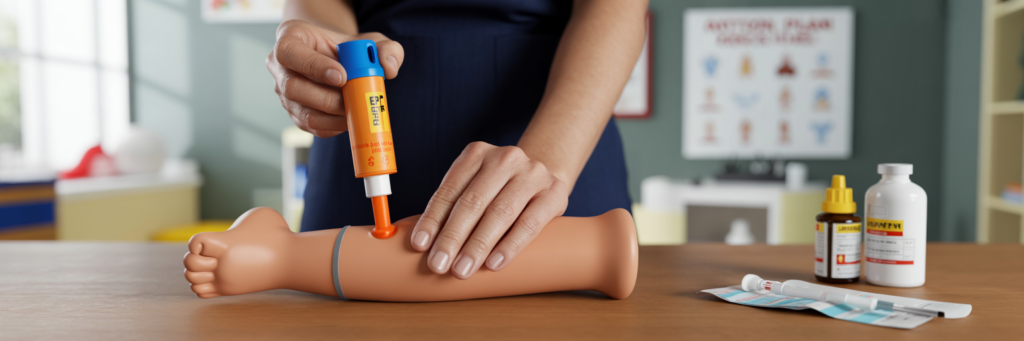
Step 1: Position the EpiPen – Orange tip down, blue cap up. The EpiPen works through clothing—you do NOT need to pull down pants.
Step 2: Remove the Blue Safety Cap – Pull straight up, don’t twist.
Step 3: Inject Into Outer Mid-Thigh – Push down HARD until you hear a click. Keep holding for 3 seconds.
Step 4: Call 000, Position, Monitor – Keep the used EpiPen for paramedics. Position child lying flat with legs elevated UNLESS they’re vomiting or having trouble breathing. Call 000 immediately—even if symptoms improve, they MUST go to hospital.
Here’s what your hands will do: they’ll shake. Your heart will race. That’s normal. The EpiPen still works.
If there’s no improvement after 5 minutes, you’re administering a second EpiPen if available. Same process, same or opposite thigh.
Common Mistakes Educators Make
The “Wait and See” Approach – This is the killer. Those few minutes can be the difference between a scary situation and a tragedy. If you’re even thinking “should I use the EpiPen?” the answer is yes.
Calling the Parent Before Calling 000 – EpiPen first, 000 second, parent third. The parent can meet you at the hospital.
Letting the Child Sit Up – After EpiPen, kids often feel better quickly. Don’t let them sit up or walk around. Sudden position changes can cause dangerous blood pressure drop.
Forgetting to Document – You need exact time of symptom onset, exact time of EpiPen administration, child’s response, time of 000 call.
Asthma Emergency Response – Beyond the Blue Puffer
Asthma’s tricky because it doesn’t always announce itself with dramatic wheezing. Sometimes a severe attack looks quiet. And that quiet? That’s when you need to move fast.
The 4x4x4 Asthma First Aid Protocol
This is the protocol you need to memorize so well you could do it in your sleep.
4 puffs of reliever medication (the blue puffer) 4 breaths per puff using a spacer Wait 4 minutes, then reassess
That’s it. 4-4-4. If you remember nothing else, remember those three numbers.
First Cycle:
- Shake the blue puffer, attach to spacer
- Give 1 puff into spacer
- Have child take 4 breaths from spacer
- Repeat for puffs 2, 3, and 4
- Wait 4 minutes
After 4 Minutes: Is the child breathing better? Can they speak in full sentences?
If NO or symptoms worsening: Call 000 immediately and continue giving 4 puffs every 4 minutes until paramedics arrive.
According to Asthma Australia, 80% of Australian children with asthma attend childcare, with 1 in 4 experiencing asthma attack requiring emergency intervention.
Spacer Technique for Different Age Groups
Infants and Toddlers (0-3 Years):
- Small volume spacer with MASK attachment required
- Hold mask firmly over nose and mouth
- They’re gonna fight you. Keep that mask on anyway. Crying actually helps medication get in.
Preschoolers (3-5 Years):
- Can use mouthpiece OR mask depending on cooperation
- Lips need to seal around mouthpiece
- Make it a game—”take big dragon breaths”
School-Age (6+ Years):
- Regular spacer with mouthpiece
- Child can mostly do independently but you’re supervising
- Always supervise—don’t assume they can do it alone
When to Call Emergency Services
Call 000 Immediately If:
- No improvement after first 4x4x4 cycle
- Child unable to speak or walk
- Lips turning blue
- Child becoming drowsy or unresponsive
- You have ANY doubt about severity
When in doubt, call. Queensland Ambulance Service would rather respond to a child who’s improving than arrive too late to a child in crisis.
💔 Life-Saving Truth: Immediate CPR triples a child's chance of survival. Even imperfect CPR with shaking hands is infinitely better than no CPR. The only unforgivable mistake is doing nothing.
Cardiopulmonary Resuscitation (CPR) for Infants and Children
This is the scenario that absolutely terrifies every childcare educator: a child who’s stopped breathing.
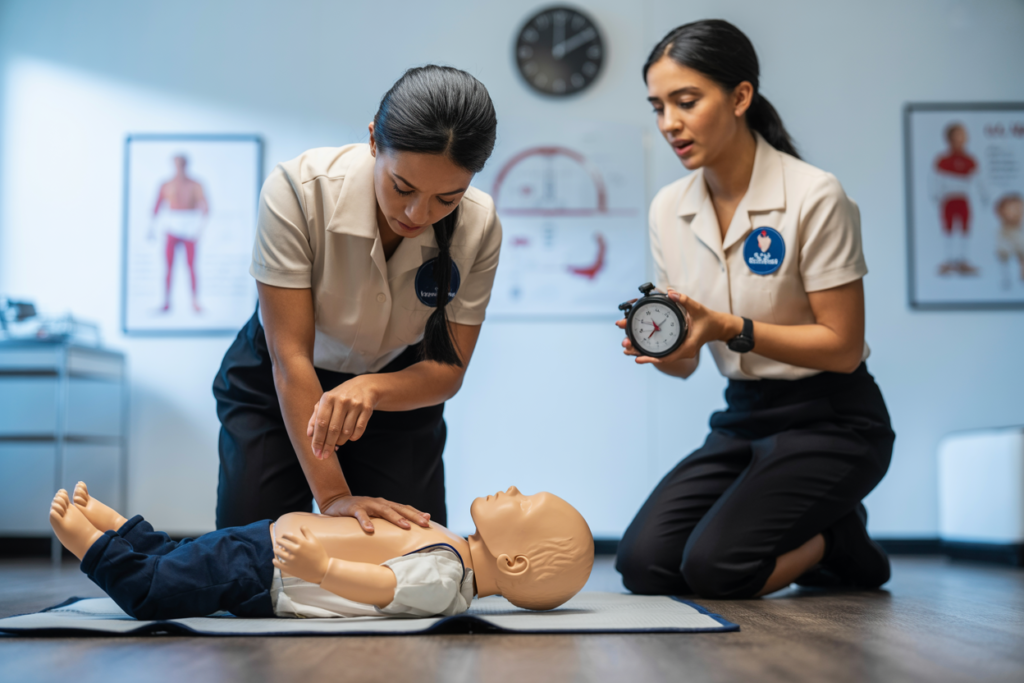
DRSABCD Action Plan
D – Danger: Check the scene is safe before approaching
R – Response: Check if child is conscious (flick foot for infant, tap shoulder for child)
S – Send for help: Point at specific person—”Sarah, call 000 now”
A – Airway: Head tilt-chin lift (gentle for infants)
B – Breathing: Check for normal breathing (10 seconds max)
C – CPR: Compressions and breaths
D – Defibrillation: Use AED if available
Infant CPR (Under 12 Months)
Hand Position: Two fingers only, just below nipple line, center of chest
Compression Depth: One-third depth of chest (about 4cm)
Compression Rate: 100-120 per minute (sing “Stayin’ Alive”)
Ratio: 30 compressions : 2 breaths
Rescue Breaths: Your mouth covers BOTH infant’s nose and mouth, gentle puffs
Child CPR (1-12 Years)
Hand Position: Heel of one hand for smaller children, two hands for larger children, center of chest
Compression Depth: One-third depth of chest (about 5cm)
Compression Rate: 100-120 per minute
Ratio: 30 compressions : 2 breaths
If you’ve got another trained staff member, switch every 2 minutes. CPR is exhausting and effectiveness deteriorates after that.
Choking Response – When Seconds Determine Outcomes
Choking happens most frequently in childcare settings. Especially during meal times when you’ve got 15 toddlers eating at once.
Recognizing Choking vs. Coughing
Effective Coughing (NOT an Emergency):
- Child coughing forcefully, can speak or cry between coughs, making noise
Ineffective Coughing/Complete Obstruction (EMERGENCY):
- Silent or weak cough, cannot speak or breathe, hands clutching throat, face turning blue
The difference between effective and ineffective coughing is the difference between “monitor closely” and “intervene immediately.”
Back Blows and Chest Thrusts for Infants
You cannot do abdominal thrusts on infants—you’ll cause serious damage.
- Hold infant face-down along your forearm, head lower than body
- Give 5 back blows with heel of hand between shoulder blades (sharp, firm blows)
- Turn infant face-up, give 5 chest thrusts (same position as CPR compressions)
- Repeat cycle until object comes out OR infant becomes unconscious
- If unconscious: start CPR immediately
Abdominal Thrusts for Children (Heimlich Maneuver)
If Child is Standing:
- Stand behind child, wrap arms around waist, lean them forward
- Make fist above belly button, below ribcage
- Cover fist with other hand
- Give quick, upward thrusts (separate and distinct, not continuous)
- Continue until object expelled OR child becomes unconscious
How hard? Hard enough to create pressure that expels the object. You might leave bruises. That’s okay. Bruises heal.
Common Food Hazards
High-Risk Foods:
- Grapes (quarter lengthwise, not halved)
- Cherry tomatoes (quarter them)
- Hot dogs/sausages (cut lengthwise, then small pieces)
- Popcorn (avoid for under-4s)
- Nuts, chunks of meat, apple chunks, raw carrot
A whole grape is the perfect size and shape to completely block a toddler’s airway. Quartering lengthwise is the only safe way for kids under 5.
Seizure Management – Protecting During Convulsions
Your job isn’t to stop the seizure—you can’t. Your job is to keep the child safe while it happens and know when it’s gone from “scary but manageable” to “call an ambulance right now.”
The “Stay, Safe, Side” Protocol
STAY: Don’t leave the child. You’re staying with them, someone else gets help.
SAFE: Make the environment safe
- Move furniture/toys away
- Put something soft under their head
- Remove glasses, loosen tight clothing
- Do NOT put anything in their mouth
- Do NOT try to hold them still
SIDE: Once active seizing stops, roll them onto their side (recovery position) to keep airway open and allow fluids to drain.
When to Call 000
Call Immediately If:
- This is child’s FIRST seizure ever
- Seizure lasts longer than 5 minutes
- Multiple seizures without regaining consciousness between
- Child injured during seizure
- Child not breathing normally AFTER seizure ends
- Seizure happens in water
- Child has diabetes
DON’T Call If:
- Child has known epilepsy AND seizure is typical AND stops within 5 minutes AND they recover normally (follow their action plan instead)
Timing a 5-minute seizure feels eternal. Your brain will tell you it’s been 10 minutes. Check the actual time.
Post-Seizure Recovery
The post-ictal state (after seizure) can last from minutes to an hour. Child will be drowsy, confused, possibly scared.
Keep them on their side until fully alert. Don’t try to give water or food yet. Speak softly, reassure them. Monitor breathing and color. Time the recovery.
Bleeding Control and Shock Management
Direct Pressure Technique
Step 1: Gloves on FIRST (universal precautions for bloodborne pathogens)
Step 2: Apply direct pressure with clean cloth/gauze
Step 3: Maintain pressure for at least 5 minutes without peeking
Step 4: Elevate if possible (unless suspected broken bone)
Step 5: Add more dressing if blood soaks through (don’t remove first layer)
If you’ve applied firm pressure for 10 minutes and blood is still flowing freely, call 000.
Recognizing Shock
Shock happens when the body isn’t getting enough blood flow to vital organs.
Early Signs:
- Pale, cool, clammy skin
- Rapid breathing and heart rate
- Anxiety, restlessness
- Weakness
Late Signs (Critical):
- Blue lips and fingernails
- Drowsiness or unconsciousness
- Weak pulse
- Glazed eyes
Shock Management:
- Lay child flat, elevate legs about 30cm
- Keep them warm (blanket, but don’t overheat)
- Monitor breathing continuously
- Do NOT give food or water
- Call 000
Head Injuries
Red Flags – Call 000 Immediately:
- Any loss of consciousness
- Repeated vomiting (2+ times)
- Clear or bloody fluid from nose/ears
- Severe headache getting worse
- Pupils different sizes
- Seizure after head injury
- Extreme drowsiness
- Slurred speech or confusion
Head injury symptoms can develop hours later. This is why parent communication after ANY significant head bump is critical.
📞 Panic-Proof Script: When you call 000 in a crisis, your brain goes blank. Having a rehearsed script means your mouth can operate on autopilot while your hands continue first aid. Practice it now, use it when it matters.
You’re More Prepared Than You Think
If you’ve read this far, you’re already the kind of educator who takes child safety seriously. That worry about whether you’d know what to do when it matters? That’s actually a good sign.
Let’s recap:
Anaphylaxis: Orange to thigh, 3 seconds, call 000. Only mistake is hesitation.
Asthma: 4-4-4 protocol. If no improvement, call 000 and continue cycles.
CPR: Different techniques for infants vs children. DRSABCD. Compressions matter more than perfection.
Choking: Back blows for infants, abdominal thrusts for children. Silent = act immediately.
Seizure: Stay, Safe, Side. Call 000 if over 5 minutes or first-time.
Bleeding: Direct pressure 5 minutes without peeking. Recognize shock early.
000 Calls: Have your script ready. Give critical info first, story later.
Here’s the truth about knowledge versus confidence:
Reading this gave you knowledge. Quality HLTAID012 training gives you confidence.
There’s a difference between knowing what you’re supposed to do and feeling confident you can actually do it. Competence comes from quality training with realistic scenarios, regular practice that builds muscle memory, and confidence from repetition.
The children in your care deserve educators who are genuinely prepared, not just paper-certified. Educators who know the protocols well enough that training kicks in even when emotions are overwhelming.
You can be that educator. You already are—you’re here, reading this, learning, preparing.
Now take the next step. Invest in quality HLTAID012 training. Practice those skills. Build that confidence.
Because somewhere right now, there’s a child who’s going to be in your care. And they deserve an educator who’s genuinely prepared to keep them safe.
The work you do matters more than you know.
Book Your First Aid Training Now
Fast, affordable, and nationally accredited training delivered by professionals who care
Frequently Asked Questions About HLTAID012 Emergency Procedures
Q.How often do I need to renew my HLTAID012 certification?
HLTAID012 certification is valid for three years, but the CPR component (HLTAID011) within it requires annual refresher training according to Australian Resuscitation Council recommendations. While your full certification lasts three years for ACECQA compliance, many quality childcare centers now require yearly CPR updates to keep skills sharp. Set phone reminders for both your three-year full recertification and annual CPR refreshers so you're never caught scrambling days before expiry when you legally cannot supervise children.
Q.What's the difference between HLTAID012 and regular first aid (HLTAID011)?
HLTAID011 is basic CPR and general first aid for adults, children, and infants, but it's NOT sufficient for childcare work. HLTAID012 includes everything in HLTAID011 PLUS asthma management specific to children, anaphylaxis management with EpiPen training, age-specific considerations for infants through preschoolers, education-specific scenarios, and ACECQA compliance requirements. If you work in childcare in Queensland, HLTAID012 is what you legally need—HLTAID011 alone won't meet regulatory requirements.
Q.Can I complete HLTAID012 training entirely online?
No, you cannot get legitimate ACECQA-recognized HLTAID012 certification through 100% online training. The theory component (learning about symptoms, protocols, guidelines) can be completed online, but the practical component—demonstrating CPR, using EpiPen trainers, practicing choking response—MUST be done in person with a qualified assessor watching you. Any provider advertising "fully online HLTAID012" is either running a certification mill that won't hold up under ACECQA inspection or misleading you about their blended learning format that actually includes mandatory in-person assessment.
Q.How long does HLTAID012 training actually take?
The course includes:
- 4–6 hours of self-paced online theory
- A 1.5-hour face-to-face practical assessment
This blended format ensures thorough preparation for childcare-specific emergencies while respecting your time.
Q.What happens if I fail the HLTAID012 assessment?
Failing doesn't mean you're incompetent—it means you need more practice before you're ready to perform these skills in a real emergency. You typically don't fail the entire course; instead, you might need to re-demonstrate one specific skill (like CPR compression depth) or retake the theory assessment. Reputable providers give immediate feedback, offer additional practice time that day if possible, schedule free reassessment within 1-2 weeks, and work with you until you achieve genuine competency rather than just passing everyone to collect certificate fees.
Making first aid training more affordable for
every classroom
We believe every student deserves access to life-saving first aid knowledge. That’s why we offer specially reduced pricing for schools and educational groups. Whether you’re booking for a single class, a year group, or your entire school, our flexible packages make training more accessible and cost-effective — without compromising quality.
Contact Us
Have questions or ready to enrol in a course? Reach out to our friendly team for bookings, group sessions, or general enquiries. We’re here to help you choose the right first aid training for your needs.
