

A child in your care has an asthma attack. Instead of panic, you feel calm. Your hands move confidently—four puffs, spacer attached, exactly as you’ve practiced dozens of times. You know precisely when to call 000. The other children stay calm because you’re calm. Parents arrive to find their child safe, breathing normally, because you responded perfectly.
This isn’t fantasy—it’s the reality for childcare educators who complete HLTAID012 face to face training that prioritizes genuine competence over checkbox compliance.
Here’s what most people don’t tell you about first aid certification: there’s a massive gap between watching an online video about EpiPen administration and actually being able to use one when a toddler’s throat is closing. That gap? It’s the difference between educators who freeze during emergencies and those who respond confidently.
Online modules teach theory. They show you what an EpiPen looks like, walk you through the steps on a screen. But they don’t teach your hands what 5cm of compression depth actually feels like. They don’t build the muscle memory you need when a child stops breathing. They don’t prepare you for the chaos, the noise, the other kids watching.
Face-to-face training builds muscle memory, decision-making frameworks, and the psychological resilience you need when a child’s life depends on you.
If you’re a childcare educator reading this late at night, already carrying the weight of being responsible for fifteen other people’s children—you’ve probably laid awake replaying scenarios. What if Mia has an allergic reaction? What if Oliver’s asthma gets bad? What if I freeze?
Those fears? They’re not going away with an online module you click through during your lunch break.
In this article, we’ll explore five critical benefits of face-to-face HLTAID012 face to face training that transform anxious educators into confident first responders. Real, hands-on practice. Expert feedback in the moment. Realistic scenarios that prepare you for actual childcare chaos.
Because you don’t just need a certificate. You need confidence.
Why Face to Face First Aid Training is More Effective
Face to face first aid training is better than online courses because it builds genuine competence through hands-on practice, not just theoretical knowledge.
Muscle Memory Development: Practicing CPR, EpiPen administration, and asthma management repeatedly creates automatic responses that work under pressure.
Real-Time Feedback: Instructors immediately correct hand placement, compression depth, and technique errors that online modules can’t detect.
Stress Inoculation: Realistic scenario training with noise, urgency, and distractions prepares you for actual emergency chaos.
Confidence Building: Physical practice eliminates the gap between knowing what to do and confidently executing it when a child’s life depends on you.
💪 The Reality Check: Your brain can understand EpiPen steps in 5 minutes. Your hands need 5-10 practice rounds to do it automatically when a child's airway is closing. That's the difference between watching and doing.
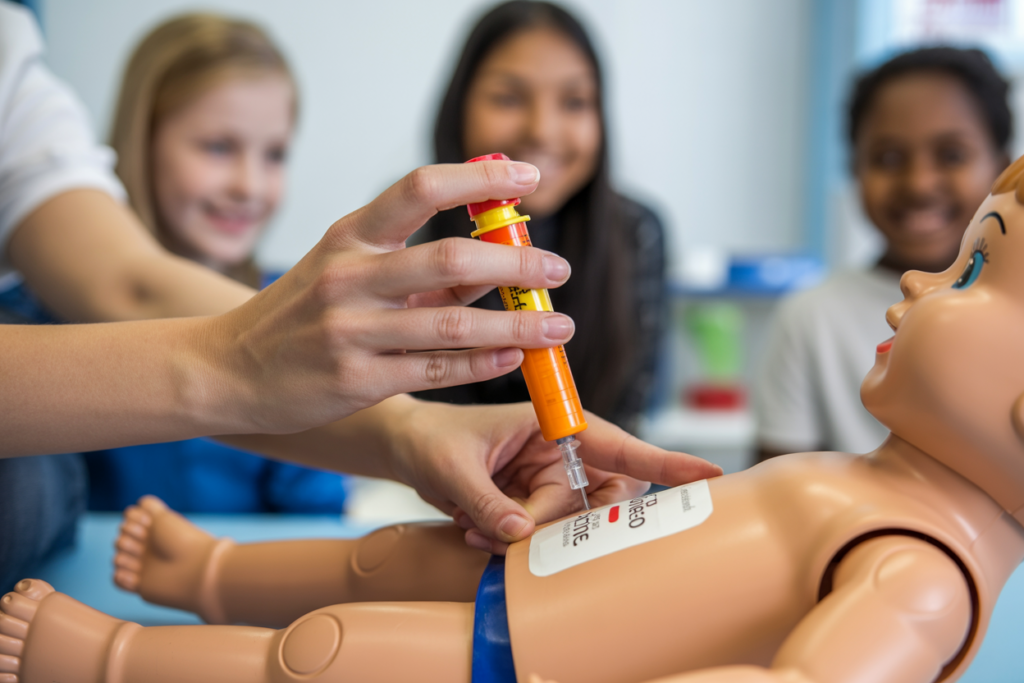
Benefit 1: Build Muscle Memory That Works Under Pressure
Why Watching Isn’t the Same as Doing
You know from working with children that watching someone tie their shoes and actually being able to tie your own shoes are completely different skills. A two-year-old can watch you do it fifty times and still struggle when it’s their turn. That’s because watching activates mirror neurons in your brain—you understand the concept—but your hands don’t learn by watching. They learn by doing.
The same principle applies to first aid, except the stakes are way higher.
Studies show motor skills retention is 75% higher with physical practice compared to visual learning alone. That’s the difference between remembering how to respond and standing there frozen while a child’s airway closes.
When you watch an EpiPen demonstration video online, your brain recognizes the steps: remove safety cap, orange tip to outer thigh, press firmly, hold for three seconds. You pass the quiz. You get your certificate.
But here’s what the video doesn’t teach you: what “press firmly” actually feels like. How hard you need to push through a squirming toddler’s clothing while they’re thrashing. The resistance you’ll feel. How your hands will shake the first time you do it for real.
The Repetition Factor: Practice Until It’s Automatic
In quality face-to-face HLTAID012 face to face training, you don’t practice using an EpiPen once. You practice it five times. Eight times. Ten times. Until your hands move automatically. Until the action becomes as automatic as reaching for your phone when it rings.
Online courses? You watch the demonstration. Maybe twice if you’re diligent. Then you move on.
That’s not enough repetitions to build muscle memory. Psychology research shows muscle memory formation requires 300-500 repetitions for complex motor skills. You’re not going to do 500 EpiPen practices in a single course—but you need enough that your body starts to remember. Five to ten practice rounds gets you there. One video demonstration doesn’t.
In face-to-face training, you’ll practice EpiPen administration, CPR compressions with depth feedback, asthma inhaler techniques, choking responses, and recovery position placement—repeatedly, with real manikins, until each skill becomes automatic.
Every single one of these skills requires your hands to know what to do, not just your brain.
Real Childcare Scenario: The Anaphylaxis Response
Sarah, an educator who completed face-to-face training, was helping children at lunch when she heard coughing. One of her kids with a severe nut allergy—face already going red, starting to swell.
“I didn’t think. My body just moved. The EpiPen was in my hand. Orange to the thigh. Press and hold. I counted three seconds. My hands were shaking after, but during? They knew exactly what to do.”
That’s muscle memory. Sarah’s hands moved before her conscious brain processed what was happening. That’s what repetitive hands-on first aid training gives you. You practice until the response becomes automatic.
You can’t get that from watching a video twice.
Benefit 2: Get Immediate Expert Feedback You Can’t Get Online
The Hidden Mistakes Online Modules Miss
Here’s something that happens in almost every face-to-face first aid course: someone thinks they’re doing CPR correctly. They’re confident. They’ve watched the videos.
Then the instructor walks over and says: “Your hand placement is too high—you’re on the ribs instead of the sternum. And you’re only going about 3cm deep when you need 5cm.”
The student is shocked. They genuinely thought they were doing it right.
This is the problem with online learning. You can’t see yourself from the outside. You don’t know if your hand placement is off by three centimeters—which is the difference between effective CPR and ineffective CPR.
Common errors instructors catch: Hand placement too high, insufficient compression depth, incorrect compression rate, incomplete chest recoil, wrong head-tilt angle.
Every single one of these mistakes can happen without you realizing it. An instructor catches them in real-time. An online module has no idea what you’re actually doing on the other side of the screen.
Personalized Correction for Your Specific Learning Needs
Good face-to-face instruction recognizes that everyone makes different mistakes. Some educators are too hesitant, others too forceful.
A good instructor adjusts feedback specifically for you. “You’re hesitating with the EpiPen—commit to the motion. Press hard.” Or the opposite: “Slow down on those compressions. We want controlled, rhythmic pressure.”
Online courses give everyone the same information. Face-to-face training meets you where you are.
⚡ Real Emergency vs. Online Training Scenario
| Online Module Shows | Real Childcare Emergency |
|---|---|
| Quiet room, calm patient | 15 kids, crying, chaos |
| Step-by-step sequence | Everything happens at once |
| No distractions | Multiple children need you |
| Perfect conditions | Noise, panic, time pressure |

Benefit 3: Practice Real Scenarios That Prepare You for Childcare Chaos
The Sanitized Classroom vs. The Real World Gap
Online first aid modules present emergencies in controlled, sanitized ways. Quiet background. Calm narrator. Perfect sequence. The “patient” lies still while someone demonstrates flawless technique.
Then you get to your actual childcare center and reality looks nothing like that.
There’s noise—constant childcare noise. Kids talking, someone crying, chairs scraping. You’re helping multiple children at once. And then you notice one child’s face turning red. Coughing. Clawing at their throat.
This is chaos. Real, loud, scary chaos. Every other child is about to start panicking. And you’ve got seconds to respond.
⚠️ Key Point: Realistic first aid training prepares you for this version—the messy, loud, chaotic version where you have to make decisions under pressure with a dozen other things demanding your attention.
Stress Inoculation: Training Your Brain to Function Under Pressure
Here’s what most people don’t understand about emergency response: your brain works differently when you’re stressed. Life-or-death stressed.
There’s this thing called cognitive narrowing—your brain shuts down everything except immediate survival processing. Your peripheral vision narrows. Your ability to access complex information decreases. You might forget things you know perfectly well under normal circumstances.
This is why educators sometimes freeze during emergencies even though they technically know what to do. Their training happened in calm, quiet conditions. But the emergency is happening in chaos.
Stress inoculation training – solves this by deliberately creating stress during practice. You practice skills while the instructor adds distractions, noise, time pressure, and multiple competing demands—simulating what real childcare emergencies actually feel like.
Good face-to-face HLTAID012 face to face training includes scenarios like this: You’re practicing anaphylaxis response. The instructor suddenly makes the manikin “cough” and “struggle.” They set a timer counting down—loud beeping. They tell you three other “children” just started crying. They ask questions while you’re trying to administer the EpiPen.
It’s deliberately stressful. Deliberately chaotic. And that’s exactly the point.
Because when you practice under simulated stress, your brain learns to function under actual stress. You build “stress resilience”—the ability to execute correctly even when adrenaline is flooding your system.
One educator said: “The instructor made us practice while playing recordings of children crying. It was stressful. But later when a child actually started choking, my hands knew what to do. I’d already practiced in chaos.”
Online modules can’t create that pressure. They present information in calm conditions—so you only learn to perform in calm conditions.
Benefit 4: Develop Lasting Confidence Through Hands-On Success
The Confidence Gap: Knowing vs. Believing
There’s a huge difference between knowing you’re supposed to do something and actually believing you can do it.
You might know the steps for asthma response. Pass a test about it. But do you genuinely believe your hands will do the right thing when a three-year-old is struggling to breathe? That you won’t freeze or fumble?
That’s the confidence gap.
The gap doesn’t close from reading or watching videos. It closes from doing the thing successfully, multiple times, until your body proves to your brain: yes, you can do this.
When you practice administering an EpiPen and do it correctly—orange tip to the thigh, firm press, you hear the click—your brain registers: I did that. I can do that. Each successful repetition builds another layer of confidence.
By the fifth or sixth practice round, you know you can because you’ve already done it multiple times.
That’s completely different from watching someone else do it on a screen.
The Success-Builds-Success Cycle
Here’s how confidence develops:
First attempts: You’re nervous. Your hands shake. The instructor guides you through. You do it—not perfectly, but you do it. Small win.
Middle attempts: Less nervous. You remember the steps. The instructor only corrects one thing. You’re improving.
Later attempts: Your hands move smoothly. You can do it while the instructor adds distractions. The motion is becoming familiar. The anxiety is replaced by competence.
This cycle only works with hands-on practice.
One educator said: “After the third time practicing CPR, something clicked. I could feel the right depth and rhythm. That feeling of ‘I’ve got this’? That’s what I needed.”
You can’t get that from an online module.

Benefit 5: Eliminate Certification Confusion with ACECQA-Recognized Training
The “Did I Book the Right Course?” Anxiety
Figuring out which first aid course you actually need causes unnecessary stress. Is it HLTAID012? Or HLTAID011? Do you need CPR separately? What about asthma and anaphylaxis?
Face-to-face providers let you talk to a real human before booking. You can ask: “I work in childcare—is this the right course?” And get a straight answer.
When you show up, the instructor explains exactly what the course covers and why it meets ACECQA requirements. That clarity is worth a lot.
In-Person Verification of RTO Accreditation
Some online training providers aren’t properly registered. You complete the course, then discover your certificate isn’t recognized by ACECQA.
With face-to-face training, you verify legitimacy before booking. Legitimate providers display their RTO certificate on the wall. You can see their ACECQA recognition. You can verify credentials in person.
A website can say anything. A certificate on the wall is harder to fake.
Clear Communication About What’s Included
HLTAID012 includes CPR, asthma management, anaphylaxis management, and all specific first aid requirements for working with children. You don’t need separate certificates or multiple courses.
But many educators don’t know this. They see references to CPR and wonder if they need that separately.
Face-to-face instructors clear this up immediately. “Everything you need is included. When you walk out, you’ll have full ACECQA compliance.”
You know you’re done. You can stop worrying.
🎓 Your Next Step: Face-to-face HLTAID012 training transforms paper compliance into genuine competence. You'll practice until your hands know what to do, get expert feedback that catches mistakes, train under realistic pressure, build confidence through success, and walk out with verified ACECQA certification.
Making the Choice That Builds Real Confidence
Look, here’s what it comes down to: you can complete an online first aid module, get a certificate, and technically meet compliance requirements.
But when one of them starts having an allergic reaction—when their face is swelling and you need to administer that EpiPen correctly—the question isn’t whether you have a certificate.
The question is whether your hands know what to do.
Whether you’ve practiced enough that the motion is automatic. Whether an instructor has corrected your technique so you know you’re doing it right. Whether you’ve practiced under stress so your brain can function when adrenaline floods your system. Whether you genuinely believe you can do this, not just hope you’ll remember.
That’s what HLTAID012 face to face training gives you that online modules don’t.
Five critical benefits that transform paper compliance into genuine competence:
- Muscle memory through repetition—your hands learn through doing, not watching
- Real-time expert feedback—instructors catch and correct mistakes immediately
- Realistic scenario training—practice under simulated stress prepares you for actual chaos
- Lasting confidence through hands-on success—proving to yourself you can do this
- Zero certification confusion—direct verification of credentials and clear answers
You’re not just buying training. You’re buying the ability to sleep at night knowing you’re actually prepared.
You’re buying the confidence to look parents in the eye and know—not hope, but know—that if their child has a medical emergency, you can handle it.
Face-to-face training requires commitment. But when the alternative is standing there frozen while a child needs help, unsure if you’re doing it right because you’ve only watched someone else do it on a screen? The choice becomes pretty clear.
If you’re ready to build genuine confidence, book a face-to-face HLTAID012 course. Find a provider with small class sizes, qualified instructors who have real emergency experience, and a track record of preparing childcare educators—not just certifying them.
Your hands need to practice. Your brain needs expert feedback. Your confidence needs hands-on success.
An online module can’t give you that. But face-to-face training can.
And when you respond to your first real emergency and your hands move automatically and you keep that child safe—you’ll know it was worth it.
Book Your First Aid Training Now
Fast, affordable, and nationally accredited training delivered by professionals who care
Frequently Asked Questions About HLTAID012 Face to Face Training
Q.Is HLTAID012 the same as regular first aid certification?
No, HLTAID012 is specifically designed for education and care settings. While regular first aid (HLTAID011) covers CPR and general emergency response, HLTAID012 includes everything in HLTAID011 plus specific training for managing children's medical emergencies including asthma, anaphylaxis, and age-appropriate responses for infants, toddlers, and preschoolers. It's the certification ACECQA requires for childcare educators.
Q.How long does HLTAID012 certification last?
Your HLTAID012 certificate is valid for three years from the date of issue. However, CPR skills need to be refreshed annually, so many providers recommend doing a CPR refresher each year and then completing the full HLTAID012 recertification every three years. This keeps your skills sharp and your certification current for ACECQA compliance.
Q.Can I do part of the training online and part face-to-face?
Some providers offer blended learning where you complete theory components online and then attend face-to-face for practical assessments. However, the hands-on practice component must be done in person with a qualified instructor. Pure online HLTAID012 courses without any face-to-face component don't build the muscle memory and confidence you need for real emergencies.
Q.What should I bring to a face-to-face HLTAID012 course?
Most providers require you to bring photo ID and wear comfortable clothing you can move in (you'll be kneeling, bending, and practicing physical skills). Some courses provide all materials, while others ask you to bring a pen and notebook. Check with your specific provider beforehand, but generally you don't need any prior knowledge or materials—just yourself and willingness to practice.
Q.What's the difference between HLTAID012 and HLTAID004?
HLTAID004 is the old code that was replaced by the updated training package. If you see a provider still advertising HLTAID004, they may not be using current training standards. The current code is HLTAID012 (Provide First Aid in an Education and Care Setting). Always book the current HLTAID012 course to ensure your certification meets current ACECQA requirements.
Making first aid training more affordable for
every classroom
We believe every student deserves access to life-saving first aid knowledge. That’s why we offer specially reduced pricing for schools and educational groups. Whether you’re booking for a single class, a year group, or your entire school, our flexible packages make training more accessible and cost-effective — without compromising quality.
