

It’s 9pm on a Sunday and you’ve just realised your new educator starts tomorrow morning without a current first aid certificate. Or maybe it’s worse, you’re staring at a compliance register and one of your longest serving staff members let their HLTAID012 lapse three weeks ago and nobody caught it. Either way, you’re now googling frantically, trying to work out what you actually need before you can book someone in.
Here’s the good news. When it comes to HLTAID012 prerequisites, there are no formal prerequisite units you need to complete first. You don’t need to have done another course, hold another certificate, or tick some hidden box before you’re allowed to enrol. That part is simple.
But “no prerequisites” doesn’t mean “no requirements.” There’s a difference, and it’s one a lot of centre directors and educators trip over. Training providers set their own entry conditions around things like age, identification, and physical capability, and these can catch people out if nobody mentions them until the morning of the course.
So in this guide we’re going to walk through exactly what you need to sort before training day. We’ll cover the age rules, why you need a USI and how to get one, what the language and literacy expectations actually look like, why the physical side of the course matters more than people expect, how HLTAID012 differs from HLTAID011 if you’re not sure which one your team actually needs, and finish with a simple checklist so you’re not scrambling the night before like our hypothetical 9pm googler above.
Let’s get into it.
What Are the Prerequisites for HLTAID012?
Quick answer, for anyone skimming. There are no formal prerequisite units required for HLTAID012. You don’t need to hold an earlier first aid certificate or complete a lead in course. What you do need is a handful of practical things sorted before you turn up.
- Minimum age 14, anyone under 18 needs a parent or guardian consent form signed
- A valid USI (Unique Student Identifier), this is non negotiable for your certificate to actually count
- English language, literacy and numeracy (LLN) sufficient for a short written assessment, nothing like a formal exam, but you do need to be able to read and respond to questions in English
- Physical capability for floor based CPR, this one surprises people, and there are no exemptions for it
That’s the whole list at a glance. Now let’s actually unpack each one, because a couple of these have caught out plenty of educators and center directors who assumed it’d be a formality.
🎂 Heads up: Age isn't just "how old are you today," it's your age across the whole calendar year the course falls in.

Age Requirements for HLTAID012 Enrolment
Is there a minimum age for HLTAID012?
Yes. You need to be at least 14 in the calendar year you’re attending the course. So if you turn 14 later in the year but you’re 13 on the day of the course itself, that’s still fine, it’s the calendar year that counts, not your exact age on the day.
If you’re under 18, though, there’s an extra step. You’ll need a parent or guardian to sign a consent form before you can take part. This isn’t a rare quirk, it’s pretty standard across providers, so don’t be surprised when it comes up in your enrolment paperwork.
What about younger kids who might need to be in the room, say a family day care educator who can’t arrange separate care that day? Some providers will allow under 14s to sit in as observers, but they won’t receive an accredited outcome for it, usually just a non accredited Certificate of Attendance instead. This is provider dependent though, so it’s worth checking directly with your provider rather than assuming it applies everywhere.
If you’re booking a group of staff at once and want to sort consent forms and age checks for the whole team in one hit, ask about group and on site booking options. It makes things a lot less painful than chasing everyone individually.
Do You Need a USI to Enroll in HLTAID012?
Short answer, yes, and this one trips up more people than you’d think.
A USI, or Unique Student Identifier, is mandatory if you want to walk away with an accredited Statement of Attainment for HLTAID012. Without it, your training provider literally cannot issue your certificate into the national system, no matter how well you performed on the day. It doesn’t matter how good your CPR technique was or how confidently you handled the scenario questions, no USI means no accredited outcome.
The good part is it costs nothing and it’s simple to sort. You create it yourself through the government portal at usi.gov.au, and once you’ve got it, it’s yours for life. You’ll use the same one for any nationally recognised training you ever do again, not just first aid.
A tip for centre directors: build USI collection straight into your onboarding paperwork for new staff. Don’t leave it as a “sort it out before your course” afterthought, because that’s exactly the kind of thing that gets forgotten in a busy week, and then you’re the one fielding a panicked phone call the morning of the course from an educator who can’t remember their USI or never made one in the first place.
📖 Don't overthink it: The LLN check is about basic reading and understanding, not an exam you can fail out of.
Language, Literacy and Numeracy (LLN) Requirements
What LLN level does HLTAID012 require?
This is the one people ask the fewest questions about and probably should ask more. HLTAID012 does involve a written assessment component, so you need a working level of English language, literacy and numeracy to get through it. Specifically, providers are generally looking at around ACSF Level 2 to 3 for reading and learning, and Level 2 for numeracy and oral communication.
Don’t let those numbers intimidate you though. This isn’t an academic exam and nobody’s marking you against a university style rubric. It’s a short pre course assessment designed to check you can read a scenario, understand what’s being asked, and respond in a way that shows you’ve understood the material. If you can read a text message and figure out what someone’s asking you, you’re most likely well within range.
If you want to understand what those ACSF levels actually mean in plain terms, the Australian Core Skills Framework is outlined on education.gov.au and it breaks down what each level looks like in practice.
If additional support is available for staff who might need a hand with the written component, that’s worth flagging to your team early rather than letting anyone quietly worry about it in silence until the day itself.
Physical Requirements: Why the Floor Based CPR Matters
Can I do HLTAID012 if I have a physical limitation?
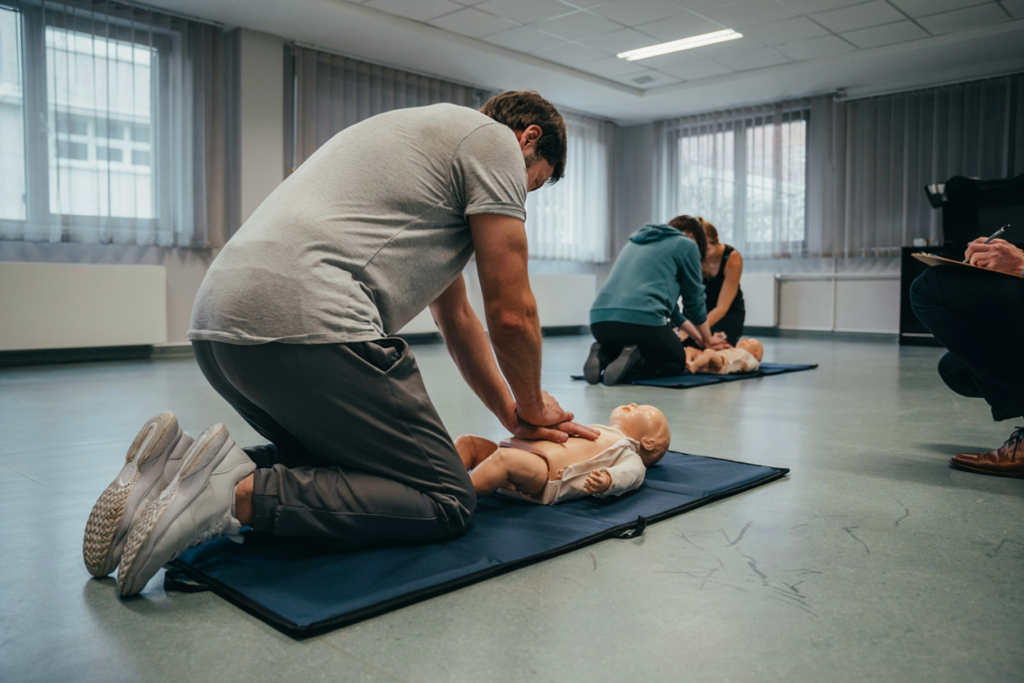
Here’s the part of HLTAID012 prerequisites that catches the most people off guard, more than age, more than the USI, more than the LLN component combined. This course requires uninterrupted floor based CPR practice, and there are no exemptions for it.
Think about what that actually means for a second. In a real emergency, you might be on a hard floor, on carpet, on playground bark chips, kneeling over a child for an extended stretch while you perform compressions. The course is designed to replicate that reality as closely as it safely can, because a certificate that says you’re competent needs to actually mean something when it counts. There’s no “watch from a chair and we’ll sign you off anyway” version of this training, and honestly, that’s exactly how it should be. You want the person doing CPR on your own child to have actually practised it on the floor, not from a seat.
A couple of practical notes:
- Wear comfortable clothing. You'll be kneeling, moving, and getting into position repeatedly, so leave the tight work skirts and dress shoes for another day.
- Flag any physical limitations with your provider early, not on the morning of the course. Bad knees, back issues, pregnancy, recent surgery, whatever it might be. A good provider would rather know in advance and talk through it with you than have you struggling silently through a session that isn't working for your body.
If this is a genuine concern for someone on your team, it’s a conversation worth having with your provider before booking day, not after.
⚖️ Same prerequisites, different qualification: HLTAID012 and HLTAID011 look similar on paper but are not interchangeable for education and care settings.
HLTAID012 vs HLTAID011, Which Prerequisites Apply?
A quick note on course confusion
Quick clarification because this comes up constantly, and it’s genuinely one of the most common and costly mix ups in the childcare sector. HLTAID012 (Provide First Aid in an Education and Care Setting) and HLTAID011 (Provide First Aid) share a very similar prerequisite profile. No formal lead in units, similar age and USI requirements, similar LLN expectations. But they are not interchangeable, and a regulator will not treat them as the same thing.
HLTAID012 is the qualification specifically recognised for staff working in education and care settings under the National Quality Framework. HLTAID011 is a more general workplace first aid course. If one of your educators shows up with an HLTAID011 certificate from a previous job, say a retail role, that certificate won’t satisfy your centre’s regulatory requirement, even though the prerequisites to get either one look almost identical on paper.
If you’ve got even one staff member whose current certificate you’re not sure about, it’s worth taking the time to check which course they actually hold before assuming it covers them.
Your Pre Course Checklist: What to Prepare Before Training Day
A simple readiness checklist
Alright, let’s bring this all together into something you can actually use. Before you or your team turn up to HLTAID012, run through this list.
Item | Done? |
USI created and details on hand | Yes / No |
Consent form signed (if under 18) | Yes / No |
Comfortable clothing sorted for floor based practical | Yes / No |
LLN self check done, no concerns flagged | Yes / No |
Any physical limitations flagged with provider in advance | Yes / No |
That’s it. Five things, none of them complicated, all of them avoidable headaches if left until the morning of the course.
One centre director told us about an educator who turned up ready to go, uniform sorted, enthusiasm high, only to realise at check in she’d never created a USI and couldn’t remember if she’d done one years ago under a different surname. It took a phone call and a scramble through old paperwork to sort out, and it delayed the whole group’s start. A quick check the week before would’ve avoided the whole thing.
Getting the paperwork sorted early means the actual training day can be spent focused on the skills that matter, not chasing admin.
If you’ve worked through this list and you’re ready to lock in a date, reach out to see upcoming HLTAID012 course dates, or if you’re booking for multiple staff at once, ask about group and on site training options so you’re not pulling your whole roster off the floor one at a time. Got questions before you commit? Give us a call and we’ll talk you through it.
Conclusion
So that’s the real answer to what HLTAID012 prerequisites actually involve. No formal lead in units, no earlier certificate you need to hold first, nothing hidden behind a hoop you didn’t know about. Just a handful of practical things, your age, your USI, your ability to read and respond in English, and your physical readiness for floor based CPR, that need to be sorted before you walk in the door.
The thing worth remembering here is that “no prerequisites” and “no preparation needed” are two different ideas, and mixing them up is exactly how people end up scrambling the night before a course, or worse, showing up and finding out on the day that something’s missing. A missing USI, an unsigned consent form, a physical limitation nobody flagged in advance, none of these are dealbreakers if you catch them early, but every one of them turns into a stressful last minute problem if you don’t.
For centre directors especially, this stuff matters beyond just one person’s enrolment. When you’re responsible for a whole staff roster’s compliance, a small gap in one person’s paperwork can ripple out into a bigger staffing headache, especially if it means someone can’t be counted toward your required first aid coverage on a given day. Building these checks into onboarding, rather than treating them as a last minute scramble, saves you that stress every single time.
And if there’s one thing worth sitting with from all of this, it’s the reminder of why the physical requirement exists in the first place. A certificate is only worth something if it reflects real, practised competence, the kind you’d want from the adult kneeling next to your own child in an actual emergency. That’s not red tape for its own sake, that’s the whole point of the course.
So work through the checklist, get your USI sorted early, flag anything unusual with your provider ahead of time, and walk in on training day ready to focus on the part that actually matters, learning the skills that make you the confident, capable adult in the room when it counts.
Book Your First Aid Training Now
Fast, affordable, and nationally accredited training delivered by professionals who care
Frequently Asked Questions
Q.Do I need any previous first aid training to enroll in HLTAID012?
No. There are no formal prerequisite units or earlier certificates required. Anyone meeting the age, USI, LLN, and physical requirements can enroll regardless of prior first aid experience.
Q.Can I complete HLTAID012 fully online?
The theory component can often be completed online beforehand, but the practical CPR and first aid skills component needs to be done in person, since assessors need to see you actually perform the skills, particularly the floor based CPR.
Q.What happens if I turn up without a USI?
You generally won't be able to receive your accredited Statement of Attainment until a USI is provided, so it's worth creating one before training day rather than risking a delay to your certificate.
Q.Is the LLN assessment something I can fail?
It's designed as a basic check rather than a pass or fail exam, so as long as you can read and respond to straightforward written scenarios in English, you should get through it without issue.
Q.How long is HLTAID012 valid once I complete it?
Certification periods can vary slightly depending on the specific skill set, so it's best to confirm your exact renewal date with your provider once you receive your Statement of Attainment.
Q.Can someone with a physical injury still complete the course?
It depends on the nature of the limitation, but because floor based CPR has no exemptions, it's important to flag any injury or condition with your provider before the course so they can talk through what's realistic for you.
Making first aid training more affordable for
every classroom
We believe every student deserves access to life-saving first aid knowledge. That’s why we offer specially reduced pricing for schools and educational groups. Whether you’re booking for a single class, a year group, or your entire school, our flexible packages make training more accessible and cost-effective — without compromising quality.
Contact Us
Have questions or ready to enrol in a course? Reach out to our friendly team for bookings, group sessions, or general enquiries. We’re here to help you choose the right first aid training for your needs.
