

It starts with a notification on a spreadsheet.
Two certificates expiring in six weeks. One of those educators is your anaphylaxis lead in the preschool room. The room with four children on documented ASCIA action plans. You open Google and start searching. You need answers fast, and you need the right ones.
If you’re a childcare director, that moment is not hypothetical. It happens constantly — in the quiet before families arrive, between ratio checks, sometimes at 2am. And when it does happen, the last thing you need is a vague provider page that tells you nothing useful about what an HLTAID012 refresher course actually involves.
This post covers what the 2026 HLTAID012 refresher includes, what Queensland’s compliance requirements actually say, and what to look for in a provider who genuinely builds courses for education and care settings. ACECQA and the NQF set the bar. This post helps you clear it.
What is included in an HLTAID012 refresher course?
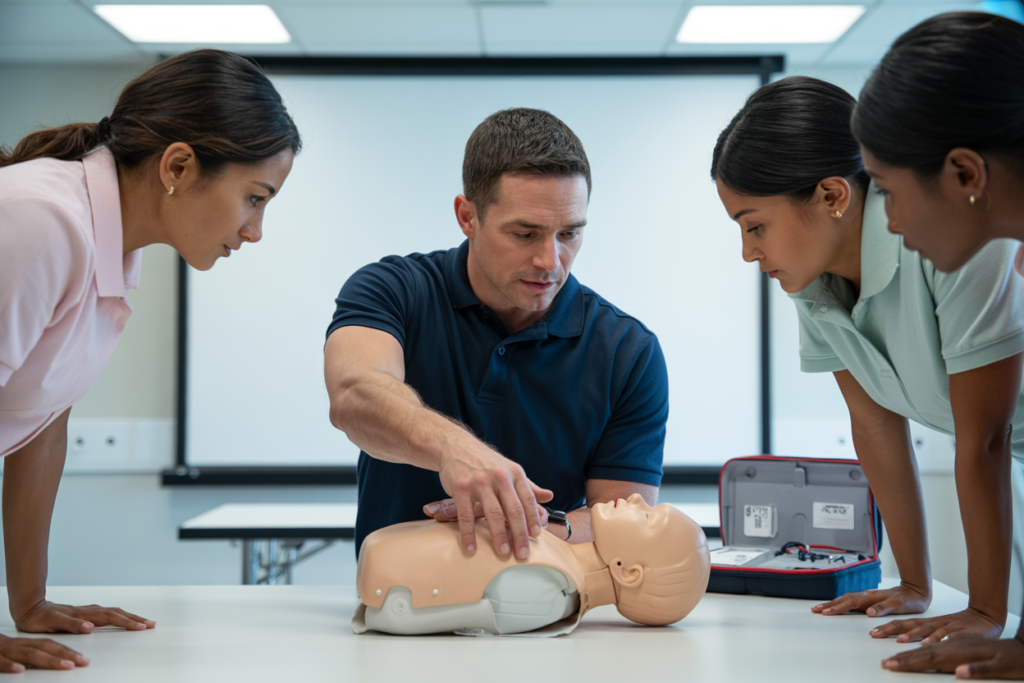
An HLTAID012 refresher course covers the skills and knowledge required to provide first aid in an education and care setting, as defined under the Education and Care Services National Regulations 2011. In Queensland, the refresher must be delivered face-to-face by an ASQA-registered RTO and assessed against current ANZCOR and ASCIA guidelines.
- CPR and resuscitation: adult, child, and infant sequences; continuous CPR on a manikin; AED operation
- Anaphylaxis management: ASCIA action plan response; EpiPen/auto-injector administration; recognition of early and late-stage symptoms in children
- Asthma management: 4-step asthma first aid protocol; use of spacer and inhaler in paediatric emergencies
- Paediatric emergency response: choking (infant and child), febrile convulsions, head injuries, and bleeding management in an education and care context
- Legal and duty of care obligations: consent, documentation, incident reporting under Queensland requirements
- Practical scenario assessment: simulated childcare emergencies; written or verbal knowledge assessment
What Is an HLTAID012 Refresher Course and Is It Different From the Full Course?
This is one of the first questions directors ask, and it’s a fair one. If your educator already holds HLTAID012, are they really doing the same course all over again? The short answer is: structurally, yes. But in practice, there are some differences worth understanding before you book.
Full course vs. refresher: what actually changes
In the Australian VET system, there is no formally distinct “refresher” unit. The qualification is HLTAID012 whether your educator is completing it for the first time or renewing it for the third time. The certificate issued is identical. The compliance outcome is identical.
What can differ is how a course day is structured for returning learners. Some RTOs take prior knowledge into account. Others run the exact same session regardless. What does not change is the assessment standard the same practical assessment, the same scenario-based components, and the same documented outcomes. If a provider tells you the refresher is significantly shorter without explaining how assessment requirements are still met, that’s worth a follow-up question before you book.
Why “refresher” still means face-to-face in Queensland
Some directors ask whether the renewal can be done online. It cannot. Not fully, anyway.
HLTAID012 has a mandatory practical assessment component that cannot be completed through an online platform. No amount of video modules or online theory replaces the requirement to physically demonstrate CPR on a manikin, respond to a simulated anaphylactic reaction, or work through a paediatric choking scenario with an assessor watching.
What some RTOs do offer is a blended model educators complete online pre-reading before the course day, reducing face-to-face time. That’s a legitimate structure, as long as the practical component is fully delivered and assessed in person. Any provider offering a fully online HLTAID012 is non-compliant with ASQA requirements. Full stop. If you see it advertised that way, move on.
| First Time Completing HLTAID012 | Renewing HLTAID012 | |
|---|---|---|
| Format | Face-to-face or blended | Face-to-face or blended |
| Assessment Method | Practical + written/verbal | Practical + written/verbal (same standard) |
| Certificate Outcome | HLTAID012 issued | HLTAID012 reissued, identical certificate |
Once you understand what the refresher involves structurally, the more important question is what it should actually cover. And this is where a lot of providers fall short.
What Does the 2026 HLTAID012 Refresher Course Cover?
This is the section most provider websites get wrong. They list the unit code, paste in a generic course description, and call it done. What they don’t tell you is whether the content is actually built around the realities of an education and care setting — or whether it’s a standard workplace first aid course with the right qualification code attached.
For a childcare director managing Regulation 136 compliance and a room full of children with documented allergy action plans, that distinction matters enormously.
CPR and resuscitation what’s assessed in 2026
CPR training within HLTAID012 follows current ANZCOR Guidelines and covers adult, child, and infant resuscitation sequences. These are not interchangeable. Compression depth, rescue breath volume, and technique for an infant are meaningfully different from an adult sequence, and your educators need to be assessed on all three. AED familiarisation is also included — educators need to know how to operate a defibrillator in a real emergency without freezing.
One thing a lot of directors miss: the CPR unit embedded within HLTAID012 is HLTAID009, and HLTAID009 must be renewed annually. That’s a separate compliance obligation from the three-year HLTAID012 renewal. Many directors assume the three-year renewal covers everything. It doesn’t. More on that in the compliance section below.
Anaphylaxis management: ASCIA-aligned content
This is where a genuine childcare HLTAID012 separates itself from a generic course. A properly delivered refresher covers the full ASCIA action plan response sequence: recognising early symptoms (hives, swelling, vomiting) and late-stage symptoms (difficulty breathing, collapse), administering an auto-injector correctly, calling 000 at the right moment, and biphasic reaction awareness. Post-incident documentation requirements are part of the picture too.
Here’s the compliance piece that catches directors out. Regulation 137 operates as a completely separate requirement from HLTAID012. It requires that an educator trained in anaphylaxis management is present whenever a child with a documented allergy is in attendance. HLTAID012 only satisfies this if the anaphylaxis component is genuinely integrated and assessed within the course — not superficially included to tick a box.
🚨 Compliance Alert: Regulation 137 requires an anaphylaxis-trained educator to be present whenever a child with a documented allergy is in attendance. Before booking, confirm with your provider that ASCIA action plan administration and EpiPen use are explicitly assessed within the course. Not mentioned in passing. Actually assessed.
Asthma first aid in an education and care setting
The 4-step asthma first aid protocol from the National Asthma Council is a core component of a childcare-specific HLTAID012. Educators need to know how to use a spacer and inhaler correctly with a child, how to recognise the difference between a mild-to-moderate episode and a severe one, and when the situation has escalated to the point where 000 needs to be called.
Documentation and parent notification requirements are part of this too. An asthma episode in a childcare setting has administrative obligations attached to it, not just clinical ones. A course that skips this is leaving your educators underprepared for the full scope of their duty of care.
Paediatric emergency scenarios covered in the course
This is the area where generic workplace courses consistently fall short. Infant choking technique is different from child choking technique, and both are different from adult technique. Febrile convulsions are a scenario that a construction site first aid course will never cover. Head injuries in young children, bleeding management, burns, fractures, and poisoning all present differently in paediatric contexts and require specific response knowledge.
A legitimate childcare HLTAID012 provider builds their scenario-based assessment around these situations. They don’t run your educator through a generic “adult collapsed in the workplace” scenario and hand them a certificate. If you’re not sure what scenarios your current provider uses, it’s worth asking directly.
💡 Key Takeaway: The difference between a genuine childcare HLTAID012 and a generic course with the right code attached comes down to three things: whether infant and child CPR sequences are assessed separately, whether anaphylaxis management is explicitly assessed using ASCIA action plans, and whether the scenario-based component reflects real early childhood emergencies. Ask your provider those three questions before you book.
Queensland Compliance Requirements: What Directors Must Know in 2026
If you’ve sat through a Quality Assessment visit with a compliance gap on Quality Area 2, you already know what’s at stake. If you haven’t, here’s the regulatory picture clearly laid out — because the consequences of a lapsed certificate are more immediate than most directors realise until it happens to them.
Regulation 136 – the ratio requirement
Under the Education and Care Services National Regulations 2011, Regulation 136 requires that at least one educator holding a current HLTAID012 is present at all times when children are being educated and cared for. Not most of the time. Not during core hours. At all times.
That includes before and after core operating hours, during excursions, and during any period where relief or casual staffing is in place. The common compliance gap is assuming that one qualified educator per service is sufficient. It isn’t. One qualified educator covers the service right up until that person calls in sick, goes on leave, or resigns. ACECQA first aid requirements under the NQF are clear: the approved provider is responsible for maintaining coverage across all operating hours. In practice, that means building a buffer. One qualified educator above your minimum is not excessive. It’s basic risk management.
Regulation 137 – anaphylaxis management as a separate obligation
This is the regulation that catches even experienced directors off guard, because it operates completely independently of Regulation 136. Regulation 137 requires that an educator trained in anaphylaxis management is present whenever a child with a documented allergy is in attendance. Not just when there’s a known risk that day. Whenever that child is enrolled and present.
For most long day care services with even one child on an anaphylaxis action plan, this means every single operating hour. And HLTAID012 only satisfies this requirement if the anaphylaxis component is genuinely integrated and assessed within the course — not covered in passing without a practical component.
⚠️ Compliance Alert: Regulation 137 is a separate compliance obligation from Regulation 136. Holding a current HLTAID012 does not automatically satisfy Reg 137 unless anaphylaxis management was explicitly assessed within the course. If you're not certain your current provider met this standard, that's worth investigating before your next Quality Assessment visit.
HLTAID009 annual CPR renewal the requirement most often missed
The CPR unit embedded within HLTAID012 is HLTAID009. And HLTAID009 must be renewed annually as a separate compliance line item.
Most directors know that HLTAID012 has a three-year validity period. What many don’t know is that the annual CPR renewal operates on top of that. An educator can hold a current HLTAID012 certificate and still be non-compliant if their HLTAID009 has lapsed. These are two separate tracking obligations. Advanced Resuscitation Training runs standalone HLTAID009 CPR renewal sessions.
What happens if a certificate lapses?
From the moment an HLTAID012 certificate expires, the service is potentially non-compliant with Regulation 136. There is no grace period. The exposure begins on the date of expiry, not the date someone notices. A compliance notice from the Queensland Department of Education is the immediate consequence. In serious cases, escalation to the Queensland Family and Child Commission is possible. A lapsed certificate found during a Quality Assessment visit will affect your Quality Area 2 rating — potentially dropping “Meeting NQF Requirements” back to “Working Towards.”
The recommended renewal trigger point is 60 days before expiry. Sixty days gives you enough runway to find a suitable course date, arrange cover if needed, and have the certificate in hand before the expiry date arrives.
| Certificate Type | Validity Period | Renewal Trigger Point | Consequence of Lapse |
|---|---|---|---|
| HLTAID012 | 3 years | 60 days before expiry | Regulation 136 breach; compliance notice risk |
| HLTAID009 (CPR) | 1 year | 60 days before expiry | Separate compliance breach; QA2 impact |
| Anaphylaxis Management (Reg 137) | Confirm with provider | Ongoing | Regulation 137 breach whenever allergy child is present |
📋 Compliance Alert: A lapsed HLTAID012 certificate creates immediate Regulation 136 exposure from the date of expiry. The recommended renewal trigger is 60 days before the certificate lapses. Not the day it expires.
How to Choose the Right HLTAID012 Refresher Provider
If you’ve been burned by a generic provider before, you already know that not every course page telling you it delivers HLTAID012 is telling you the full story. The qualification code is the same. The course experience, the content depth, and the genuine preparedness of your educators when they walk back through your centre door — that’s where providers separate.
Check the RTO registration first
Every provider delivering HLTAID012 must be registered with ASQA and have the unit on their scope of registration. A certificate issued by an unregistered provider will not satisfy your regulatory authority’s requirements, regardless of what the document looks like. Verification takes two minutes — go to training.gov.au, search the provider’s RTO number, and confirm HLTAID012 is on their current scope. If a provider won’t give you their RTO number upfront, that tells you something. Advanced Resuscitation Training’s RTO number is [ART RTO number].
Confirm the course is genuinely childcare-specific
A legitimate HLTAID012 course for childcare educators covers paediatric CPR sequences assessed separately for adults, children, and infants. Infant choking with correct technique. Anaphylaxis management using ASCIA action plans and auto-injector administration. Asthma first aid using the 4-step protocol. And scenario-based assessment through real early childhood emergencies, not generic workplace situations.
Ask directly before you book: “Do your scenarios reflect early childhood emergencies, or general workplace scenarios?” A provider who genuinely works in the education and care space will answer with specifics. A provider who hasn’t will give you something vague.

HLTAID012 vs HLTAID011: Which Qualification Do Childcare Educators Actually Need?
This is one of the most common points of confusion for directors onboarding new staff who arrive from non-childcare workplaces with an existing first aid certificate.
HLTAID011 is the standard workplace first aid certificate — appropriate for offices, construction sites, and retail environments. HLTAID012 includes everything in HLTAID011 plus education and care setting-specific content: paediatric CPR sequences assessed separately for infants and children, ASCIA-aligned anaphylaxis management, asthma first aid using the 4-step protocol, and scenario-based assessment built around real early childhood emergencies.
Under the National Quality Framework, HLTAID012 is the required qualification for Queensland childcare services. HLTAID011 alone does not satisfy Regulation 136. When a new educator joins your team holding an HLTAID011 from a previous employer, that certificate does not count toward your ratio. They need HLTAID012 before they can be counted as a qualified educator on your floor.
Book Your HLTAID012 Refresher
Running a compliant Queensland childcare service means managing more moving parts than most people outside the sector ever appreciate. Certificate expiry dates, ratio coverage, Regulation 136, Regulation 137, annual CPR renewals, Quality Assessment visits. It’s a lot to carry, and the stakes are real.
Advanced Resuscitation Training’s HLTAID012 is built specifically for education and care settings. Not adapted from a generic workplace course. Built from the ground up around the emergencies that actually happen in childcare centres, the regulatory framework that governs Queensland services, and the genuine preparedness your educators need when something goes wrong in the first 90 seconds.
ASCIA-aligned anaphylaxis and asthma content, same-day digital certificates issued on completion, and Saturday courses available so your ratios stay intact. When a director in your network asks who you use for HLTAID012, this is the provider you’ll be recommending.
Book Your First Aid Training Now
Fast, affordable, and nationally accredited training delivered by professionals who care
Frequently Asked Questions
Q.Can HLTAID012 be completed online?
No. HLTAID012 cannot be completed entirely online. A practical face-to-face assessment component is mandatory under ASQA's requirements for this unit — educators must physically demonstrate CPR on a manikin, respond to simulated paediatric emergencies, and be assessed by a qualified trainer in person. Some RTOs offer a blended model where online pre-reading reduces face-to-face time, but the practical assessment cannot be moved online. Any provider advertising a fully online HLTAID012 is not delivering the qualification to the required standard.
Q.How often does HLTAID012 need to be renewed?
HLTAID012 must be renewed every three years, but the CPR unit within it — HLTAID009 — must be renewed annually as a separate requirement. These are two distinct compliance obligations, and an educator can hold a current HLTAID012 certificate and still be non-compliant if their annual CPR renewal has lapsed. Both must be tracked separately and renewed through an ASQA-registered RTO.
Q.What is the difference between HLTAID011 and HLTAID012?
HLTAID011 is the standard workplace first aid certificate and is appropriate for general workplace settings. HLTAID012 includes all HLTAID011 content plus education and care setting-specific components — paediatric CPR sequences, ASCIA-aligned anaphylaxis management, asthma first aid using the 4-step protocol, and scenario-based assessment in a childcare context. Under the National Quality Framework, HLTAID012 is the required qualification for Queensland childcare services, and HLTAID011 alone does not satisfy Regulation 136.
Q.What happens if an educator's HLTAID012 certificate lapses?
From the moment the certificate expires, the service is potentially in breach of Regulation 136 — there is no grace period. Depending on the circumstances, this can result in a compliance notice from the Queensland Department of Education, escalation to the Queensland Family and Child Commission, or a negative impact on Quality Area 2 at the next Assessment and Rating visit. The recommended renewal trigger is 60 days before expiry, not the day it lapses.
Making first aid training more affordable for
every classroom
We believe every student deserves access to life-saving first aid knowledge. That’s why we offer specially reduced pricing for schools and educational groups. Whether you’re booking for a single class, a year group, or your entire school, our flexible packages make training more accessible and cost-effective — without compromising quality.
