

You’ve finally found time in your packed weekend schedule to complete your HLTAID012 training—but then the confirmation email arrives with a list of “pre-course requirements” and suddenly you’re wondering: Did I book the right course? Do I need to bring documents? What if I’m not prepared and waste my entire Saturday?
Last month, Sarah—a room leader—showed up to her HLTAID012 course ready to learn. She’d set her alarm early on a Saturday, arranged for her partner to handle the kids, and drove to the training venue. But when the instructor asked for her USI number, she froze. “My what?” She’d skimmed past that part of the confirmation email, assuming it was optional admin stuff. After creating her USI during the lunch break and feeling flustered the whole morning, she told us: “I just wish someone had explained what I actually needed before I walked in.”
Understanding HLTAID012 requirements before you arrive at training isn’t just about avoiding embarrassment. It’s about making the most of your precious weekend time and ensuring you leave genuinely prepared to handle pediatric emergencies in your childcare setting. When you show up knowing exactly what to expect, you can focus on what actually matters: building the confidence to use that EpiPen, remembering those CPR ratios, and finally getting rid of those 3am nightmares about choking emergencies.
We’ve helped hundreds of educators navigate the HLTAID012 process. We know exactly what confuses people, what gets overlooked, and what you actually need to know before stepping into the classroom.
What Are the Requirements for HLTAID012?
HLTAID012 (Provide First Aid in an Education and Care Setting) has three main requirements:
Pre-Course Requirements:
- Valid Photo ID (driver’s license, passport, or proof of age card)
- Unique Student Identifier (USI) – free government number for training records
- Pre-course online learning – reading and quizzes (language, literacy, numeracy assessment)
On-the-Day Requirements:
- Physical participation – ability to kneel, perform CPR compressions, and practice on floor
- Appropriate clothing – comfortable clothes that allow floor work
- Full attendance – complete course participation from start to finish
Assessment Requirements:
- Practical demonstration – CPR, EpiPen administration, asthma management, choking response
- Written/verbal assessment – scenario-based questions proving competency
- Minimum 80% pass mark – both practical and theory components
All HLTAID012 training must be delivered by ACECQA-recognized RTOs to meet childcare regulatory requirements.
Pre-Course Document Requirements: Your Complete Checklist
Nobody wants to show up on a Saturday morning and realize they’re missing something. The instructor can’t just wave it through—these are government requirements. So let’s make sure you’ve got everything sorted before training day.
Valid Photo Identification
You need to bring government-issued photo ID. Not a photocopy, not a picture of your license on your phone—the actual physical card or passport.
What counts as valid ID:
- Driver’s license (even if it’s a learner’s permit)
- Australian passport
- Proof of age card
- Photo ID card issued by your state government
Here’s what trips people up: the name on your ID needs to match your enrollment details exactly. If you booked as “Catherine Smith” but your license says “Cathy Smith,” that’s gonna cause headaches. And if your license expired? You’ll need your passport instead.
When you book online, you can upload a digital copy of your ID. But on training day, bring the original. We’ve had people arrive with just the digital copy, then had to drive home to grab the real thing.
Why this matters: Your certificate gets issued in the exact name that appears on your ID. If there’s a mismatch when ACECQA inspectors check your credentials, that’s a compliance issue for your center.
Unique Student Identifier (USI) – Why You Need It
This is the one that catches people out. The USI.
It’s a free government reference number—think of it like a Medicare number, but for all your training records. Every time you complete nationally recognized training, it gets logged against your USI.
Here’s why you legally need one: RTOs cannot issue your certificate without it. Not “we prefer to have it”—we literally cannot, by law, give you that piece of paper that proves you completed HLTAID012.
Creating your USI takes just a few minutes at usi.gov.au. You’ll need your full name, date of birth, email address, and one form of ID to verify your identity.
The website walks you through it step by step. You get your USI number immediately—write it down, screenshot it, email it to yourself. Don’t rely on remembering a random string of letters and numbers.
What happens if you don’t have your USI on training day? You’ll still complete the course and pass the assessment. But your certificate gets held up. We can’t release it until you create your USI and send it through. Most people get around to it within a few days, which means your director’s asking “where’s your certificate?” and you’re scrambling to explain the delay.
Plenty of students arrive without their USI sorted. Don’t be that person.
Pre-Course Online Learning (LLN Assessment)
Right, so before you rock up to the face-to-face training day, there’s online work you gotta complete. It’s called the LLN assessment—Language, Literacy, and Numeracy.
What it actually is: Self-paced reading and quizzes that you do on your computer, tablet, or phone. You’ll read through emergency scenarios, watch some videos, answer questions about what you’d do in different situations.
Most providers send you the login details as soon as you book. The system saves your progress, so you don’t have to finish it all at once.
Why this exists: The government requires it for all nationally recognized training. They need proof that you can read emergency action plans, understand medication labels, write accurate incident reports—all the literacy stuff that’s actually part of working in childcare.
Here’s what people worry about: “What if I fail?”
Listen, this isn’t designed to be a test you can fail. It’s designed to identify if you need extra learning support. If you’re working as a childcare educator right now, dealing with daily documentation and parent communications, you’re already operating at the literacy level this assessment checks for.
You need 80% on the knowledge checks to proceed to face-to-face. If you don’t hit that mark on the first go, you can review the material and try again. There’s no limit on attempts.
🤝 Support Available: If you struggle with reading or writing, let the training provider know before course day. There are support options—additional resources, verbal assessments, or translator services for educators where English is a second language.
Physical Requirements & What to Wear
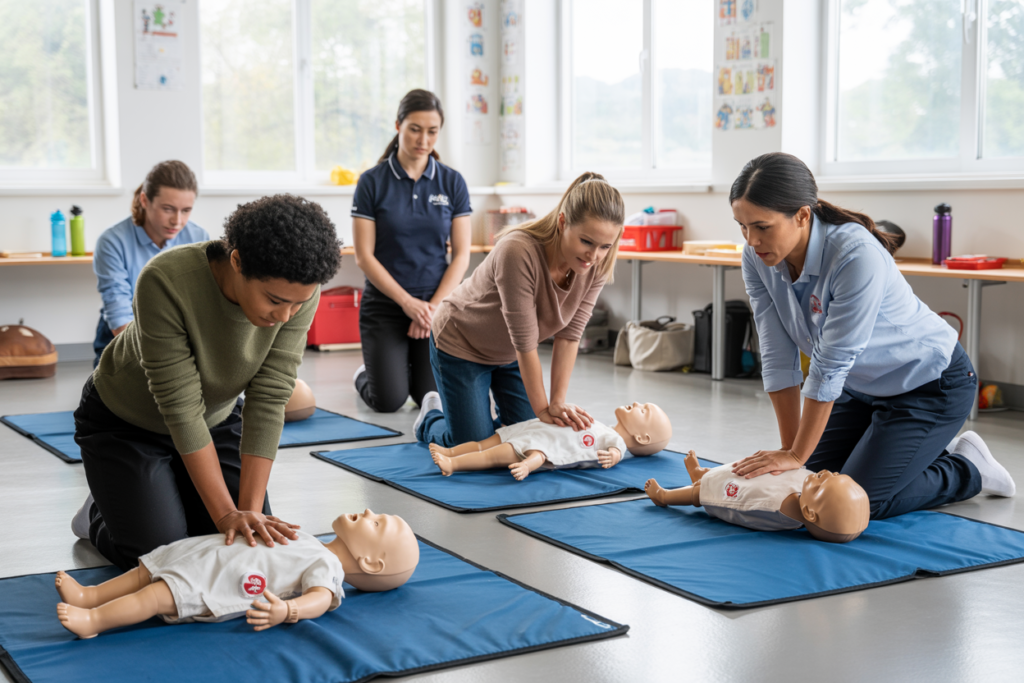
HLTAID012 isn’t a spectator sport. You’ll be kneeling on the floor for CPR practice, performing chest compressions repeatedly, moving between standing and floor positions, and lifting manikins.
No specific fitness level required. If you can physically do your job as a childcare educator, you can handle this training.
But here’s where we need to be honest: many educators have knee issues, back problems, or shoulder concerns. If that’s you, let your instructor know at the start. “Hey, I’ve got a dodgy knee—kneeling for long periods is tough for me.” They can make modifications—different positions, cushions, more frequent breaks.
What to wear: Comfortable casual clothes (jeans or tracksuit pants and a t-shirt), closed-toe shoes, nothing restrictive. What would you wear for outdoor play duty at your center? That’s perfect for HLTAID012 training.
What to avoid: Short skirts or dresses, super tight jeans, low-cut tops, dangling jewelry, high heels.
One educator showed up in a pencil skirt because she had plans after. She spent the whole day trying to kneel modestly and ended up borrowing tracksuit pants. Learn from her mistake.
What to Bring on Training Day
✅ Photo ID (original) – The actual physical card, not a photo on your phone
✅ USI number written down – Don’t rely on remembering it
✅ Confirmation email – Saved on your phone or printed
✅ Pen and notepad – For taking your own notes
✅ Water bottle – You’ll be doing physical activities
✅ Lunch and snacks – Pack something that doesn’t need heating
✅ Phone (on silent) – For emergencies only
Helpful extras: Small cushion or knee pad, paracetamol, hand sanitizer, sweater.
❌ What NOT to bring: Young children, laptops/tablets, expensive jewelry, distractions.
Survival tip: The post-lunch slump is real. Don’t have a massive carb-heavy lunch or you’ll be fighting to stay awake during the afternoon practical work.
Common Mistakes That Cost Time
Booking the Wrong Course
You Google “first aid course,” book it, complete training, then your director says, “This is HLTAID011, not HLTAID012. This doesn’t meet ACECQA requirements.”
- HLTAID011 = General first aid (for offices, retail, general workplaces)
- HLTAID012 = First Aid in Education and Care Setting (pediatric content, asthma, anaphylaxis, childcare scenarios)
For childcare educators, you need HLTAID012. Check the course code explicitly says HLTAID012 and verify it’s ACECQA-approved.
Missing Pre-Course Deadlines
Most providers have a deadline for completing online learning—usually a few days before training. Miss it and you can’t attend. Complete the pre-course work within days of booking, set a reminder, don’t leave it until the night before.
Not Disclosing Physical Limitations
You’ve got a bad knee or shoulder injury but don’t mention it, then struggle through in agony. The instructor can make modifications—different positions, cushioning, extra breaks—but only if they know. Tell them at the start: “Hey, I’ve got a dodgy knee.” Problem solved.

After Training: Certificate and Compliance
Most RTOs send your digital certificate quickly. You’ll get an email with a PDF—that’s your official proof. This PDF is legally valid; you don’t need to wait for a plastic card.
If it doesn’t arrive: Check spam folder. Check your email address was correct. If it’s been a day, contact the RTO.
Save multiple copies: Email it to yourself at multiple addresses. Save to Google Drive. Download to your phone. Print a copy.
Submit to your employer immediately. Don’t wait. Soon as you get that PDF, email it to your director. Your center needs it for compliance records.
Keep your own copy too. Have your own folder with all your professional development certificates.
Understanding Your Certificate Expiry Date
Your HLTAID012 certificate is valid from the date of issue. Some centers require annual CPR refreshers, others only require the full HLTAID012 renewal every few years. Ask your director about their specific policy.
Set a renewal reminder now. Open your calendar. Create an event several months before your certificate expires: “HLTAID012 renewal due—book course NOW.” Don’t wait until the last minute when courses might be booked out.
You’re Ready – Book It Now
Before training: Create your USI, complete pre-course learning early, gather photo ID, plan comfortable clothes, pack your bag the night before.
On training day: Show up on time, pay attention, practice properly, ask questions, disclose physical limitations, stay focused.
After training: Certificate arrives via email, submit to director immediately, set renewal reminders.
That’s the whole process.
The Thing Nobody Tells You
All that anxiety about HLTAID012—worrying you’ll freeze with the EpiPen, stressing about CPR ratios, losing sleep over “what if” scenarios—the training doesn’t magically eliminate those fears.
What it does is give you frameworks, muscle memory, and decision-making tools. So when that terrifying moment happens, you won’t be completely helpless.
You might still feel scared. But your hands will know what to do because you practiced it multiple times. Your brain will default to DRSABCD. You’ll grab the EpiPen and use it because the instructor made you do it over and over.
One room leader completed her training, then later a child in her room had a reaction. She grabbed the EpiPen, administered it correctly, called the ambulance, kept the other children calm. The child was fine.
She told us afterwards: “I was shaking the whole time. But I did it. The training kicked in. I wasn’t confident, but I was capable.”
That’s what you’re aiming for. Not fearlessness—capability despite fear.
If your certificate expires soon and you’re thinking “I’ll book it next week”—you won’t. Next week you’ll be busy. Then suddenly it’s urgent.
Book it now. Today.
The children in your care deserve an educator who’s genuinely prepared for emergencies. The parents who trust you with their kids deserve to know you can handle a crisis. And you deserve to sleep without nightmares about anaphylaxis scenarios.
HLTAID012 gives you tools, knowledge, and muscle memory. It’s the difference between freezing in panic and having a framework to follow.
That’s the trade. It’s worth it.
Now go book it.
Book Your First Aid Training Now
Fast, affordable, and nationally accredited training delivered by professionals who care
Frequently Asked Questions About HLTAID012 Requirements
Q.Do I need HLTAID012 or HLTAID011 for childcare work?
You need HLTAID012 (Provide First Aid in an Education and Care Setting) if you work in childcare, OSHC, or any education and care setting. HLTAID011 is general workplace first aid and doesn't include the pediatric CPR, anaphylaxis, and asthma management that ACECQA requires for childcare educators. Your director won't accept HLTAID011 as a substitute, so make sure you're booking the right course code from the start or you'll be paying twice.
Q.What happens if I can't complete the pre-course online learning in time?
If you don't complete the pre-course LLN assessment by the deadline (usually a few days before training), you won't be able to attend the face-to-face component and your booking will need to be rescheduled. Most providers are pretty strict about this because the pre-course work is a government requirement, not just a suggestion. Complete it within 48 hours of booking while it's fresh in your mind, and you won't have to stress about missing the deadline.
Q.Do I need to bring my own EpiPen or first aid equipment to the training?
No, the training provider supplies all equipment—manikins for CPR practice, trainer EpiPens (they're practice devices, not real medication), dummy inhalers and spacers, bandages, and everything else you need. Just bring yourself, your ID, your USI number, lunch, water, and appropriate clothing. Don't waste money buying your own training equipment.
Q.What's the difference between face-to-face and online HLTAID012 courses?
HLTAID012 requires face-to-face practical training by law—you can't complete the entire course online. There's a pre-course online component (LLN assessment) you do at home, but the actual training day with CPR practice, EpiPen use, and hands-on scenarios must be in person. If someone's advertising "fully online HLTAID012," it's either a scam, not actually HLTAID012, or won't be ACECQA-compliant for childcare work.
Q.What if I fail the HLTAID012 assessment?
Most people pass first time because the course teaches you properly before assessing you—you're practicing each skill multiple times throughout the day. If you don't demonstrate competency in something, the instructor tells you on the spot ("Your CPR compression depth wasn't quite right—let's practice again"), you redo it, and they reassess. It's not a "you've failed the whole course and have to start over" situation. Very rarely someone needs to come back for additional practice on specific skills, which most providers offer at no extra charge.
Q.Do I need a new HLTAID012 every year or every three years?
Your HLTAID012 certificate is valid for three years, but the CPR component technically expires annually. Some childcare centers only require the full HLTAID012 renewal every three years, while others want you to do annual CPR refreshers in between. It depends on your center's policies and insurance requirements, so ask your director: "Do I need annual CPR updates or just the three-year HLTAID012 renewal?" Either way, set calendar reminders several months before expiry so you're not scrambling at the last minute.
Making first aid training more affordable for
every classroom
We believe every student deserves access to life-saving first aid knowledge. That’s why we offer specially reduced pricing for schools and educational groups. Whether you’re booking for a single class, a year group, or your entire school, our flexible packages make training more accessible and cost-effective — without compromising quality.
