
You’re scrolling through course providers late on a Sunday night, knowing you need to book your HLTAID012 renewal before next month’s deadline. But here’s the question keeping you up: what exactly will you learn that will actually prepare you for a real anaphylaxis emergency with a screaming toddler?
I get it. You’ve probably done first aid training before—sat through PowerPoint slides about DRSABCD, watched an instructor demonstrate CPR on a manikin once, walked out with a certificate and zero confidence that you’d actually remember what to do when a child in your care stops breathing.
And that fear? That’s not just compliance anxiety. That’s the weight of being trusted with other people’s children. That’s lying awake at night thinking about the two kids in your room with severe nut allergies. That’s the nightmare scenario playing on loop where you freeze with an EpiPen in your shaking hands while a parent’s worst fear unfolds in front of you.
If you’re a Brisbane childcare educator, you already know HLTAID012 is mandatory for ACECQA compliance. But what you might not know is exactly what’s covered in a quality HLTAID012 training course, how much hands-on practice you’ll actually get with EpiPens and asthma management, and whether you’ll leave feeling genuinely confident or just paper-compliant.
Because there’s a massive difference between those two things.
This guide breaks down everything included in a proper HLTAID012 training course—from CPR ratios for infants and children to anaphylaxis response protocols specific to education and care settings. You’ll discover what separates generic first aid training from childcare-specific preparation, understand exactly what skills you’ll practice, and know what to expect on course day.
What Is Included in HLTAID012?
HLTAID012 (Provide First Aid in an Education and Care Setting) includes comprehensive training in pediatric emergency response specifically designed for childcare environments. This isn’t just “first aid with kids instead of adults”—it’s a completely different course built around the realities of what happens in early childhood education settings.
Here’s what you’re actually learning:
Core Emergency Skills:
- Infant and child CPR (different ratios and techniques than adult CPR)
- Automated External Defibrillator (AED) use on children
- Choking management for infants, toddlers, and preschoolers
- Recovery position techniques
Childcare-Specific Medical Emergencies:
- Anaphylaxis recognition and EpiPen administration
- Asthma attack management with spacers and inhalers
- Seizure response protocols
- Head injury assessment
Education & Care Context:
- Legal requirements for incident reporting
- Communication with parents during emergencies
- Managing group dynamics while responding to incidents
- ACECQA documentation requirements
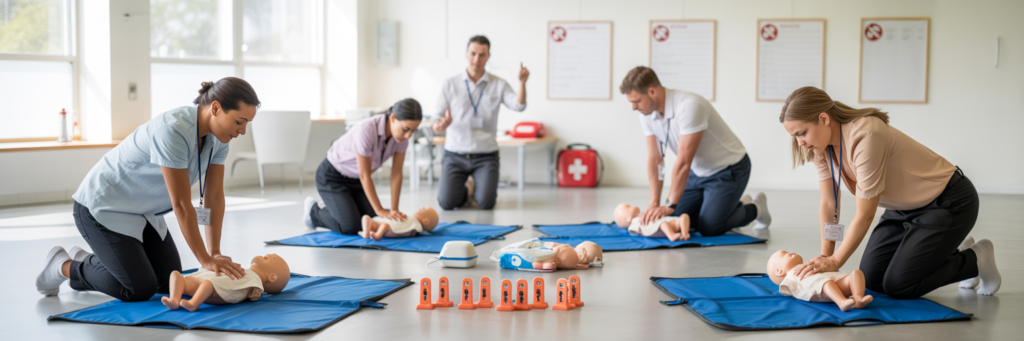
Quality courses include 70% hands-on practical training with infant and child manikins, trainer EpiPens, and asthma management equipment. That percentage matters—you’re not sitting through endless slides. You’re actually doing the thing, repeatedly, until your hands know what to do even when your brain’s in panic mode.
And that’s the real question you should be asking when comparing providers: how many times will YOU personally practice EpiPen administration? How many CPR cycles will YOU complete? How many asthma scenarios will YOU manage?
Because watching is not the same as doing. And doing it once is not the same as doing it until it feels automatic.
Core CPR and Life Support Skills in HLTAID012
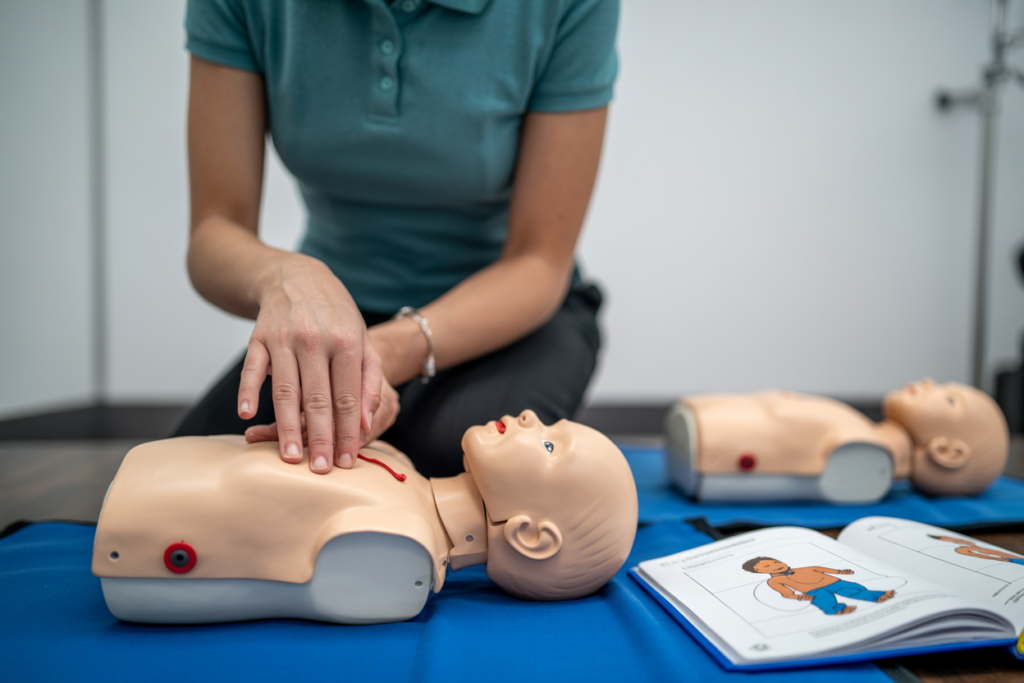
The foundation of any HLTAID012 training course is pediatric cardiopulmonary resuscitation—and if you’ve previously learned adult CPR, you’ll quickly discover that infant and child techniques are significantly different.
Infant CPR (Under 12 Months)
When responding to an unresponsive infant in your care, every second counts. HLTAID012 training dedicates substantial time to infant CPR because the technique differs dramatically from child and adult protocols.
Key specifications you’ll learn:
- Compression method: Two-finger technique positioned one finger-width below the nipple line
- Compression depth: Approximately one-third of chest depth (about 4cm)
- Compression rate: 100-120 compressions per minute
- Ratio: 30 compressions to 2 rescue breaths (single rescuer)
- Rescue breaths: Gentle puffs that make the chest visibly rise—not full adult breaths
You might supervise babies during sleep time, bottle feeding, or tummy time. Sudden Infant Death Syndrome (SIDS), choking incidents, and medical emergencies can occur without warning. Quality courses give you repeated practice on infant manikins until the muscle memory feels automatic.
And here’s something most people don’t realize until they’re in training: infant CPR is physically exhausting. Your fingers will ache. Your back will hurt from leaning over. That’s intentional—you need to know what it feels like to maintain compressions while waiting for an ambulance.
Child CPR (1-8 Years)
Most Brisbane childcare educators work primarily with toddlers and preschoolers, making child CPR the most relevant life-saving skill you’ll develop.
Child CPR specifications:
- Compression method: One-hand or two-hand technique (depending on child’s size)
- Compression depth: Approximately one-third of chest depth (about 5cm)
- Compression rate: 100-120 compressions per minute
- Ratio: 30:2 (single rescuer)
- Rescue breaths: Enough to make chest rise visibly
In quality training, you’ll perform child CPR on manikins multiple times, rotating through scenarios—alone, with a partner, while managing other “children,” and under time pressure. This repetition builds the confidence you need when facing the real situation.
⚠️ Here's What Most Educators Don't Realize: Infant CPR is completely different from child CPR, which is different from adult CPR. You can't just "scale down" the technique—you need specific training for each age group. Get it wrong and you could cause serious harm.
Anaphylaxis Management: EpiPen Training and Protocol
If there’s one section of HLTAID012 that keeps Brisbane childcare educators awake at night, it’s anaphylaxis management. With childhood food allergies affecting approximately 1 in 10 Australian children, the question isn’t if you’ll encounter anaphylaxis, but when.
And here’s what makes it terrifying: you might have 5 minutes between first symptoms and complete airway closure. Five minutes to recognize what’s happening, locate the EpiPen, remember the technique, and administer it correctly while a child’s face swells and they claw at their throat.
Recognizing Anaphylaxis Symptoms in Children
Early symptoms:
- Tingling or itching in mouth, lips, or tongue
- Hives or welts appearing on skin
- Facial swelling, particularly around eyes and lips
- Abdominal pain or vomiting
Progression to severe symptoms:
- Difficulty breathing or noisy breathing
- Swelling of tongue or throat
- Persistent coughing or difficulty swallowing
- Pale or floppy appearance
- Confusion, anxiety, sense of “impending doom”
Young children can’t always articulate what’s happening. A 2-year-old won’t say “I’m experiencing throat tightness”—they’ll cry, claw at their neck, or simply become very quiet and pale. You’re reading symptoms through behavior changes, not clear communication.
EpiPen Technique: Step-by-Step Protocol
This is where hands-on practice becomes non-negotiable. You cannot learn EpiPen administration by watching a video.
Step-by-step protocol you’ll practice:
- Prepare the EpiPen: Remove from case, form fist around device (orange end down), pull off blue safety cap
- Position the child: Lay child flat if possible, expose outer mid-thigh
- Administer the injection: Place orange end against outer mid-thigh, push firmly until you hear “CLICK,” hold for 3 seconds
- Post-administration: Note the time, keep used EpiPen, place child in recovery position or begin CPR if unresponsive
Common hesitations that training addresses:
- “What if I push the wrong end?” (Practice makes grip position automatic)
- “What if I don’t push hard enough?” (The click is unmistakable)
- “What if I hurt the child?” (The injection hurts less than dying from anaphylaxis)
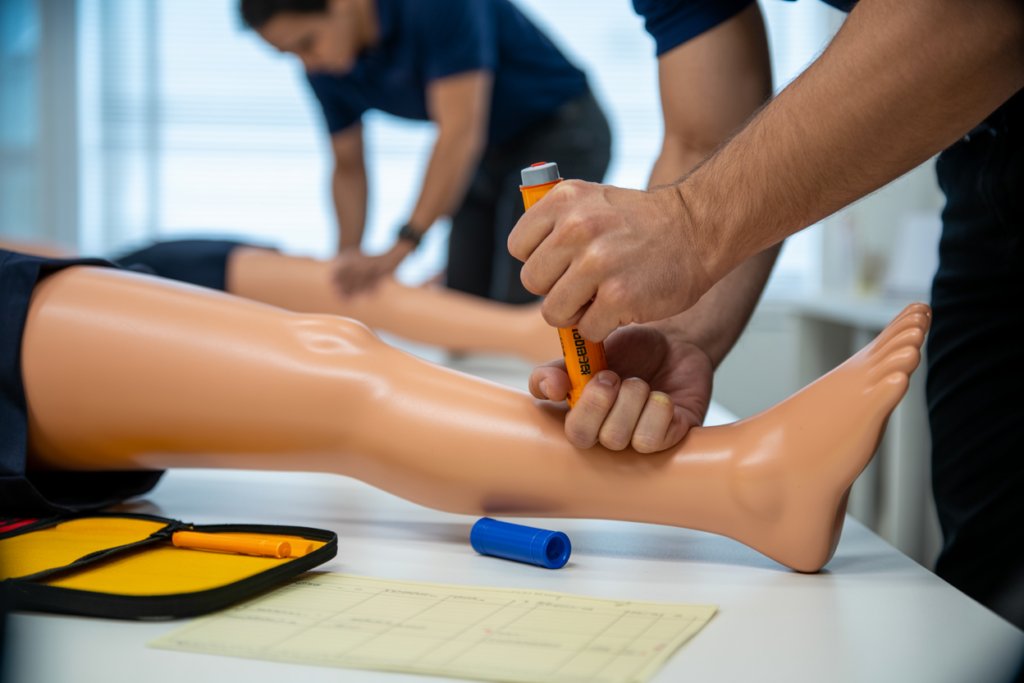
In quality training, you’ll practice this sequence 5-7 times minimum. Not watching someone else do it five times—YOU doing it five times. With a trainer EpiPen on practice legs, until the motion becomes automatic.
Asthma Attack Response in Education Settings
Asthma is the most common chronic condition you’ll encounter in Brisbane childcare settings—affecting roughly 1 in 9 Australian children. Unlike anaphylaxis (which you might never see), asthma attacks are something most educators will face multiple times.
Recognizing Asthma Symptoms
Mild-to-moderate asthma symptoms:
- Persistent coughing, particularly after physical activity
- Wheezing sound during breathing
- Shortness of breath
- Chest tightness
- Using accessory muscles (shoulders rising with each breath)
Severe asthma attack warning signs:
- Unable to speak in full sentences
- Sitting hunched forward, refusing to lie down
- Lips or fingernails turning blue
- Extreme distress, panic
- Wheeze becomes very quiet or disappears (this is BAD—means almost no air movement)
The 4x4x4 Rule
Australian asthma guidelines use the 4x4x4 rule for emergency asthma management:
First 4: Give 4 puffs of blue reliever (one puff at a time through spacer, 4 breaths per puff)
Second 4: Wait 4 minutes (monitor breathing, keep child calm)
Third 4: If no improvement, give 4 MORE puffs
When to call 000 IMMEDIATELY:
- Child’s lips or skin turning blue
- Child struggling to breathe with little chest movement
- Severe wheeze or completely silent chest
- Child becoming drowsy or confused
Choking, Bleeding, and Common Childcare Injuries
While anaphylaxis and severe asthma attacks are the emergencies that keep you awake at night, choking incidents and common injuries are what you’ll actually face regularly.
Choking Response for Different Ages
For infants (under 12 months):
- Support infant face-down along your forearm (head lower than body)
- Give 5 back blows between shoulder blades
- Turn infant face-up, give 5 chest thrusts using two fingers
- Repeat cycle until object dislodges or infant becomes unconscious
For toddlers and preschoolers (1-8 years):
- Encourage coughing if they can still cough
- If cough becomes ineffective: 5 back blows, then 5 abdominal thrusts
- Alternate until object clears
⚡ Critical decision point: Not every cough means choking. Effective cough (child can still cough forcefully, make noise, breathe) means stand by and encourage. Ineffective cough (silent, weak, turning blue) means immediate intervention.
Managing Bleeding and Wound Care
Your response for bleeding:
- Wear gloves (universal precautions—every time)
- Apply direct pressure with clean cloth
- Elevate if practical
- Clean with running water once bleeding stops
- Document incident
When to call 000 for bleeding:
- Arterial bleeding (spurting blood with each heartbeat)
- Uncontrollable bleeding despite direct pressure
- Signs of shock (pale, cold, drowsy)
- Suspected spinal or neck injury
⚖️ Legal Reality Check: "I didn't know" isn't a defense when ACECQA inspectors find your certificate expired. Non-compliance can drop your center's rating, trigger formal notices, or in severe cases, result in service closure. Your certification status is that serious.
Legal Requirements and ACECQA Compliance
First aid certification isn’t just about being able to help children—it’s about meeting legal requirements that protect children, satisfy regulators, and demonstrate duty of care.
ACECQA First Aid Requirements
Every education and care service must have at least one educator with current approved first aid qualification. HLTAID012 satisfies ALL requirements in one course—you don’t need three separate certificates for first aid, anaphylaxis, and asthma.
Certificate validity: HLTAID012 certification lasts 3 years from date of issue. There is NO grace period—expired certificate means non-compliance immediately.
ACECQA inspectors verify certificates are:
- Current (not expired)
- Correct course code (HLTAID012, not HLTAID011)
- Issued by ASQA-registered RTO
Documentation Requirements
Every time you provide first aid, you must complete documentation including:
- Child’s name and date of birth
- Date and time of incident
- Description of what happened
- Details of first aid provided
- Parent notification time
- Signatures
Common documentation mistakes:
- ❌ “Child fell and hurt knee”
- ✅ “Child tripped over mat edge during outdoor play, fell forward onto concrete, sustained 2cm graze to right knee”
Document like you’ll be reading this in court two years from now, because you might be.
HLTAID012 vs. HLTAID011: Which Course Do You Need?
This is where educators waste money booking the wrong course.
HLTAID011 = Provide First Aid (general workplace first aid, does NOT satisfy ACECQA)
HLTAID012 = Provide First Aid in an Education and Care Setting (specifically for childcare, satisfies all ACECQA requirements)
What’s in HLTAID012 That’s NOT in HLTAID011
- Extended pediatric CPR content (infant and child techniques)
- Comprehensive anaphylaxis management with multiple EpiPen practice rounds
- Detailed asthma management including 4x4x4 protocol
- Managing emergencies while supervising groups
- ACECQA documentation requirements
- Parent communication during incidents
HLTAID011 touches on some pediatric topics but doesn’t go deep enough to satisfy ACECQA or prepare you for childcare realities.
| Key Differences | HLTAID011 (Provide First Aid) | HLTAID012 (Education & Care Setting) |
|---|---|---|
| Primary Focus | General workplace first aid (adult-focused) | Pediatric emergencies in childcare settings |
| CPR Training | Adult CPR with brief pediatric overview | Extensive infant and child CPR (separate techniques) |
| Anaphylaxis | Basic awareness | Comprehensive EpiPen training (5-7 practice rounds) |
| Asthma Management | Limited or none | Detailed 4x4x4 protocol, spacer technique |
| Choking Protocols | Adult focus | Age-specific (infant, toddler, child) |
| Group Management | Not covered | Managing emergencies while supervising children |
| Who Needs This | Office workers, general employees | Childcare educators, teachers, family day care |
Assessment Requirements and Pass Criteria
HLTAID012 assessment is competency-based (not percentage scores). You either demonstrate competency or you don’t yet.
What You’ll Be Assessed On
Practical components:
- Perform CPR correctly (proper technique, adequate depth, correct ratio)
- Demonstrate anaphylaxis management (recognize symptoms, use EpiPen safely)
- Demonstrate asthma management (spacer technique, 4x4x4 protocol)
- Demonstrate choking response (appropriate technique for age)
Written component:
- 20-30 questions covering DRSABCD, CPR knowledge, anaphylaxis, asthma, legal requirements
- Multiple choice, true/false, scenario-based questions
- Pass requirement typically 80% or higher
What If You Don’t Pass
Responsible providers offer:
- Same-day remediation with additional coaching
- Scheduled reassessment within specified timeframe
- Clear explanation of specific skill gaps
- Pathway to achieve competency
Most providers report 95-98% pass rate on first attempt. If you paid attention during training and practiced the skills, you’ll pass.
🔍 Provider Research Checklist: Don't just Google and book the first result. Spend 30 minutes asking questions about class size, instructor background, and practice guarantees. That half hour saves you from wasting a full weekend and money on inadequate training.
Stop Worrying. Start Training. Save Lives.
You’ve been putting this off for weeks. You know you need to book it. You know ACECQA compliance isn’t optional.
But maybe you’re anxious about using an EpiPen on a real child, forgetting CPR ratios under pressure, or not being confident enough to make split-second decisions.
Here’s what actually happens when you choose quality HLTAID012 training course: You show up nervous. You practice until your hands know what to do automatically. You work through realistic scenarios. You leave with a certificate AND genuine confidence.
Six months later, a child in your care has an allergic reaction. Their lips are swelling. They’re having trouble breathing. And instead of freezing in panic, your hands grab the EpiPen, orange end down, outer mid-thigh, push until click, hold for three seconds. You call 000 calmly. Paramedics arrive and say “You did everything right.”
That child goes home to their parents that night because YOU knew what to do.
That’s what proper training gives you. Not just a piece of paper for your compliance folder. Actual ability to save a child’s life when it matters most.
Book your course today. Not next week. Not when you “have more time.” Today.
Because the child who needs you to know what to do won’t wait until it’s convenient for you to get trained.
Book Your First Aid Training Now
Fast, affordable, and nationally accredited training delivered by professionals who care
Frequently Asked Questions About HLTAID012 Training
Q.How long does HLTAID012 certification last?
HLTAID012 certification is valid for 3 years from the date of issue, with no grace period—once it expires, you're immediately non-compliant and cannot legally supervise children until renewed. While the full certification lasts 3 years, the CPR component is recommended to be refreshed annually (though not legally required). Set calendar reminders or choose a provider that offers automatic renewal alerts at 90, 60, and 30 days before expiry to avoid last-minute scrambling.
Q.Is HLTAID012 recognized by ACECQA?
Yes, HLTAID012 is specifically designed to satisfy all ACECQA requirements for first aid, asthma management, and anaphylaxis training in education and care settings—it's the only course you need. ACECQA inspectors verify that certificates show the correct course code (HLTAID012, not HLTAID011), are current (not expired), and are issued by an ASQA-registered training provider. This single certification covers everything required under the National Law for childcare educators.
Q.What's the difference between HLTAID011 and HLTAID012?
HLTAID011 is general workplace first aid focused on adults and does NOT satisfy ACECQA requirements for childcare work, while HLTAID012 is specifically designed for education and care settings with extensive pediatric content including infant/child CPR, comprehensive anaphylaxis management with multiple EpiPen practice rounds, detailed asthma protocols, and managing emergencies while supervising groups of children. Booking HLTAID011 by mistake means you'll need to pay for and complete HLTAID012 anyway, wasting both money and your weekend.
Q.Is CPR included in HLTAID012 or do I need a separate certificate?
CPR (HLTAID011 - Provide CPR) is fully included in HLTAID012—you don't need a separate CPR certificate. HLTAID012 covers both infant and child CPR in much more depth than standalone CPR courses, with extensive practice on proper technique, compression ratios, and age-specific protocols. Some educators mistakenly think they need both certificates, but HLTAID012 is comprehensive and covers all CPR requirements for childcare compliance.
Q.What happens if I don't pass the assessment?
Responsible providers offer same-day remediation with additional coaching at no extra cost, allowing you to re-attempt the assessment after targeted practice on specific skills where you struggled. If same-day remediation isn't sufficient, you can schedule a reassessment within a specified timeframe (usually 2-4 weeks) to practice the skills and return for evaluation. With 95-98% pass rates on first attempts at quality providers, most people who paid attention and practiced during training will demonstrate competency without issues.
Making first aid training more affordable for
every classroom
We believe every student deserves access to life-saving first aid knowledge. That’s why we offer specially reduced pricing for schools and educational groups. Whether you’re booking for a single class, a year group, or your entire school, our flexible packages make training more accessible and cost-effective — without compromising quality.
