

Your tender’s compliance register has a gap. Your apprentice’s standard first aid certificate doesn’t cover it. And the principal contractor wants HLTAID014 on file before mobilisation. So now you’re stuck with the question that decides how fast you close that gap: face to face, or online?
If you’ve searched “HLTAID014 face to face,” you’re probably past the “do I even need this” stage. You know Advanced First Aid is the requirement. What you need to know is which delivery format gets your crew compliant without blowing out the schedule.
Here’s the short version, and it might save you a headache. A fully online HLTAID014 doesn’t exist in a form that satisfies ASQA’s practical assessment requirements. There’s no version where someone watches a few videos at home and walks away with a valid Statement of Attainment. But, and this matters for a time-poor supervisor, the theory component can be completed online ahead of a more focused face-to-face practical session.
In this guide we’ll break down what’s delivered face to face versus online, how blended learning can cut down your time off-site, what WorkSafe Queensland and contractor management platforms actually expect to see, and how to book your crew without the process turning into its own little project.
What Is the Difference Between HLTAID014 Face to Face and Online?
HLTAID014 (Provide Advanced First Aid) cannot be completed fully online. ASQA requires hands-on practical assessment for skills like CPR, wound management, and casualty handling, so every HLTAID014 course includes a face-to-face component.
The difference lies in how the theory is delivered:
- Face-to-face only: Theory and practical skills are taught together in one in-person session
- Blended (online + face-to-face): Theory is completed online beforehand, reducing the in-person component to a shorter, focused practical assessment session
For supervisors needing minimal site downtime, blended HLTAID014 is usually the faster path to a Statement of Attainment, without skipping any requirement.
🩹 On-the-tools reality: The practical day is where the muscle memory actually gets built. No provider can shortcut CPR, defibrillation, or casualty handling onto a screen.
What’s Actually Included in HLTAID014 Face-to-Face Training?
Let’s get one thing straight: the face-to-face component isn’t a formality you sit through to tick a box. It’s where the skill gets built, and it’s the part of HLTAID014 that ASQA won’t let any provider skip.
So what’s actually happening in that room?
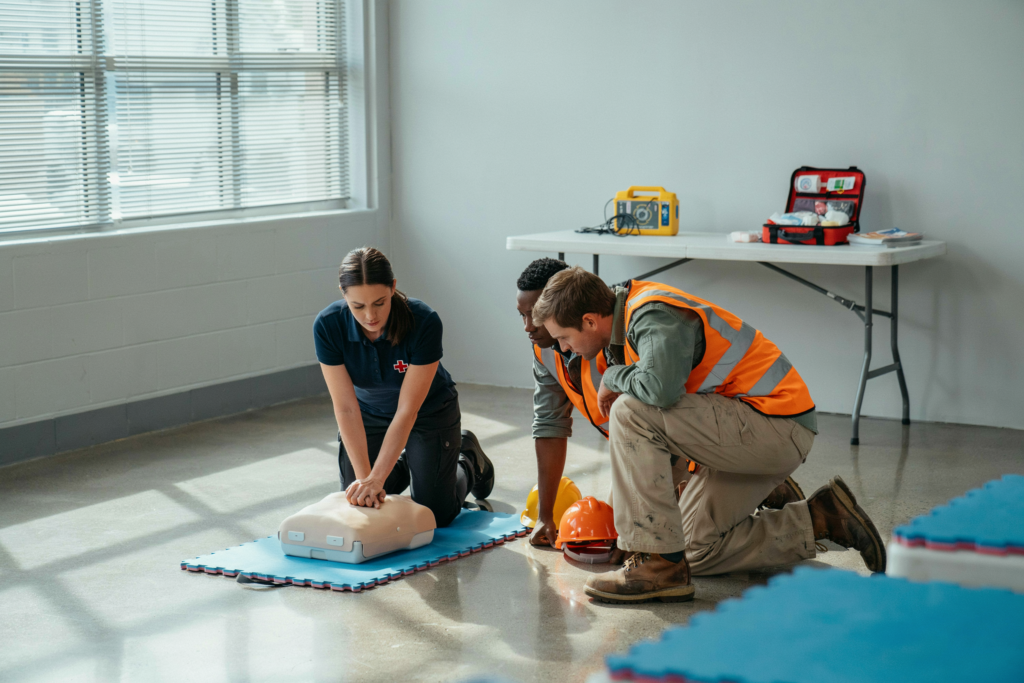
The practical assessment is built around real situations a site supervisor might genuinely have to manage, not a generic “how to put on a bandaid” session. You’re working through:
- CPR and defibrillation: Hands-on practice repeated until it becomes muscle memory, not just something you watched once
- Advanced wound and bleeding management: Covers serious bleeding situations that don't stop with basic gauze and pressure
- Fracture and spinal precaution basics: Learn how to manage a casualty without making a serious injury worse
- Casualty management in remote or delayed-response settings: Build confidence handling emergencies when immediate ambulance support isn't available
A face-to-face-only session covers theory recap and practical skills stations together, finishing with assessment. A blended practical session, where the theory’s already done online, is shorter, since you’re not sitting through content you could’ve covered beforehand.
The practical component isn’t optional. ASQA mandates it because skills like CPR and defibrillation need to be physically demonstrated and verified against ARC and ANZCOR resuscitation guidelines. You can’t tick a multiple-choice question and call it competency. Whichever provider you go with, this practical component exists somewhere in the process. It’s a unit-of-competency thing, and you can cross-check it against the HLTAID014 listing on training.gov.au.
For Marcus-type readers checking this against a tender requirement, that’s why it’s named explicitly in pre-qualification documents. The principal contractor isn’t asking for “some first aid training.” They’re asking for HLTAID014 because it proves this level of practical competency was actually assessed.

Can You Complete HLTAID014 Online? Clearing Up the Confusion
So if the practical component is non-negotiable, where does “online HLTAID014” actually fit in?
Here’s where a fair bit of confusion creeps in, and some of it isn’t accidental. A fully online HLTAID014 doesn’t satisfy ASQA requirements, full stop. ASQA’s Standards for RTOs are clear that higher-order clinical and physical skills have to be practically assessed. Not watched. Not quizzed on. Assessed, in person, by someone qualified to confirm you can do it.
What the online component does cover is theory only. Think the underlying knowledge: anatomy basics, recognizing signs of different injuries, understanding why you do what you do before you ever do it in front of an assessor. It’s useful, but it’s not a substitute for the practical day. It’s a lead-in to it.
Here’s a red flag worth knowing about. If you come across a provider advertising “100% online” Advanced First Aid, or anything implying a valid HLTAID014 certificate without showing up in person, that’s a compliance risk you don’t want near your tender register or platform upload. If it gets flagged during an audit or platform check, you’ve lost the time and probably the trust of whoever signed off on the booking.
Here’s how the two formats actually stack up against each other:
Face-to-Face Only | Blended (Online + Face-to-Face) | |
Theory delivery | In-person | Completed online beforehand |
Practical assessment | In person, same session | Shorter, focused in-person session |
Time off-site | Higher | Lower |
Compliance outcome | Valid HLTAID014 Statement of Attainment | Valid HLTAID014 Statement of Attainment |
Best suited for | Workers without reliable pre-course internet/device access | Time-poor supervisors and crews wanting minimal site downtime |
Worth noticing: both columns end up at the same destination. Same unit code, same Statement of Attainment, same compliance outcome. The difference is in how much of your crew’s working time gets eaten up getting there.
⏱️ The trade-off in one line: Face to face is one sitting and done. Blended spreads the theory out first, so the in-person day is shorter and the crew's back on tools sooner.
Face-to-Face vs Blended Learning: Which Gets Your Crew Compliant Faster?
Now that it’s clear what each format includes, the real question isn’t “which one’s more thorough.” They’re both thorough; ASQA makes sure of that. The real question is which one gets the crew back on tools faster.
Time is the actual enemy here, not money, since the company’s usually covering the cost anyway. Every hour a crew spends off-site is an hour you’re not making progress on whatever the project needs.
A blended practical session means a crew can realistically be back on tools sooner. That’s the kind of detail that actually changes whether you book this week or push it back another fortnight.
Group and crew logistics matter just as much here. Coordinating a full off-site session for a larger crew is a bigger ask than it sounds. You’re not just losing the hours, you’re losing the coordination of having that many people away at once, which on some jobs means bringing in cover. Staggered online theory, followed by a shared practical session, spreads that load. Workers knock over the theory on their own time, and only the practical session needs coordinating as a group.
That matters even more against a last-minute tender or audit deadline. If the gap in your register was only flagged this week and the tender closes soon, blended is usually the format that gets you there. There’s less to coordinate, and the bit that has to happen face to face is shorter.
None of this is a knock on face-to-face-only courses. For some crews, particularly where workers don’t have reliable access to a device or decent internet beforehand, doing it all in one sitting is genuinely the more practical option. It’s about which one suits the deadline and the crew in front of you.
WorkSafe Queensland, Tenders & Contractor Management Platforms: What’s Actually Required
Choosing the right format only matters if the certificate satisfies whoever’s asking for it. So let’s talk about what’s probably keeping you up at night more than the training itself: the paperwork.
Why do principal contractors specify HLTAID014 by name in tenders and pre-qualification? High-risk sites, things like falls from height, mobile plant, excavation, electrical work, fall outside what a standard first aid officer is trained or assessed to handle. The Work Health and Safety Act 2011 requires every Queensland employer to provide trained first aiders appropriate to the hazards present, and that’s where Advanced First Aid earns its place. It’s not the principal contractor being difficult. It’s them covering their obligations, and HLTAID014 proves the gap’s actually closed.
- Correct unit code: HLTAID014, not a generic “advanced first aid” descriptor
- RTO name and registration number: allows the platform to verify a genuine training provider
- Issue date and validity period: platforms can flag expired certificates automatically, and a flagged worker may lose site access
- Worker's full legal name matching their site ID: a mismatched name is a common reason for an upload to be rejected
What your compliance register needs to show:
✓ Current HLTAID014 Statement of Attainment, correctly coded
✓ RTO name and number clearly stated
✓ Valid issue and expiry dates
✓ Worker name matching site ID exactly
✓ Document uploaded before site mobilization, not scrambled together after an audit flags the gap
That last point is really the crux of the whole worry. The question underneath “if WorkSafe audits us next month, are we covered” is “do I have time to fix this before someone notices.” That’s why same-day digital certificate issuance matters. At First Aid Alive, the Statement of Attainment goes out digitally the same day, so there’s no lengthy wait before you can upload it where it needs to go.
If you want to see the underlying obligation in writing rather than taking our word for it, Safe Work Australia and WorkSafe Queensland’s first aid in the workplace guidance lays out the employer’s duty in plain terms. Worth a read if you’re justifying the training budget upward.
📞 Before you call: Have worker names, site address, and your deadline ready. It turns a back-and-forth booking into a one-call booking.
How to Book HLTAID014 for Your Crew Without the Booking Process Becoming a Project
Once you know which format suits your timeline, the next bottleneck is usually the booking process. For a lot of supervisors, it ends up being a string of back-and-forth emails just to get a date locked in.
So let’s strip it back to what it should look like.
Group booking. Most of the time you’re booking for a crew, and they all need to come out of this complaint. Group booking means you’re not filling out an individual form for every name. One enquiry, one headcount, one date, the whole crew sorted in the same transaction.
Flexible session availability. If you can’t pull a live site crew off the job without it costing the project, flexible session times exist for that reason. For a lot of supervisors, it’s the only realistic way to get a crew through training without losing a billable day on-site.
What to have ready before you call or book, so the process doesn’t drag on:
- Worker names: Use the names exactly as they appear on site ID to avoid certificate upload mismatches
- Site address: Required when arranging an on-site or near-site training session
- Your deadline date: Include the actual driver for urgency, whether it's a tender close, audit date, or mobilisation date
Have those three things ready and the process moves a lot faster, because there’s nothing left to chase up after the fact.
The booking process, in three steps:
- Enquire: Call or submit an enquiry with your headcount and deadline
- Confirm headcount & date: We lock in a session that fits your timeline
- Receive booking confirmation: Your crew is booked and certificate delivery is sorted before anyone shows up
Why This Matters Coming From Bill Hunter
That’s not a special case. It’s what blended HLTAID014 is meant to do when the deadline’s tight and the crew’s spread across shifts.
First Aid Alive holds RTO registration 31106, verifiable on training.gov.au, and every HLTAID014 course we deliver follows ARC and ANZCOR resuscitation standards, assessed face to face, no shortcuts taken regardless of how the theory’s delivered.
Whichever format suits your crew, the gap on your compliance register doesn’t close itself, and it doesn’t shrink the longer it sits there. The decision isn’t really about which course is better in some abstract sense. It’s about matching the format to the deadline you’re working against, and being honest about how much time you can pull a crew off-site for.
Face to face gets it done in one sitting, and for some crews that’s genuinely the simpler path, especially where workers don’t have reliable access to a device or decent internet beforehand. There’s something to be said for getting the whole thing over and done with in one go, rather than juggling an online component around everyone’s shifts.
Blended gets it done with less time off-site, and for a time-poor supervisor chasing a tender close or an audit deadline, that’s usually the difference between booking this week and watching the deadline slip past. Spreading the theory out online means the in-person component only covers what genuinely needs a person standing in the room to assess it. That’s not cutting corners. That’s just not wasting anyone’s time on content that didn’t need to happen face to face.
Either way, both formats end at the same place. Same unit code, same Statement of Attainment, same compliance outcome sitting on file when the audit or platform check comes around. The certificate doesn’t know or care which path got you there, and neither does the principal contractor reviewing your register. What matters is that it’s current, correctly coded, and uploaded before anyone’s standing at the site gate wondering why access hasn’t come through.
So the real question isn’t face to face or online in isolation. It’s which one gets your specific crew, with your specific deadline, across the line without the training becoming the bottleneck. Get that part right, and the paperwork, the platform upload, the audit trail, takes care of itself.
Book Your First Aid Training Now
Fast, affordable, and nationally accredited training delivered by professionals who care
Frequently Asked Questions About HLTAID014 Advanced First Aid
Q.Is there a fully online HLTAID014 course?
No. Every HLTAID014 course needs a face-to-face practical component for skills like CPR, defibrillation, and casualty handling. The theory side can be done online, but the hands-on assessment is non-negotiable, regardless of which provider you go with.
Q.How is blended HLTAID014 different from face-to-face only?
Blended HLTAID014 moves the theory online so the in-person session is shorter and focused on practical assessment. Face-to-face only covers theory and practical skills together in one session. Both lead to the same valid HLTAID014 Statement of Attainment.
Q.Does WorkSafe Queensland require HLTAID014 for construction sites?
It depends on the risk profile of the site rather than a blanket rule. High-risk environments such as working at heights, mobile plant, or excavation are where Advanced First Aid tends to get specified, either through WHS obligation or a principal contractor's tender requirements.
Q.How quickly can I get my Statement of Attainment after the course?
First Aid Alive issues digital certificates the same day assessment's completed, so there's no waiting around before it's ready to upload into a contractor management platform like RapidGlobal, Cm3, or Avetta.
Making first aid training more affordable for
every classroom
We believe every student deserves access to life-saving first aid knowledge. That’s why we offer specially reduced pricing for schools and educational groups. Whether you’re booking for a single class, a year group, or your entire school, our flexible packages make training more accessible and cost-effective — without compromising quality.
