

The Australian Resuscitation Council reviews its guidelines on a rolling basis, and 2026 has brought changes that touch how your HLTAID015 refresher gets delivered and assessed. If your last renewal was before mid-2024, some of what you’re tested on this time round is genuinely different, not just the same slide deck with a new date stamped on it.
Maybe you’ve booked your HLTAID015 refresher 2026 session already and you’re wondering if you need to brush up on anything beforehand. Or maybe you’re the one who got the email from your unit manager saying it’s time to renew, and you’re trying to work out what’s actually changed since ANZCOR last touched Section 11. Either way, you’re in the right spot.
Below: what’s changed for 2026, what’s stayed the same, who actually needs to renew and when, and how to book a HLTAID015 refresher at First Aid Alive without the runaround.
How Often Do You Need to Refresh HLTAID015?
The Australian Resuscitation Council recommends renewing HLTAID015 (Provide Advanced Resuscitation and Oxygen Therapy) every 12 months. That’s different from HLTAID011, which stays valid for three years, so if you’ve been working off the same renewal clock for both, one of those dates has been wrong.
Here’s the actual breakdown, because the terminology gets mixed up more than it should:
- ● ARC clinical recommendation: 12 months.
- ● Certificate technical validity: your Statement of Attainment doesn't carry a legal expiry date. The 12-month interval is a recommendation, not a hard cutoff printed on the certificate itself.
- ● Employer or credentialing requirement: often stricter than the ARC guidance. Plenty of hospitals and high-acuity employers treat 12-month renewal as a scope-of-practice condition, not a polite suggestion.
That 12-month recommendation hasn’t changed for 2026. What has changed is some of what you’ll actually be assessed on when you get there.
What’s Changed in the 2026 ANZCOR Guidelines
ANZCOR reviewed Section 11 (Adult ALS) in early 2026, and if your last HLTAID015 was completed before mid-2024, some of what’s in your refresher this time round wasn’t in the syllabus last time. This refresher reflects the current guideline set, not the version from your last renewal cycle.
We’re not going to re-run the full guideline-by-guideline breakdown here, that already lives on its own page and duplicating it doesn’t help you.
That covers what’s changed at the guideline level. Next: what your actual refresher session now covers, skill by skill.

What Your HLTAID015 Refresher Now Covers
This isn’t a repeat of a basic first-aid refresher with an “advanced” label stuck on it. HLTAID015 sits at a different tier, and the skills assessed reflect that.
Core Skills Assessed
- ● Rhythm recognition, including shockable and non-shockable rhythm management.
- ● Defibrillation, both manual and AED.
- ● Advanced airway management.
- ● Oxygen therapy administration.
- ● Team-based resuscitation scenarios, including crisis resource management (CRM).
None of that is new in concept for 2026, it’s the baseline of what this unit has always assessed. What’s changed is covered above: the guideline set behind the rhythm recognition and ALS algorithm content has been updated, so the scenarios you run through reflect current ANZCOR Section 11 guidance rather than the version from two or three renewal cycles ago.
What’s Different From HLTAID011 and HLTAID014
HLTAID011 and HLTAID014 cover CPR and advanced first aid at a workplace-first-aider level. HLTAID015 goes further: manual defibrillation, airway management beyond basic positioning, and oxygen therapy administration aren’t part of those units. If your last course only covered chest compressions and an AED prompt talking you through it, this is a different scope entirely, not a longer version of the same content.
📋 Two units, two dates: HLTAID015 and HLTAID009 are tracked separately. Renewing one doesn't cover the other, and most credentialing bodies check both.
HLTAID015 vs HLTAID009: Why Both Need Separate Renewal
HLTAID015 and HLTAID009 (CPR) are separate units of competency, and they’re tracked separately, not as one combined renewal.
That distinction matters more than it sounds like it should. CPR (HLTAID009) covers compressions, basic airway management, and AED use. HLTAID015 covers manual defibrillation, advanced airway management, oxygen therapy, and rhythm recognition, on top of a separate clinical scope entirely. Renewing one doesn’t extend or cover the other, and a lapsed HLTAID015 sitting next to a current HLTAID009 won’t satisfy an employer or credentialing body checking for both.
Hospitals and high-acuity employers often check these independently, since they map to different parts of your scope of practice. If your credentialing committee or unit manager is tracking renewal dates, expect them to be tracking two separate dates, not one.
Unit | Covers | ARC Recommended Renewal |
HLTAID009 (CPR) | Compressions, basic airway, AED | 12 months |
HLTAID015 (Advanced Resuscitation) | Manual defib, advanced airway, oxygen therapy, rhythm recognition | 12 months |
HLTAID011 (Provide First Aid) | General workplace first aid | 3 years |
Does This Refresher Satisfy Hospital Credentialing and CPD?
Here’s the thing nurses ask us most, and honestly, it’s the right thing to be asking. You’re not doing this refresher for a piece of paper to shove in a drawer. You need it to actually count for something, whether that’s your hospital’s credentialing committee or your own CPD portfolio you’re keeping an eye on for AHPRA.
So let’s be straight about it. What you walk away with is a Statement of Attainment, that’s the actual document, nationally recognised, tied to the HLTAID015 unit of competency.
If your unit or your credentialing body needs something specific from that certificate, a particular format, particular wording, ask before you book, not after. Most of the time it lines up fine. But you know your workplace better than we do, and a five minute email saves you a headache down the track.
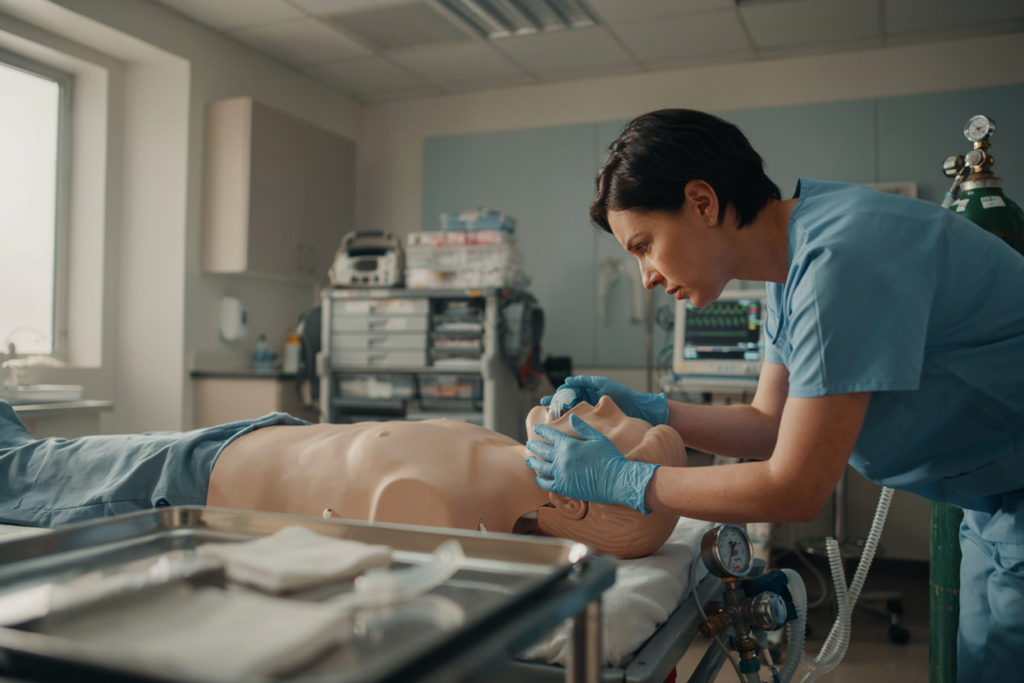
Group Bookings for ICU, ED and Clinical Teams
Booking one person in for a refresher is easy. Booking your whole ICU team in, on a day when half of them are only off because of a swap they organized three weeks ago, that’s a different job altogether, and if you’ve done it before you know exactly what I’m talking about.
If you’re the one organising it, here’s what actually matters to you: enough gear for everyone in the room, and an instructor who isn’t running between six people trying to give proper feedback on rhythm recognition or airway management. Nobody wants to be the person who booked a group session and had it turn into a shambles because there weren’t enough manikins to go around.
We run these as proper cohort sessions, not a scaled-up version of an individual booking, and we can come to you, on-site, if that’s easier for your unit than getting everyone to us.
- ● Dedicated group booking pathway, separate from individual bookings.
- ● On-site delivery available for ICU, ED and clinical teams.
- ● Ratios and equipment provisioning stated up front, not left as a surprise on the day.
📅 Booking tip: Filter by the date that actually works with your roster, not a generic calendar you have to scroll through.
How to Book Your HLTAID015 Refresher at First Aid Alive
Right, so you know what you need and you know why you need it. Here’s the easy part.
Find a date that actually works with your roster, that’s the whole point of the filterable search, you’re not scrolling through a generic calendar hoping something lines up. Pick your day, book your spot, done.
- ● Book your HLTAID015 refresher and choose from the available dates that suit your schedule.
- ● Booking as a group? There's a separate pathway for that, so your unit doesn't end up as nine individual bookings.
- ● Bring whatever your workplace needs you to bring, and if you're not sure, ask before your session, not on the day.
That’s the practical side sorted. What’s left is just getting you in the door.
Conclusion
A resuscitation currency lapsing quietly in the background is a strange kind of problem, because nothing goes wrong until, one day, something does, and that’s exactly the moment you don’t want to be working from a skill you haven’t drilled in over a year. The 12-month interval on this unit isn’t bureaucratic box-ticking dressed up as clinical caution. It exists because rhythm recognition, manual defibrillation, and advanced airway management are the kind of skills that fade quietly if they’re not kept sharp, and nobody finds that out at a convenient time.
What changes year to year isn’t the underlying skill set so much as the evidence behind it. Guidelines get reviewed, algorithms get adjusted, and the version of advanced life support you learned three renewal cycles ago isn’t necessarily wrong, it’s just not current. That gap between “what I was taught” and “what’s actually recommended now” is a genuinely uncomfortable place to be standing in the middle of a real event, which is a big part of why this renewal cycle exists in the first place.
There’s also a paperwork side to this that’s easy to underestimate until it bites. A Statement of Attainment sitting in a folder doesn’t automatically satisfy a credentialing committee, a scope-of-practice review, or a portfolio audit, and finding that out after the fact, mid-shift, is a far worse conversation than checking it beforehand. The people who avoid that conversation are usually the ones who asked the boring administrative question early, not the ones who assumed it would sort itself out.
Group logistics matter for a different reason entirely. When an entire unit renews together, the actual constraint isn’t willingness, it’s coordination: enough equipment, enough instructor attention, and a date that doesn’t collide with nine different rosters at once. Under-resourcing a group session doesn’t just waste a day, it undermines the confidence the whole exercise was supposed to build, which defeats the purpose of doing it as a team in the first place.
None of this is really about a certificate. It’s about the gap between knowing something in theory and being able to do it without hesitation when it actually counts, and that gap only closes with practice that’s current, specific, and taken seriously rather than rushed through as an annual formality.
Book Your First Aid Training Now
Fast, affordable, and nationally accredited training delivered by professionals who care
Frequently Asked Questions
Q. Does HLTAID015 have a legal expiry date?
No. A HLTAID015 Statement of Attainment doesn't carry a legal expiry date once issued. The 12 month renewal window is a clinical recommendation from the Australian Resuscitation Council, though many hospitals and high acuity employers set it as a stricter internal requirement tied to scope of practice.
Q. Do I need to renew HLTAID009 (CPR) as well as HLTAID015?
Yes. HLTAID009 and HLTAID015 are separate units of competency with separate renewal tracking. Completing one doesn't extend or replace the other, and most credentialing bodies check both independently.
Q. Will this refresher cover the 2026 ANZCOR guideline changes?
Yes. This refresher reflects the current ANZCOR guideline set reviewed in early 2026, including updates to Section 11 (Adult ALS), so the content and scenarios you're assessed on are current rather than carried over from a previous renewal cycle.
Q. Can our whole unit renew together?
Yes. There's a dedicated group booking pathway for ICU, ED and other clinical teams, with instructor-to-participant ratios and equipment provisioning stated up front rather than left as a surprise on the day.
Q. What happens if my HLTAID015 lapses?
A lapsed HLTAID015 doesn't affect your CPR currency under HLTAID009, but it can affect the parts of your scope of practice tied to advanced resuscitation, since many hospitals treat the 12 month renewal as a condition rather than a guideline.
Making first aid training more affordable for
every classroom
We believe every student deserves access to life-saving first aid knowledge. That’s why we offer specially reduced pricing for schools and educational groups. Whether you’re booking for a single class, a year group, or your entire school, our flexible packages make training more accessible and cost-effective — without compromising quality.
