
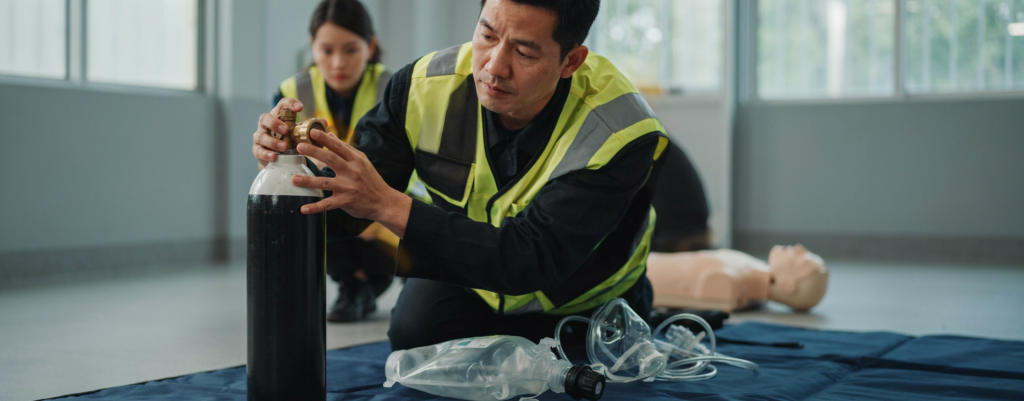
The AED was on, the compressions were good, and then the oxygen regulator wouldn’t seat on the cylinder. Three seconds. Maybe four. Anyone who’s run an ERT knows that fumble, and that gap is exactly what the HLTAID015 unit of competency is built to close. Its full title is Provide Advanced Resuscitation and Oxygen Therapy.
This one’s for ERT leaders, senior first aid officers, event first aiders and FIFO workers around Brisbane whose sites keep oxygen and airway gear in the first aid room. You already know CPR, nobody needs to walk you through compressions again. HLTAID015 is the next layer up, and it fits the port, industrial and event crowd, from warehouse floors to stadium shifts and the Ekka.
So here’s a plain breakdown of what the unit actually asks you to do on the day, skill by skill, and how you get assessed on it. We’ll cover what’s in it, the equipment you’ll get your hands on, how assessment works, how it stacks up against HLTAID014, and what to check before you book. Short answer first.
What Does HLTAID015 Cover?
HLTAID015 Provide Advanced Resuscitation and Oxygen Therapy is a nationally recognised unit of competency that trains you to use specialised equipment to deliver resuscitation and oxygen therapy in line with Australian Resuscitation Council (ARC) guidelines. It covers:
- Single-rescuer and two-rescuer CPR on adult and infant manikins
- Bag-valve-mask ventilation with supplemental oxygen
- Selecting and inserting a basic airway adjunct
- Managing vomiting or regurgitation with positioning and suction
- Using an AED and following its prompts to deliver a shock
- Checking a conscious casualty with a pulse oximeter and administering oxygen at the correct flow rate
- Managing life-threatening bleeding using tourniquets and haemostatic dressings
- Handing over to paramedics, documenting incidents and maintaining equipment
Each of these is assessed hands-on. The sections below break down what that looks like on the day.
That list maps onto five formal elements. Here’s what each one means on a real site.
The Five Elements of the HLTAID015 Unit of Competency
Every nationally recognised unit is built the same way. Elements are what you need to achieve, and performance criteria are how a trainer judges whether you’ve actually got it. The HLTAID015 unit of competency has five elements. Here’s the plain-English version.
Element | What it means for an ERT leader |
1. Respond to an emergency situation | Scene safety, recognising when oxygen or advanced resus is needed, controlling life-threatening bleeding, calling 000, and checking the area is safe for oxygen |
2. Perform resuscitation procedures | Single and two-rescuer resus with oxygen to ARC guidelines, using the equipment the way the manufacturer intends |
3. Deliver oxygen therapy | Deciding when oxygen is needed (pulse oximetry included), choosing the delivery device, monitoring the casualty and fixing problems as they come up |
4. Communicate details of the incident | Handover to paramedics, site reporting, incident documentation and privacy |
5. Review the incident | The psychological impact on you and your team, the response debrief, and cleaning and maintaining equipment |
Element 5 is the one people skim, and they shouldn’t. That sit-down after a real job, where you tell your manager the regulator gave you grief, is Element 5. The unit counts the review, including how the incident hit you and your crew, as part of the work. Plenty of providers barely mention it.
⚠️ Release note: HLTAID015 is currently on Release 2, an equivalent outcome release. You can check the current unit details on training.gov.au.
Elements describe the outcome. The assessment requirements describe exactly what you’ll have to do with your hands.
What You’ll Actually Do on the Day: A Skill-by-Skill Breakdown
Everything below comes from the official Assessment Requirements for the unit. These are the tasks you have to demonstrate to be signed off, not a trainer’s wish list.
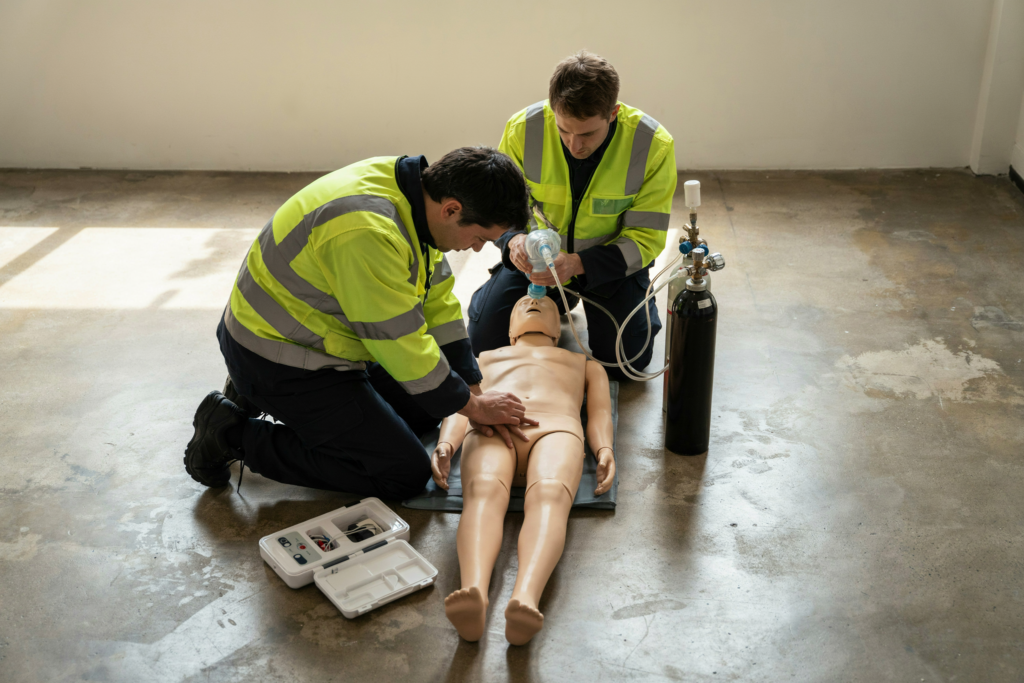
Two-Rescuer CPR with Bag-Valve-Mask and Oxygen
This is the centrepiece. You and a partner run two-rescuer CPR with bag-valve-mask ventilation and oxygen on an adult manikin on the floor. One of you is on compressions, one is on the bag, and you rotate operators with minimal interruption to compressions. That’s how an ERT actually works. The swaps are where good teams look smooth and shaky teams lose seconds, so practising the handoff matters as much as practising the squeeze.
Airway Adjuncts and Suction
You’ll be selecting and inserting a basic airway adjunct, and sizing is the skill that fades. If the only time you size an airway is at a refresher, your hands might remember but your head won’t, not under pressure. Then there’s managing vomiting or regurgitation with positioning and suction. It’s messy and nobody loves practising it. Do it anyway.
AED Use Inside an Advanced Resus Sequence
You already know how an AED works. The difference here is running it inside a team sequence. You follow the prompts and deliver at least one shock while the BVM and oxygen keep going. AED integration is really about choreography: who stops, who clears, and who’s back on the chest the second the shock’s done. Think pit crew. Everyone knows their job before the car pulls in.
Oxygen Therapy for a Conscious Casualty
Not every oxygen job is an arrest. You’ll check a conscious casualty’s breathing, pulse, oxygen saturation and level of consciousness, then check the area for ventilation and ignition sources before you open anything up. From there you select the equipment and give oxygen at the correct flow rate. We’re leaving flow rates and saturation targets out of this post on purpose. That’s what ARC guidance and your training are for.
When the Equipment Fails: Managing an Oxygen Malfunction
Back to that regulator that wouldn’t seat. The good news is the unit actually requires you to manage an equipment malfunction. Troubleshooting isn’t a side note, it’s an assessed skill. So you get to fumble it in a training room and fix it with someone watching, which beats finding out on a warehouse floor. The calm you want on a real job mostly comes from having already been stuck once, somewhere safe.
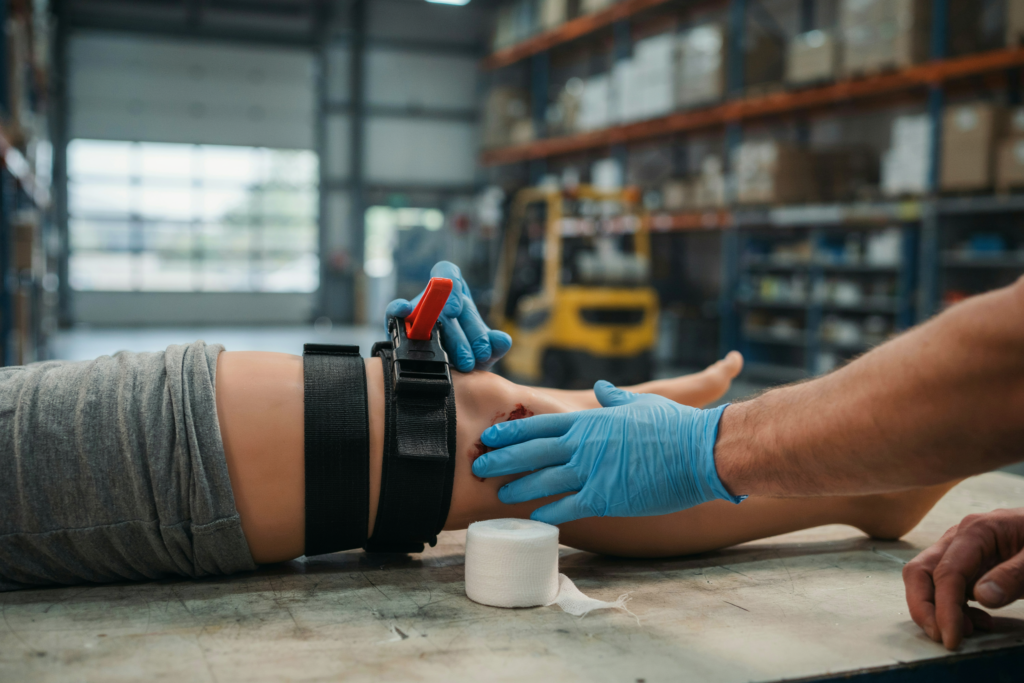
Life-Threatening Bleeding: Tourniquets and Haemostatic Dressings
This one catches people out. It’s an oxygen unit, so why are you packing wounds? Because the assessment includes managing life-threatening bleeding with tourniquets and haemostatic dressings. On industrial sites with forklifts, conveyors and heavy machinery, crush and machinery injuries are a real risk, so it earns its spot.
Infant CPR
You’ll do single-rescuer infant CPR on a manikin on a firm surface. If you work events like the Ekka or stadium games, there are babies and toddlers in the crowd. Plenty of ERT members are parents too.
Handover, Documentation and the Debrief
Last up is everything after the ambulance arrives. You give a verbal and written report, hand over to paramedics and contribute to the incident review. That’s Element 5 from earlier, in action. Writing it up honestly, including what went sideways, is how the next response gets better.
None of that works without the right kit in front of you, which is why the equipment list matters more than most people think.
The Equipment You’ll Train On
Any oxygen therapy course Brisbane ERTs take seriously should put this gear in your hands. The list comes from what the unit requires for assessment, grouped the way you’d find it in a well-stocked first aid room.
Resuscitation | Oxygen and monitoring | Bleeding and other |
Adult and infant ARC-compliant manikins, airway model, bag-valve-mask, airway adjuncts, suction, AED trainer | Oxygen resuscitation system with cylinder and regulator, masks and tubing, pulse oximeter | Tourniquets and tourniquet trainer, haemostatic dressings and wound packing trainer, PPE, incident report form |
Here’s the bit worth remembering. If a provider can’t show you this kit, they can’t properly assess the unit. Not “can’t do it as well”. They can’t do it. Nobody can sign you off on managing a malfunction with a regulator that never comes out of the box, or on suction when there’s no suction unit in the room. Ask what’s there before you book, and ask to see it.
The gear matters for another reason too. Your first aid room at work has its own regulator and its own bag of airways. The closer your training feels to that, the less translating your hands have to do on the day. An emergency is not the moment to be adjusting.
Once you know what you’re working with, the next question is how you’re judged on it.
How HLTAID015 Assessment Works
You’re assessed by doing, not by writing. HLTAID015 uses a practical, observed assessment in a realistic simulated environment. A trainer watches you work through each skill on the actual equipment, the way you’d do it on a real job.
Being watched is kind of the point, honestly. A bit of pressure in training makes the real thing feel less foreign.
Your first aid currency gets checked before assessment starts, so have your current certificate handy when you book.
It’s competency-based, so there’s no score out of 100. You’re either competent or not yet competent. “Not yet” isn’t a fail stamped on your forehead. It just means there’s a skill that needs tightening up before you’re signed off.
If you already hold HLTAID014, you might be wondering how much of this is actually new.
HLTAID015 vs HLTAID014: Which Do You Need?
The HLTAID015 vs HLTAID014 question comes up a lot, because the names sound so alike.
HLTAID014 Provide advanced first aid is the broad one. It covers first aid management across a whole incident. HLTAID015 narrows right in on resuscitation equipment and oxygen: the bag, the airways, the suction, the cylinder and the regulator. One is the wide-angle lens, the other is the zoom.
HLTAID014 | HLTAID015 | |
Full title | Provide advanced first aid | Provide advanced resuscitation and oxygen therapy |
Focus | Broad first aid management | Resuscitation equipment and oxygen therapy |
So it’s less a case of picking one. Plenty of ERT leaders hold both, because running a site’s first aid response and running its oxygen kit are two different hats. If that sounds like your role, ask about doing them together.
Whether you need one unit or both mostly comes down to your role and the equipment on your site.
Who Needs the HLTAID015 Unit in Brisbane?
If there’s oxygen in your first aid room and you’re the one who gets called, this unit is probably yours. Here’s how it usually shakes out across Brisbane.
Workplace Emergency Response Teams
This is the biggest group. Port, logistics and manufacturing sites often keep oxygen and airway kit onsite, and someone has to be able to use it properly. That’s what ERT first aid training in Brisbane looks like at the advanced end.
Queensland’s First Aid in the Workplace Code of Practice links the training first aiders need to the site’s risk assessment and the equipment it holds. So don’t take a blanket rule from anyone, including us. Check your own site’s risk assessment and go from there.
Event First Aiders
Concerts, stadium games, the Ekka. For casual event work, a current ticket is often the difference between getting the shift and watching someone else take it. An advanced resuscitation course in Brisbane keeps you on the roster.
Dental Practices and Other Workplaces
Dental practices that keep oxygen onsite often train the whole practice together. Any other workplace holding oxygen or airway equipment should check its risk assessment to see where HLTAID015 fits.
If HLTAID015 fits your role, the provider you pick decides how much you actually get out of the day.
Choosing a Brisbane HLTAID015 Provider: What to Check Before You Book
The best advanced resuscitation course in Brisbane isn’t the one with the slickest website. It’s the one where you walk out able to do the job. Most people who’ve been burned once by an empty cylinder and a slideshow don’t make the same mistake twice, so here’s what to check before you hand over your details.
Start with the paperwork, because your insurer and principal client will. Your Statement of Attainment should show the RTO number, the NRT logo, and the full unit code and title. First Aid Alive is RTO 31106.
Next, the kit. Everything from the equipment table above should be in the room and working, and that includes cylinders that actually contain gas. Then ask how the day is split between hands-on time and slides. You already know the theory. What you want is time with your hands on the regulator, the bag and the airways.
If you’re booking for a team, ask about onsite or split sessions so your facility stays covered while people train. And if you call with a question about the regulator and get a vague answer, that tells you something.
Finally, renewal. Many employers and insurers expect regular refreshers, so check your own requirements rather than going off what a mate’s site does. Skill fade is real with gear you don’t touch often, and an HLTAID015 refresher in Brisbane is the easiest fix.
Book Your First Aid Training Now
Fast, affordable, and nationally accredited training delivered by professionals who care
Frequently Asked Questions
Q.What does HLTAID015 cover?
HLTAID015 covers two-rescuer CPR with a bag-valve-mask and oxygen, airway adjuncts, suction, AED use, oxygen therapy for a conscious casualty, bleeding control with tourniquets and hemostatic dressings, and the handover and paperwork after the incident.
Q.What are the five elements of HLTAID015?
They respond to an emergency situation, perform resuscitation procedures, deliver oxygen therapy, communicate details of the incident, and review the incident. The last one covers the debrief and equipment care, and it's the one people tend to forget.
Q.Does HLTAID015 include bleeding control?
Yes. The assessment includes managing life-threatening bleeding with tourniquets and hemostatic dressings. It surprises people in an oxygen unit, but it makes sense on sites full of heavy machinery.
Q.Do I need a current first aid qualification before HLTAID015?
Your first aid currency gets checked before assessment, so have your current certificate ready when you book. If you're not sure yours counts, call and ask before you lock in a date.
Q.What's the difference between HLTAID014 and HLTAID015?
HLTAID014 Provide Advanced First Aid covers broad first aid management across a whole incident, while HLTAID015 zooms in on resuscitation equipment and oxygen therapy. Plenty of ERT leaders hold both.
Q.How is HLTAID015 assessed?
It's a practical, observed assessment in a realistic simulated environment. A trainer watches you do each skill on the actual equipment, and you're marked competent or not yet competent.
Q.How often should I renew HLTAID015?
Many employers and insurers expect regular refreshers, so check what your employer, insurer or principal client requires. Skill fade with oxygen and airway gear is real, so don't wait until your ticket's about to lapse.
Making first aid training more affordable for
every classroom
We believe every student deserves access to life-saving first aid knowledge. That’s why we offer specially reduced pricing for schools and educational groups. Whether you’re booking for a single class, a year group, or your entire school, our flexible packages make training more accessible and cost-effective — without compromising quality.
