

Getting the wrong certificate is more common than most providers will admit. Site supervisors across Brisbane have sat through a full day of training, handed the certificate to their project manager, and been told it’s the wrong unit code. HLTAID011 when the contract, the insurer, or the pre-qualification checklist specifically required HLTAID014. One full day of training. Zero compliance outcome.
If you’re a site supervisor, WHS officer, or designated First Aid Officer whose HLTAID014 is coming up for renewal — or if you’re getting it for the first time — this guide gives you exactly what you need to get it right, first time.
You’ll learn what HLTAID014 actually covers and why it’s genuinely different from HLTAID011, what Queensland workplaces legally require, what to look for in a provider, and how the course day runs from arrival to digital certificate landing in your inbox.
No filler. No upselling you on courses you don’t need. Just a clear, step-by-step breakdown so you can book with confidence and get back to running your site.
How to Get Your HLTAID014 Certificate: The Short Answer
Getting your HLTAID014 certificate in Queensland involves five straightforward steps:
- Confirm you meet the entry requirements — there are no formal prerequisites, but basic literacy and physical ability to perform CPR and patient assessment are expected
- Choose a Registered Training Organisation (RTO) — verify their RTO number on training.gov.au and confirm the unit code is HLTAID014, not HLTAID011
- Book your course — select a date that suits your site schedule; weekend courses are available and don’t require you to take annual leave
- Complete the training — HLTAID014 is delivered as a single intensive day combining scenario-based skills assessment with written or verbal knowledge assessment
- Receive your digital certificate — reputable RTOs issue your HLTAID014 certificate digitally on the same day, ready for immediate upload to your insurance or compliance register
Your certificate is valid for three years from the date of issue.

What Is HLTAID014 and Who Actually Needs It?
The full unit name is Provide Advanced First Aid. It sits above HLTAID011 in the national training framework and it’s the qualification that gets you recognised as the designated First Aid Officer on a worksite — not just someone who can perform CPR in an emergency.
That distinction matters more than most people realise when they’re shopping for a course.
What HLTAID014 Covers That HLTAID011 Doesn’t
HLTAID011 is the standard first aid course. It covers CPR, basic wound management, and common medical emergencies. It’s the right qualification for a lot of roles — but it’s not the Advanced First Aid qualification, and it doesn’t meet the requirements for a nominated First Aid Officer on a high-risk worksite.
HLTAID014 goes considerably further. Where HLTAID011 stops, HLTAID014 keeps going.
| Competency | HLTAID011 | HLTAID014 |
|---|---|---|
| CPR and AED use | ✅ | ✅ |
| Basic wound and burn management | ✅ | ✅ |
| Common medical emergencies | ✅ | ✅ |
| Primary and secondary patient surveys | ❌ | ✅ |
| START triage — multi-casualty coordination | ❌ | ✅ |
| Shock management | ❌ | ✅ |
| Spinal immobilisation | ❌ | ✅ |
| Complex anaphylaxis management | ❌ | ✅ |
| Extended airway management | ❌ | ✅ |
| Haemorrhage control | ❌ | ✅ |
| Who it's for | General staff | Designated First Aid Officers |
| Certificate validity | 3 years | 3 years |
A provider who describes their HLTAID014 course without mentioning triage systems, multi-casualty coordination, or extended patient assessment is almost certainly delivering a padded-out version of HLTAID011 with a different unit code on the certificate. Anyone who’s been to one of those courses knows exactly what that feels like.
Which Queensland Industries and Roles Require HLTAID014
The industries where HLTAID014 is commonly mandated aren’t a surprise. Construction, civil infrastructure, mining services, manufacturing, energy and utilities — anywhere the risk profile is high and the consequences of an inadequately trained first responder are serious.
The role-specific requirement is where it gets more precise. If you are the nominated First Aid Officer on a site with 10 or more workers, HLTAID011 is typically insufficient. That’s not a technicality buried in a policy document — that’s what shows up in a WorkSafe Queensland investigation when something goes wrong and your certificate is the one under scrutiny.
Is HLTAID014 a Legal Requirement on Your Site?
Under Safe Work Australia guidelines and the corresponding Queensland framework, the answer depends on your workplace’s risk classification — but for most construction and civil infrastructure sites, the answer is yes. Your insurer may also require it independently of the legal minimum, and many do. State and local government infrastructure contracts list current HLTAID014 as a mandatory pre-qualification requirement.
If you’re not sure whether your specific role requires HLTAID014 or HLTAID011, the [HLTAID014 vs HLTAID011 comparison post] breaks it down by role and industry in plain language.
🔍 Before You Book: Not all HLTAID014 providers are equal. Verify the RTO number, confirm the unit code, and check trainer credentials before committing — the certificate you receive is only as good as the course that issued it.
How to Choose the Right HLTAID014 Provider in Brisbane
There are a lot of providers offering advanced first aid courses. Some of them are excellent. Some of them are delivering what is essentially a padded-out HLTAID011 with a different unit code on the certificate — and the only way you find out is when you submit the certificate and get told it doesn’t meet the contract requirement, or when you’re in a real emergency and realise your training didn’t actually prepare you for it.
Here’s how to tell the difference before you book.
5 Things to Check Before You Book Any HLTAID014 Course
- Verify the RTO number on training.gov.au. If the provider isn’t listed as a Registered Training Organization, the certificate they issue won’t be nationally recognized. This takes about 90 seconds to check and it’s non-negotiable.
- Confirm the exact unit code — HLTAID014 — on the booking page, the confirmation email, and the certificate itself. A provider who describes their course only as “Advanced First Aid” without displaying the unit code is a red flag. The unit code is what your insurer, your project manager, and a WorkSafe Queensland auditor will check. Not the course name.
- Check trainer backgrounds. A paramedic, ICU nurse, or ex-military medic teaching the course is a strong signal that the content will actually reach the standard HLTAID014 requires. Someone without a clinical background delivering a scenario involving multi-casualty triage or extended airway management is a different experience entirely — and experienced site supervisors can tell the difference within the first hour.
- Check the equipment list. Clinical-grade AEDs, traction splints, airway management kits — these are the tools that signal a provider is actually delivering advanced content. A course run with basic first aid kit supplies is not an HLTAID014 course in any meaningful sense.
- Confirm the tax invoice format before you book. Your employer reimbursement process needs a clean tax invoice with the provider’s ABN, RTO number, and the specific unit code HLTAID014. If the booking system doesn’t auto-generate this, you’re the one chasing it — and that’s time you don’t have.
Why Trainer Credentials Matter
For most site supervisors and WHS officers, training is employer-funded — so the out-of-pocket difference between providers is often zero. What isn’t zero is the difference between leaving a course genuinely prepared to manage a serious workplace incident and leaving with a certificate that passes an audit but didn’t actually teach you anything new.
A paramedic or ICU nurse with years of clinical experience brings something to an HLTAID014 course that a generalist trainer simply can’t replicate — real patient outcomes, real emergency decision-making, and the kind of scenario delivery that actually sticks when the adrenaline hits on a real site.
Our trainers are [paramedics and ICU nurses with X years of clinical experience] — [link to full trainer bios]. That’s not a marketing line. It’s the reason our Google reviews consistently mention the quality of the instruction, not just the convenience of the booking process.
Red Flags That a Provider Is Delivering a Padded HLTAID011
Watch for these warning signs:
- No trainer bios on the website — or bios with no clinical background listed
- RTO number not visible on the course page or booking confirmation
- Course described only as “Advanced First Aid” with no unit code displayed
- No same-day certificate delivery
- Course description doesn’t mention triage, multi-casualty coordination, or extended patient assessment
If a provider’s course page doesn’t use clinical language — START triage, primary and secondary patient surveys, shock management, spinal immobilization — they’re almost certainly not delivering it. Generic descriptions aren’t just vague marketing. They’re a reliable indicator of what the course actually contains.
What to Expect on Your HLTAID014 Course Day
First-time HLTAID014 candidates and experienced renewals alike tend to have the same question before they book: what actually happens on the day? Knowing the format in advance means you arrive prepared, you’re not caught off guard by the assessment process, and you’re not the person in the room who didn’t wear the right clothes for floor-based scenarios.
Course Format
HLTAID014 is delivered as a single intensive day with no split-day format and no multi-day commitment. You show up, you complete the training, and you leave with your certificate.
The day splits broadly into two components. The first part covers the theory — workplace health and safety legislation as it applies to first aid, patient assessment frameworks, and the principles behind triage in a multi-casualty environment. A good HLTAID014 provider weaves the theory into the practical from early in the day so the clinical reasoning makes sense in context, not in isolation. The second and larger part of the day is hands-on scenario work. This is where HLTAID014 separates itself from every other first aid course on the market.
Skills You’ll Actually Practice — Not Just Watch
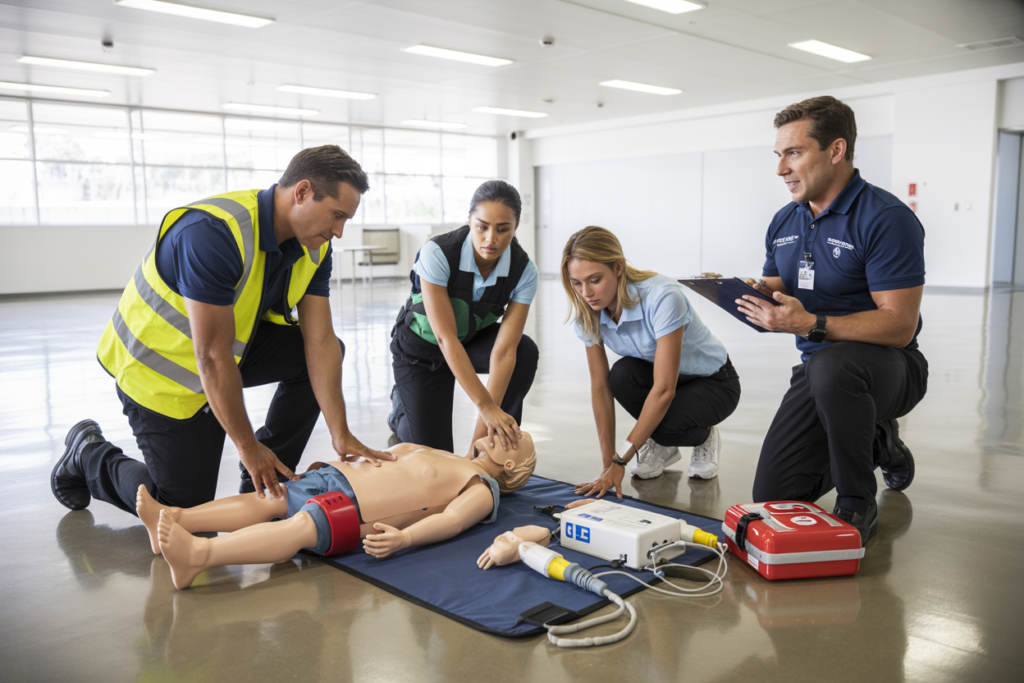
The scenario component of a genuine HLTAID014 course covers a lot of ground. Expect to work through primary and secondary patient surveys, START triage with simulated multi-casualty scenarios, CPR with AED use on clinical-grade manikins, spinal immobilization, hemorrhage control, shock management, anaphylaxis with EpiPen administration, and extended airway management. If a provider’s course day doesn’t include all of these, they’re not delivering HLTAID014 to the standard the unit requires. That’s not an opinion — it’s what the unit competencies actually specify.
How Assessment Works
Assessment in HLTAID014 is not an exam room situation. There are no trick questions, no multiple choice paper slid across a desk at the end of an exhausting day. Assessment is woven through the training itself — a combination of practical skills observation and either written knowledge questions or verbal questioning. Your trainer is looking for correct technique, appropriate decision-making under scenario conditions, and the ability to apply the frameworks you’ve learned to a situation that doesn’t follow a script.
Receiving Your Certificate
On successful completion, your HLTAID014 certificate is issued digitally on the same day and delivered to your email as a PDF. That means your certificate can be uploaded to your insurance portal, compliance register, or pre-qualification submission before end of business the same day — not Monday, not after a week of chasing the provider.
What to bring on course day:
- Comfortable clothing you can move in — you’ll be on the floor for scenario work
- Closed-toe shoes
- Photo ID
- Any relevant medical information your trainer should be aware of
- Your booking confirmation (digital is fine)
🔄 Renewal Reminder: Your HLTAID014 certificate is valid for three years. Book your renewal three to four months before expiry — weekend courses fill fast inside the six-week window.

HLTAID014 Renewal — What You Need to Know Before Your Certificate Expires
Renewal catches more site supervisors off guard than it should. Not because they forget — most WHS officers are across their own expiry date — but because they underestimate how fast the good weekend courses fill up once they’re inside the six-week window. By the time the calendar reminder fires, the dates that work around the site schedule are already gone.
How Long Is HLTAID014 Valid?
Your HLTAID014 certificate is valid for three years from the date of issue — not from the date your previous certificate expired, but from the date you complete the course. That distinction matters if you’re renewing early, which you should be.
Can You Renew Early Without Losing Validity?
Yes. Completing your HLTAID014 renewal before your current certificate expires doesn’t forfeit the remaining validity on your existing certificate — your new certificate runs from the date of completion. You’re not losing time on your current cert. You’re banking a clean, current certificate while good course dates are still available and before the pre-expiry scramble starts. Check the specific early renewal window with your RTO when you book, as this can vary slightly between providers.
What Happens If Your Certificate Has Already Lapsed?
If your HLTAID014 has already expired, there’s no shortened refresher pathway under the current unit. You complete the full course again — same content, same assessment, same same-day digital certificate on completion. Most experienced site supervisors who’ve let their certificate lapse find the full course day a genuinely useful refresh anyway. The clinical content gets updated, and the scenario work surfaces gaps that built up during the lapsed period.
The practical advice is straightforward: set a calendar reminder three to four months before your expiry date. That’s enough lead time to find a weekend date that works around your site commitments without any stress. A Senior Site Supervisor renewed his HLTAID014 before expiry on a weekend course. His digital certificate was in his inbox by late afternoon. He uploaded it to the project insurer’s portal before end of business the same day. The pre-qualification submission went in Monday morning without a problem.
Site Register Management — Tracking Expiry Across a Rotating Crew
The harder problem for most WHS officers isn’t their own renewal. It’s tracking expiry across designated first aid responders on rotating crews. Certificates expire at different times. People move between projects. The lapse usually surfaces during a toolbox talk or a pre-mobilization check — never with enough lead time to do anything about it cleanly.
A simple tracking register prevents this. Name, unit code, issue date, expiry date, renewal reminder date — maintained in one place and reviewed monthly. It takes about ten minutes to set up and saves the kind of conversation nobody wants to have with a Director during an insurance audit.
Getting your HLTAID014 certificate right the first time isn’t complicated — but it does require paying attention to a few things that a lot of providers would rather you didn’t think too hard about. The unit code on the certificate. The clinical background of the trainer. Whether the course description actually mentions triage or just uses the phrase “Advanced First Aid” and hopes you don’t ask follow-up questions.
For site supervisors and WHS officers, the stakes attached to getting this wrong are real. A lapsed certificate during a WorkSafe Queensland investigation. A pre-qualification submission that fails because the nominated First Aid Officer’s unit code doesn’t match the contract requirement. An insurance audit that surfaces lapsed HLTAID014 certificates on a site that was supposed to be compliant. These aren’t hypothetical scenarios — they’re the situations that drive people to search for a provider at the worst possible time, with the least possible options available.
The better approach is straightforward. Book early. Verify the RTO. Check the trainer credentials. Confirm the unit code before you pay. Get the certificate in your inbox the same day. Upload it before end of business. Done.
If your HLTAID014 is coming up for renewal — or if you’re getting it for the first time and want to do it with a provider who actually delivers the advanced content the qualification requires — we run weekend courses across Brisbane. Taught by paramedics and ICU nurses. Same-day digital certificate. Tax invoice with your ABN, RTO number, and unit code HLTAID014 generated automatically.
Book Your First Aid Training Now
Fast, affordable, and nationally accredited training delivered by professionals who care
Frequently Asked Questions
Q.Is HLTAID014 the same as Advanced First Aid?
Yes — HLTAID014 is the unit code for the nationally recognised qualification called Provide Advanced First Aid. Some providers advertise it simply as "Advanced First Aid" without displaying the unit code, which is where the confusion creeps in. Always confirm the exact unit code appears as HLTAID014 on the booking page, the confirmation email, and the certificate itself — because that's what your insurer, project manager, and any compliance auditor will actually check.
Q.What is the difference between HLTAID014 and HLTAID011?
HLTAID011 is the standard Provide First Aid qualification suited to general staff in lower-risk environments. HLTAID014 is the designated First Aid Officer qualification and covers considerably more ground — including START triage, multi-casualty coordination, primary and secondary patient surveys, shock management, spinal immobilisation, complex anaphylaxis, extended airway management, and haemorrhage control. If you're the nominated First Aid Officer on a high-risk worksite with 10 or more workers, HLTAID011 typically won't meet the requirement.
Q.Can I do HLTAID014 on a weekend in Brisbane?
Yes. Weekend courses are available and are the preferred option for most site supervisors and WHS officers who can't afford to lose a weekday to training. Saturday courses run the same full-day format as weekday sessions — same content, same assessment, same same-day digital certificate on completion. Weekend dates do fill up, particularly inside the six-week window before common expiry periods, so booking well in advance gives you the most flexibility.
Q.Does my HLTAID014 certificate need to be renewed every 3 years?
Yes. HLTAID014 is valid for three years from the date of issue. There is no shortened refresher pathway if your certificate lapses — you complete the full course again. If you renew before expiry, your new certificate runs from the completion date, so you don't lose any remaining validity on your current certificate. Setting a calendar reminder three to four months before your expiry date gives you enough lead time to find a weekend date that suits your schedule.
Q.Is HLTAID014 recognised across all Australian states?
Yes. HLTAID014 is a nationally recognised unit of competency under the Australian Skills Quality Authority (ASQA) framework. A certificate issued by a registered RTO in Queensland is recognised in all Australian states and territories. Always verify your provider's RTO number on training.gov.au before booking to confirm the certificate will be nationally accepted.
Making first aid training more affordable for
every classroom
We believe every student deserves access to life-saving first aid knowledge. That’s why we offer specially reduced pricing for schools and educational groups. Whether you’re booking for a single class, a year group, or your entire school, our flexible packages make training more accessible and cost-effective — without compromising quality.
