

You’re the only person in the room. Someone collapses. Do you actually know what to do next — or do you know what you think you’d do?
There’s a version of that question most clinicians have answered in their head a hundred times. And then there’s what actually happens when the theory meets a real body on the floor, no team behind you, no crash cart to reach for, no one to hand off to. Knowing how to resuscitate someone in a ward setting and knowing how to resuscitate someone completely alone are two very different things.
This guide covers the complete sequence — scene safety through to handover with paramedics — aligned with current ANZCOR guidelines. It applies to adults, children, and infants, built specifically around the solo responder context.
What Are the Steps to Resuscitate Someone?
Before getting into the detail of each step, here’s the complete sequence — every action in order, from the moment someone goes down.
- Check for danger — confirm the scene is safe before approaching
- Check for response — tap shoulders, call their name loudly
- Call Triple Zero (000) — dial immediately, put on speakerphone
- Open the airway — tilt the head back, lift the chin
- Check for breathing — look, listen, feel for no more than 10 seconds
- Begin chest compressions — 30 at 100–120 per minute, depth 5–6cm
- Give rescue breaths — 2 breaths after every 30 compressions, if trained
- Attach AED if available — power on, follow voice prompts, resume CPR immediately after shock
- Continue until help arrives — do not stop unless clear signs of life appear
Each of these steps is covered in detail below, including what changes when you’re completely alone.
Why Resuscitating Someone Alone Is Different
In a ward setting, the work gets distributed. Someone calls the code, someone else takes compressions, another manages the airway. The roles rotate. Compression quality stays higher because tired arms get relieved.
When you’re alone, all of that lands on one person. You’re making the call to Triple Zero, managing the airway, doing compressions without relief, and deciding when to break from CPR to attach the AED. There’s no one to delegate to.
When You’re the Only Responder: What Changes
Three things change immediately when you’re the only person there.
The first is Triple Zero management. You can’t step away to make the call — dial 000, switch to speakerphone, and place the phone near the patient’s head before you start compressions. The dispatcher stays on the line and guides the sequence verbally.
The second is compression continuity. With no one to rotate with, your compression quality will degrade — after roughly two minutes, depth and rate start to drop. Full effort for two minutes beats half effort for four.
The third is AED management. Compressions pause only for pad attachment and analysis. Voice prompts handle the rest — the device is designed for solo use.
💡 Clinical Tip: Put the phone on speaker before you start compressions — not after. The dispatcher is trained to guide you through the sequence in real time.
How Fatigue Affects CPR Quality and What to Do About It
Compression fatigue sets in faster than most people expect. At the two-minute mark, solo compressors begin to unconsciously reduce depth to compensate for exhaustion. The response isn’t to pace yourself — it’s to go hard and go correctly. Bystander CPR doubles or triples survival odds compared to no CPR at all, according to the Australian Resuscitation Council. That remains true even when technique isn’t perfect.
If there are untrained bystanders present, direct them. Even an untrained person can do compression-only CPR under your verbal guidance while you manage the AED.
Now that you understand what changes when you’re alone, here’s the exact sequence to follow from the moment someone collapses.
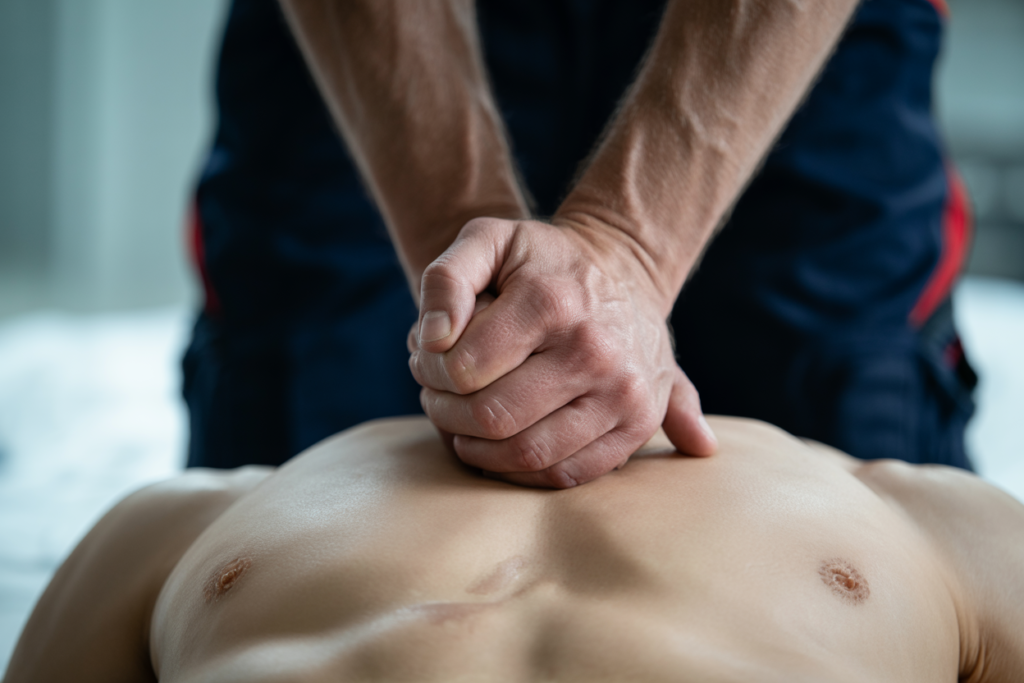
Step-by-Step: How to Resuscitate Someone When You’re Alone
Step 1–2: Scene Safety and Checking for Response
Before you touch anyone, you scan. Traffic. Water. Electrical hazards. Unstable surfaces. A rescuer who goes down doesn’t help anyone.
Once the scene is clear, tap both shoulders firmly and call their name. For trained clinicians, a sternal rub is an appropriate response check — distinct from what you’d use for a lay responder. No response, no normal movement — move immediately to the next step.
Step 3: Calling Triple Zero (000) While Alone
You cannot perform effective CPR while holding a phone to your ear. Dial 000, announce the location as specifically as you can, and switch to speakerphone before putting the phone down near the patient’s head. Tell the dispatcher you’re alone. They’ll stay on the line and can direct someone to retrieve an AED if needed.
If anyone else is present, send them for the AED directly. Point at them. “You — go and get the AED.” Bystanders without a direct instruction tend to freeze.
Step 4–5: Opening the Airway and Checking for Breathing
Tilt the head back and lift the chin to open the airway. If spinal injury is suspected — a fall, collision, or unclear mechanism — use a jaw thrust instead: two fingers under the angle of the jaw, push forward, head neutral.
Check for breathing — look for chest rise, listen, feel for airflow — no more than 10 seconds.
⚠️ Warning: Agonal breathing — irregular, gasping, or gurgling — is not normal breathing. It's a sign of cardiac arrest. If a person is unresponsive and displaying agonal breathing, begin CPR immediately. Do not wait.
Step 6–7: Chest Compressions and Rescue Breaths
Heel of one hand on the centre of the chest, second hand on top, fingers interlaced. Straight arms. Use body weight, not just your arms.
Compress to 5–6cm at 100–120 per minute. Allow full chest recoil — the heel lifts completely between compressions. Leaning on the chest reduces venous return and drops the effectiveness of each compression.
After 30 compressions, give 2 rescue breaths — head tilted back, seal over the mouth, one breath over one second. Watch for chest rise. Return immediately to compressions.
💡 Clinical Tip: Each minute without CPR reduces survival by 7–10%. The 30:2 ratio keeps oxygenation going while maintaining the compression volume that drives cardiac output.
If rescue breaths aren’t possible — infection risk, physical limitation — compression-only CPR is acceptable under ANZCOR guidelines. Significantly better than nothing.
Step 8: Using an AED Alone
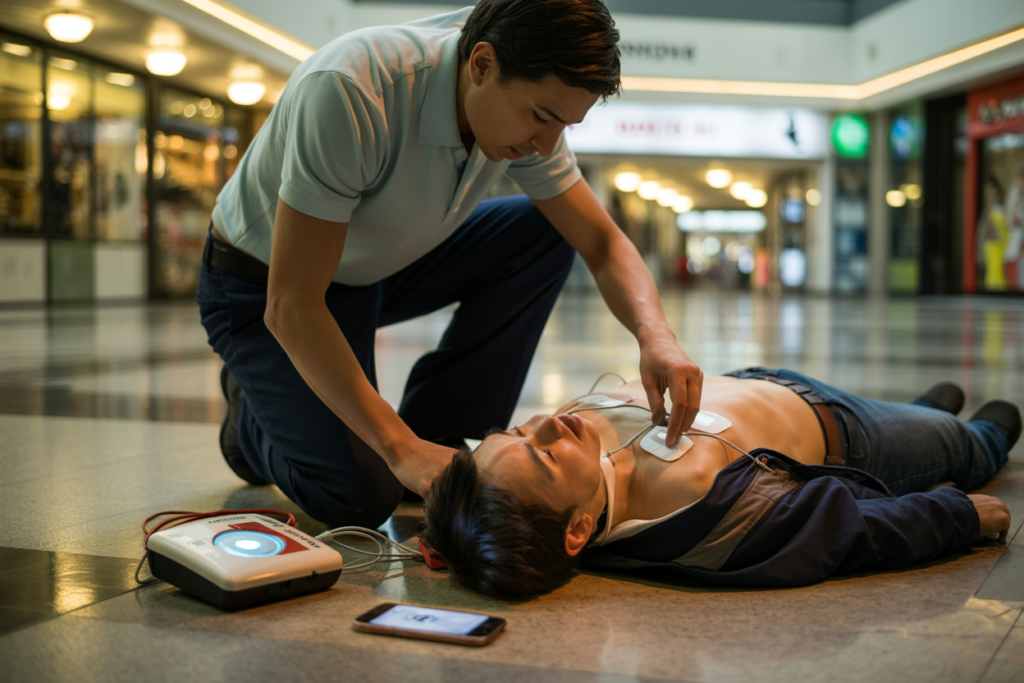
Power on the AED as soon as it’s within reach. It will guide you through pad placement, analysis, and shock delivery. For adults, one pad below the right collarbone, the other on the lower left side of the chest. Remove clothing, dry the chest if wet.
During analysis and shock, no one touches the patient. Call “clear” even if you’re alone.
Resume compressions immediately after shock. Don’t pause to check for a pulse — the AED will prompt a recheck after two minutes.
Step 9: Maintaining CPR Until Paramedics Arrive
Keep going. Unnecessary interruptions — checking for a pulse every 30 seconds, pausing to reassess — are among the strongest predictors of poor outcomes. AED use within minutes of collapse is associated with survival rates of 50–70%, according to the Australian Resuscitation Council. Every delay reduces that figure.
You stop when paramedics take over. Not before, unless signs of life are unambiguous.
The steps above apply to adults — but if the person who collapses is a child or infant, several parameters change.
Resuscitating a Child or Infant Alone: What Changes
The fundamentals are the same — scene safety, responsiveness check, Triple Zero, airway, compressions, breaths. But technique adjusts significantly by age.
One sequencing difference catches people off guard: if you’re alone with a child or infant and there are no bystanders, perform one minute of CPR before stepping away to call Triple Zero. Pediatric cardiac arrests are far more commonly respiratory in origin — early oxygenation buys more time than it does in a primary cardiac event.
CPR for Children (1 Year to Puberty): Solo Responder Modifications
Use one hand — or two fingers if the child is small — on the lower half of the sternum. Target depth is one-third of chest depth. Rate stays at 100–120 per minute, 30:2 ratio. Rescue breaths are more strongly recommended in pediatric arrests — oxygenation is often the critical intervention. For AED use, pediatric pads or mode is preferred; an adult AED is acceptable if that’s all available.
CPR for Infants (Under 12 Months): Solo Responder Modifications
Use two fingers — index and middle — just below the nipple line. Target depth approximately 4cm. Rate remains 100–120 per minute. Rescue breaths require a mouth-to-mouth-and-nose seal — keep breaths small and gentle, just enough to see chest rise. The one-minute-CPR-before-calling rule applies here too.
| Parameter | Child (1yr–puberty) | Infant (under 12 months) |
|---|---|---|
| Compression technique | One hand or two fingers | Two fingers (lone rescuer) |
| Compression depth | One-third of chest | ~4cm / one-third of chest |
| Rate | 100–120 per minute | 100–120 per minute |
| Ratio | 30:2 | 30:2 |
| Rescue breaths | Strongly recommended | Strongly recommended |
| Call Triple Zero first? | 1 min CPR before calling if alone | 1 min CPR before calling if alone |
| AED | Paediatric pads/mode preferred; adult AED acceptable | Paediatric pads/mode preferred |
Knowing the correct steps is one thing — but knowing the most common errors is what separates a confident responder from one who hesitates at exactly the wrong moment.
Common Mistakes That Reduce Survival Chances
Most CPR errors aren’t made out of panic. They’re made out of habits that feel right in the moment but quietly undermine the physiology you’re trying to support. These are the six that show up most often in solo responders.
The 6 Most Common Solo CPR Errors
| Parameter | Child (1yr–puberty) | Infant (under 12 months) |
|---|---|---|
| Compression technique | One hand or two fingers | Two fingers (lone rescuer) |
| Compression depth | One-third of chest | ~4cm / one-third of chest |
| Rate | 100–120 per minute | 100–120 per minute |
| Ratio | 30:2 | 30:2 |
| Rescue breaths | Strongly recommended | Strongly recommended |
| Call Triple Zero first? | 1 min CPR before calling if alone | 1 min CPR before calling if alone |
| AED | Paediatric pads/mode preferred; adult AED acceptable | Paediatric pads/mode preferred |
Pulse checks – are the most common source of unnecessary interruption. Every pause costs perfusion pressure, and that pressure takes several compressions to rebuild. Unless the person opens their eyes or starts breathing normally, you keep going.
Chest recoil – gets skipped more than almost any other element, especially when fatigue sets in. Leaning on the chest even slightly prevents the heart from refilling between beats. Full recoil is not optional.
Rescue breath volume – is the other common error. Over-inflating causes gastric insufflation and reduces the effectiveness of the next compression cycle. One second. Watch the chest rise. Stop the moment it does.
Avoiding these mistakes maximises survival odds — but every responder also needs to know when continuing CPR is no longer the right call.
When to Stop and What Comes Next
When Is It Safe to Stop CPR?
Four situations make stopping appropriate:
- Paramedics or another qualified responder takes over
- The person shows clear, unambiguous signs of life — purposeful movement, normal breathing, eyes opening
- You are physically unable to continue
- A doctor is present and pronounces death
Tiredness alone is not on that list. Neither is a missing pulse between AED cycles. Neither is a no-shock advisory from the AED — that indicates a non-shockable rhythm and CPR must continue.
⚠️ Warning: Do not stop CPR solely because the AED advises no shock. PEA and asystole are non-shockable rhythms — resume compressions immediately.
Handing Over to Paramedics: What to Tell Them
When paramedics arrive, they need a fast handover. The information that matters most: time of collapse, time CPR started, number of shocks delivered, any known medical history or medications. ISBAR is the framework most clinicians know — in a resuscitation handover, situation and background are what the incoming team needs first.
After the Event: Looking After Yourself
Performing solo resuscitation outside a clinical environment is a genuinely traumatic experience regardless of outcome. Critical incident stress is real and doesn’t always surface immediately. If your workplace has an Employee Assistance Programme, use it. Peer support networks within nursing and allied health exist specifically for this. Talking to a colleague who’s been through something similar is not a sign of weakness.
One Last Thing
Reading this guide and knowing what to do are closer than most people think. The sequence isn’t complicated. The steps are logical, they follow a clear order, and every one of them exists for a reason grounded in physiology.
What the guide can’t give you is the muscle memory that only comes from doing it under pressure. Knowing that agonal breathing isn’t normal breathing is one thing. Recognising it with your hands already moving is another. Cognitive knowledge and procedural confidence are built differently, and only one of them transfers reliably when the moment arrives.
The clinicians who feel genuinely prepared for a solo arrest aren’t the ones who’ve read more. They’re the ones who’ve run the scenario — with a real instructor, real feedback, and a room full of peers who understand the stakes. That’s what simulation training exists for.
Book Your First Aid Training Now
Fast, affordable, and nationally accredited training delivered by professionals who care
Frequently Asked Questions
Q.What are the steps to resuscitate someone?
The complete sequence is: check for danger, check for response, call Triple Zero (000) on speakerphone, open the airway with a head-tilt chin-lift, check for breathing for no more than 10 seconds, begin 30 chest compressions at 100–120 per minute to a depth of 5–6cm, give 2 rescue breaths, attach an AED if available, and continue until paramedics arrive or clear signs of life appear.
Q.Can you perform CPR alone?
Yes. Dial 000 and switch to speakerphone before you start compressions so the dispatcher can guide you while your hands stay on the chest. If you reach genuine physical exhaustion, compression-only CPR at full effort is acceptable under current ANZCOR guidelines — significantly better than stopping altogether.
Q.How long should you do CPR before stopping?
Continue CPR until paramedics take over, the person shows clear signs of life, or you are physically unable to continue. A no-shock advisory from the AED is not a reason to stop — it indicates a non-shockable rhythm such as PEA or asystole, and compressions must resume immediately.
Q.Is CPR different for children and infants?
Yes. For children aged one year to puberty, use one hand or two fingers and compress to one-third of chest depth at 100–120 per minute. For infants under 12 months, use two fingers and compress to approximately 4cm. Rescue breaths are more strongly recommended in paediatric arrests, and if you're alone with a child or infant, perform one minute of CPR before stepping away to call Triple Zero.
Q.What is agonal breathing and should I start CPR?
Agonal breathing is the irregular, gasping, or gurgling breathing that can occur in the early stages of cardiac arrest. It is not normal breathing and should not be mistaken for adequate respiration — if a person is unresponsive and displaying agonal breathing, begin CPR immediately without waiting for it to stop on its own.
Making first aid training more affordable for
every classroom
We believe every student deserves access to life-saving first aid knowledge. That’s why we offer specially reduced pricing for schools and educational groups. Whether you’re booking for a single class, a year group, or your entire school, our flexible packages make training more accessible and cost-effective — without compromising quality.
