

When a patient is arrested, every second counts, but so does every breach in infection control. You know this already if you’ve ever been the one standing at the head of the bed with a bag-valve-mask in your hands, watching the room fill up with people while someone’s airway is wide open and the clock is running. Frontline nurses and paramedics work through some of the highest-risk moments for pathogen transmission there are: aerosol-generating procedures, uncapped airways, a team of bodies moving fast and close around one patient. All of that compounds the risk, and it compounds it fast.
Here’s the problem though. A lot of resuscitation refreshers still treat infection control like a footnote. It gets tacked onto the end of a BLS algorithm as a PPE reminder, like an afterthought, rather than being taught as a core competency woven into every single step of the response.
Healthcare-associated transmission risk during resuscitation events is a big part of why this matters for accreditation, not just for good practice.
This guide breaks down what current ANZCOR-aligned infection control resuscitation training actually requires during a resuscitation event, from PPE sequencing under time pressure, to airway management hygiene, to what happens after the event during decontamination. And it covers what clinicians should be able to expect from a resuscitation training provider that treats infection control as clinically serious, not as a box to tick.
Quick Answer: Infection Control Precautions During Resuscitation
Infection control precautions during resuscitation come down to one thing: protecting both the responder and the patient from pathogen transmission during procedures that are, by nature, aerosol-generating and high risk.
Here’s what that actually looks like in practice:
That’s the shape of it. The rest of this guide gets into the why behind each one, starting with the procedures themselves.
🩺 Reality check: A surgical mask grabbed out of habit isn't the same as a respirator chosen because you know you're about to bag a patient. The gear is only as good as the thinking behind it.
Why Infection Control Is a Resuscitation Competency, Not a Compliance Add-On
Most people think of infection control and resuscitation as two separate boxes on a checklist. PPE goes here, algorithm goes there, and somewhere in between someone reminds you to wash your hands. That’s not how it actually works in the room, and if you’ve ever run a code you already know that.
Think about what’s happening in those first ninety seconds. You’ve got proximity, you’ve got aerosol generation from bag-mask ventilation or suctioning, and you’ve got time pressure pushing everyone to move fast and move close. Those three things stacked on top of each other create a real window where transmission risk goes up, not down, compared to routine clinical care. That’s not a compliance detail, that’s a clinical fact about how the physics and the biology of the situation work together.
This is where a lot of training falls short. Standard PPE use, the kind you’d do for a routine dressing change or a blood draw, assumes you’ve got a minute to think and a controlled pace. Resuscitation gives you neither. The urgency doesn’t excuse the infection control step, it changes what the step actually requires, and that’s a distinction most generalist first aid content skips right past.
For clinicians, ANZCOR alignment and your hospital’s own infection control policy aren’t the finish line here, they’re the floor. If your training treats meeting those standards as the achievement, it’s aiming too low. The real competency is being able to execute correct infection control while the arrest is happening, under the same pressure as every other part of the algorithm, without it becoming the thing that slows the team down, or the thing that gets quietly skipped when things get chaotic.
Advanced Resuscitation Techniques training builds infection control into the scenario itself rather than teaching it as a separate module.
Understanding why infection control matters is only half the picture though. The next question is which procedures actually carry the elevated risk, and that’s where we’re heading next.
Aerosol-Generating Procedures in Resuscitation: What Counts, and Why It Matters
Not every part of a resuscitation carries the same risk. Some of it’s fairly low stakes from an infection control standpoint, chest compressions on their own, for instance, aren’t generating much in the way of airborne particles. But the second you start moving air in and out of that patient’s lungs with equipment, the risk profile changes completely, and that’s the part a lot of training glosses over.
Which resuscitation procedures are classified as AGPs
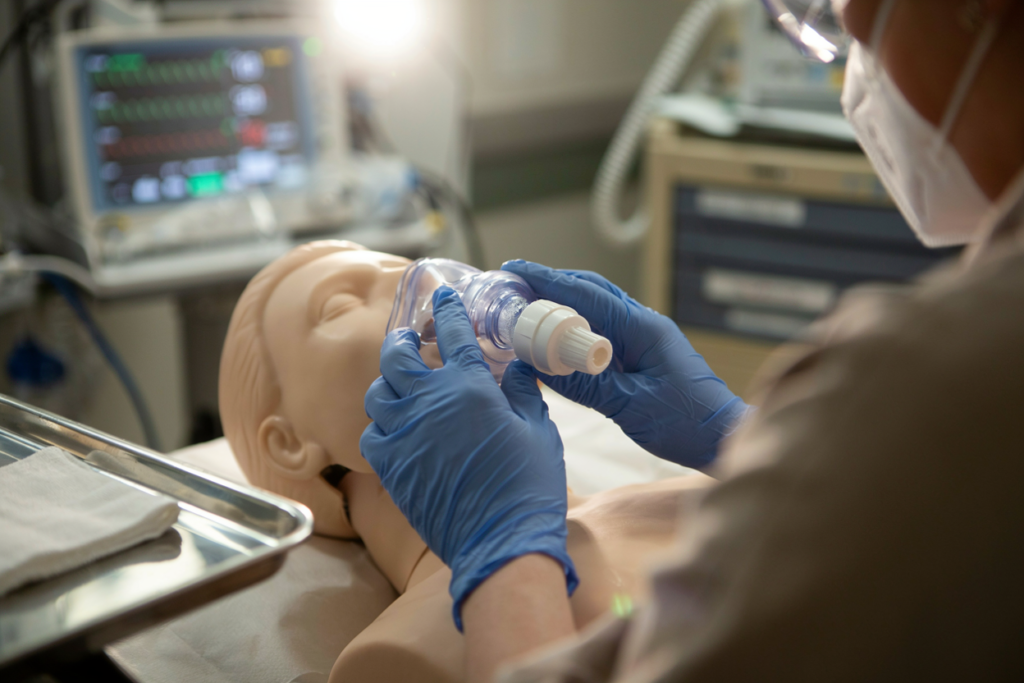
Under current guidance, bag-mask ventilation, intubation, and suctioning are all classified as aerosol-generating procedures, or AGPs. CPR itself, depending on which guidance you’re reading and the clinical context, is increasingly being treated the same way. What all of these have in common is they push air, and whatever’s in that air, out past the patient’s normal airway defences and into the space around them, and around you.
This isn’t a technicality. If you’ve been treating a viral filter or a P2 respirator as something you grab “if there’s time,” this is the section that should change your mind. There often isn’t time. That’s exactly the point.
How AGP status changes PPE tier
A standard surgical mask does a job, and it’s the right call for a lot of routine clinical work. It is not the right call once you’re in AGP territory. That’s where you move up to a fit tested P2 or N95 respirator, because a surgical mask isn’t built to filter the smaller particles that come off an aerosol-generating procedure, it’s built to stop droplets, and those are two different things.
So the tier isn’t a suggestion, it’s tied directly to what’s actually happening at the bedside. Bag-mask ventilation in progress means you’re in AGP PPE. Suctioning means the same. The moment the procedure changes, so does what you’re required to be wearing, and a good training provider will drill that switch until it’s automatic, not something you have to stop and think about mid-arrest.
Correct PPE only protects anyone if it’s on the right person at the right time, and that’s exactly where the next problem shows up: how do you get it on fast enough that it doesn’t cost the patient the seconds that matter most.
⏱️ The honest tension: Correct donning takes time you don't feel like you have. The fix isn't rushing the sequence, it's building a team that's already staged and ready before the code starts.
PPE Sequencing Under Time Pressure: Donning Without Delaying Response
Here’s the tension nobody likes to say out loud: the correct donning sequence takes time, and time is the one thing you don’t have when someone’s coding. Gloves, gown, eye protection, respirator, in the right order, done properly, that’s not a thirty second job if you’re doing it solo and doing it right. So what do you do when the patient can’t wait for you to get dressed?
You don’t skip steps. What good providers teach instead is how to build a system around the team so the sequence doesn’t fall on one person scrambling.
Team-based donning strategies that actually work:
- ● One responder is designated PPE-ready before anyone else touches the airway, so there's always someone protected and ready to step in.
- ● Equipment is staged, not stored, meaning gowns and respirators are within arm's reach of where the arrest is likely to happen, not in a supply cupboard down the hall.
- ● The team calls out PPE status the same way they'd call out compressions or rhythm checks, so it becomes part of the resuscitation communication loop, not a separate task happening off to the side.
This is crisis resource management (CRM) in practice, the same discipline that governs how a team divides roles and communicates under pressure gets applied here too. Nobody’s improvising PPE mid-code if the team has drilled who does what and when, before the code ever happens.
Getting dressed correctly is only half the job though. What you do with your hands once you’re in that gear, and what happens to the equipment after, is where the next set of risks show up.
Airway Management and Equipment Hygiene During and After Resuscitation
Getting the PPE right is only step one. What you actually do with the airway equipment, during the event and after it, is where a lot of the risk either gets managed properly or gets missed entirely.
Viral filters and single-use airway adjuncts
A viral filter on your bag-valve-mask device isn’t an optional extra kit, it’s a basic line of defence between whatever’s in that patient’s airway and everyone else in the room. Same goes for single-use airway adjuncts wherever they’re available. The logic is simple: anything that’s been in contact with an open airway during an AGP is now a transmission risk, and the fewer times it gets reused or handled, the better.
Managing shared equipment risk in multi-responder scenarios
Resuscitation is rarely a one-person job, and that’s exactly where shared equipment becomes a problem if it’s not managed properly. Bag-valve-masks getting passed between hands, laryngoscopes going down on a surface and back up again, suction equipment being used by more than one responder, all of it needs a clear protocol for who touches what and how it gets handled between uses. A good team doesn’t leave this to chance mid-code, they’ve drilled it the same way they’ve drilled compressions.
Post-event decontamination
Once the event’s over, the risk doesn’t just end because the patient’s stabilised or the team’s stepped back. Everything that was in that resuscitation zone, surfaces, reusable equipment, the trolley, needs decontaminating to AGP-level standards, not a routine wipe-down. And any AGP exposure during the event needs to be documented properly, both for the patient’s record and for the team’s own occupational health tracking.
Post-event decontamination checklist:
- ● All reusable airway equipment decontaminated to AGP-level standard.
- ● Trolley and immediate resuscitation zone surfaces cleaned.
- ● Single-use items disposed of per infection control policy.
- ● AGP exposure documented for team members involved.
- ● Patient record updated with AGP procedures performed.
None of this holds up on paper alone though. The next section is about what it means for your actual credentialing and CPD documentation, and how a provider should be capturing this competency, not just teaching it.
📋 Committee's-eye view: A credentialing panel only sees your certificate, not your practice. If infection control isn't named on it, you're the one left explaining the gap.

What This Means for Your Credentialing and CPD Documentation
Doing the right thing in the room is one part of this. Being able to prove you did it, in a way that actually satisfies a hospital credentialing committee or holds up in your own CPD portfolio, is the other part, and it’s the part that trips a lot of clinicians up after the fact.
How providers should document infection control competency
A Statement of Attainment that just says you completed a resuscitation course doesn’t tell your credentialing committee anything about whether infection control was actually assessed as part of that training, or just mentioned in passing. If your unit or your hospital is tracking this as a specific competency, and increasingly they are, the documentation needs to reflect that infection control protocols, PPE tier selection, and AGP management were taught and assessed, not just referenced in a slide somewhere.
This matters more than it might seem to on the surface. A credentialing committee reviewing your file isn’t in the room watching you drill PPE sequencing under pressure. All they’ve got is what’s on the certificate in front of them. If that certificate is vague, you’re the one left explaining the gap, not the provider who issued it.
Need documentation for hospital credentialing? Ask about CPD-mapped certificates.
Everything up to this point has been about the clinical substance. The last piece is a practical one, what all of this should tell you about choosing a provider in the first place.
Choosing a Resuscitation Training Provider That Treats Infection Control Seriously
Everything so far has been about the clinical substance, the PPE sequencing, the AGP classifications, the decontamination steps. But none of it matters much if the provider teaching it treats infection control as an afterthought bolted onto the end of a BLS refresher.
So what should you actually be looking for when you’re choosing where to book your next resuscitation refresher?
What to look for | Why it matters |
Instructor background | ICU, critical care specialty, or paramedic experience, not a generalist trainer reading off a slide deck they didn’t write |
Syllabus depth | Infection control woven through the whole course, not a fifteen minute segment at the start |
Scenario realism | Team-based drills under real time pressure, PPE donning included, not just discussed |
Credentialing documentation | Certificates that name the specific competencies assessed, not a generic Statement of Attainment |
If a provider can’t tell you, plainly, how infection control is assessed as part of their resuscitation training, that’s worth asking about before you book, not after.
Bringing It All Back to the Bedside
Infection control resuscitation training isn’t a box you tick once a year and forget about until the next renewal date shows up in your inbox. It’s the difference between walking into a code confident that your team knows exactly who’s donning PPE and when, and walking into one hoping everyone remembers on the fly.
The procedures don’t change because you’re under pressure. What changes is whether you’ve actually drilled them enough that PPE sequencing, AGP awareness, and post-event decontamination happen without anyone having to stop and think. That’s what good infection control resuscitation training should give you, not just the theory, but the muscle memory.
If you’re due for a refresher, or if your documentation needs to hold up in front of a credentialing committee, the provider you choose should be able to speak to all of this plainly, no vague answers, no generic slide decks. Ready to renew your resuscitation currency with training that matches your clinical level? View upcoming Advanced Resuscitation Techniques dates, or enquire about group training for your unit.
Book Your First Aid Training Now
Fast, affordable, and nationally accredited training delivered by professionals who care
Frequently Asked Questions
Q. What infection control precautions are needed during resuscitation?
Precautions center on treating resuscitation as a high-risk aerosol-generating event from the start. That means donning appropriate PPE, including a fit-tested P2/N95 respirator, before airway contact, treating CPR and airway procedures as AGPs, using viral filters on bag-valve-mask devices where available, keeping the resuscitation zone limited to essential responders, and decontaminating equipment and surfaces to AGP-level standards immediately after the event.
Q. Why are bag-mask ventilation and CPR classified as aerosol-generating procedures?
These procedures push air past the patient's normal airway defenses and out into the surrounding space, along with whatever pathogens may be present in that air. That's a different risk profile to routine clinical contact, which is why current guidance treats them as AGPs requiring a higher PPE tier than standard care.
Q. How does infection control training affect hospital credentialing?
Credentialing committees rely on what's documented on your certificate, not on what actually happened in the training room. If infection control competency, including PPE tier selection and AGP management, isn't specifically named as assessed, the documentation may not satisfy a committee reviewing your file, even if the training itself covered it well.
Making first aid training more affordable for
every classroom
We believe every student deserves access to life-saving first aid knowledge. That’s why we offer specially reduced pricing for schools and educational groups. Whether you’re booking for a single class, a year group, or your entire school, our flexible packages make training more accessible and cost-effective — without compromising quality.
