
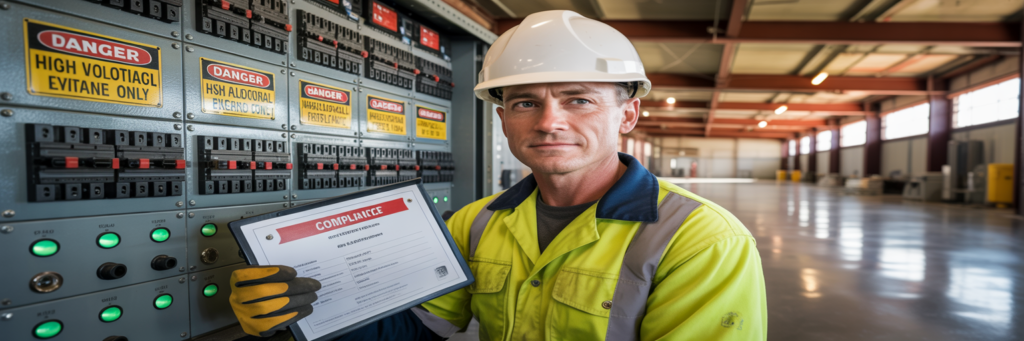
This one’s real, and it happens to good electricians every week.
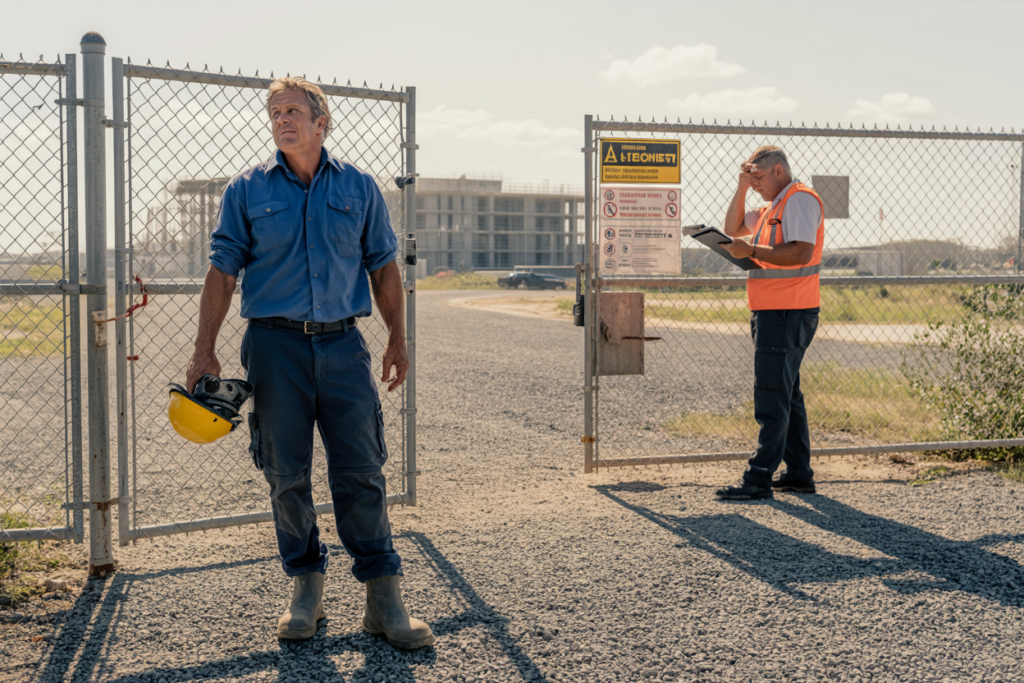
You pull up to a commercial site you’ve been on for six weeks. Work’s going well. The super’s happy with you. You grab your tools, head to the gate and that’s where it stops. Someone with a clipboard checks your compliance docs, looks up, and tells you your LVR ticket expired three weeks ago. You didn’t know. There’s no negotiation. You drive home.
That’s not a hypothetical. That’s a Tuesday morning in Brisbane for someone who didn’t know the answer to one simple question: is LVR training mandatory in Australia?
The answer is yes. Full stop. It’s a legal requirement, not a recommendation, not a best-practice suggestion. If you’re a licensed electrician in Queensland working near live low voltage electrical equipment, you need a current LVR certificate. No exceptions.
This article is for licensed electricians in Queensland, sole traders, subcontractors, and anyone whose livelihood depends on getting on site and getting the job done. By the end, you’ll know what the law says, who it applies to, how often your ticket needs renewing, and how to get back on site fast if it’s already lapsed.
Is LVR Training Mandatory in Australia?
Yes. Low Voltage Rescue (LVR) training is legally mandatory in Australia for any licensed electrician who works on or near live low voltage electrical equipment. In Queensland, the requirement is enforced under the Electrical Safety Act 2002 and the Electrical Safety Regulation 2013. The certificate must be issued by a registered RTO and renewed every three years. CPR, which is co-delivered with LVR, must be renewed annually.
Who legally requires LVR certification:
- Licensed electrical contractors working near live LV panels
- Sole trader electricians on commercial, infrastructure, or government sites
- Subcontractors whose principal contractor requires evidence of currency before site access
- Apprentices working under supervision in live electrical environments
What Is Low Voltage Rescue Training?
Low Voltage Rescue training, or LVR, is a nationally recognized unit of competency that trains you to safely rescue someone in contact with live low voltage electrical equipment, without becoming a second casualty yourself.
That last part matters more than people realize. The instinct when you see a workmate getting electrocuted is to grab them and pull. That instinct can kill you. LVR training replaces that instinct with a procedure that actually works.
What Does the UETDRRF018 Unit Cover?
UETDRRF018 covers hazard identification, safe approach, isolating power, performing the rescue, and initiating CPR until emergency services arrive. It’s the nationally recognized unit code under the UET Electrotechnology training package. Your certificate is issued by a registered RTO and recognized on worksites across Australia, not just Queensland.
What’s the Difference Between LVR and Standard First Aid?
This is where a lot of electricians get caught out. They’ve got a current HLTAID011 (Provide First Aid) certificate and assume that covers them. It doesn’t. Standard first aid does not cover electrical rescue scenarios. If a site supervisor asks for your LVR ticket and you hand over a first aid certificate, you’re going home.
The CPR component, HLTAID009, is co-delivered as part of your LVR course and counts toward your annual CPR compliance. But a standalone first aid certificate cannot substitute for LVR. They’re not interchangeable.
| Comparison | LVR (UETDRRF018) | Standard First Aid (HLTAID011) |
|---|---|---|
| Electrical rescue scenarios | Yes | No |
| CPR included | Yes (HLTAID009) | Yes |
| Required near live LV panels | Mandatory | Does not satisfy requirement |
| Renewal frequency | Every 3 years | Every 3 years |
Is LVR Training a Legal Requirement in Australia?
Yes, and the law is specific about it. This isn’t an industry guideline or a principal contractor preference. It’s legislated.
The Queensland Legal Framework
In Queensland, LVR is mandated under the Electrical Safety Act 2002 and the Electrical Safety Regulation 2013. Any person working on or near energised low voltage electrical equipment must hold a current LVR certificate issued by a registered RTO.
The obligation sits with the individual worker, not just the employer. If your ticket is expired, that’s on you, not your boss. Your QBCC licence does not keep your LVR current. They’re entirely separate obligations. Renewing your QBCC licence takes care of nothing LVR-related. The Electrical Safety Office can show up on site without warning and issue on-the-spot fines for non-compliance.
For the full legislative text, see electricalsafety.qld.gov.au and legislation.qld.gov.au.
What the Electrical Safety Act 2002 Actually Says
In plain English, the Act places a duty on workers and employers to manage electrical risk. Working near energised low voltage equipment without current LVR certification is a breach of that duty. It’s not a grey area. The certificate requirement exists because the consequence of getting it wrong near live LV equipment isn’t a near-miss. It’s a fatality.
Does It Apply to Every State?
Queensland is the most strictly enforced jurisdiction in Australia, but the obligation isn’t unique to Queensland. Every state has equivalent requirements:
- Victoria covered under the Electricity Safety Act 1998 and OHS Regulations
- NSW enforced under the Work Health and Safety Act 2011 and Electricity (Consumer Safety) Act 2004
- WA covered under the Electricity (Licensing) Regulations 1991
Safe Work Australia’s Model WHS Regulations underpin state-level requirements nationally. See safeworkaustralia.gov.au. If you’re working interstate, assume the requirement applies.
⚠️ Queensland Compliance Alert: An expired LVR certificate means no site access, no exceptions. Principal contractors are legally required to verify currency before granting entry. There is no grace period under the Electrical Safety Act 2002.
Who Needs LVR Training in Queensland?
If you’re a licensed electrician in Queensland, the short answer is almost certainly you.
Licensed Electrical Contractors
Any licensed electrician working near live low voltage electrical equipment needs a current LVR certificate. Doesn’t matter how long you’ve been in the trade. The “I’ve been doing this for 20 years” conversation doesn’t hold up in a compliance check. Experience doesn’t substitute for a current certificate.
Subcontractors and Sole Traders
If you’re a subcontractor under a principal contractor, your LVR currency is checked at the gate. Not in theory. At the actual gate, on the actual morning you show up to work. Commercial, infrastructure, and government sites are the highest-enforcement environments. If your ticket’s expired, you’re turned away and someone else gets the work.
Residential-only sole traders have lower enforcement on domestic jobs, but there’s no legal exemption. The obligation still applies near live panels.
Apprentices and Trainees
Requirements vary by supervision context. If you’re an apprentice and unsure whether the requirement applies to your situation, the Electrical Safety Office Queensland is the right place to get a definitive answer.
Workers Who Think They’re Exempt (But Aren’t)
There is no exemption for years of experience, employer size, remote location, or residential-only work near live panels. If you’re a licensed electrician near live low voltage electrical equipment, you need the certificate.
✅ Do You Need LVR? Check All That Apply:
- You hold a current electrical contractor or apprentice licence
- Your work involves live or potentially live low voltage electrical equipment
- You work on commercial, infrastructure, government, or multi-residential sites
- Your principal contractor requires evidence of LVR currency for site access
If you ticked any of these, yes, you need it.
How Often Does LVR Certification Need to Be Renewed?
The two certificates from your LVR course have different expiry cycles. Miss either one and you’re non-compliant.
Your UETDRRF018 certificate is valid for three years. The date is on your Statement of Attainment, somewhere in your email inbox or your glovebox. There’s no grace period. The day it lapses, you’re non-compliant.
CPR, HLTAID009, runs for twelve months. So you walk out of the course with both certificates, but they expire at different times. The scenario that plays out constantly: an electrician checks his LVR, sees it’s good for two more years, shows up on site and gets turned away because his CPR lapsed eight months ago. Both certificates must be current at the same time.
Renewal Quick Reference
- LVR Certificate (UETDRRF018): renew every 3 years
- CPR Certificate (HLTAID009): renew every 12 months
- Both must be current for site access, one lapsed certificate means full non-compliance
What Happens If Your LVR Ticket Expires?
This is the section a lot of people are reading first. They’ve already got the call. So let’s get straight to it.
An expired LVR certificate means you cannot legally work near live low voltage electrical equipment. No self-renewal process, no grace period, no experience exemption. The certificate is either current or it isn’t.
Principal contractors are legally exposed if they permit a non-compliant worker on site. They will not take that risk for any subcontractor. You get sent home, the job goes to someone else, and the relationship you’ve spent years building takes a hit. Electrical Safety Office inspectors can also appear without warning and ask for documentation on the spot.
The only pathway back to compliance is completing a full UETDRRF018 course with a registered RTO. No refresher pathway exists. You do the course, get assessed, get your certificate.
This happens every week. It takes one Saturday morning to make sure it never happens to you.
How to Choose a Registered RTO for LVR Training
Not every provider offering LVR training is legitimate. Paying for a certificate that gets rejected at the gate because the provider wasn’t a registered RTO is a real outcome.
An RTO, Registered Training Organisation, must be registered with ASQA to legally issue a UETDRRF018 Statement of Attainment. Verify any provider at training.gov.au before you book. Search by provider name or RTO number. If UETDRRF018 isn’t listed against their registration, walk away.
What to Look for in an LVR Course Listing
| Green Flags | Red Flags |
|---|---|
| RTO number prominently displayed | No RTO number visible |
| UETDRRF018 listed explicitly | Course name vague, no unit code |
| Digital certificate issued same day | Certificate posted within days |
| Saturday availability shown | Weekday-only courses |
| LVR + CPR bundle clearly stated | No mention of CPR component |
💡 Pro Tip: Check any RTO on the national register at training.gov.au before handing over your card. Takes 60 seconds and protects you from a wasted Saturday.
LVR Training, What to Expect on the Day
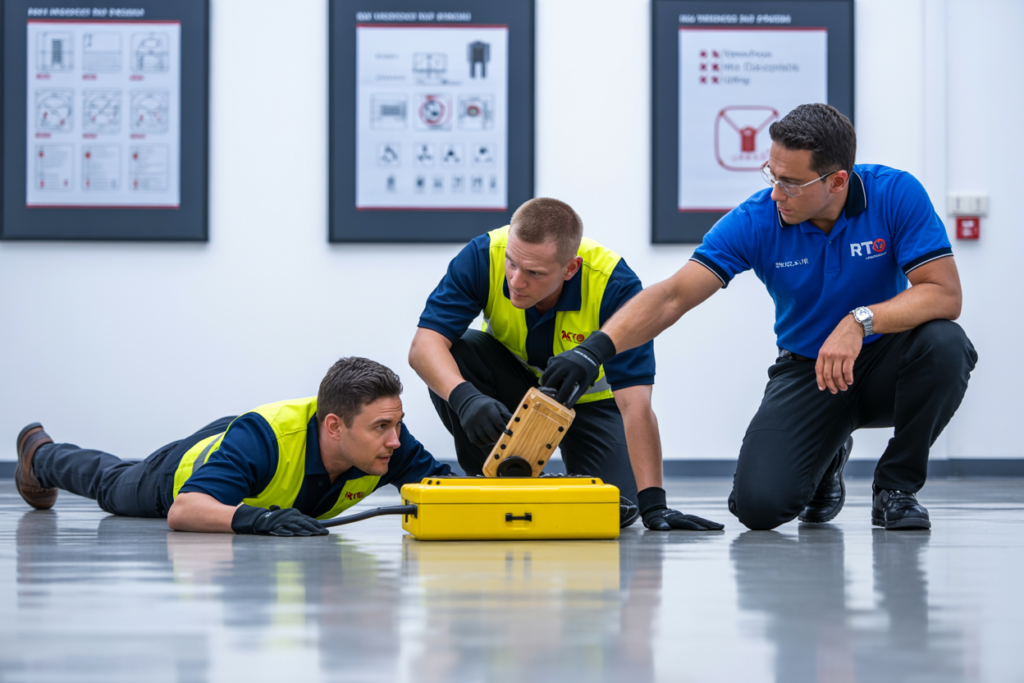
LVR is hands-on. You’ll run through a rescue scenario using training equipment and be assessed on CPR using a mannequin. Neither is difficult if you pay attention. The trainers are there to get you through it, not to trip you up.
What You Need to Bring
- Photo ID, driver’s licence is fine
- Your current electrical licence or apprenticeship papers
- Comfortable clothing, you’ll be on your feet doing practical work
Confirm the specifics at time of booking. Once you’ve been marked as competent across both components, your digital certificate gets emailed to you that day. If you do a Saturday course, your site supervisor can have it before Monday morning kickoff.
Wrapping Up
The answer to whether LVR training is mandatory in Australia has never been complicated. It’s yes, and it applies to every licensed electrician working near live low voltage electrical equipment regardless of experience, employer size, or site type. The law doesn’t grade you on how long you’ve been in the trade. It checks your certificate.
What catches most electricians off guard isn’t ignorance of the rule. It’s losing track of the expiry date. Your UETDRRF018 runs three years. Your CPR runs twelve months. Those two cycles don’t line up, and when one lapses without you noticing, the result is the same as having no certificate at all.
Getting back to compliance is straightforward. Find a registered RTO delivering UETDRRF018 with Saturday availability, confirm they issue a digital certificate the same day, bring your ID and licence papers, and you’re done. Your site supervisor has your cert before Monday morning. You’re back on the tools, back on the job, and back to being the subcontractor who shows up organised and compliant.
If your ticket is current, set a reminder now, sixty days before your LVR expiry and thirty days before your annual CPR renewal. If it’s already lapsed, the fix is one Saturday away. Either way, don’t wait for a site supervisor with a clipboard to be the one who tells you.
Book Your First Aid Training Now
Fast, affordable, and nationally accredited training delivered by professionals who care
Frequently Asked Questions
Q. Is LVR training the same as first aid training?
No, they're two different certifications that cover different scenarios. Standard first aid, HLTAID011, covers general medical emergencies like falls, burns, and cardiac events. LVR, UETDRRF018, specifically covers the rescue of a person in contact with live low voltage electrical equipment. The two are not interchangeable, and a first aid certificate will not satisfy an LVR requirement on a worksite. The CPR unit, HLTAID009, is co-delivered as part of your LVR course, so you walk out with both, but LVR cannot be replaced by first aid alone.
Q. How long is an LVR certificate valid in Queensland?
Your UETDRRF018 Low Voltage Rescue certificate is valid for three years from the date of issue. The co-delivered CPR certificate, HLTAID009, is valid for twelve months and must be renewed annually regardless of where you are in your LVR cycle. Both certificates must be current at the same time for you to be compliant on site, so it's worth tracking both expiry dates separately and setting reminders well in advance of each.
Q. Can I still work if my LVR ticket has expired?
No. An expired LVR certificate means you cannot legally work near live low voltage electrical equipment. There is no grace period, no partial compliance arrangement, and no exemption based on experience. Principal contractors are legally required to verify your currency before allowing site access, and they will not make exceptions. The only pathway back to compliance is completing a full UETDRRF018 course with a registered RTO, there is no refresher or online-only shortcut available.
Q. What happens if an Electrical Safety Office inspector comes on site and my LVR is expired?
The Electrical Safety Office can conduct unannounced site inspections and request LVR documentation from any electrician present. If your certificate is expired at the time of inspection, you're facing an on-the-spot compliance notice and potential fine, and the situation becomes a regulatory matter rather than just a contractor one. Inspectors don't offer grace periods or warnings, the requirement is either met or it isn't, so having both your UETDRRF018 and HLTAID009 certificates current is the only compliant position.
Q. Is a digital certificate accepted on site or do I need the physical card?
Most principal contractors and site WHS officers accept a digital certificate emailed directly from the RTO as proof of currency. A reputable registered RTO will email your Statement of Attainment on the day you complete the course, which means a Saturday course can have your site supervisor holding your certificate before Monday morning. If you need a physical card, confirm with your provider at time of booking what format they issue and how quickly it's delivered.
Q. Do I need LVR if I only do residential electrical work?
The legal obligation under the Electrical Safety Act 2002 applies to any licensed electrician working near live low voltage electrical equipment, regardless of whether the site is residential or commercial. Enforcement is higher on commercial, government, and infrastructure sites where principal contractors actively verify compliance at the gate, but the obligation exists in all contexts where live LV equipment is involved. Lower enforcement on residential sites doesn't mean no obligation.
Making first aid training more affordable for
every classroom
We believe every student deserves access to life-saving first aid knowledge. That’s why we offer specially reduced pricing for schools and educational groups. Whether you’re booking for a single class, a year group, or your entire school, our flexible packages make training more accessible and cost-effective — without compromising quality.
