
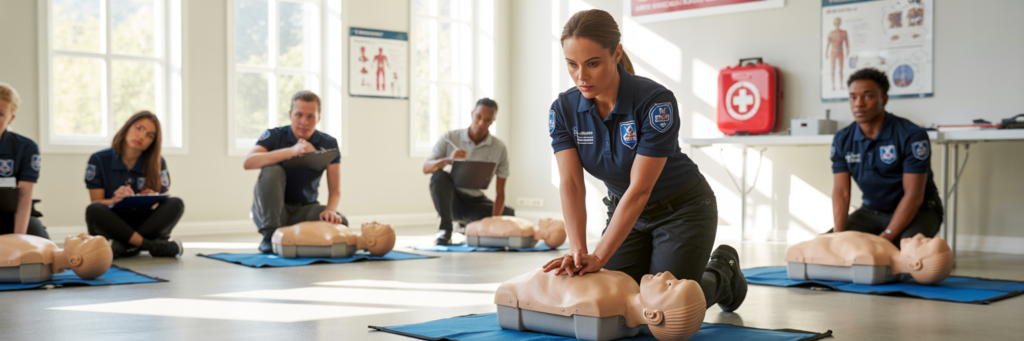
What would you do if someone collapsed in front of you right now—at the gym, in a park, or at your workplace? Would you know how to help, or would panic take over?
Every year in Australia, over 25,000 people suffer cardiac arrests outside of hospitals. And here’s the sobering part: survival rates drop by 10% with every single minute that passes without CPR. The difference between life and death often comes down to one thing: whether someone nearby knows what to do.
Learning CPR isn’t just a professional requirement for fitness trainers, healthcare workers, or teachers. It’s an essential life skill that could help you save a family member, colleague, or complete stranger. Whether you’re looking to meet certification requirements or simply want the confidence to act in an emergency, mastering these 10 fundamental CPR skills will prepare you for the moment that matters most.
In this guide, you’ll discover the techniques, step-by-step processes, and knowledge needed to perform effective CPR. From proper hand placement to rescue breathing, we’ll cover everything you need to know.
What is CPR and How Do You Do It?
CPR (Cardiopulmonary Resuscitation) is an emergency life-saving technique you use when someone’s heart stops beating or they stop breathing. It combines chest compressions and rescue breaths to manually pump blood and oxygen to vital organs until medical help arrives.
Here’s how to perform CPR:
- Check responsiveness – Tap the person’s shoulder and shout “Are you okay?”
- Call 000 – Or have someone else call while you begin CPR
- Position your hands – Place the heel of one hand on the center of the chest, other hand on top
- Give 30 chest compressions – Push hard and fast (5-6cm deep, 100-120 compressions per minute)
- Give 2 rescue breaths – Tilt head back, lift chin, pinch nose, breathe into mouth
- Repeat cycles – Continue 30 compressions and 2 breaths until help arrives
Immediate CPR can double or triple survival rates in cardiac arrest victims. The Australian Resuscitation Council recommends hands-on training to master proper technique.
Skill #1 – Recognizing Cardiac Arrest vs. Other Emergencies
The biggest mistake people make isn’t performing CPR wrong—it’s not starting CPR at all because they weren’t sure if they should.
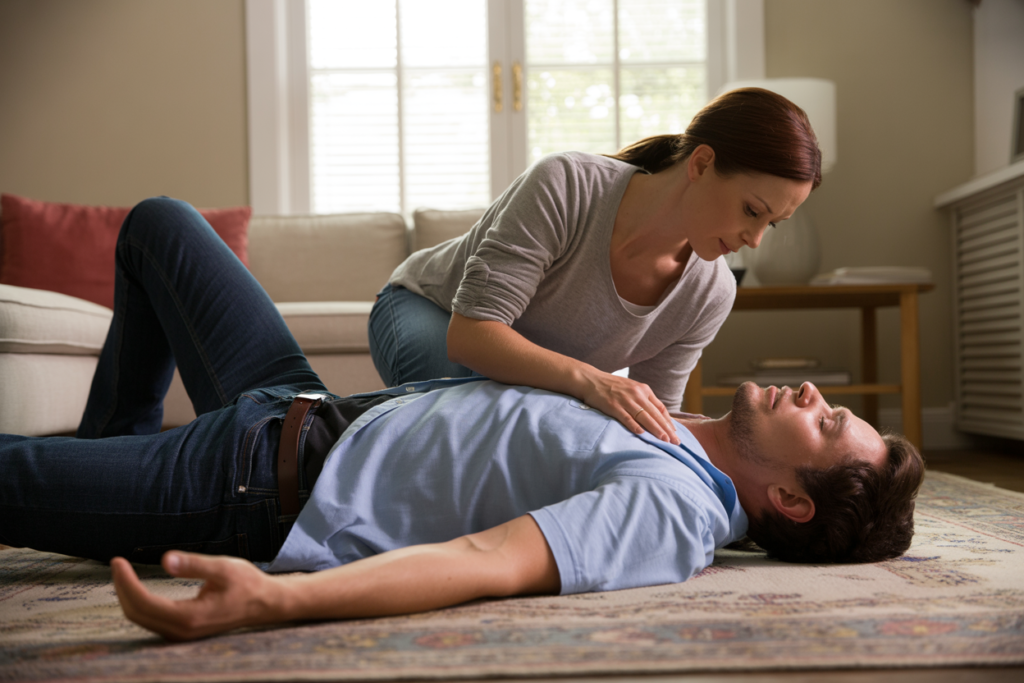
Cardiac arrest is when someone’s heart stops beating effectively. They collapse. That’s it—no dramatic clutching of the chest like you see in movies. One second they’re upright, the next second they’re on the ground, unconscious and not breathing normally.
Brain damage starts within 4-6 minutes without oxygen. Permanent death occurs within 8-10 minutes. Every minute you delay CPR, that person’s survival rate drops by 10%.
Difference Between Cardiac Arrest, Heart Attack, and Choking
| Condition | Key Signs | Action Needed |
|---|---|---|
| Cardiac Arrest | Unconscious, no breathing, no pulse | Start CPR immediately |
| Heart Attack | Conscious, chest pain, difficulty breathing | Call 000, keep them comfortable |
| Choking | Conscious, clutching throat, can't speak | Perform Heimlich maneuver |
A heart attack means the heart is still beating but an artery is blocked. The person is usually conscious. You call 000, keep them comfortable—but you don’t do CPR because their heart is still working.
Cardiac arrest? The person is on the ground, unresponsive, not breathing. That’s your signal. Don’t wait. Don’t second-guess yourself.
The Australian Resuscitation Council is clear: “If someone is unconscious and not breathing normally, start CPR immediately—you won’t harm them, but delaying could cost their life.”
Skill #2 – The DRSABCD Action Plan
DRSABCD is the emergency response sequence used by paramedics, first responders, and trained bystanders across Australia.
- D – Danger: Check for hazards to yourself, bystanders, and the victim
- R – Response: Check if person is conscious (tap shoulder, shout)
- S – Send for help: Call 000 or have someone else call
- A – Airway: Open airway using head tilt-chin lift
- B – Breathing: Check for normal breathing (look, listen, feel)
- C – CPR: If not breathing, start CPR immediately
- D – Defibrillator: Apply AED as soon as available
Danger first prevents you from becoming a second victim. Calling 000 early means help is already on the way while you’re working. Starting CPR quickly means you’re keeping blood flowing to the brain during those critical first minutes.
You’ve got 10 seconds maximum to check for breathing. If you see normal breathing, hear regular breath sounds, and feel air on your cheek—they’re breathing. If you don’t see regular chest movement or don’t hear breathing after 10 seconds, assume they’re not breathing and start CPR immediately.
Skill #3 – Proper Hand Placement for Chest Compressions
Hand placement seems simple until you’re actually doing it. There’s a specific spot you need to hit, and if you’re too high, too low, or off to the side, your compressions won’t be as effective.
Finding the Correct Hand Position
Step 1: Locate the center of the chest—roughly between the nipples.
Step 2: Place the heel of your hand on the center of the chest, on the lower half of the sternum. Not your palm, not your fingers—the heel of your hand.
Step 3: Place your other hand on top. Interlock your fingers or just stack them.
Step 4: Position your shoulders directly over your hands, arms straight, elbows locked.
Step 5: Keep your fingers up off the chest.
When you compress the chest correctly, you’re squeezing the heart between the sternum and the spine, forcing blood out to the body. When you release, the heart refills with blood. But this only works if you’re compressing the right spot with enough force.
Yes, you might break ribs. About 30% of cardiac arrest victims who receive CPR end up with fractured ribs. But broken ribs heal. Dead doesn’t.
Skill #4 – Correct Compression Depth and Rate
Effective CPR is physically demanding. If you’re doing it right, you should be tired after 2 minutes. If you’re not tired, you’re probably not pushing hard enough.
The 5-6cm Depth Rule
You need to push down 5-6 centimeters. That takes force. Real force. You’re compressing the ribcage, pushing the sternum down toward the spine, squeezing the heart.
Most untrained bystanders only compress 3-4cm because they’re afraid of hurting the person. But 3-4cm isn’t enough to generate meaningful blood flow. You need that full 5-6cm to effectively pump blood to the brain.
The 100-120 Beats Per Minute Rhythm
You need to be doing 100-120 compressions per minute. Use the song “Stayin’ Alive” by the Bee Gees—it’s almost exactly 103 beats per minute. If you’re compressing to the rhythm of “Stayin’ Alive,” you’re in the right ballpark.
Allow Full Chest Recoil
After each compression, you need to let the chest come all the way back up. Full recoil. When you release, the chest springs back to its normal position, creating negative pressure that pulls blood back into the heart. If you’re leaning on the chest between compressions, you’re preventing the heart from refilling.
Once you start CPR, you keep going. You don’t stop to check if it’s working. You don’t stop because your arms are tired. You keep going until paramedics arrive, the person starts breathing normally, or you physically cannot continue.
Skill #5 – Rescue Breathing Technique
Rescue breathing means putting your mouth on a stranger’s mouth and breathing into their lungs. It’s uncomfortable. But combined with compressions, that’s when CPR becomes truly effective.
Opening the Airway Properly
Before you can give rescue breaths, you need to open the airway with a head tilt-chin lift. Place one hand on their forehead, two fingers under their chin, and gently tilt the head back while lifting the chin.
Giving Proper Rescue Breaths
Pinch the nose closed. Place your mouth over their mouth to make a complete seal. Blow steadily into their mouth for about 1 second—you should see their chest rise. Pull away and watch the chest fall. Give a second breath the same way.
That’s it. Two breaths. You’re not trying to fully inflate their lungs. Each breath should be just enough to make the chest visibly rise.
The 30:2 Ratio
30 chest compressions, 2 rescue breaths. Repeat.
You do 30 compressions, then stop, give 2 rescue breaths, then immediately back to 30 compressions. Keep this cycle going until help arrives or the person starts breathing on their own.
If you’re genuinely uncomfortable with mouth-to-mouth, do compression-only CPR. Hands-only CPR is absolutely better than standing there doing nothing
.
Skill #6 – Using an Automated External Defibrillator (AED)
AEDs are designed for people like you. These things literally talk you through every single step. If you can follow voice instructions, you can use an AED.
An AED analyzes the heart’s rhythm. If the heart is in a shockable rhythm, the AED delivers an electrical shock to stop that chaotic rhythm so the heart can reset and start beating normally.
Step-by-Step AED Operation
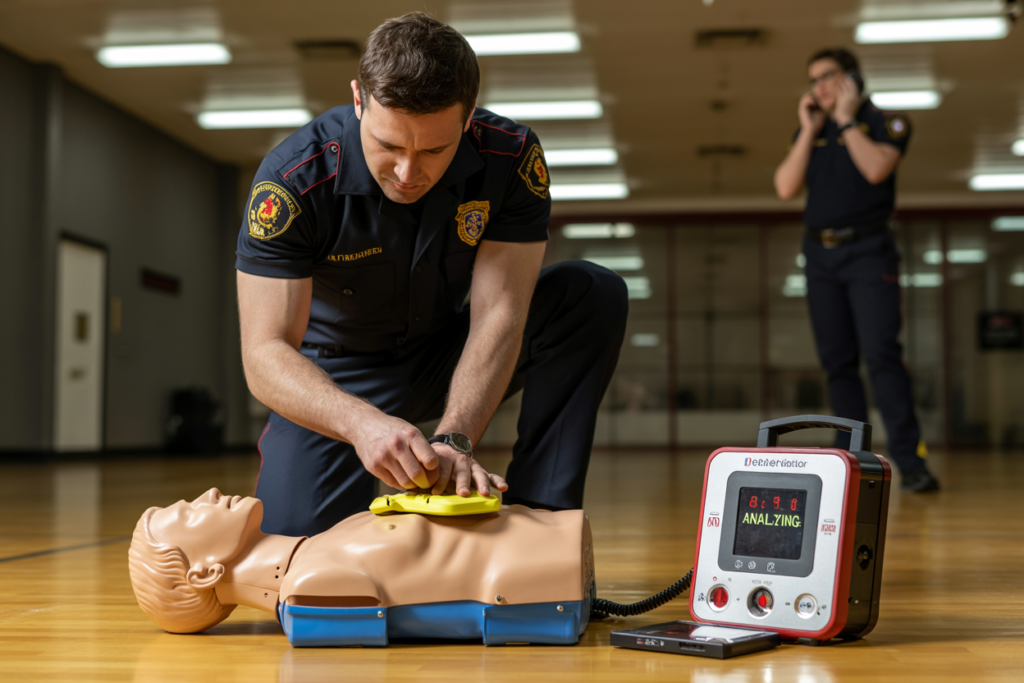
Step 1: Turn on the AED. It starts talking to you immediately.
Step 2: Attach the pads to the person’s bare chest. One pad on the upper right chest, one on the lower left chest. The pads have pictures showing exactly where they go.
Step 3: Stop CPR and don’t touch the person. The AED will say “Analyzing heart rhythm.”
Step 4: Follow the AED’s instructions. If it says “Shock advised,” make sure no one is touching the person, shout “Clear!” and press the shock button. If it says “No shock advised,” go straight back to CPR.
Step 5: Resume CPR immediately after the shock. The AED will tell you when to stop for the next analysis.
The AED won’t let you shock someone who doesn’t need it. It analyzes the rhythm and only allows a shock if appropriate. You literally cannot mess this up—the machine makes all the decisions for you.
Skill #7 – CPR for Special Populations (Children, Infants, Pregnant Women)
Children, infants, and pregnant women require modifications to standard adult CPR technique.
| Factor | Adult (8+ years) | Child (1-8 years) | Infant (<1 year) |
|---|---|---|---|
| Compression Depth | 5-6cm | 4-5cm | 4cm |
| Hand Position | Two hands | One or two hands | Two fingers |
| Compression Location | Center of chest | Center of chest | Just below nipple line |
For infants, use two fingers (index and middle) placed just below the nipple line. Compress 4cm depth—about one-third of the chest depth.
For pregnant women after 20 weeks gestation, perform standard adult CPR but tilt the victim to the left side (15-30 degrees) using a rolled towel under the right hip. This prevents compression of major blood vessels by the uterus.
Skill #8 – Recovery Position for Unconscious But Breathing Victims
If someone’s unconscious but breathing normally, they do NOT need CPR. They need the recovery position.
Unconscious + NOT breathing normally = CPR immediately
Unconscious + breathing normally = Recovery position
The recovery position keeps their airway open and allows any fluids (vomit, blood, saliva) to drain out of their mouth instead of being inhaled into their lungs.
Here’s how: Kneel beside them. Place the nearest arm at a right angle to their body. Place the far arm across their chest with the hand against their near cheek. Bend the far knee up. Roll them toward you onto their side. Tilt their head back to keep the airway open.
Monitor their breathing every 30-60 seconds. If their breathing stops, immediately roll them onto their back and start CPR.
Skill #9 – Avoiding the 7 Most Common CPR Mistakes
Mistake #1: Hesitating to Start
About 70% of bystanders who witness cardiac arrest don’t attempt CPR at all. They’re scared of doing it wrong. But that person is already dead—their survival rate with no intervention is 0%. Imperfect CPR gives them a 30-40% survival rate.
Mistake #2: Compressions Too Shallow or Too Slow
Push HARD (5-6cm). Push FAST (100-120 per minute). Use your body weight, not arm strength.
Mistake #3: Not Calling for Help First
Call 000 FIRST. Put the phone on speaker so you can talk to the dispatcher while you’re working.
Mistake #4: Stopping Compressions Too Often
Every time you stop compressions, blood pressure drops to zero. Only stop for rescue breaths, AED analysis, or if the person starts breathing normally.
Mistake #5: Incorrect Hand Placement
Center of chest, lower half of the sternum, between the nipples. Check your position and maintain it.
Mistake #6: Not Allowing Full Chest Recoil
Let the chest come all the way back up between compressions. Full recoil is when the heart refills with blood.
Mistake #7: Giving Up Too Soon
You don’t stop CPR until paramedics arrive, the person recovers, you’re too exhausted to continue, or the scene becomes unsafe. “It’s been 5 minutes and they’re not responding” is not a reason to stop.
Skill #10 – Getting Officially Certified (Why Hands-On Training Matters)
Reading about CPR and actually doing CPR are completely different things.
Studies show that 80% of CPR skills are forgotten within 6 months if you don’t practice them physically. But participants who completed hands-on CPR training retained 75% of their skills at six months—three times better retention just from physically practicing.
HLTAID009 (also called “Provide CPR”) is the nationally recognized CPR certification in Australia. It’s what Fitness Australia requires, what insurance companies want to see, and what employers ask for.
The course covers everything we’ve talked about in this guide, but you actually practice it. You perform CPR on mannequins. You apply AED pads. You demonstrate the recovery position. You get assessed on your technique.
The real value of certification isn’t the piece of paper—it’s the confidence. Before certification, if someone collapsed, your brain would freeze trying to remember what to do. After certification, your hands move automatically. Muscle memory takes over.
The Difference Between Knowing and Doing
You’ve just learned the 10 essential CPR skills that could save someone’s life.
But here’s the question that really matters: If someone collapsed in front of you right now, would you act?
Would your hands move automatically to the center of their chest? Would you remember to call 000 first? Would you push hard enough, fast enough, long enough? Or would you freeze, paralyzed by the gap between reading about CPR and actually performing it when someone’s life is on the line?
That gap is what kills people. Not lack of knowledge—most bystanders have heard of CPR. It’s the lack of confidence. The uncertainty that comes from never having actually done it.
You’ve got three choices right now.
Choice #1: Do nothing. Hope you never need this information.
Choice #2: Bookmark this article, plan to review it later, convince yourself that reading more will prepare you.
Choice #3: Get certified. Hands-on practice until your muscles remember the technique. Expert instructors correcting your form. The confidence that comes from having actually done it.
Only one of those choices gives you what you actually need when someone’s life depends on you.
This isn’t just about compliance. This is about the person who collapses near you. This is about your family member, your colleague, a stranger. This is about being the person who acts instead of the person who watches.
Someone in Australia will have a cardiac arrest today. Most will die—not because they couldn’t be saved, but because no one started CPR quickly enough.
You can’t save all of them. But you could save one. The one who happens to collapse near you. The one whose survival depends entirely on whether you know what to do.
You can keep reading about CPR, or you can learn to actually do it.
Because reading this article won’t save anyone’s life. But getting certified just might.
Book Your First Aid Training Now
Fast, affordable, and nationally accredited training delivered by professionals who care
Frequently Asked Questions About CPR
Q.How long does CPR certification last in Australia?
HLTAID009 CPR certification is valid for 12 months in Australia, which means you need to renew it annually. This shorter validity period compared to other first aid certificates exists because CPR skills decay quickly without practice—studies show that 80% of skills are forgotten within 6 months. The annual recertification requirement makes sure your technique stays current with updated guidelines and that your muscle memory remains sharp enough to perform effective compressions when someone's life depends on it.
Q.What's the difference between CPR and first aid certification?
CPR certification (HLTAID009) specifically covers cardiopulmonary resuscitation techniques for when someone's heart stops or they stop breathing, and it's valid for 12 months. First aid certification (HLTAID011) is more comprehensive, covering CPR plus treatment for injuries like burns, fractures, bleeding, shock, and other medical emergencies, and it's valid for 3 years. Most people who need professional certification get both—the full first aid course includes CPR training, so you walk away with both certificates in one session.
Q.How hard should I push during chest compressions?
You need to compress the chest 5-6 centimeters deep (about 2 inches), which requires real force—you should be using your body weight, not just arm strength, and yes, you might break ribs. About 30% of cardiac arrest victims who receive CPR end up with fractured ribs or a fractured sternum, but broken ribs heal while cardiac arrest without proper CPR is fatal. If you're not compressing deep enough to see visible chest movement and you're not tired after 2 minutes of CPR, you're probably not pushing hard enough to generate meaningful blood flow to the brain.
Q.How do I know if someone needs CPR or just fainted?
Check for two things: consciousness and breathing. Tap their shoulders and shout "Are you okay?"—if they respond at all, they don't need CPR. If they're completely unresponsive, immediately check for normal breathing by looking at their chest, listening for breath sounds, and feeling for air on your cheek for up to 10 seconds maximum. If they're breathing normally (regular chest rise and fall, clear breath sounds), put them in the recovery position and monitor them. If they're not breathing or you're not sure after 10 seconds, assume cardiac arrest and start CPR immediately.
Q.What's the difference between cardiac arrest and a heart attack?
A heart attack happens when blood flow to part of the heart is blocked (usually by a clot), but the heart is still beating and the person is usually conscious, experiencing chest pain, and able to talk. Cardiac arrest is when the heart stops beating effectively—the person collapses, becomes unconscious, and stops breathing. Heart attack victims need you to call 000 and keep them comfortable while waiting for paramedics, but cardiac arrest victims need immediate CPR because their heart has stopped and their brain is dying. A heart attack can lead to cardiac arrest if untreated, but they're different emergencies requiring different responses.
Making first aid training more affordable for
every classroom
We believe every student deserves access to life-saving first aid knowledge. That’s why we offer specially reduced pricing for schools and educational groups. Whether you’re booking for a single class, a year group, or your entire school, our flexible packages make training more accessible and cost-effective — without compromising quality.
