
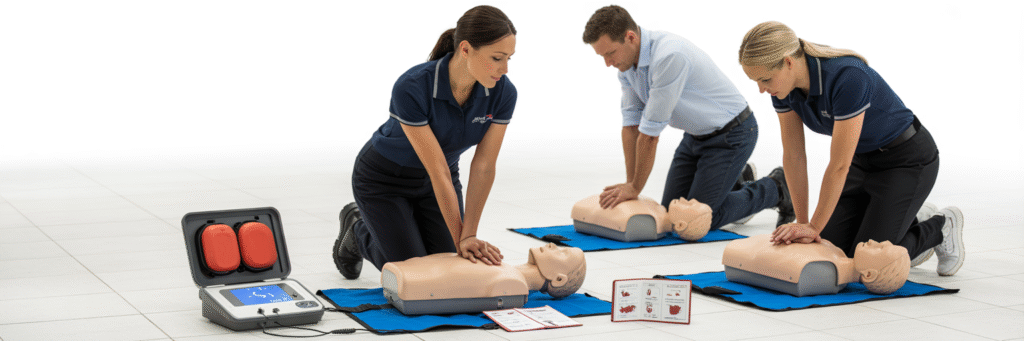
Ever wondered what you’d actually do if someone collapsed right in front of you at the shopping centre? Or if your mate’s kid started choking during a backyard BBQ?
I’ll be honest with you—most of us freeze up. We know we should help, but we don’t know how. And that feeling of helplessness? It sticks with you.
Learning first aid isn’t just about ticking some workplace compliance box (though yeah, your boss probably needs you to do that too). It’s about having the confidence to actually help when someone needs it. When those few minutes before the ambulance arrives could genuinely make the difference between someone living or dying.
Whether your certificate just expired and you’re scrambling before an audit, you’re a parent who wants to be prepared, or you’re changing careers and need the qualification—knowing where to start can feel confusing as hell. Different course codes, multiple providers, varying options.
This guide breaks down everything you need to know about learning first aid in 2025. Which course you actually need, what happens during training, and how to choose the right provider.
What Do You Learn in a First Aid Course?
A comprehensive first aid course (HLTAID011 Provide First Aid) teaches you the life-saving skills you need to respond confidently when someone’s in trouble.
Core Skills Covered:
- CPR techniques for adults, children, and infants
- Using an AED (automated external defibrillator)
- Managing serious bleeding with direct pressure and bandaging
- Treating burns of varying severity
- Recognizing and responding to heart attacks, strokes, and anaphylaxis
- Managing fractures and sprains with proper immobilization
- Treating shock and positioning casualties safely
- Assessing an emergency scene for safety
- Calling emergency services with accurate information
- Providing casualty care until paramedics arrive
First aid training combines theoretical knowledge with hands-on practice using mannequins, bandages, and real-world scenario simulations. Courses include practical assessments to make sure you can confidently perform each skill when it actually matters.
Why Learn First Aid?
The Statistics That Matter
When someone goes into cardiac arrest, every second counts.
Without anyone helping: 8% survival rate
With immediate CPR: 18% survival rate
CPR plus using an AED: 35-40% survival rate
That’s the difference between someone’s partner, parent, or kid making it or not. According to Australian Resuscitation Council guidelines, the chance of survival drops by about 10% for every minute that passes without CPR.
Here in Queensland, Safe Work Australia reports that around 30,000 workplace injuries happen every year that could’ve been managed better with immediate first aid response. We’re talking serious bleeding, burns, fractures—stuff where those first few minutes really count before the ambos arrive.
Brisbane’s pretty spread out. If you’re in the outer suburbs or somewhere like The Gap or Capalaba, ambulance response times can hit 15-20 minutes depending on traffic. That’s a long time to just stand there watching someone struggle to breathe.
💡KEY FACT: According to Australian Resuscitation Council guidelines, the chance of survival drops by about 10% for every minute that passes without CPR. Those minutes literally mean the difference between life and death.
Real Scenarios Where First Aid Makes a Difference
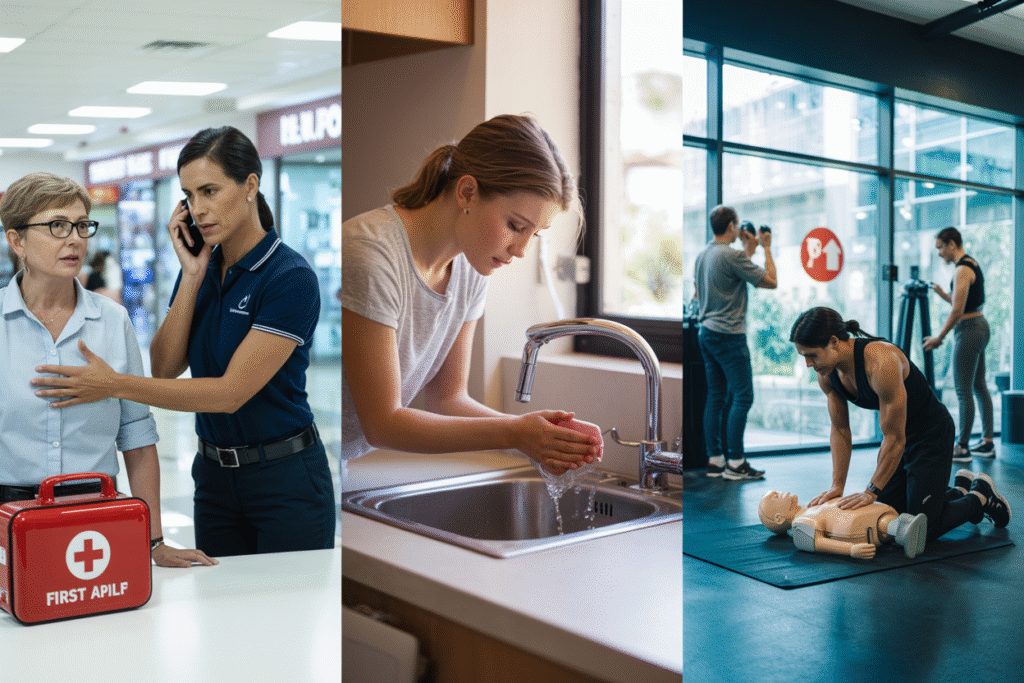
At Work: You’re managing the floor at Westfield when a customer goes down. Maybe they’re diabetic and their blood sugar crashed. Maybe they’re having a heart attack. Do you know the difference? Do you know what to do while you’re waiting for the ambulance?
At Home: Your toddler grabs a hot cup of coffee off the counter. Second-degree burn on their arm. You’ve got maybe 20 seconds to get that under cool running water before the burn gets worse. First aid training means you know that instinctively.
Out and About: Someone collapses at Bunnings on a Saturday arvo. There’s 50 people standing around filming it on their phones. You’re the one person who actually knows CPR.
Beyond Emergencies
Here’s what nobody tells you about learning first aid—it changes how you move through the world.
You’re not just learning CPR. You’re learning to stay calm when everyone else is panicking. You’re learning to quickly assess situations and make decisions under pressure.
Most management positions now require current first aid certification. For personal trainers and gym staff, it’s straight-up mandatory—Fitness Australia won’t let you register without it.
Knowing you could actually help if something went wrong removes this low-level anxiety you didn’t even know you had. You stop being the person who hopes someone else will step up. You become the person who can.
Who Should Learn First Aid?
You NEED first aid certification if you:
- Work in retail, hospitality, or office management
- Are a personal trainer or gym staff member
- Work in childcare, education, or schools
- Your employer specifically requires it for compliance
- Work in healthcare, disability, or aged care
- Volunteer with sports clubs or community groups
You SHOULD consider first aid training if you’re:
- A parent or caregiver
- Someone who spends time in remote areas
- Changing careers and want versatile skills
- Just wanting to be a capable, helpful human
Understanding Course Types (Which One Do You Actually Need?)
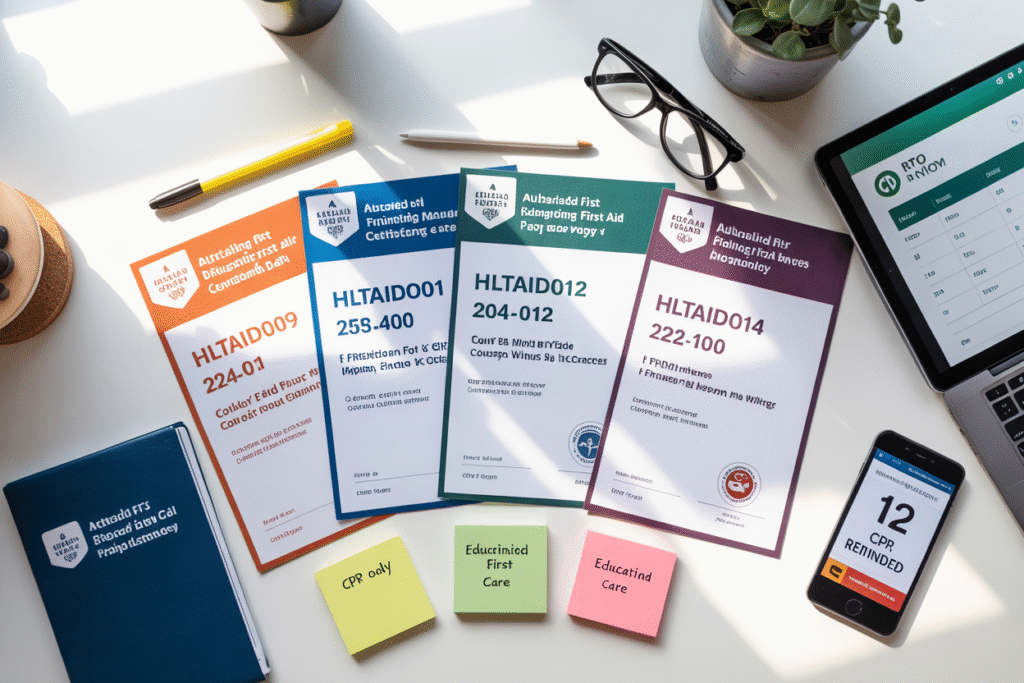
You start googling “first aid course” and suddenly you’re drowning in course codes—HLTAID009, HLTAID011, HLTAID012, HLTAID014. What the hell is the difference?
The Four Main First Aid Courses
HLTAID009 – Provide CPR: CPR only. Most employers won’t accept this by itself—they want the full first aid qualification.
HLTAID011 – Provide First Aid ⭐ (This is the one most people need): Your standard, comprehensive first aid course. Covers CPR plus everything else—bandaging, burns, fractures, medical emergencies. When your boss says “get your first aid certificate,” this is what they mean.
Who needs this: Retail workers, office staff, hospitality managers, personal trainers, pretty much anyone needing workplace first aid certification.
HLTAID012 – Provide First Aid in an Education and Care Setting: Everything in HLTAID011, plus extra child-specific content. Covers asthma management in kids, anaphylaxis protocols, child-specific scenarios.
Who needs this: Childcare educators, teachers, school staff.
HLTAID014 – Provide Advanced First Aid: Two full days of training. Way more comprehensive—covers remote area injuries, advanced casualty management, multi-casualty incidents.
Who needs this: FIFO workers, mine sites, remote tourism operators, outdoor adventure guides.
⚠️COMMON MISTAKE: Most people book HLTAID009 (CPR only) thinking it's faster and cheaper, then find out their employer needs HLTAID011 (full first aid). Don't waste your time and money—check with your employer first.
What HLTAID011 Covers
This is the nationally recognized standard first aid qualification. It replaced the old HLTAID003 “Apply First Aid” back in 2022.
Life-Threatening Emergencies:
- CPR for adults, children, and infants
- Using an AED
- Managing choking
- Severe allergic reactions (anaphylaxis)
- Heart attack and stroke recognition
Injury Management:
- Serious bleeding control
- Burns and scalds
- Fractures and dislocations
- Sprains and strains
- Head and spinal injuries
Medical Emergencies:
- Asthma attacks
- Diabetic emergencies
- Seizures
- Poisoning
- Heat exhaustion and hypothermia
The pass rate is around 98%. The instructors make sure you’re comfortable before they assess you. If you need extra practice time, they give it to you.
Does HLTAID011 Include CPR?
Yes. Stop stressing about this.
HLTAID011 includes all the CPR content. You don’t need to book two separate courses. CPR is built into the first aid training.
The only time you’d book HLTAID009 separately is for your annual CPR renewal—because while your full first aid certificate lasts 3 years, the CPR component needs refreshing every 12 months.
How to Know Which Course Your Employer Wants
Most employers are pretty vague. They’ll say “get your first aid” without specifying exactly which course code.
Here’s how to figure it out:
- Check your position description
- Ask HR directly – “Do I need HLTAID011 or HLTAID012?”
- Look at your old certificate – If it says HLTAID003, you need HLTAID011 now
- Check industry requirements – Fitness Australia requires HLTAID011, childcare requires HLTAID012
Still not sure? Call the training provider before you book. A good provider will help you figure out exactly what you need.
Choosing a Provider
Most first aid providers teach basically the same content. It’s nationally standardized. So why does it matter who you book with?
Because the difference isn’t in what they teach. It’s in how they teach it.
What Makes a Quality Provider
Small Class Sizes
Large classes (20-25 students) mean one instructor trying to monitor 25 people doing CPR. You get maybe 2 minutes of individual coaching all day.
Small classes (10-15 students) mean the instructor can actually watch your technique, you get proper individual coaching, and you leave feeling confident, not just certified.
Ask: “How many students are typically in your classes?” If they won’t give you a straight answer, that usually means they cram in as many as possible.
Experienced Instructors
Look for instructors who are current or former paramedics, emergency department nurses, or have 5+ years emergency response experience.
Check the provider’s website. Do they list instructor qualifications? Do they have photos and bios?
Red Flags to Avoid
Red Flag #1: No physical address or venue details until after you’ve paid
Red Flag #2: “Fully online” first aid courses (you can NOT do HLTAID011 fully online—it requires face-to-face practical assessment)
Red Flag #3: No reviews or only old reviews. Check Google Reviews. Look for recent reviews (past 3-6 months), 4.5+ star average from 50+ reviews.
Red Flag #4: Can’t verify RTO registration. Check ASQA’s website to confirm they’re a registered training organization.
Tips for Success
Before the Course
Get decent sleep the night before. Showing up tired makes everything harder.
Eat breakfast. If you rock up on an empty stomach, by mid-morning you’ll be distracted by hunger.
Wear comfortable clothes you can move in. Jeans or trackies, t-shirt, sneakers.
During the Course
Ask questions. Every question you ask is probably saving 3-4 other people who were too shy to ask.
Practice as much as possible. The more times you physically do the compressions, the more automatic it becomes. People who practice 15-20 times walk into the assessment feeling way more confident.
Focus on CPR technique. Pay extra attention to hand position, arm position (elbows locked straight), body position, compression depth (5-6 cm), and rhythm (100-120 compressions per minute).
Listen to instructor feedback. When the instructor says “Push a bit harder” or “Lock your elbows,” they’re coaching you, not criticizing.
During Assessment
Talk through what you’re doing. Narrate your actions out loud: “I’m checking the scene for danger… checking for response… checking for breathing… calling Triple Zero now… starting CPR…”
Don’t rush. This isn’t a timed race. Take your time. Do it right.
Trust your practice. By the time you get to the assessment, you’ve done CPR 15-20 times. Your hands know what to do.
After Certification
Your Certificate
Most providers email your digital certificate within 2 hours of finishing the course. Save it in multiple places (computer, cloud, email folder). Send a copy to your employer if they require it.
Most providers also mail you a wallet-sized card. Keep this in your wallet.
Certificate Validity
Full First Aid Certificate: 3 years
CPR Component: 12 months (requires annual renewal)
Set calendar reminders now:
- 11 months: “CPR renewal due in 30 days”
- 2 years 11 months: “First aid renewal due in 30 days”
Using Your Skills
Most people never use their first aid training for a serious emergency. And that’s actually good.
But about 15-20% of people DO use their training within the first 2 years. Usually workplace incidents, family emergencies, or public situations.
You might use it and not even realize. You’ll start doing things automatically—cooling a burn under running water for 20 minutes, elevating a sprained ankle, recognizing that someone’s chest pain is serious.
That’s your training working. It becomes instinct.
Career Benefits
First aid certification makes you a more attractive candidate for management, supervisory, or customer-facing roles. Many management positions require current first aid as a baseline qualification.
Fitness/Personal Training: Can’t register with Fitness Australia without it—mandatory requirement
Childcare/Education: Can’t work in regulated education without HLTAID012—non-negotiable
Retail/Hospitality Management: Usually required for supervisor and above
The Confidence Factor
Getting first aid certified changes how you move through the world.
You stop being the person who hopes someone else will help. You become the person who CAN help.
That subtle shift in self-identity—from helpless bystander to capable responder—affects how you show up in all kinds of situations.
It’s not just about CPR. It’s about knowing you’ve got skills that matter. That you can be useful when things go wrong. That people can count on you.
Ready to Learn First Aid?
You’ve got all the information. You know which course you need, what to expect during training, and how to choose a quality provider.
The hardest part is just making the decision and following through.
First aid isn’t just a workplace requirement—it’s a skill that could genuinely save someone’s life. Your partner’s. Your kid’s. A stranger’s. Maybe even your own.
Stop putting it off. Find a reputable provider, book your course, and get certified.
You’re one booking form away from having life-saving skills.
Book Your First Aid Training Now
Fast, affordable, and nationally accredited training delivered by professionals who care
Frequently Asked Questions
Q.Do I need CPR and first aid as separate courses?
No. HLTAID011 Provide First Aid includes CPR training. You don't need to book two separate courses. The only time you'd book HLTAID009 (CPR only) separately is for your annual renewal, since the CPR component expires every 12 months while the full first aid certificate lasts 3 years.
Q.Can I do first aid training completely online?
No. You can do some theory online through blended learning, but HLTAID011 requires in-person practical assessment. You need an instructor to physically watch you perform CPR and assess your technique. Any provider claiming "fully online first aid certification" isn't offering legitimate HLTAID011 training.
Q.What's the pass rate for first aid courses?
Around 98% of students pass on their first attempt. Instructors ensure you're prepared before assessment and provide additional coaching if needed. Most providers let you practice more and reassess at no extra cost if you're struggling.
Q.How long is my first aid certificate valid?
The full HLTAID011 certificate is valid for 3 years. However, the CPR component requires annual renewal every 12 months. You'll need to complete HLTAID009 (CPR refresher) each year to keep your CPR current.
Q.What if my old certificate says HLTAID003?
HLTAID003 "Apply First Aid" was replaced by HLTAID011 "Provide First Aid" in 2022. They're essentially the same course with updated content. If your HLTAID003 has expired, you need to complete HLTAID011 to renew it.
Q.Can I do first aid training if I'm not physically fit?
Yes. First aid training is suitable for all fitness levels and ages. Instructors can modify techniques for physical limitations, injuries, or mobility concerns. Tell the instructor at the start about any physical issues—they'll show you alternative positions or methods.
Q.What should I wear to a first aid course?
Wear comfortable clothes you can move and kneel in—jeans or trackies, t-shirt, flat shoes. You'll be getting up and down from the floor multiple times for CPR practice. Avoid tight skirts, high heels, or restrictive clothing.
Q.What happens if I fail the practical assessment?
Failing is extremely rare (only 2% of students). If you struggle with the assessment, instructors provide extra coaching until you're confident. Most providers let you practice more and reassess the same day at no extra cost. Nobody leaves without their certificate.
Q.Do I need to bring anything to the course?
Just yourself, comfortable clothes, lunch (or money for food), and a water bottle. The provider supplies all training materials, mannequins, bandages, and equipment. You don't need to bring notebooks—you'll receive a student manual.
Q.Can I use my first aid skills legally if something happens?
Yes. Good Samaritan laws in Queensland (and all of Australia) protect people who provide emergency assistance in good faith. You can't be sued for trying to help in an emergency, even if the outcome isn't perfect. However, you're not legally required to help strangers—it's your choice.
Making first aid training more affordable for
every classroom
We believe every student deserves access to life-saving first aid knowledge. That’s why we offer specially reduced pricing for schools and educational groups. Whether you’re booking for a single class, a year group, or your entire school, our flexible packages make training more accessible and cost-effective — without compromising quality.
