
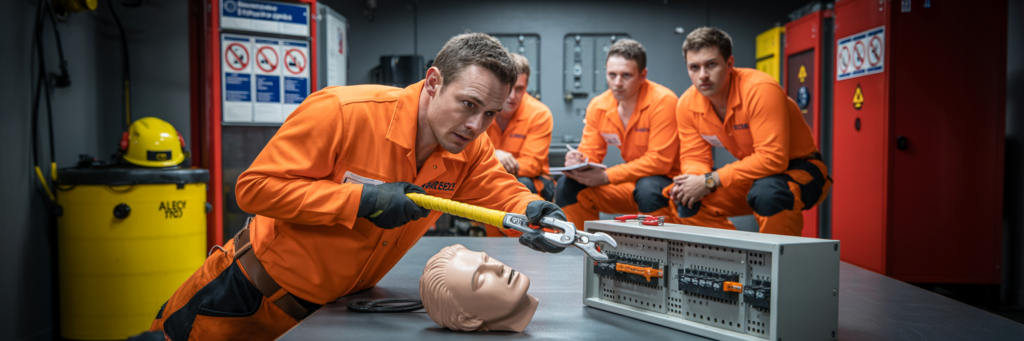
Your apprentice is convulsing against a live switchboard panel. Everyone on site is looking at you—the licensed sparkie—to act. Do you know exactly what to do in the next 10 seconds?
Every electrician carries a Low Voltage Rescue certificate, but when WorkSafe reports that electrical incidents remain among the most severe workplace injuries, the question isn’t whether you’re certified—it’s whether you’re actually prepared.
I’ve been there. Commercial fit-out, 2019. Young bloke—couldn’t have been more than 22—contacted a live busbar during panel testing. The sound he made wasn’t human. Everyone froze. I had about three seconds to decide if I remembered my training from two years earlier or if we were about to have a fatality.
That’s the thing about low voltage panel rescue procedures—you don’t get to practice on the real thing. You either know what to do instinctively, or you hesitate. And hesitation kills.
This comprehensive guide breaks down proper low voltage panel rescue procedures step-by-step, from initial assessment to successful victim separation. Whether you’re renewing your PERFORM RESCUE FROM A LIVE LOW VOLTAGE PANEL certification or need a practical refresher, you’ll learn the critical techniques that could save a crew member’s life.
How to Perform a Low Voltage Rescue
To perform a low voltage rescue safely, follow these critical steps:
- Assess the scene – Make sure your own safety before approaching. Identify all power sources and potential hazards.
- Isolate the power – Locate and switch off the main isolator or circuit breaker supplying the affected panel. Verify isolation with a test device.
- Separate the victim – Use an insulated rescue hook or non-conductive material to break contact between the victim and the electrical source. Never use bare hands.
- Move to safety – Carefully drag or carry the victim away from the electrical hazard to a safe area at least 10 meters from the panel.
- Begin CPR if needed – Check for breathing and pulse. Start CPR immediately if the victim is unresponsive and call 000.
- Do not re-energize – Keep power isolated until the area is cleared and assessed by qualified personnel.
⚠️ CRITICAL SAFETY REMINDER: In multi-victim electrical incidents, the second victim is almost always the rescuer who touched an energized person without proper assessment. Your instinct will be to rush in and help immediately. That instinct kills rescuers. Force yourself to pause for 10 seconds before approaching any electrical emergency.
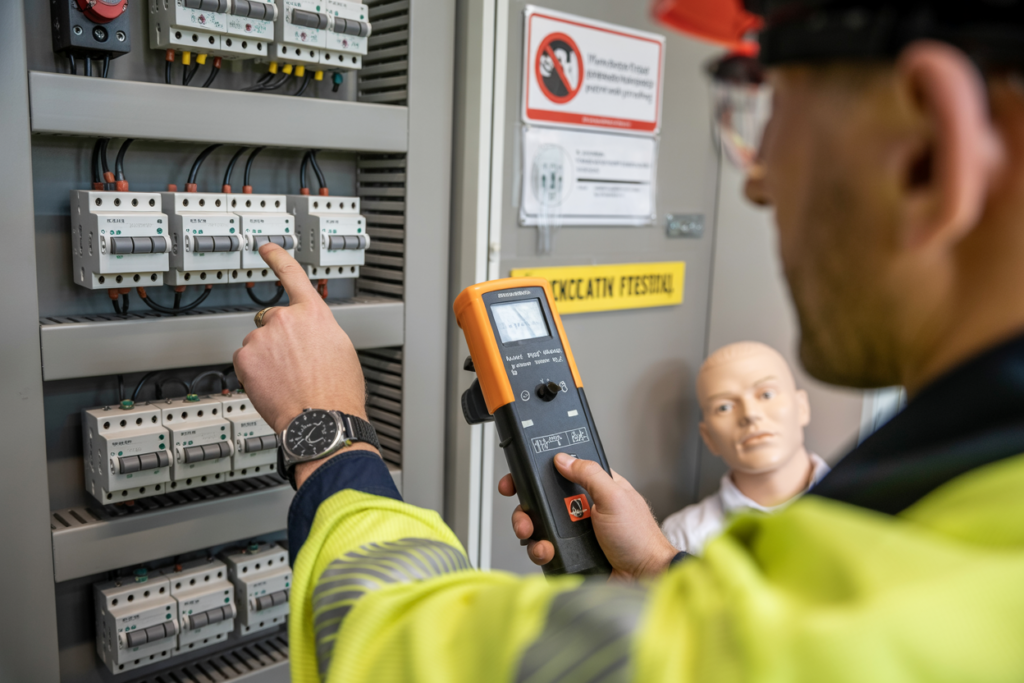
Understanding Low Voltage Panel Rescue Emergencies
What Constitutes a Low Voltage Rescue Situation
Low voltage is defined as up to 1000V AC or 1500V DC under electrical safety regulations. While “low voltage” might sound relatively safe, 240V household current or 415V commercial power can easily cause fatal injuries.
A low voltage panel rescue situation occurs when a person comes into contact with energized electrical conductors or equipment and cannot break free. Common scenarios include:
- Switchboard maintenance work where an electrician contacts a live busbar
- Panel testing where inadequate isolation leads to unexpected energization
- Circuit work where multiple power sources create confusion
- Apprentice errors during supervised electrical work
The victim typically cannot release their grip due to involuntary muscle contractions caused by electrical current passing through their body. This “can’t let go” phenomenon occurs because electricity causes muscles to contract—and the hand muscles that close your grip are stronger than those that open it.
Why Standard First Aid Isn’t Enough
Your standard workplace first aid training—while valuable—doesn’t prepare you for electrical rescue scenarios. Here’s why specialized low voltage rescue training is legally required:
Ongoing energization risk: The victim remains in contact with the electrical source. Every second of delay increases injury severity, but rushing in without assessment can create a second victim.
Rescuer safety paradox: Your instinct is to help immediately. But in electrical emergencies, that instinct can kill you. You must override your natural response and follow a methodical procedure.
Legal requirements: WorkSafe mandates that all persons performing electrical work must hold current PERFORM RESCUE FROM A LIVE LOW VOLTAGE PANEL certification. This isn’t optional—it’s a legal requirement for holding a Restricted or Unrestricted Electrical License.
Recognizing Electrical Shock Symptoms
Being able to rapidly identify an electrical shock emergency can save critical seconds. Look for:
Visible signs:
- Victim in physical contact with electrical equipment or conductors
- Involuntary muscle contractions or rigid posture
- Electrical burns (entry and exit wounds)
- Victim unable to release grip from equipment
Audible indicators:
- Buzzing or humming sound from electrical equipment
- Arcing or crackling sounds
- Victim unable to speak or call for help
Environmental clues:
- Smell of burning (flesh, insulation, or equipment)
- Visible smoke or fire
- Damaged or exposed conductors
- Other workers backing away from area in alarm
Pre-Rescue Safety Assessment (The Critical First 10 Seconds)
The “Don’t Become a Second Victim” Protocol
The hardest thing you’ll ever do in an emergency is pause. Every instinct screams at you to rush forward and help. But in electrical rescue, that impulse kills.
The brutal statistics: In multi-victim electrical incidents, the second victim is usually the would-be rescuer who touched an energized person without assessment. You cannot help anyone if you’re incapacitated.
I watched this happen at a data center in 2017. Electrician contacted live equipment. His mate—good bloke, been a sparkie for 15 years—saw him convulsing and grabbed him without thinking. Two victims instead of one. Both survived, but barely. The “rescuer” spent three weeks in ICU.
The 10-Second Assessment
Before you approach any electrical rescue scenario, force yourself to take 10 seconds. Count them out loud if you have to. Those 10 seconds feel like an eternity when someone’s dying in front of you, but they’re what separate successful rescues from disasters.
What to check in your assessment:
- Multiple power sources: What’s the primary power source for this panel? Are there backup generators, UPS systems, solar connections, or parallel feeds?
- Environmental hazards: Wet floors, metal structures that could be energized, confined spaces, heights, heavy equipment nearby.
- Victim contact points: Where is the electrical contact? Can you see it clearly? Is the victim still rigid (still energized) or limp (lost contact)?
- Isolation points: Where’s the main isolator? Can you reach it safely? Is there upstream isolation if the local isolator is unsafe?
- Available equipment: Insulated rescue hooks, protective equipment, improvised tools?
- Your escape route: If things go wrong, where do you go?
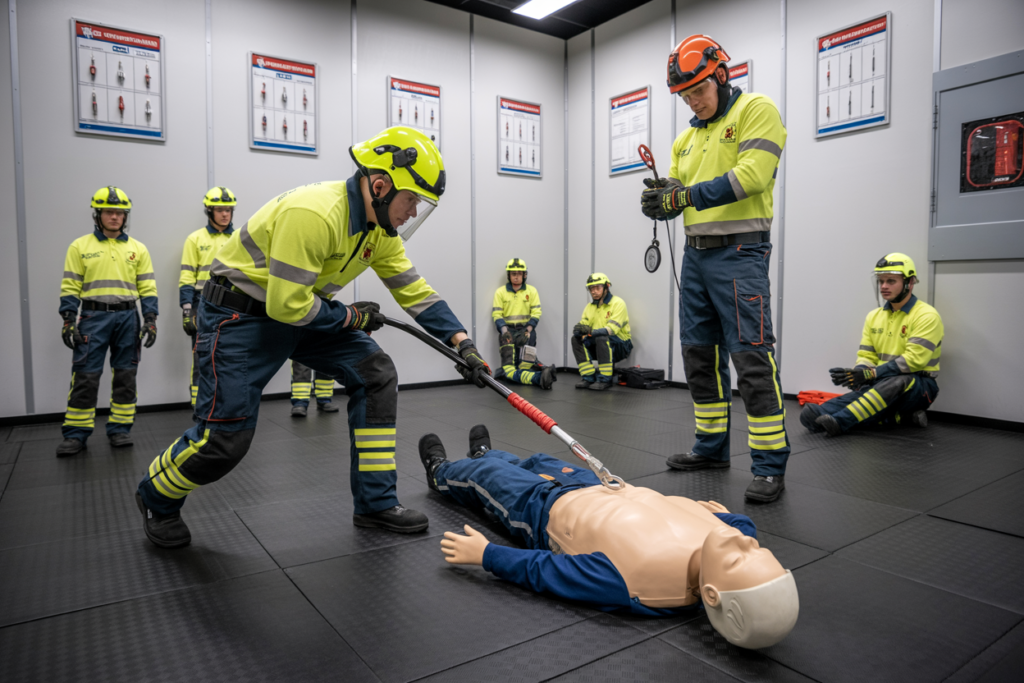
Power Isolation Procedures
Once you’ve confirmed the scene is safe to approach and identified all power sources, the next critical step is proper isolation.
Isolation Priority Hierarchy
- Remote isolation (safest): Cut power from a location where you’re not near the victim or energized equipment. Upstream switchboard, main distribution board, or building main switch.
- Local isolation (acceptable if safe): Isolator or circuit breaker near the affected panel—but only if you can reach it without contacting energized parts or the victim.
- Alternative separation (if isolation impossible): Use insulated rescue hook or non-conductive material to break victim’s contact with the electrical source.
- Wait for fire brigade (when situation exceeds your capability): Multiple unidentified power sources, high voltage equipment, or extreme hazards.
Step-by-Step Isolation Procedure
Before you touch the isolator:
- Confirm this is definitely the correct isolation point
- Check the isolation device isn’t damaged
- Make sure you’re not standing in water or touching metal structures
- Take a breath (panicked mistakes kill people)
Operating the isolation device:
- Switch to OFF position firmly
- Don’t hesitate halfway (creates arcing)
- Confirm it stays in OFF position
- If multiple breakers, isolate all relevant circuits
Multiple Power Source Complications
Modern commercial sites have power coming from everywhere. That panel might still be energized from rooftop solar even though you’ve isolated the grid supply. Generator backup systems, UPS systems, multiple grid connections, temporary construction power—all create complications.
⚡ If you can't isolate: Use insulated rescue hook to separate the victim, wait for fire brigade if the situation is too complex, or call the network operator to isolate at the street level.
CPR Quick Reference for Electrical Shock Victims:
| Assessment | Finding | Your Action |
|---|---|---|
| No pulse, no breathing | Cardiac arrest | Start CPR immediately (30 compressions, 2 breaths) |
| Pulse present, no breathing | Respiratory arrest | Rescue breaths only (check pulse every 2 minutes) |
| Pulse present, breathing | Conscious or unconscious | Recovery position, monitor closely, call 000 |
| Agonal breathing (gasping) | Cardiac arrest | Treat as no breathing - start CPR |
Post-Separation Emergency Response
You’ve got the victim separated and moved to safe distance. What happens in the next 60 seconds determines if they live or die.
Immediate Assessment (The ABC Check)
A – Airway: Check if airway is clear. Look in mouth for obstructions, tongue hasn’t fallen back, no vomit or blood. Position head properly (head tilt, chin lift).
B – Breathing: Is the victim breathing? Don’t spend more than 10 seconds checking. Look for chest rising, listen for breath sounds, feel for air movement.
Electrical shock victims might have stopped breathing entirely, agonal breathing (irregular gasping – NOT effective breathing), or shallow rapid breathing.
C – Circulation: Check for pulse at carotid artery in neck. Maximum 10 seconds. Electric current through the chest causes cardiac arrest more often than any other injury mechanism.
If no pulse and no breathing: Start CPR immediately.
Starting CPR for Electrical Shock Victims
Standard CPR protocol:
- Position victim flat on back on hard surface
- Heel of one hand on center of chest, other hand on top
- Push hard and fast (at least 5cm depth, 100-120 compressions per minute)
- 30 compressions, then 2 rescue breaths
- Continue until ambulance arrives
Electrical shock considerations: Victims sometimes don’t respond to CPR as quickly as other cardiac arrest causes. Don’t give up. I’ve seen victims take 15-20 minutes of CPR before they came back.
Using an AED
If there’s an AED on site, get it immediately. Turn on the AED, attach the pads (one upper right chest, one lower left chest), let the AED analyze, follow AED instructions.
Calling 000
Point at a specific person: “You. Red shirt. Call 000 now. Tell them electrical shock, not breathing. Give them this address. Come back and confirm you’ve called.”
Get acknowledgment. They’re now responsible for the call.
Managing the Scene While Performing CPR
Designate someone to keep other workers back. Monitor for re-energization risk—someone needs to watch that no one approaches the panel or tries to restore power.
Don’t move the victim unless absolutely necessary. Only move if fire develops, weather exposure is severe, or location prevents effective CPR.
Electrical Burn Assessment
Look for electrical burns while performing CPR or after they’re breathing. Entry wounds (usually hands) and exit wounds (usually feet). Surface burns might look minor—the real damage is internal.
This is why electrical shock victims ALWAYS go to hospital, even if they seem fine.
Common Mistakes That Endanger Rescuers
After training thousands of electricians, I’ve seen the same dangerous mistakes repeated. These aren’t theoretical errors—these are actual mistakes that get rescuers killed.
Mistake #1: Rushing In Without Assessment
You see your mate being electrocuted. You run forward and grab them. Now you’re victim number two. The same current flowing through them is now flowing through you.
Force yourself to pause. Count to 10 out loud. Those 10 seconds separate successful rescues from disasters.
Mistake #2: Assuming Power Is Isolated
You flipped the breaker. Panel lights went off. You assume power is dead. But commercial sites often have multiple power sources—solar, generators, UPS systems, parallel feeds from different switchboards.
Quick verification takes 5 seconds. Check panel indicator lights, listen for equipment sounds, use non-contact voltage detector if available. If any doubt exists, use insulated rescue hook instead of direct contact.
Mistake #3: Using Bare Hands for Victim Separation
Even after isolation, there can be stored energy in capacitors, residual charge in cables, equipment you didn’t realize was still energized. Use insulated rescue hook even after isolation.
Mistake #4: Neglecting to Guard Isolation Points
You’ve isolated power, performed rescue, victim is receiving CPR. Meanwhile, someone else on site doesn’t know what’s happening. They see a tripped breaker. They “fix” it by re-energizing.
Soon as you isolate, designate someone specific to guard that isolation point. Point at them: “You. Stand right here. No one touches this switch until I tell you.”
Mistake #5: Inadequate Distance from Electrical Source
You’ve separated the victim. You move them 2 meters away and start CPR right there. But arc flash risk, re-energization risk, and secondary hazards mean you need minimum 10 meters from electrical source.
Mistake #6: Delaying or Not Calling 000
Someone says “should we call an ambulance?” You reply “let’s see if they start breathing first.” Wrong. Call 000 immediately. Ambulance dispatch time is typically 8-15 minutes. Every minute you delay calling adds to response time.
Mistake #7: Inadequate CPR Quality
You start CPR but you’re exhausted after 3 minutes. Compressions get shallow and slow. Poor quality CPR is barely better than no CPR.
Get someone to swap with you. Rotate compressions every 2 minutes. Push HARD—you’ll probably crack ribs. That’s normal and acceptable. Broken ribs heal. Dead doesn’t.
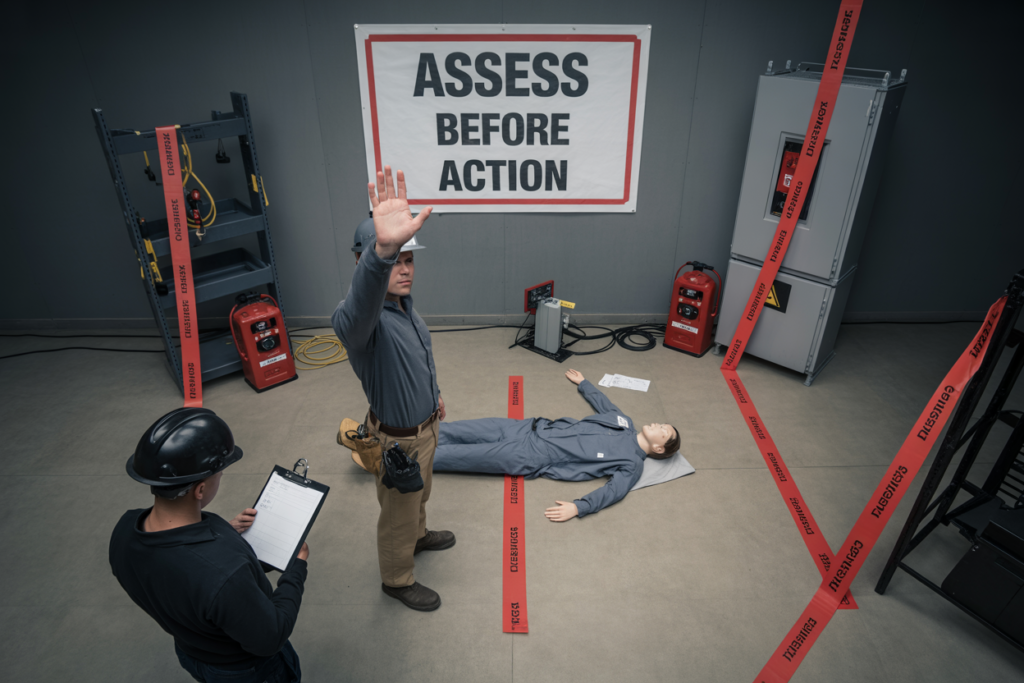
Building Rescue Competence (Not Just Certification)
There’s a massive difference between holding a Low Voltage Rescue certificate and actually being able to save someone’s life.
Most sparkies get training the same way: warehouse with 35 other people, sit through PowerPoint slides, practice on a mannequin for 10 minutes total, pass a test, get a certificate.
This training model is broken.
WorkSafe data shows that 45% of rescue failures are due to rescuer hesitation. Not equipment problems. Just people freezing because their training was inadequate.
What Quality Training Actually Involves
Repetition-based practice: You need to perform the rescue procedure 10-15 times minimum. One practice attempt gets you to “I understand the concept.” Fifteen attempts gets you to “I can execute this instinctively.”
Realistic electrical scenarios: Training should use actual electrical equipment mockups. Mock switchboards that look like real panels, equipment positioned at realistic heights, confined space scenarios.
Electrical-experienced instructors: Your instructor should be a licensed electrician with years of experience who’s actually performed rescues or witnessed electrical emergencies.
Stress inoculation exercises: Practice under pressure—time limits, noise and distractions, multiple people watching. Under stress, your performance degrades. If you’ve only practiced in calm conditions, real emergencies will overwhelm you.
Self-Assessment: Are You Actually Competent?
Answer honestly: If someone got electrocuted tomorrow, would you know exactly what to do without hesitation?
If you hesitated answering that question, your competency is inadequate. Certificate or no certificate.
The Muscle Memory Factor
Competence isn’t about memorizing steps. It’s about muscle memory—your body executing the procedure automatically without conscious thought.
Most Low Voltage Rescue training gets you to “consciously thinking about every step.” You need “body executes automatically” for real emergencies.
💡 How to know you've achieved muscle memory: If someone asked you to explain the rescue procedure in detail, you might struggle to verbalize every step—because you perform it automatically. That's genuine competence.
Conclusion
The six steps are straightforward: Assess, Isolate, Separate, Move, CPR, Don’t re-energize. But knowing the steps intellectually and being able to perform them under pressure are completely different things.
Quality training creates muscle memory through repetition. Not one practice attempt with 40 other people watching. Fifteen attempts with individual coaching until it’s automatic.
Your Low Voltage Rescue certificate might satisfy compliance requirements, but the real question is: Would you actually know what to do if your apprentice grabbed a live busbar tomorrow?
If you hesitated answering that question, your competency needs refreshing.
Book Your First Aid Training Now
Fast, affordable, and nationally accredited training delivered by professionals who care
Frequently Asked Questions About Low Voltage Panel Rescue Procedures
Q.How long does Low Voltage Rescue certification last?
The PERFORM RESCUE FROM A LIVE LOW VOLTAGE PANEL certification is valid for 3 years from the date of issue. However, the CPR component may require annual renewal depending on your insurer and WorkSafe requirements. Most electricians renew both components every 3 years during their license renewal, but best practice is to refresh CPR annually since muscle memory degrades faster than the certificate expires.
Q.Can I perform a low voltage rescue without proper training?
Legally, no—WorkSafe mandates current certification for anyone performing electrical work. Practically, attempting rescue without training dramatically increases your risk of becoming a second victim. While Good Samaritan laws may protect bystanders who attempt rescue, electricians are held to higher standards and can face prosecution if they attempt rescue without current certification. If you're not trained and certified, call 000 and establish a safety perimeter rather than attempting rescue yourself.
Q.What's the minimum safe distance from an electrical panel during rescue?
The standard minimum safe distance is 10 meters from the electrical source when performing rescue operations or CPR. This distance protects you from arc flash if stored energy discharges, provides buffer if power is accidentally re-energized, and removes you from secondary hazards like collapsing panels or falling cables. In confined spaces where 10 meters isn't possible, you need 100% certainty that power is isolated and someone guarding the isolation point.
Q.Should I move an electrical shock victim before ambulance arrives?
Only move the victim twice: first, immediately after separation, drag them minimum 10 meters from the electrical source to protect both of you from re-energization or arc flash; second, only move them again if fire develops, weather exposure becomes severe, or their location physically prevents effective CPR. Otherwise, keep them in place once they're at a safe distance. Moving victims unnecessarily can worsen internal injuries and interrupts CPR quality.
Q.How do I know if someone is being electrocuted or just unconscious?
Key indicators of active electrocution: victim in physical contact with electrical equipment, rigid posture with locked muscles (especially clenched fists), inability to respond to verbal commands, buzzing or arcing sounds from equipment, smell of burning, and other workers backing away in alarm. An unconscious person who's not being electrocuted will be limp, not rigid. If you see someone collapsed near electrical equipment, always assume electrocution until proven otherwise—approach with extreme caution and assess for 10 seconds before acting.
Q.How often should I practice low voltage rescue procedures?
Formal retraining is required every 3 years for certification renewal, but competency degrades faster than that. Best practice is mental review of procedures every 6 months (talk through the steps, visualize the actions), physical practice annually if possible (some RTOs offer refresher sessions), and CPR practice every 6-12 months since it's physically demanding and requires muscle memory. If your last training was poor quality (one practice attempt with 40 other people), consider retraining with a quality provider rather than waiting 3 years.
Making first aid training more affordable for
every classroom
We believe every student deserves access to life-saving first aid knowledge. That’s why we offer specially reduced pricing for schools and educational groups. Whether you’re booking for a single class, a year group, or your entire school, our flexible packages make training more accessible and cost-effective — without compromising quality.
