
Your Low Voltage Rescue certificate expires in 47 days. You don’t remember exactly when. You’re juggling three commercial jobs, family responsibilities, and now this compliance deadline is adding to your stress. If WorkSafe Queensland shows up for a random audit tomorrow, are you 100% confident your paperwork is current?
Yeah, that’s what I thought.
Low voltage safety training isn’t just another compliance box to tick off. It’s your license protection. Your career insurance. And potentially the difference between your apprentice going home to his family or ending up in hospital because you froze when he got shocked.
Most electricians treat low voltage safety training like a tax return. Something you gotta do, don’t really want to do, and probably leave till the last possible minute. You book the cheapest course, sit through PowerPoint slides presented by someone who’s never picked up a multimeter, get your piece of paper, and forget everything within a week.
But that certificate isn’t optional. Your Restricted Electrical License depends on it. Your insurance depends on it. Your ability to walk onto a commercial site depends on it. And yeah, your ability to actually save someone’s life depends on it too.
This guide covers everything you need to know about low voltage safety training requirements in 2025. Current WorkSafe Queensland and ESO compliance requirements, what training you legally need, certificate validity periods, how to pick quality training that actually prepares you, and certificate management systems that work.
Whether you’re a newly licensed sparkie or a veteran contractor, this cuts through the noise and gives you what you need to keep your license current without losing your mind.
⚠️
COMPLIANCE QUICK CHECK
Your certificate expires in less than 90 days? Book training NOW. WorkSafe doesn't give grace periods, and your insurance won't cover you if something goes wrong while you're non-compliant. One expired certificate = license suspension risk.
What is Low Voltage Safety Training?
Low voltage safety training is mandatory workplace safety education that teaches you how to perform emergency rescue procedures when someone’s being electrocuted by low voltage electrical systems—anything up to 1000V AC or 1500V DC.
In Queensland, this training is legally required under WorkSafe Queensland regulations for anyone holding an electrical license. Full stop.
Here’s what it covers:
- Emergency response procedures – What you do in the first 30 seconds when someone gets shocked
- Safe isolation techniques – How to kill the power without becoming the second casualty
- Rescue from live panels – The hands-on technique for separating someone from a live panel
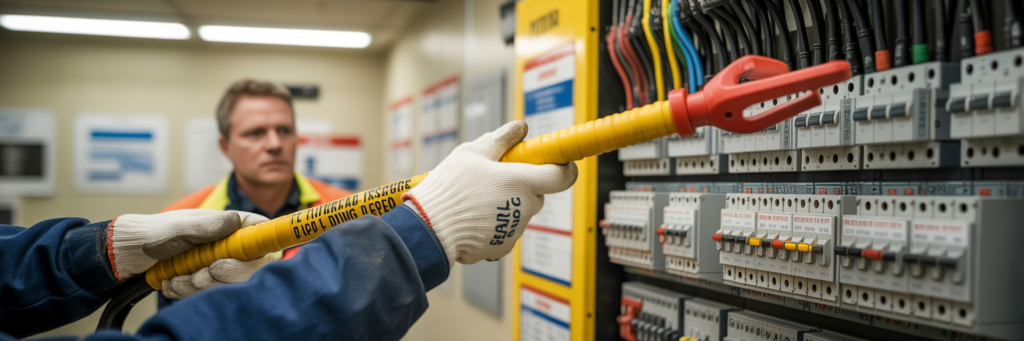
- Insulated rescue equipment – How to use rescue hooks and insulated tools under pressure
- CPR for electrical shock victims – The HLTAID011 component for electrical injuries
- Risk assessment – How to spot dangerous situations before they happen
- Legal obligations – What the Electrical Safety Act 2002 requires
The official unit is PERFORM RESCUE FROM A LIVE LOW VOLTAGE PANEL. That’s what ESO Queensland wants to see when you renew your license.
This training needs to be renewed every three years. Both Restricted and Unrestricted License holders need it. No exceptions. No “I’ve been doing this for 20 years” exemptions.
And no, your general first aid certificate doesn’t count. No, that online course isn’t recognized. The requirements are the requirements.
Queensland Low Voltage Safety Training Legal Requirements
Let’s talk about what you’re actually legally required to have. Not what some training provider says you should consider. Not what would be nice to have. What WorkSafe Queensland and the Electrical Safety Office will suspend your license over if you don’t have it.
WorkSafe Queensland Mandates
The Electrical Safety Act 2002 states that anyone performing electrical work must be competent in rescue and resuscitation procedures. “Competent” means you’ve got current certification from a registered training organization.
WorkSafe Queensland conducted over 3,400 workplace safety inspections across Queensland in 2024, with electrical work sites being a priority. When they show up—and they do show up without warning—they can ask to see your certifications on the spot.
Who needs current certification:
- Every licensed electrician (Restricted and Unrestricted)
- Electrical apprentices performing electrical work
- Anyone supervising electrical work
- Electrical contractors
The penalties aren’t just a slap on the wrist. WorkSafe can issue on-the-spot license suspension. Suspended right there. You’re done working until you sort it out.
Individual fines reach $13,345. Company fines up to $66,725. And if someone gets injured and WorkSafe finds your certifications weren’t current, you’re looking at prosecution, potential criminal charges, and insurance companies refusing claims.
The electrical community is tight. Word gets around fast. Get pinged for non-compliance, and every project manager you’ve worked with will hear about it within 24 hours.
Electrical Safety Office (ESO) Queensland License Requirements
| License Type | Low Voltage Rescue Required? | Renewal Frequency | ESO Documentation |
|---|---|---|---|
| Restricted Electrical License | Yes - Mandatory | Every 3 years | Certificate must be current at renewal |
| Unrestricted Electrical License | Yes - Mandatory | Every 3 years | Certificate must be current at renewal |
| Trainee License (Apprentice) | Yes - If performing electrical work | Every 3 years | Employer verification required |
When you renew through the ESO Queensland portal, you need proof of current Low Voltage Rescue certification. The certificate has to be valid when you submit your application. If your certificate expired last month, ESO will reject your application.
No grace periods or extensions. Your license expires on the date it expires. Your training certificate expires on the date it expires. If you let your license lapse due to expired training, you’re looking at a different reinstatement process, and you can’t work electrical in the meantime.
Your electrical license renewal and your Low Voltage Rescue certificate aren’t automatically synced. You might renew your license in January but your training expires in August. Track both separately.
Understanding Low Voltage Safety Training Certificate Validity
This is where a lot of electricians get caught out, so let’s be crystal clear about how long your certificates are actually valid and when you need to renew them.
Certificate Duration and Expiry Dates
Your Low Voltage Rescue certificate is valid for three years from the date you complete the course. If you finish training on 18 January 2025, your certificate expires on 18 January 2028. At 12:01am on 19 January 2028, you’re non-compliant. No grace period. No “close enough.”
The CPR component (HLTAID011) typically has 12-month validity, though some earlier versions were three years. Check your certificate for the actual expiry date.
Here’s the catch: your Low Voltage Rescue and CPR don’t necessarily expire at the same time. You might do combined training in January 2025, and your LV Rescue is good till January 2028, but your CPR expires in January 2026. That means CPR renewal in 2026 and both certificates renewed in 2028.
What’s Actually Covered in Quality Low Voltage Safety Training
Let’s talk about what you should expect from proper low voltage safety training. Not the bare minimum certificate-mill version. Actual quality training that might save someone’s life.
Core Training Units and Competencies
The mandatory unit is PERFORM RESCUE FROM A LIVE LOW VOLTAGE PANEL. The competency includes:
Identify and assess electrical emergencies – Recognize when someone’s in trouble, what voltage system is involved, and what hazards exist before you become casualty number two.
Perform safe isolation procedures – Know where the isolation point is, how to verify it’s isolated, and what to do if you can’t access the isolator.
Use insulated rescue equipment – Hands-on practice pulling someone off a live panel using proper technique. Reading about it doesn’t cut it.
Separate the victim from the electrical source – The physical technique for breaking contact without getting yourself electrocuted. This requires practice.
Assess the victim’s condition – Work out what injuries they’ve got and what immediate treatment they need. Electrical shock victims present differently.
Perform CPR for electrical injuries – The HLTAID011 unit focuses on electrical shock victims because electricity causes cardiac arrhythmias.
Communicate with emergency services – What information Triple Zero needs and how to describe hazards still present on site.
Practical Assessment Requirements
Quality training separates from rubbish training at the practical assessment. The unit requires demonstration of competency—you have to perform rescue procedures while an assessor watches. Multiple-choice questions don’t cut it.
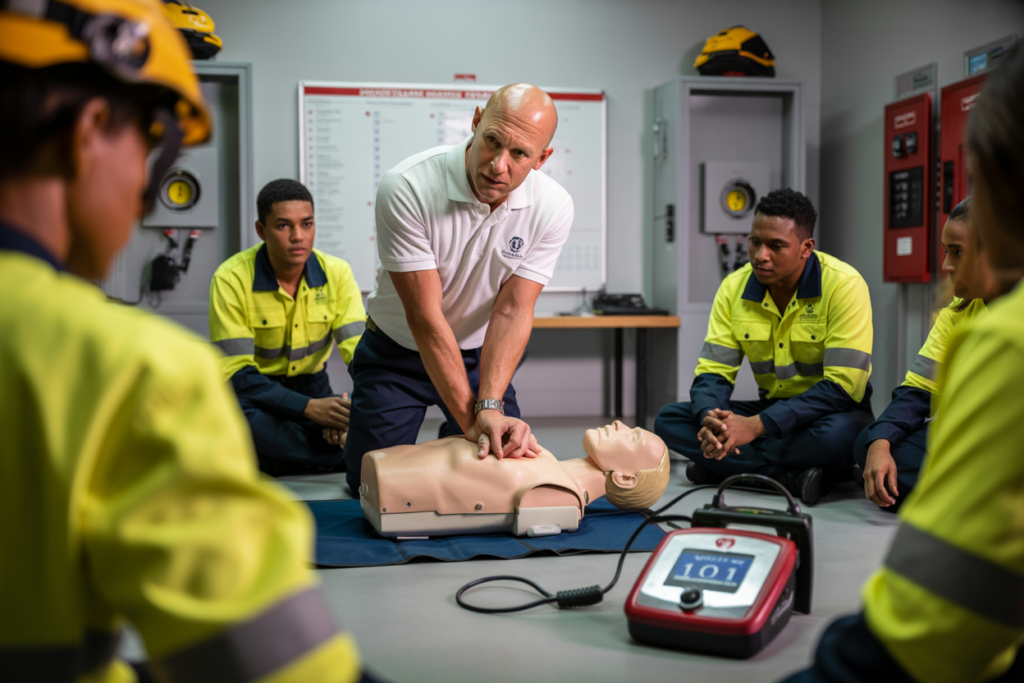
Quality training includes multiple practice scenarios with repeated rescue procedures until it becomes muscle memory. You should practice on actual switchboard and panel setups, not just generic mannequins. Time-pressure simulations matter because real emergencies don’t happen in slow motion.
If you’re sitting with dozens of others watching PowerPoint slides for hours, then getting a few minutes on a mannequin, that’s not preparing you for an actual emergency.
Theory Components and Knowledge Requirements
The theory should be directly relevant to job sites:
Electrical hazard recognition – Understanding what makes situations dangerous. Voltage levels, current paths, arc flash risks, secondary hazards.
Queensland electrical safety legislation – What the Electrical Safety Act 2002 requires and why.
Body systems and electrical injury – How electricity affects the heart, nervous system, muscles. Why someone might look fine but still need hospital transport.
Emergency response protocols – Step-by-step procedures for different scenarios. What you do if you can isolate power vs if you can’t.
The theory should be concise. You need enough to understand the why, but most of your time should be practical.
CPR Integration (HLTAID011)
The CPR component is integrated because electrical shock victims often need immediate CPR. HLTAID011 covers recognizing cardiac arrest, performing compressions, using AEDs, managing airways, and continuing CPR until ambos arrive.
For electrical shock victims, training should emphasize checking for ongoing electrical hazards before starting CPR, understanding electrical-induced cardiac arrhythmias, and proper AED use.
The CPR component should be practiced repeatedly. By the end, you should perform competent CPR without thinking about the steps—it should be automatic.
🔍 RED FLAGS VS GREEN FLAGS
| Red Flags (Avoid These Providers) | Green Flags (Quality Indicators) |
|---|---|
| No ASQA registration number visible | ASQA registration prominently displayed |
| "Our experienced instructors" (no names/credentials) | Named instructors with electrical trade backgrounds |
| Can't verify instructor qualifications | Licensed electrician instructors with 10+ years |
| Vague about practical training equipment | Specific details about electrical panel mock-ups |
| Online-only course options | Hands-on practical assessment required |
| Price seems too cheap (under $150) | Reasonable pricing for quality instruction |
Choosing Quality Low Voltage Safety Training Providers
You need low voltage safety training. You Google it. You get dozens of results all claiming they’re the best. How do you actually tell which ones are legitimate and which ones are just certificate mills?
ASQA Registration and RTO Verification
ASQA is the Australian Skills Quality Authority—the government body regulating training organizations. If a provider isn’t ASQA-registered, they can’t issue nationally recognized qualifications.
Every legitimate training provider displays an ASQA registration number prominently: “RTO #XXXXX” or “ASQA Registered RTO XXXXX.” If you can’t find this number within 30 seconds, that’s a red flag.
Verify the registration on the ASQA website at training.gov.au. It’ll tell you if they’re registered, what they can teach, and if they’ve got compliance issues.
Some dodgy operators display fake RTO numbers. Five minutes on the ASQA website tells you if they’re legitimate. Do this before you book.
WorkSafe Queensland also maintains a list of approved training providers for electrical safety training. Check both for certainty.
Practical Training Facilities and Equipment
Quality training requires proper equipment and facilities. Here’s what you should expect:
Electrical panel mock-ups – Realistic switchboards and distribution boards that look like what you’d encounter on job sites. Not just pictures of panels or generic metal boxes. Actual equipment you can practice on.
Insulated rescue equipment – Real rescue hooks, insulated poles, isolation devices. You should be handling the actual tools you’d use in an emergency, not just looking at photos of them.
CPR mannequins – Adequate mannequins for CPR practice. You need enough practice time.
Training space adequate for safe practice – Room to spread out, practice safely, and not be crammed shoulder-to-shoulder. Electrical rescue scenarios require space.
Ask providers about their facilities before you book. “What equipment will we be using for practical training?” If they can’t give you specific details, that’s a warning sign.

Certificate Management and Administrative Systems
Digital Certificates and Online Portal Access
Physical certificates are a pain. They get lost in your van, damaged, or fade. You need them on a job site and they’re at home.
Digital certificates solve this. A PDF certificate emailed after training is accessible from your phone anytime, can’t get physically lost, easy to forward to project managers, and can be stored in multiple places.
Quality training providers email your certificate within hours of completing the course.
Save your digital certificate in multiple places—multiple email addresses, Google Drive, Dropbox, your phone, your computer.
When a project manager asks for your LV Rescue certificate, you can forward it within 30 seconds.
Tracking Expiry Dates and Renewal Reminders
Most sparkies rely on memory to track certification expiry dates. Then they get caught out when something expires without them realizing.
Set phone calendar reminders:
- 90 days before expiry: First warning, consider booking renewal
- 60 days before expiry: Time to book renewal training
- 30 days before expiry: Urgent, book immediately
- 7 days before expiry: Critical
Taking Action: Getting Your Low Voltage Safety Training Sorted
If your Low Voltage Rescue certificate is expired or expiring soon, book training now. Every day you delay is another day you’re at risk of WorkSafe audit, project managers asking for certs you can’t provide, or your license becoming invalid.
The sparkies who maintain compliance without stress book renewal training 60-90 days before their certificate expires. They’re not scrambling for last-minute courses.
If your certificate expires in the next 90 days:
- Check training provider websites for course availability
- Compare 2-3 providers (instructor credentials, facilities, equipment)
- Book the soonest convenient course
- Set up calendar reminders for before the new certificate expires
If your certificate is already expired:
- Find the absolute soonest available course
- Don’t perform electrical work until you’re re-certified
- Book immediately
- Never let it happen again
If your certificate doesn’t expire for 6+ months:
- Set calendar reminders for 90/60/30 days before expiry
- Bookmark quality training providers
- Don’t get complacent
Your License, Your Responsibility
Nobody’s going to hold your hand and make sure your certifications stay current. Not ESO Queensland. Not WorkSafe. Not your project managers. That’s your job.
The sparkies who treat compliance as a priority don’t struggle with it. They book training well in advance. They track expiry dates properly. They choose quality providers who actually prepare them.
Book quality training. Show up on time. Take it seriously. Practice properly. Stay compliant.
Your license will stay active. Your conscience will stay clear. And if the worst happens on a job site, you’ll actually know what to do.
Book Your First Aid Training Now
Fast, affordable, and nationally accredited training delivered by professionals who care
Frequently Asked Questions About Low Voltage Safety Training
Q.How long is low voltage safety training valid for?
Your Low Voltage Rescue certificate (PERFORM RESCUE FROM A LIVE LOW VOLTAGE PANEL) is valid for three years from the date you complete the course, while the CPR component (HLTAID011) is typically valid for 12 months. You need to track both expiry dates separately because they don't necessarily expire at the same time, and ESO Queensland requires both to be current when you renew your electrical license.
Q.Can I do low voltage rescue training online?
No, you cannot complete low voltage safety training fully online. The competency unit requires practical demonstration of rescue procedures while being assessed, which can't be done remotely. Some providers offer blended learning with online theory components, but you still must attend in-person practical sessions for hands-on assessment. Fully online courses are either scams or issuing certificates that ESO Queensland and WorkSafe won't accept.
Q.Does my first aid certificate count as low voltage rescue training?
No, general first aid certificates don't satisfy low voltage rescue requirements. Standard first aid assumes hazards are already controlled, while low voltage safety training specifically teaches you to control active electrical hazards before providing care. ESO Queensland and WorkSafe require the specific PERFORM RESCUE FROM A LIVE LOW VOLTAGE PANEL unit—you need both first aid and low voltage rescue certifications separately.
Q.What do I need to bring to low voltage rescue training?
You need current photo ID (driver's license or passport), covered footwear (work boots or enclosed shoes—no thongs), a pen for taking notes, and a water bottle since the training involves physical practice. Don't bring laptops, electrical tools, or previous certificates unless the provider specifically requests them. Show up on time, ready to participate in hands-on practical scenarios.
Making first aid training more affordable for
every classroom
We believe every student deserves access to life-saving first aid knowledge. That’s why we offer specially reduced pricing for schools and educational groups. Whether you’re booking for a single class, a year group, or your entire school, our flexible packages make training more accessible and cost-effective — without compromising quality.
