
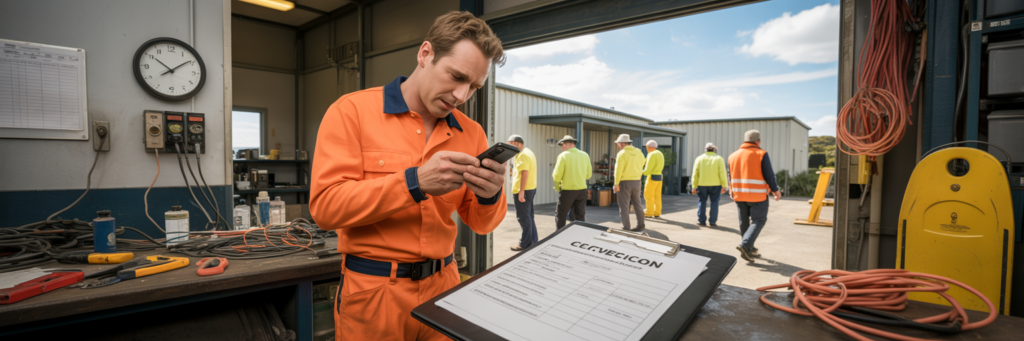
It’s 3pm Thursday afternoon. You’re finishing up a switchboard install when your phone buzzes. Text from the project manager: “Jake, need all your compliance docs by COB tomorrow for Monday’s hospital job start.”
You pull up your certs folder. CPR—current. White Card—current. Low Voltage Rescue—expired two months ago.
Now you’re scrambling. Google search: “LV rescue training Brisbane urgent.” First three results? Tuesday course (can’t lose a work day), weeknight sessions over three weeks, or next available course four weeks out.
Sound familiar?
Here’s the thing most Brisbane sparkies find out the hard way—when you need LV rescue training Brisbane fast, most providers just aren’t set up for it. They’re running courses once a month on Tuesday mornings like electricians don’t have jobs to get to.
But there’s a better way. Fast-track LV rescue training that doesn’t blow up your work schedule, doesn’t cost you hundreds in lost income, and gets you that certificate in your inbox same day.
Let’s talk about how to actually make this happen.
⚡ QUICK REALITY CHECK: Most Brisbane sparkies lose $400-600 taking a weekday off for training. Saturday courses eliminate that cost completely while getting you compliant in one morning. Same certificate, zero lost income.
How Long Does LV Rescue Training Take in Brisbane?
The course runs for approximately 2 hours, split between 1 hour of theory and 1 hour of practical training. This streamlined format delivers all required content efficiently, ensuring minimal downtime from work while maintaining full compliance.
Certificate delivery depends on the provider. Same-day digital certificates get emailed within hours of course completion—you can forward them to project managers that afternoon. Traditional providers take 7-14 days to mail physical certificates, which doesn’t help when you need compliance sorted by Monday.
The single-day intensive format is designed specifically for time-poor electricians who can’t afford multiple sessions or weekday training that costs hundreds in lost work income.
Why Brisbane Electricians Need Fast-Track LV Rescue Options
Look, the traditional training model was built back when sparkies were employed full-time by one company, got paid sick days, and could just tell the boss “I’ve got training Tuesday.” That’s not how most of us work anymore.
Compliance Deadlines Don’t Wait
Your Low Voltage Rescue cert doesn’t care that you’re busy. It expires exactly three years after issue date, and Electrical Safety Office Queensland doesn’t give extensions because you forgot.
Here’s where it gets real: WorkSafe Queensland can audit your compliance documentation anytime. Not scheduled, not with warning—just shows up on site and asks to see your current certifications. License gets suspended on the spot if you’re expired. Not “go get it sorted this week”—suspended immediately, stop work, leave site.
Your Restricted Electrical License renewal? Won’t process without current LV Rescue uploaded to the ESO portal. Miss that renewal window because you’re scrambling to find weekend training? Now you’re having conversations with licensing authorities about why your paperwork is late.
And project managers. They want compliance docs 24-48 hours before job commencement. Some bloke on the South Bank high-rise project lost a multi-week contract last year because he couldn’t produce current LV Rescue when the PM requested it Thursday afternoon. Job started Monday, went to someone else who had their docs sorted.
The Real Cost of Waiting
You realize your LV Rescue expires in 30 days. Think “plenty of time, I’ll sort it later.” Three weeks pass, suddenly it’s expired.
Week 1 expired: Commercial switchboard upgrade opportunity requests compliance docs. You can’t provide current LV Rescue. Job goes to competitor.
Week 2 expired: Your regular PM texts about a hospital maintenance contract. You mention you’re sorting your LV Rescue. PM uses someone else who’s compliant—and they become the new regular.
Meanwhile, your mate Dave booked Saturday training the day he realized his cert expired. Certificate in his inbox that afternoon, started Monday’s job fully compliant.
Brisbane’s electrical community isn’t that big. Project managers talk. “Jake’s good but his admin’s always a mess” becomes “just use Dave instead, less hassle.”
What to Look for in Fast-Track LV Rescue Training
Not all Saturday courses are created equal. Some are genuine fast-track training that actually prepares you. Others are just certificate mills that crammed a bad course into a weekend slot.
Here’s how to tell the difference when you’re looking for best LV rescue training Brisbane.
Instructor Credentials Matter
Your instructor’s background determines whether you walk out genuinely prepared or just holding another piece of paper you don’t trust.
Licensed electrician instructors vs generic OHS trainers. This one’s non-negotiable. You need someone who’s worked the tools, not someone who did a “Train the Trainer” course and now teaches everything from first aid to forklift operation.
An instructor who’s been a sparkie for 15-20 years knows what you’re actually dealing with on job sites. They understand the scenarios where things go wrong and can answer electrical-specific questions that generic trainers can’t.
When you ask “what if the main isolator’s behind the panel and I can’t access it?” you need an instructor who’s been in that exact situation.
Real emergency response background – separates instructors who’ve performed actual rescues from those teaching theory they’ve never used. You want to hear “here’s what actually happens” from someone who’s seen it, not someone reading from a textbook.
Check instructor bios before booking. Look for electrical license numbers, years working as electrician, and emergency response qualifications beyond just teaching credentials.
Practical Training vs Theory-Only Courses
You already know this from previous training—some courses are all PowerPoint slides and videos, some actually let you practice the skills.
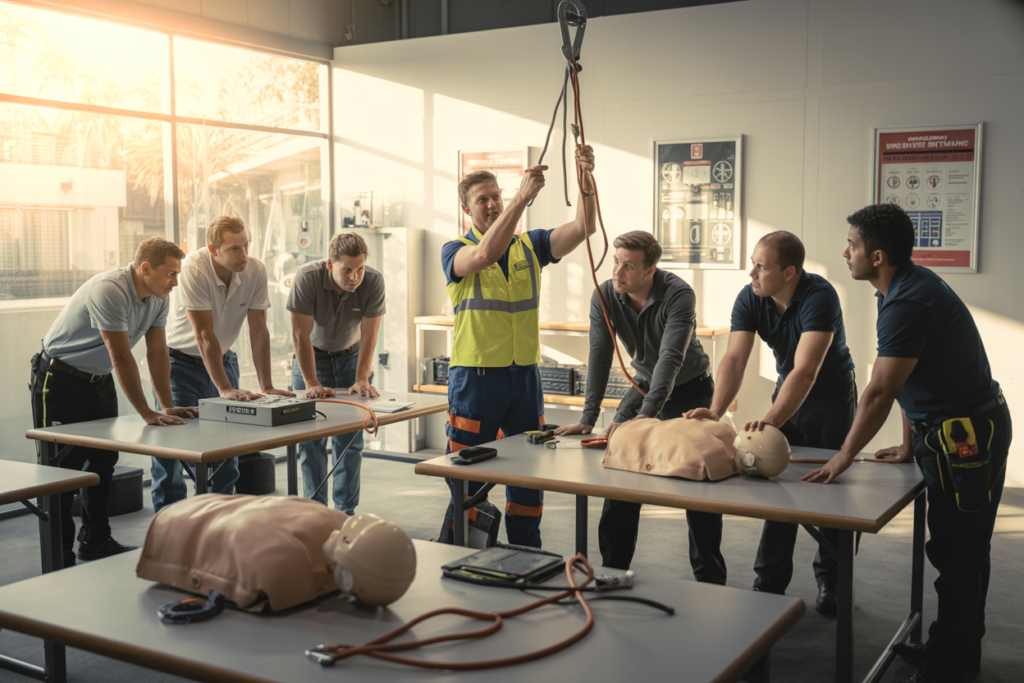
Hands-on practice requirements – should mean multiple repetitions. Not “watch the instructor demonstrate twice, then you try it once.” You need to perform the rescue procedure over and over until your hands know what to do without thinking.
Because if someone’s being electrocuted in front of you, you’re not going to calmly think through steps you learned in a video three years ago. You’re going to react with whatever muscle memory you’ve developed.
Good training has you practicing until it’s automatic. Approach the panel, verify isolation, use rescue hook to separate victim, check breathing, commence CPR. Do it enough times and your body remembers even when your brain’s panicking.
Realistic electrical scenarios – mean mock switchboards and panels that look like what you actually work on. Not generic mannequins lying on the floor. Proper electrical panels, circuit breakers, situations that mirror real job sites.
The certificate might look the same either way, but your confidence in a real emergency won’t be.
ASQA Registration and WorkSafe Approval
This is about making sure your certificate’s actually valid and won’t get rejected when you need it.
ASQA registration – means the training provider is a legitimate Registered Training Organisation. They’re audited by the Australian Skills Quality Authority, have to meet quality standards, can be held accountable if they’re issuing dodgy certificates.
Check the ASQA website—you can look up any RTO by name or registration number. Takes 30 seconds. If they’re registered, they’ll appear in the database.
Red flags of certificate mills:
- Price too good to be true when everyone else charges market rates
- No physical training facility address
- Generic hotmail/gmail contact email
- Certificates issued before course is actually completed
- No instructor credentials listed
- Reviews mentioning “just paid for certificate” or “barely any training”
WorkSafe Queensland prosecuted three RTOs in the last few years for issuing certificates without proper training delivery. Students who “completed” those courses had to re-certify with legitimate providers. That’s your money, your time, and your compliance risk if you choose the cheap option.
Your license is worth more than saving money on training. Use ASQA-registered providers, verify their registration number, check they’ve been operating for a few years.
The Same-Day Certificate Advantage
Getting your training done Saturday morning is one thing. Actually having the certificate in your inbox that afternoon? That’s what changes everything.
Why Same-Day Matters
Thursday 3pm: Project manager texts requesting compliance docs for Monday hospital job. Your LV Rescue expired. Panic mode.
Thursday evening: Find training provider with Saturday morning course. Book online in minutes. Confirmation SMS arrives immediately.
Saturday: Training complete.
Saturday afternoon: Digital certificate arrives in your email. Save it to three different places.
Saturday evening: Upload certificate to ESO Queensland portal from your phone. Forward to project manager. “All docs attached, see you Monday.”
Monday morning: You start the hospital job fully compliant. No drama, no delays.
That’s what LV rescue certificate same day Brisbane providers make possible. Thursday crisis to Monday compliance in 72 hours.
Immediate compliance verification – means project managers can see you’re sorted before the weekend’s over.
Monday job starts become possible – even when you don’t realize your cert’s expired until Thursday afternoon. With traditional 7-14 day processing, you’re compliant two weeks later—job’s long gone by then.
No postal delivery delays – removes a whole category of problems. Digital certificates don’t get lost in the mail, don’t get delivered to wrong address, don’t sit in your mailbox while you’re on a job site. They arrive in your inbox regardless of where you are.

Compliance and Legal Requirements
WorkSafe Queensland Mandates
Electrical Safety Act 2002 – specifically requires that anyone performing electrical work must have appropriate rescue training for the type of work they’re doing.
For sparkies working with low voltage electrical systems, that means current Low Voltage Rescue certification. Not expired, not “I’ll get it sorted next month”—current and valid.
WorkSafe Queensland’s position is clear: if you’re performing electrical work without current rescue training, you’re in breach of the Act. Penalties range from on-the-spot license suspension to prosecution with significant fines.
Random compliance audits – happen more often than most sparkies realize. WorkSafe inspectors show up at job sites and request compliance documentation.
Missing current LV Rescue? License gets suspended immediately. You leave the site, project manager gets notified, your reputation takes a hit.
ESO Queensland Integration
Electrical Safety Office Queensland – manages electrical licensing. Your license renews through them, gets suspended by them if you’re not compliant.
License renewal process – requires you to upload current certificates before renewal processes. ESO won’t renew your license without proof of current Low Voltage Rescue training.
Use ASQA-registered Brisbane providers who understand ESO Queensland’s requirements. They issue certificates formatted exactly how ESO expects them. No verification delays, no rejected applications.
Insurance Requirements
Public liability insurance – policies have specific requirements around electrical rescue training.
Your insurance policy says coverage is conditional on maintaining current safety certifications appropriate to your work. For electrical work, that includes Low Voltage Rescue.
What happens if you have an incident on site and your LV Rescue cert’s expired? Insurance company discovers you weren’t compliant at time of incident, denies coverage based on policy breach.
Keep your LV Rescue current, keep documentation accessible, keep your insurer happy.
Taking the Next Step: Book Your Fast-Track LV Rescue Training
Here’s what happens if you don’t sort this now: Three weeks pass, life gets busy, you forget about it. Two months later you’re Thursday afternoon realizing your cert expired and scrambling to find weekend availability.
Or worse—WorkSafe shows up, asks for compliance docs, your LV Rescue’s expired. License suspended on site. That job? Stopped. Next three jobs? Gone to other sparkies.
Don’t let it get there.
If your LV Rescue expires in the next 90 days: Book Saturday training this week. Check next few Saturday dates, pick one that works. Takes minutes on your phone. Your compliance is handled before it becomes a crisis.
If your cert’s already expired: Book this weekend’s course if spots are available, next weekend if not. Same-day certificate delivery means you’re compliant again within 48-72 hours.
If you’re months away from expiry: Set three calendar reminders right now. One at 90 days before expiry, one at 60 days, one at 30 days. When the first reminder pops up, book your training then.
The sparkies making good money in Brisbane, getting called for premium jobs, building solid businesses—they just stay ahead of compliance instead of constantly catching up.
Fast-track LV rescue training Brisbane: exists specifically for time-poor electricians who can’t afford weekday training, can’t wait weeks for course availability, and can’t accept lengthy certificate processing.
Your license is your livelihood. Book the training, get the certificate, upload it to ESO portal, set your renewal reminder. One Saturday morning every three years to maintain the qualification that lets you keep working.
Stop thinking about it. Book it.
Book Your First Aid Training Now
Fast, affordable, and nationally accredited training delivered by professionals who care
Frequently Asked Questions
Q.Can I do LV Rescue training completely online?
No, you can't complete LV Rescue training entirely online. WorkSafe Queensland and ASQA requirements mandate that you must demonstrate practical rescue competency in person with an assessor watching. Some dodgy providers advertise "online LV rescue" but these certificates won't be accepted by ESO Queensland for license renewal or by WorkSafe for site compliance. You need in-person practical training from an ASQA-registered provider—anything else is wasting your money on a worthless certificate.
Q.What happens if I fail the LV Rescue assessment?
Most people pass first go because the assessment checks basic competency, not trying to trick you. If you do fail, good training providers offer immediate feedback about what went wrong, let you practice more right there, and give you a re-attempt same day or schedule a free re-assessment session within 30 days. If you fail and the instructor can't clearly explain what you need to improve, that's a training quality problem. Budget providers with massive classes have higher failure rates because students don't get enough practice time during the course.
Q.How often do I need to renew my LV Rescue certificate?
Low Voltage Rescue certification expires exactly 3 years from the issue date shown on your certificate. The CPR component is recommended for annual renewal, though when bundled with LV Rescue some interpretations say it follows the 3-year cycle. Check your insurance and project requirements—some builders require annual CPR regardless. Set calendar reminders for 90 days before your expiry date so you can book Saturday training before it becomes an urgent scramble, and make sure your ESO Queensland license renewal includes current LV Rescue certification before submitting.
Q.Can I bring my apprentices to LV Rescue training?
Yes, most Brisbane providers welcome group bookings and often offer discounts for 3+ people. Apprentices need basic electrical knowledge and must be physically capable of performing rescue, so 3rd and 4th year apprentices are typically ready while 1st and 2nd years might not have enough panel experience yet. You can usually arrange B2B invoicing instead of individual payments, and booking your whole crew for the same Saturday session means everyone's sorted at once. Some providers even run dedicated contractor group sessions if you've got 8-10 people needing training together.
Q.What if I need to reschedule my LV Rescue course?
Rescheduling policies vary by provider—some offer free one-time rescheduling, others charge a fee, some make you forfeit and rebook at full price. Ask about this before booking, especially if your work schedule is unpredictable. Life happens—jobs run long, kids get sick, vans break down—so knowing the reschedule policy upfront prevents surprises. Better providers understand sparkies have unpredictable schedules and make rescheduling straightforward, while rigid providers treat it as revenue opportunity and penalize you for changing dates.
Q.What should I bring to LV Rescue training?
Bring four things: photo ID (driver's license works), a pen for written assessment, covered work boots (steel cap or composite, no thongs), and a reusable water bottle. That's it—no tools required, no pre-reading needed, no site gear necessary. Wear comfortable work clothes like jeans and work shirt since you'll be doing physical training, but you don't need high-vis or full site PPE. Some courses include lunch or give you long enough break to grab something nearby, and most provide pens if you forget, but bringing your own covers all bases and you're ready to go.
Making first aid training more affordable for
every classroom
We believe every student deserves access to life-saving first aid knowledge. That’s why we offer specially reduced pricing for schools and educational groups. Whether you’re booking for a single class, a year group, or your entire school, our flexible packages make training more accessible and cost-effective — without compromising quality.
