

In Queensland, an expired LVR certificate means zero site access. No exceptions, no grace period, no negotiating with the site super.
That’s not a maybe. That’s not “it depends on the project manager.” That’s the Electrical Safety Act 2002 (QLD) and the Electrical Safety Regulation 2013, and principal contractors enforce it exactly that way.
But here’s what catches a lot of sparkies off guard. LVR and CPR don’t expire on the same schedule. Your UEECD0007 LVR certificate sits inside a 3-year framework, but your CPR component (HLTAID009) needs renewing every 12 months. Miss a CPR renewal and most commercial sites will treat your ticket as non-current. Full stop.
This article covers exactly when you need to do your LVR annual renewal, what’s included in the course, and how to find a Saturday course with a same-day digital certificate so you’re not stuck waiting to get back on site.
No fluff. Just what you need to stay on site and keep getting paid.
How Often Does an LVR Certificate Need to Be Renewed in Queensland?
In Queensland, a Low Voltage Rescue (LVR) certificate must be renewed every 12 months. This is the enforced standard across commercial, infrastructure, and government job sites, regardless of whether your certificate was originally issued under a 3-year framework.
Renewal schedule Brisbane electricians need to know:
- LVR practical rescue component – renewal required every 12 months
- CPR component (HLTAID009) – renewal required every 12 months
- No grace period – an expired ticket means no site access, effective immediately
- Certificate delivery – digital certificate issued same day at registered RTOs
Governed by the Electrical Safety Act 2002 (QLD) and enforced by principal contractors across South East Queensland.
Why LVR Certificates Need to Be Renewed Every 12 Months in Queensland
What the Electrical Safety Act 2002 Actually Requires
The Electrical Safety Act 2002 (QLD) governs how electrical work gets done in Queensland, and it doesn’t leave much room for interpretation when it comes to LVR.
Any licensed electrician working on or near live low voltage equipment is required to hold a current LVR certificate issued by a registered RTO. Current means renewed. Not “renewed a couple of years ago.” Not “I’m pretty sure it’s still good.” Current, as in valid right now, today, when the site supervisor asks to see it. The Electrical Safety Regulation 2013 ties the certification requirement to the working environment itself. If there’s a risk of contact with live low voltage equipment on your site, you need a current ticket to be there.
Why the 12-Month Standard Overrides the 3-Year Framework
This is the part that trips people up, and it’s worth being clear about it.
The UEECD0007 unit of competency sits inside a 3-year certification framework. That’s the national training framework. But the industry standard, enforced by WorkSafe Queensland and required by principal contractors on commercial, infrastructure, and government sites, is annual renewal. Every 12 months.
This isn’t a grey area. It’s not up for debate on site. Principal contractors set their WHS requirements based on industry standard and their own liability exposure, and the standard they apply is 12 months. So even if your certificate technically hasn’t hit the 3-year mark, if you haven’t renewed in the last 12 months, you’re not getting past the site induction.
What Happens If Your LVR Ticket Expires on a Queensland Job Site
No grace period. Zero exceptions.
A principal contractor’s WHS officer isn’t going to give you time to sort it out. They’re not going to let you start the job while you “get it organized.” The ticket is expired, you’re off site. That’s how it works, and every site super and project manager in South East Queensland knows it.
A locked day off site means lost billable work. If it’s a long-term subcontract arrangement, the professional fallout can be worse, because being the guy who showed up non-compliant isn’t a great look with a principal contractor you’ve been trying to lock in as a regular client.
WorkSafe Queensland electrical safety requirements back this up. The obligation sits with the individual license holder. You are responsible for tracking your own renewal.
| Framework | What It Covers | Accepted on Site? |
|---|---|---|
| 3-year national training framework | Original certification currency under the unit of competency | No - industry standard overrides this |
| 12-month industry standard | Annual renewal of practical LVR and CPR components | Yes - enforced by principal contractors across SEQ |
What’s Actually Included in an LVR Renewal Course
LVR Practical Rescue Component – What You’ll Cover
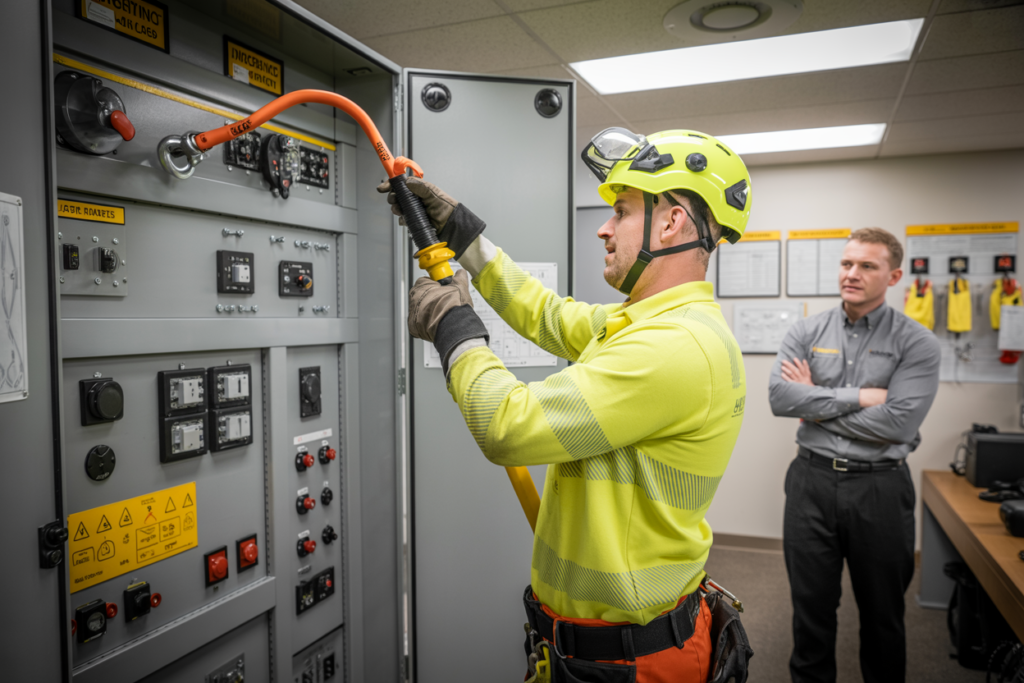
This isn’t a classroom sit-down where someone reads slides at you. An LVR renewal is hands-on practical training. You’re doing the work, not watching it get explained.
The practical rescue component covers the stuff that actually matters when something goes wrong on site:
- Isolation procedures – correctly isolating the supply before you touch anything
- Rescue sequence – the step-by-step process for safely removing a person who’s in contact with live equipment
- Post-rescue protocol – what happens after the rescue, including managing the casualty until emergency services arrive
The unit code is UEECD0007 [CONFIRM UNIT CODE WITH RTO]. That code needs to appear on your certificate for it to be accepted on site. If it doesn’t, you’ve got a problem before you even start the job.
CPR Refresher – Why It’s Delivered Together
A lot of electricians book an LVR renewal not realising CPR is already included. Then they go looking for a separate CPR course and book that too. You don’t need to do that.
CPR (HLTAID009) is co-delivered in the same session as your LVR renewal. One morning. Both certificates. Done.
The CPR component follows ANZCOR guidelines, and that standard is annual renewal. Same as your LVR. The good news is you’re not booking two separate courses. It all happens in the same room on the same Saturday morning.
It’s a Refresher – Not a Full Recertification
You’re not redoing the full initial certification from scratch. A renewal is a refresher. It assumes you already know the fundamentals and focuses on keeping your practical skills current and compliant. If you’ve held an LVR certificate before, your renewal is a focused practical session, not a full-day course from the beginning.
| LVR Component | Included? |
|---|---|
| Practical isolation procedure | Yes |
| Rescue sequence - hands on | Yes |
| Post-rescue casualty management | Yes |
| CPR refresher (HLTAID009) | Yes |
| Digital certificate - same day | Yes |
| Full initial recertification from scratch | No - refresher only |
How to Know If Your LVR Ticket Is Still Current
Where to Find Your LVR Expiry Date
Nobody’s judging you for not having your renewal date memorized. You’re running a business, quoting jobs, chasing invoices, managing materials, keeping subbies in line. Tracking a training certificate expiry date isn’t the thing at the top of your list on a Tuesday morning.
But you do need to find it:
- Your certificate card – check your wallet or the glovebox of the ute
- Email from your original RTO – search your inbox for the course confirmation or certificate email
- Call the RTO directly – if you genuinely can’t find it, ring the provider who delivered your original course
If none of those work, assume it’s expired and book a renewal.
The CPR Trap – Your LVR Might Be Expired Even If You Think It Isn’t
This is the one that catches people out. Pay attention here.
Your LVR certificate (UEECD0007) sits inside a 3-year framework. So if your ticket was issued in March 2023, you might look at it and think “yeah, that’s still good.” And technically, the LVR component might be. But here’s the problem.
If you didn’t renew your CPR in March 2024, and again in March 2025, you’re non-compliant on most commercial sites right now, even if your LVR hasn’t hit the 3-year mark.
Principal contractors check both components. If your CPR has lapsed, the ticket is treated as non-current and you’re not getting on site. The CPR renewal schedule is every 12 months, no exceptions. If you’re not certain your CPR is current alongside your LVR, treat the whole ticket as expired.
What to Do If You’ve Already Missed Your Renewal Window
You’re not the first sparky to find out on site that their ticket’s gone. It happens constantly. The site supervisor who tells you isn’t surprised. He’s seen it a hundred times.
Book a renewal course. That’s it. A refresher at a registered RTO, not a full recertification from scratch, not a complicated process. Show up on Saturday morning, do the practical training, get your digital certificate emailed to you, and you’re back on site Monday.
If you’re not sure whether your ticket is current, assume it’s expired and book a renewal.
A subcontractor we spoke to recently had his LVR expiry flagged mid-week by the principal contractor’s WHS officer, right there on site, first thing in the morning. He pulled out his phone from the ute, found a Saturday course at First Aid Alive, booked it in under two minutes, showed up that weekend, and had his digital certificate in his inbox before he left the carpark. Monday morning he was back on the tools. No lost contract, no awkward conversation with the builder, no drama.
That’s how it’s supposed to work when a provider has Saturday availability and same-day certificates sorted.

How to Book an LVR Renewal Course
What to Look For in a Registered RTO
Not every provider offering LVR training is worth booking with. A cheap course from a provider with no RTO number on their website is a risk you can’t take, because if the certificate gets knocked back on site, you’re worse off than when you started.
Here’s what a legitimate RTO should have visible on their booking page:
- RTO registration number displayed prominently – not buried in the footer
- ASQA registration statement – confirms the provider is nationally recognised
- Unit code on the course listing – UEECD0007 [CONFIRM UNIT CODE WITH RTO] clearly on the course description
- “Accepted by principal contractors” language – a legitimate provider will say this outright
Verify any RTO’s registration at training.gov.au before you book.
Same-Day Digital Certificate – What to Ask Before You Book
This one matters more than most providers will tell you upfront.
Some RTOs post your certificate after the course. Allow 5-7 business days, they say. That’s a week minimum where you can’t prove compliance to a principal contractor. If you need to be back on site Monday, a certificate in the mail next Friday is useless.
What a Legitimate LVR RTO Should Offer
| What to check | What to look for |
|---|---|
| RTO number | Displayed prominently on the website - not hidden |
| ASQA registration | Stated clearly on the booking or about page |
| Unit code | UEECD0007 [CONFIRM] visible on the course listing |
| Principal contractor acceptance | Explicitly stated - not implied |
| Saturday availability | Confirmed dates showing on the booking page |
| Same-day digital certificate | Stated outright - not "allow 5-7 days" |
| CPR included | Clearly bundled - no separate booking needed |
Up Next
Your LVR annual renewal isn’t paperwork. It’s the thing that gets you through the site gate on Monday morning and keeps the money coming in. Every electrician working near live low voltage equipment is legally required to hold a current certificate under the Electrical Safety Act 2002 (QLD), and current means renewed within the last 12 months. That’s the standard principal contractors apply, and there’s no talking your way around it when the WHS officer asks to see your documentation.
The CPR component is the one that catches people out. Your LVR might look fine on paper, still inside the 3-year framework, but if your CPR has lapsed you’re non-compliant on most commercial sites regardless. Both components need to be current, both need to be renewed every 12 months. If there’s any doubt about either one, treat the whole ticket as expired and get it sorted before your next start date.
The renewal itself is not a big deal. You’re not redoing the full initial certification and you’re not losing a day of billable work. You show up, complete the practical LVR rescue components and CPR, get your digital certificate emailed before you leave, and you’re back on site Monday. The only version of this that gets complicated is the one where you leave it too long and find out on site that your ticket’s gone.
Book Your First Aid Training Now
Fast, affordable, and nationally accredited training delivered by professionals who care
LVR Renewal FAQs for Brisbane Electricians
Q. Does my LVR certificate need to be renewed every year or every 3 years?
Every 12 months is the enforced standard on Queensland job sites. The UETDRRF018 unit sits inside a 3-year national training framework, but that's not what principal contractors on commercial, infrastructure, and government sites work from. They apply annual renewal as their WHS standard, and WorkSafe Queensland backs that position. If it's been more than 12 months since your last renewal, you need to book one before your next site starts.
Q. Is CPR included in my LVR renewal course at [BRAND_NAME]?
Yes. CPR (HLTAID009) is co-delivered with your LVR renewal in a single session at [BRAND_NAME]. You don't need to book a separate CPR course or find a second provider. Both components are completed on the same day and both digital certificates are emailed to you before you leave.
Q. Can I work on site with an expired LVR ticket in Queensland?
No. Under the Electrical Safety Act 2002 (QLD) there is no grace period and no exceptions. Principal contractors enforce this without negotiation - an expired ticket means no site access, effective immediately. If there's any doubt about whether your ticket is current, don't show up and hope for the best. Check it first, and if it's expired, book a renewal before your next scheduled start.
Q. Do I need to redo the full course or just a refresher?
Refresher only. If you've held an LVR certificate before, you're not starting from scratch. The renewal covers the practical LVR rescue components and CPR in a focused session on Saturday morning. The full initial certification process is only for someone who has never held the ticket before - an experienced sparky doing a renewal doesn't go through that.
Q. What unit code should be on my LVR certificate?
Your certificate should show UETDRRF018. Before you book, it's worth confirming the accepted unit code with your principal contractor's WHS officer. Different sites can have specific requirements, and the last thing you want is to complete a renewal and find the code on your certificate isn't what the site super was expecting.
Q. What if I've lost my original certificate and don't know my expiry date?
Call the RTO that delivered your original course and ask them to look you up. If you can't track down who that was, or they no longer have your records, assume your ticket is expired and book a renewal. You'll have a fresh digital certificate in your inbox the same day you complete the course, so the gap in your records gets sorted in a single Saturday morning.
Making first aid training more affordable for
every classroom
We believe every student deserves access to life-saving first aid knowledge. That’s why we offer specially reduced pricing for schools and educational groups. Whether you’re booking for a single class, a year group, or your entire school, our flexible packages make training more accessible and cost-effective — without compromising quality.
