

Quick question: if a site supervisor asked to see your LVR ticket tomorrow morning, could you hand it over with confidence? Most electricians think they’re covered. Not all of them are.
Low Voltage Rescue certification, formally known as UETDRRF018, is a legal requirement for any licensed electrician working on or near live low voltage equipment in Queensland. It must be renewed every year, and there is no grace period. An expired ticket means no site access, no exceptions.
The problem is that most electricians don’t find out their ticket has lapsed until someone else tells them, usually a site supervisor at 7:00am on a Monday.
This guide explains exactly what a nationally accredited LVR course covers, how the training is structured, what you’ll walk away with, and how to get a current certificate in your hands fast, ideally before your next site induction.
What Is a Nationally Accredited LVR Course?
A nationally accredited LVR course is a registered training qualification that certifies licensed electricians to perform a rescue from a live low voltage panel and administer emergency first aid following an electrical incident. In Queensland, the current unit of competency is UETDRRF018 – Perform Rescue from a Live Low Voltage Panel.
To be nationally accredited, the course must be delivered by a Registered Training Organisation (RTO) registered with ASQA (Australian Skills Quality Authority). Certificates issued by non-registered providers are not valid for site access, and that’s not a technicality, that’s a hard rejection at the gate.
A compliant LVR course covers:
- Electrical hazard identification and risk assessment
- Isolating a casualty from a live low voltage source safely
- Performing CPR following an electrical shock
- Using an AED (automated external defibrillator)
- Completing an emergency scene assessment
- Reporting and documentation requirements
Certificate validity: 12 months from date of completion.
Who Needs an LVR Certificate in Queensland?
If you’re a licensed electrician working on or near live low voltage equipment, you need a current LVR certificate. Full stop. This isn’t something your QBCC license covers, it’s a separate legal obligation under the Electrical Safety Act 2002 (QLD) and the Electrical Safety Regulation 2013.
Is LVR a Legal Requirement for Electricians in Queensland?
Yes, and it applies across the board. Sole traders, subcontractors, employees of small electrical firms. Doesn’t matter how you’re structured. If you’re working near live panels, the requirement applies to you. Principal contractors on commercial, infrastructure, and government sites will ask to see your certificate before they let you through the gate, not your QBCC card, your LVR ticket.
Does My QBCC License Cover LVR?
It doesn’t. This is probably the most common misconception in the trade. Your QBCC license confirms you’re a qualified electrician. Your LVR certificate confirms you’re trained to respond if something goes wrong on a live panel. They’re two separate things, and a principal contractor’s WHS officer knows the difference.
Apprentices moving into independent work should get their LVR sorted before their first subcontract job. Don’t wait for a site induction to find out you’re missing a ticket.
| Who Needs LVR | Who Is Exempt |
|---|---|
| Licensed electricians working near live low voltage equipment | Electricians not working near live low voltage equipment |
| Sole trader electricians | Office-based electrical staff with no site exposure |
| Subcontractors on commercial/government sites | Trades working in areas fully isolated and de-energised |
| Apprentices moving into independent subcontract work | - |
What Does the UETDRRF018 Course Actually Cover?
The course is split into two components, online theory and face-to-face practical assessment. You do the theory first, at your own pace, before you show up on the day. The practical is where you get assessed and where your certificate gets issued.
Online Theory – What to Complete Before You Arrive
The online theory is completed through the learning portal before your practical session. You can do it from your phone, from the UTE, from the couch on a Thursday night, whenever it works for you. It covers electrical safety legislation, hazard identification, and emergency response protocols. Most people get through it in a single sitting. If you haven’t done it before you arrive, you can’t be assessed on the day.
Face-to-Face Practical – What Happens on the Day
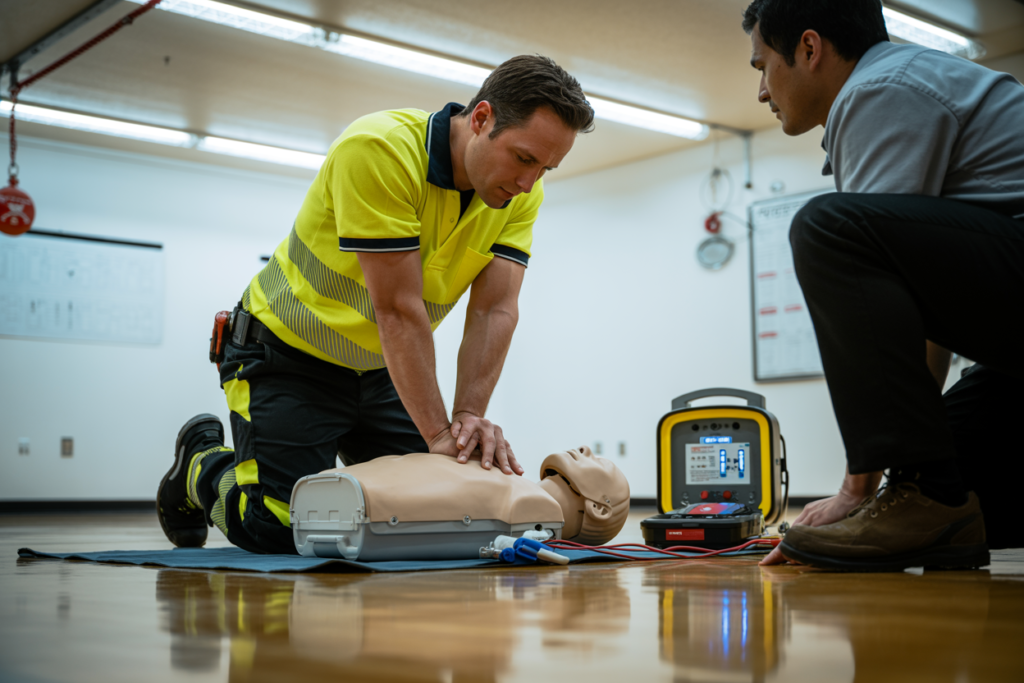
The practical session is where everything gets tested. You’ll work through:
- Isolating a casualty from a live low voltage panel
- Performing CPR on a manikin
- AED operation
- Scene assessment
- Emergency reporting procedures
You’re in, assessed, and out, with a certificate on its way to your inbox before the afternoon’s done.
Is CPR Included?
Yes, HLTAID009 (CPR) is co-delivered in the same session as UETDRRF018. One booking covers both. You don’t need to organize a separate CPR course, and you won’t walk out with one certificate when you need two. Both come through on the same day, so both renew at the same time. No surprises at the next site induction.
| Component | Format | When |
|---|---|---|
| Electrical safety theory | Online - self-paced | Before the practical session |
| Hazard identification | Online - self-paced | Before the practical session |
| Casualty rescue from live panel | Face-to-face practical | On the day |
| CPR on manikin (HLTAID009) | Face-to-face practical | On the day |
| AED operation | Face-to-face practical | On the day |
| Certificate issued | Digital - emailed | Same day |
How Long Does the LVR Certificate Last and When Do You Need to Renew?
Your UETDRRF018 certificate is valid for 12 months from the date you complete the course. Not three years. Not two years. Twelve months, and then it’s gone.
12 Months, No Exceptions
There’s a common assumption in the trade that LVR renews every three years. It doesn’t. The LVR certificate is annual, and the CPR component (HLTAID009) is also annual. At First Aid Alive both are co-delivered, so both expiry dates align. You renew once a year, you cover both.
What Happens If Your Ticket Expires?
You lose site access. No negotiation with the site supervisor, no temporary exemption, no “I’ll bring it in tomorrow.” A certificate that expired last week carries exactly the same consequence as one that expired two years ago. You’re off the job until you produce a current certificate. For a sole trader running on billable days, that’s not just inconvenient, it’s a hit to your reputation with the principal contractor you’ve been working to keep.
When to Book Your Renewal
Book well before your certificate expires. That gives you enough buffer to find a session without scrambling at short notice.
| Milestone | Action |
|---|---|
| Issue date | Certificate active - valid for 12 months |
| 10-month mark | Book your renewal session now |
| 12-month expiry | Certificate expires - no site access |
| Post-expiry | No grace period - site access denied until current certificate produced |
What Makes a Course “Nationally Accredited” and Why It Matters on Site
A nationally accredited course means it’s delivered by an RTO registered with ASQA under the Australian Skills Quality Authority Act 2011. That registration is what gives your certificate its weight on site. Without it, the piece of paper you’re holding is worthless, and a principal contractor’s WHS officer will spot the difference fast.
How to Check If a Provider Is a Registered RTO
Every registered RTO in Australia appears on the National Register at training.gov.au. Pull it up on your phone and search any provider by name or RTO number. If they’re not on there, don’t book with them.
First Aid Alive’s RTO number is 31106, verifiable at training.gov.au right now. Certificates from non-registered providers get rejected, not sometimes, every time. If the RTO number isn’t on the National Register, the certificate doesn’t count.
What Should Appear on Your Statement of Attainment?
| What Should Appear | Why It Matters |
|---|---|
| Unit code - UETDRRF018 | Confirms the correct unit of competency was assessed |
| RTO name and number | Confirms the provider is nationally registered |
| Your full legal name | Must match your ID and site induction documents |
| Date of issue | Confirms the certificate is within the 12-month validity window |
If the unit code UETDRRF018 doesn’t appear on your Statement of Attainment, the certificate is non-compliant and will be rejected on the spot.
What to Expect on the Day First Aid Alive’s LVR Course Format
Before the Course: Online Theory
Once you’ve booked, you’ll get access to First Aid Alive’s online learning portal. Work through it from your phone at any time before the session. Do it from the ute, do it on the couch the night before. Just get it done before you show up or you can’t be assessed.
On the Day: The Practical Assessment
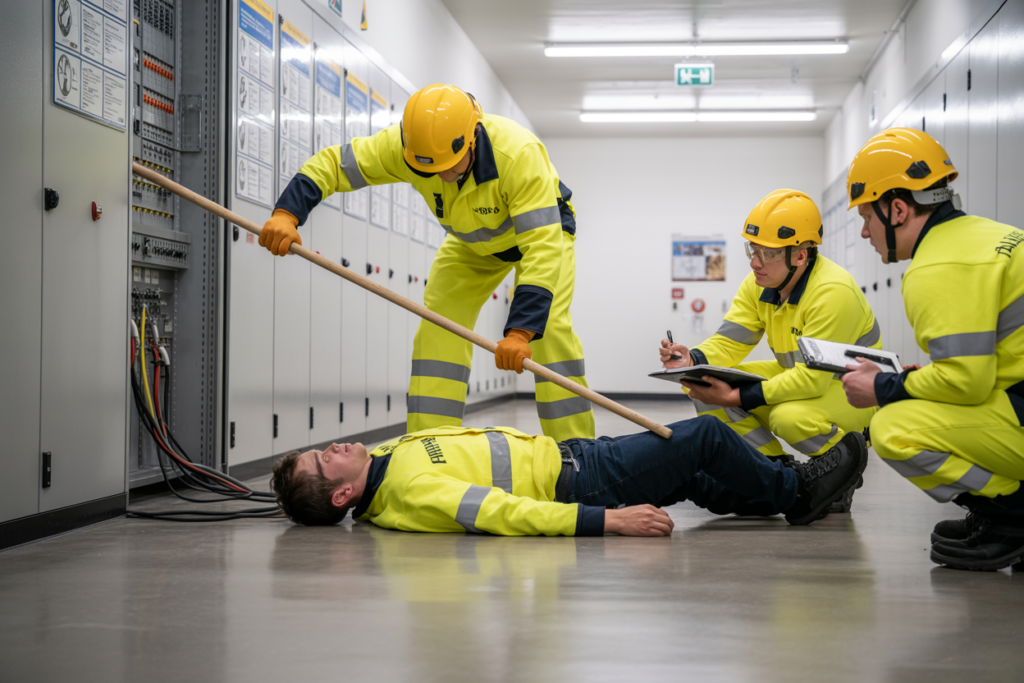
You’re not sitting through lectures. You’re being assessed on the skills, isolating a casualty from a live panel, CPR on a manikin, AED operation, scene assessment, and emergency reporting. It’s hands-on and it moves. If you’ve got a crew and prefer training at your workplace, on-site delivery is available. Minimum numbers apply, so get in touch to discuss. Wear something comfortable, the assessment involves floor-based CPR work.
After the Course: Your Digital Certificate
Once competency is confirmed across both theory and practical, your digital certificate is emailed to you the same day. Not posted out in a week. Emailed, same day, ready to forward straight to your site supervisor.
📋📧 SAME-DAY DIGITAL CERTIFICATE: Complete your practical assessment and your certificate is emailed to you the same day, ready to forward to your site supervisor before Monday morning.
A subcontractor turned up to a commercial site induction and got knocked back, his LVR ticket had lapsed three months prior. He booked the Saturday session, completed the online theory Thursday evening from his phone, showed up Saturday morning, and had his digital certificate in his inbox by early afternoon. Forwarded it to the principal contractor the same day. Back on site Monday.
Can You Do LVR and First Aid Together in One Session?
Yes, and if your site requires both, doing them together is the obvious move. One day, one booking, two certificates.
Some commercial and infrastructure sites require a full first aid certificate, HLTAID011 (Provide First Aid), in addition to your LVR ticket. If you do need both, First Aid Alive delivers multiple qualifications. You can cover LVR (UETDRRF018) and first aid (HLTAID011) in a single day session rather than two separate weekends. For a sole trader running on billable hours, that difference adds up.
If you’re running a crew, getting everyone compliant in a single session is far more practical than sending people off one at a time. First Aid Alive offers group bookings for electrical crews, and crew discounts are available on enquiry. Combining certifications in one session also means your whole crew renews on the same cycle, one date to remember instead of several.
Ready to Get Your LVR Ticket Sorted? Here’s What to Do Next
Your LVR ticket is either current, close to expiring, or already gone. If it’s any of the last two, the process is straightforward. Start by checking the next available Saturday session, tap the button below to see current dates and lock in a spot before they fill. Once you’ve booked, log in to First Aid Alive’s online learning portal and work through the pre-course theory from your phone. The night before is fine. Just get it done before you show up.
On the day, the practical session won’t eat your whole weekend. If you’ve got a crew that needs to get compliant at the same time, workplace delivery is available too. Minimum numbers apply, so get in touch ahead of time to sort the details.
Once you’ve completed the practical assessment, your digital certificate is emailed to you the same day. Not posted out later in the week. Not sitting in a portal waiting for you days later. Emailed, same day, ready to forward straight to your site supervisor or principal contractor the moment it lands.
Don’t be the subcontractor who finds out at 7:00am on a Monday that his ticket’s expired and the whole crew is standing around waiting. One Saturday session at First Aid Alive fixes it. Book now, do the theory the night before, show up Saturday morning, and have your UETDRRF018 certificate in your inbox before lunch.
Book Your First Aid Training Now
Fast, affordable, and nationally accredited training delivered by professionals who care
Frequently Asked Questions
Q. What is a nationally accredited LVR course?
A nationally accredited LVR course is a registered training qualification that certifies licensed electricians to perform a rescue from a live low voltage panel and administer emergency first aid following an electrical incident. In Queensland, the current unit of competency is UETDRRF018, and the course must be delivered by an ASQA-registered RTO. The certificate is valid for 12 months from date of completion.
Q. How long does an LVR certificate last in Queensland?
An LVR certificate (UETDRRF018) is valid for 12 months from the date of completion, and there is no grace period once it expires. A certificate that lapsed last week carries the same consequence as one that expired two years ago, and that consequence is no site access until a current certificate is produced.
Q. Is CPR included in the LVR course at First Aid Alive?
Yes, First Aid Alive co-delivers CPR (HLTAID009) with the LVR course (UETDRRF018) in a single session, so one booking covers both qualifications. Both certificates are issued on the same day, which means both renewal dates align and you won't get caught out at a site induction with one current and one expired.
Q. How do I know if an LVR provider is a registered RTO?
Every registered RTO in Australia is listed on the National Register at training.gov.au, and you can search any provider by name or RTO number from your phone in under a minute. First Aid Alive's RTO number is 31106, and certificates from providers not on that register will be rejected by principal contractors and WHS inspectors without exception.
Q. How quickly will I receive my LVR certificate after the course?
First Aid Alive issues digital certificates on the same day as course completion, once competency is confirmed across both the online theory and the practical assessment. Your certificate is emailed directly to you and is ready to forward to your site supervisor or principal contractor immediately.
Q. Do I need to complete anything before attending the practical session?
Yes, the online theory component must be completed through First Aid Alive's learning portal before you arrive for the practical. It covers electrical safety legislation, hazard identification, and emergency response protocols, and can be done from your phone at any time before the session. If you haven't completed it before you show up, you can't be assessed on the day.
Making first aid training more affordable for
every classroom
We believe every student deserves access to life-saving first aid knowledge. That’s why we offer specially reduced pricing for schools and educational groups. Whether you’re booking for a single class, a year group, or your entire school, our flexible packages make training more accessible and cost-effective — without compromising quality.
