

Picture the phone ringing at 7:45am on a Monday. It’s your newest educator, and she’s calling to say her first aid certificate from her old job (a retail gig, nothing to do with kids) doesn’t cover what your centre actually needs. You’ve got ratios to hit in fifteen minutes and now you’re one qualified adult short.
If that scenario makes your stomach drop a little, you already know the real question isn’t “does my staff have first aid training.” It’s whether they have the right first aid training. And in an education and care setting, that comes down to one qualification: HLTAID012, Provide First Aid in an Education and Care Setting.
Here’s the thing a lot of centres get caught out on. A generic first aid certificate, even a perfectly valid one, doesn’t satisfy what’s required when you’re responsible for infants and children. It’s not that the other course is wrong or lesser, it’s just built for a different job. HLTAID012 is the one that’s specifically designed around infant and child emergencies, and it’s the one your regulator is going to look for when they check your compliance register.
This kind of mix up happens more often than most directors expect, and it’s rarely because anyone’s being careless. Staff move between industries and bring qualifications with them, and unless someone actually compares the course content line by line, it’s easy to assume “first aid is first aid.” It isn’t, not when you’re talking about a room full of children under five who can’t always tell you what’s wrong, and who respond physiologically in ways that are genuinely different to adults.
So in this article we’ll walk through what HLTAID012 actually covers, how it’s different from a standard workplace first aid course, who on your team needs to hold it, and what your options look like for getting your whole staff compliant without shutting the centre’s doors for a day to do it.
What Is HLTAID012?
HLTAID012 is the nationally recognized qualification for anyone providing first aid in an infant or child care setting. It’s built specifically to meet the National Quality Framework requirements, not adapted from a general workplace course. If you’re in a long day care centre, OSHC, kindergarten, or family day care, this is the one your regulator wants to see.
Here’s what it actually covers:
- Responding to child and infant medical emergencies
- Asthma management for children
- Anaphylaxis and allergic reaction response
- CPR for infants and children
- Reporting and documentation obligations after an incident
That last one trips a lot of educators up. It’s not just about knowing what to do at the moment, you’re also expected to know what needs recording and reporting once the emergency’s over, which matters just as much when a regulator’s reviewing your files.
What’s worth understanding here is that this qualification isn’t a “nice to have” layered on top of your existing training obligations. It’s the baseline. Regulators built it into the framework precisely because early childhood settings carry a different risk profile to a standard workplace. A child can go from fine to in genuine danger far faster than an adult typically does, whether that’s a severe allergic reaction, a sudden asthma flare up, or a choking incident. The gap between “recognising something’s wrong” and “needing to act” is often measured in seconds, not minutes, which is exactly why this course exists as its own distinct qualification rather than being folded into general first aid.
⚠️ Common trap: HLTAID011 is a legitimate qualification, it's just not the one your regulator is checking for. Staff who assume "first aid is first aid" are usually the ones caught out at audit time.
What Makes HLTAID012 Different From Standard First Aid Training?
This is the mix up that catches out more centers than anything else, so it’s worth slowing down on.
The Core Difference: Who Each Course Is Designed For
HLTAID011 is the general workplace first aid course. It’s the one you’d do for a retail job, an office, a trade, pretty much any standard workplace. It’s a solid, legitimate qualification, it’s just not built around infants and children.
HLTAID012 is different. It’s purpose built for infant and child care contexts, and here’s the part that surprises people: it’s not some add-on extra sitting next to HLTAID011. HLTAID012 actually includes HLTAID009 (CPR) and HLTAID011 as component units within it. So it’s not “first aid plus a bit more,” it’s the full workplace first aid course with the infant and child care skills built in on top. A superset, not a bolt-on.
This is a genuinely important point for directors to understand, and it’s one worth passing on to staff too, because it changes how people think about the qualification. Educators sometimes assume HLTAID012 is a specialized add-on they’ll get to eventually, once they’ve “done the basics.” In reality, HLTAID012 already contains those basics. There’s no such thing as an educator who’s covered the fundamentals and just needs the pediatric component later. If they haven’t done HLTAID012, they haven’t covered what your center actually requires, full stop.
Why This Distinction Matters for Regulatory Compliance
Under the National Quality Framework, your service needs at least one HLTAID012-qualified educator in attendance at all times. Not HLTAID011. Not “a first aid certificate,” specifically HLTAID012.
This means a staff member who’s only completed HLTAID011, even if their certificate is current and valid, does not satisfy this requirement. It’s a genuinely common trap, especially with new hires who did a first aid course at a previous job and assume it transfers straight across. It usually doesn’t.
It’s worth saying plainly: this isn’t the regulator being unreasonable or pedantic. Anyone who’s spent time around young children in a group setting knows the pace of a genuine emergency is completely different when the person affected is an infant who can’t tell you what hurts, or a toddler who’s swallowed something they shouldn’t have. The requirement exists because the risk is real, and because “close enough” training isn’t actually close enough when the person responding needs to move fast and get it right the first time.
HLTAID011 (Standard First Aid) | HLTAID012 (Education & Care Setting) | |
Designed for | General workplaces (retail, office, trades) | Infant and child care settings |
Includes CPR | Yes (HLTAID009) | Yes (HLTAID009, built in) |
Satisfies NQF requirement for educators | No | Yes |

What Does HLTAID012 Training Actually Cover?
We touched on this up top, but it’s worth breaking down properly, because “first aid for kids” undersells what’s actually in this course.
Emergency Response Skills
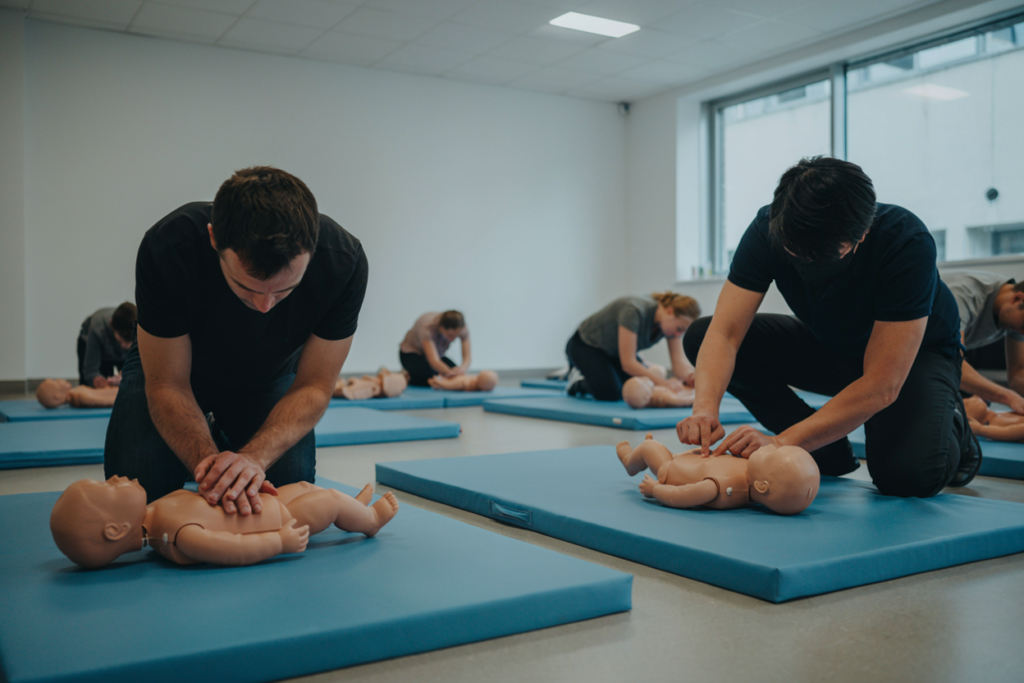
- Infant and child CPR, with techniques specifically adapted to younger age groups rather than simply using adult CPR methods
- DRSABCD adapted specifically for children, accounting for how children may present differently during an emergency
- Choking response for both infants and children, with age-appropriate techniques for each situation
These distinctions matter more than they might sound like on paper. Infant CPR uses different hand positioning, different depth, different pacing to adult CPR, and getting it wrong isn’t a small technical error, it’s the difference between effective compressions and ones that don’t do what they’re meant to. Educators who’ve only ever practiced adult CPR, even confidently, are not automatically equipped to perform infant or child CPR correctly under pressure. This is precisely why the course teaches it as its own distinct skill set rather than assuming it transfers.
Condition-Specific Response Training
- Asthma management in children
- Anaphylaxis and severe allergic reaction response
These two matter enormously in a childcare setting specifically, given how many centers have at least one enrolled child managing asthma or a diagnosed allergy at any given time. For a lot of educators, this is the part of the course that feels most immediately relevant to their day to day, because it’s not a hypothetical, it’s something they’re actively managing on individual care plans for real children they know by name. Knowing the general theory of anaphylaxis is one thing. Knowing how to recognize it escalating in a specific child, and acting decisively rather than waiting to see if it gets better on its own, is what this training is actually built around.
Documentation and Reporting Obligations
First aid doesn’t stop the moment the emergency does. HLTAID012 also covers what needs to be recorded and reported after an incident, which is exactly the kind of paper trail a regulator will ask to see during an assessment and rating visit. Knowing how to respond is half of it. Knowing how to document that response properly is the other half, and it’s the half that’s easy to forget under pressure.
This is also the part of the course that protects educators as much as it protects the center. Clear, accurate incident documentation is the record that shows exactly what happened, what was done, and when, which matters enormously if a parent has questions later, or if a follow up medical review needs to understand the sequence of events.
📋 Roster reminder: A new educator can't be rostered solo without another HLTAID012-qualified adult present. That's an immediate risk from day one, not a "get to it eventually" item.
Who Needs HLTAID012, And When?
Roles That Require This Qualification
If you’re wondering whether this applies to you or your team, here’s the short version: pretty much anyone actually working with the children needs it. That includes:
- Centre Directors
- Educators across long day care, kindergarten, and OSHC
- Family day care educators
And here’s the bit that catches new hires out most often: a new educator cannot be rostered solo, without another HLTAID012-qualified adult present, until their own qualification is sorted. That’s not a “get to it when you can” situation, it’s an immediate ratio and compliance risk from day one.
This is where a lot of the stress for directors actually comes from. It’s rarely the established staff who create the problem, it’s the onboarding gap. A new educator starts, keen and capable, but their first aid situation isn’t sorted yet, and suddenly a director is juggling rosters to make sure that person is never the only qualified adult in a room.
Renewal Timelines Educators and Directors Often Miss
This is what I’d call the silent compliance gap. Nobody plans to let a certificate lapse. It just happens quietly, in the background, while everyone’s focused on the next audit or the next new hire, and then one day someone goes to check the compliance register and finds a gap that’s been sitting there for weeks.
It tends to happen for a fairly predictable reason: qualifications don’t all expire on the same schedule, or at the same time as an educator’s other renewals, like their Working with Children Check. When you’re tracking a whole roster of educators, each with their own start date and renewal cycle, it becomes genuinely easy for one certificate to slip through unnoticed.
If tracking these dates across a whole staff roster sounds familiar (spreadsheets, wall calendars, the sticky note that fell behind the filing cabinet), that’s genuinely one of the biggest operational headaches directors deal with. It’s rarely about staff not caring, it’s about the sheer volume of dates one person is expected to hold in their head on top of everything else running a centre involves.

Getting Your Whole Team Compliant Without Closing the Centre
Group and On-Site Training Options
Pulling staff off the floor one at a time to send them to a course isn’t just disruptive, for a lot of centres it’s close to impossible given staffing ratios and the general shortage of qualified cover in this sector right now. Sending one educator off site means someone else has to cover their ratio, which often means another staff member gets pulled from where they’re needed, which creates a ripple effect through the rest of the day.
Group and on-site training exists specifically to solve that, letting your team get certified together, on site, without a full day of operational chaos to make it happen. Rather than losing staff one by one over weeks, a centre can bring the training to its own environment and get a cohort through the qualification together.
Fast Certificate Delivery for Your Compliance File
Once training’s done, certificates arrive quickly and digitally, so they can go straight into your compliance file. No waiting around wondering if the assessor’s going to ask for evidence before the paperwork’s even landed.
This matters more than it might seem at first glance. A completed course is only half the compliance picture, the other half is being able to produce the evidence the moment someone asks for it. A director who’s just had their whole team trained wants that qualification sitting in the register immediately, not chasing up paperwork weeks later while an assessment and rating visit is already underway.
Getting Your Team Ready
Let’s bring this back to where we started. That phone call at 7:45am, the one where you find out your new hire’s certificate doesn’t actually cover what you need. That moment is completely avoidable, and it usually comes down to one thing: knowing the difference between a first aid course and the first aid course your service is required to have.
HLTAID012 isn’t extra paperwork stacked on top of a job that’s already full of paperwork. It’s the qualification built specifically for the reality of your day, the kids in your care, the allergies you’re tracking, the asthma plans pinned to the wall, the possibility (however small, however unlikely) that something happens and someone needs to know exactly what to do in the next sixty seconds. That’s not a regulatory checkbox. That’s the actual job.
And look, most directors reading this already know their compliance register better than they know their own calendar. You’re not new to this. What tends to slip isn’t the big stuff, it’s the quiet stuff. A certificate that expires while everyone’s focused on an upcoming audit. A new hire whose old first aid course looked close enough but wasn’t. A staff member who was meant to renew “sometime this quarter” and quarter three is suddenly quarter four.
The good news is none of this has to be a scramble. Once you know HLTAID012 is the qualification to look for, and once you’ve got a system (even a simple one) for tracking who’s certified and when they’re due for renewal, this whole area stops being a source of stress and becomes something you just quietly manage in the background, the way it should be.
If you’re staring down a roster with a gap in it right now, or a new educator starting next week without the right certificate, the fastest path forward is getting your whole team assessed and booked in together rather than chasing individual bookings one at a time. It’s less disruptive, it’s easier to track, and it means you’re not back in this same position again in six months with a different staff member.
Directors who get ahead of this tend to describe the same shift once it clicks. It stops being a recurring source of low grade anxiety sitting in the back of their mind, and it becomes just another part of the operational rhythm of running the centre, alongside rostering, enrolments, and everything else that keeps the doors open and the children safe. The centres that manage this well aren’t the ones with the fewest challenges, they’re the ones who stopped treating it as an emergency every time a certificate came due.
At the end of the day, the families who enrol their kids with you are trusting that if something goes wrong, the adult in the room knows what to do. HLTAID012 is how you make that true, not just on paper for an assessor, but for real, on the floor, on an ordinary Tuesday when nobody’s expecting anything to happen at all.
Book Your First Aid Training Now
Fast, affordable, and nationally accredited training delivered by professionals who care
Frequently Asked Questions
Q.What is HLTAID012?
HLTAID012 is the nationally recognized qualification for providing first aid in an infant or child care setting. It's built specifically to meet National Quality Framework requirements and covers infant and child CPR, asthma management, anaphylaxis response, and the documentation obligations that follow an incident.
Q.Is HLTAID012 the same as HLTAID011?
No. HLTAID011 is the general workplace first aid course, designed for settings like retail, offices, or trades. HLTAID012 is built specifically for infant and child care contexts and actually includes HLTAID011 and HLTAID009 (CPR) as component units within it, so it's a broader qualification rather than a separate or lesser one.
Q.Does HLTAID011 satisfy childcare first aid requirements?
No. Under the National Quality Framework, your service needs at least one HLTAID012-qualified educator in attendance at all times. A staff member who holds only HLTAID011, even with a current certificate, does not meet this specific requirement.
Q.Who needs to hold HLTAID012?
Anyone actually working with the children in an education and care setting, including Centre Directors, educators across long day care, kindergarten, and OSHC, and family day care educators. A new educator cannot be rostered solo without another HLTAID012-qualified adult present.
Q.How quickly do we receive certificates for our compliance file?
Certificates are delivered quickly and digitally once training is complete, so they can be filed straight into your center's compliance register without a long wait for paperwork to catch up.
Making first aid training more affordable for
every classroom
We believe every student deserves access to life-saving first aid knowledge. That’s why we offer specially reduced pricing for schools and educational groups. Whether you’re booking for a single class, a year group, or your entire school, our flexible packages make training more accessible and cost-effective — without compromising quality.
